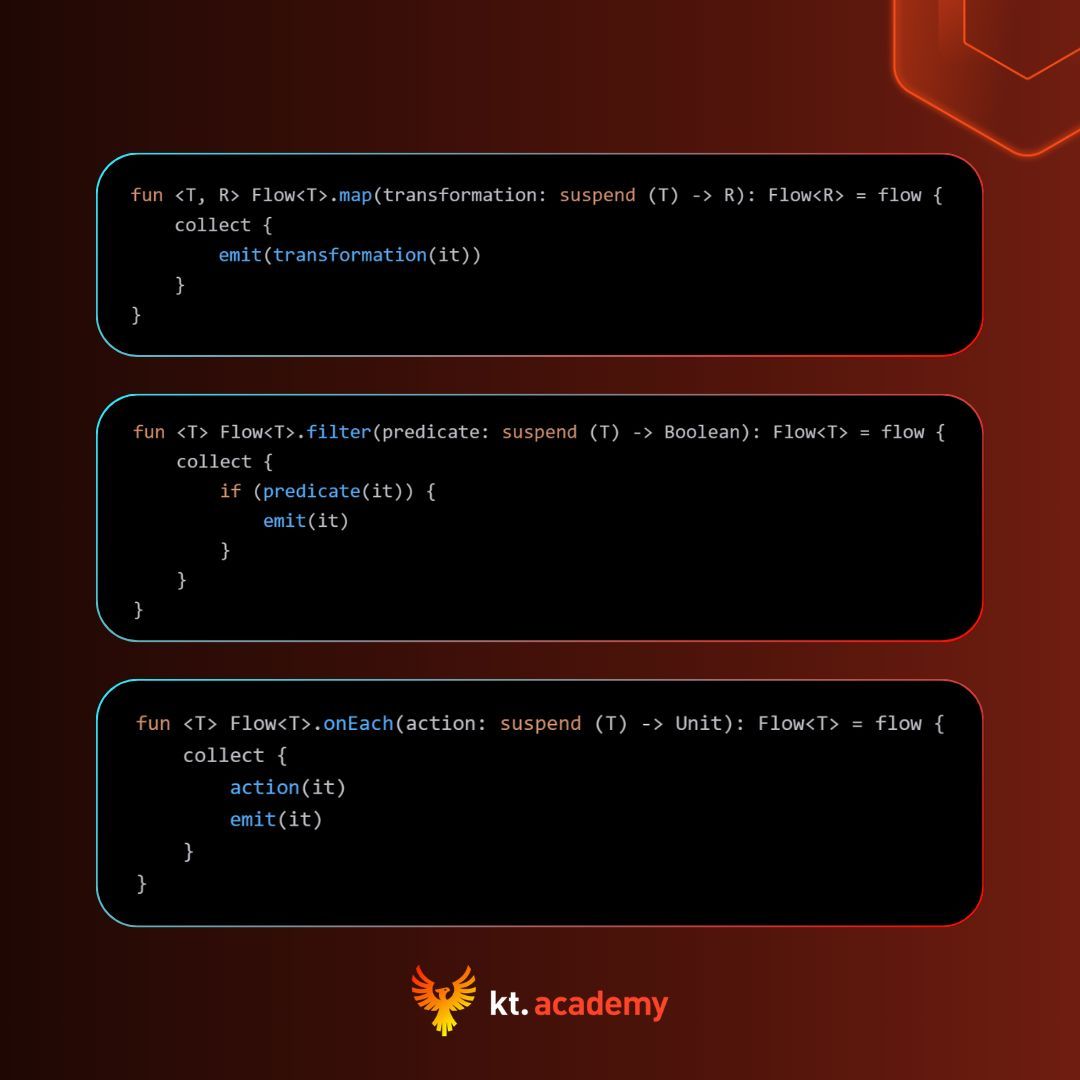
This is what the map, filter, and onEach from Kotlin Coroutines look like under the hood. Yes, it's that simple. Flow under the hood is as simple and efficient as it can be.
To help your engineers write safer and more predictable concurrent code, you can organize the Kotlin Mastery workshop for your team and equip everyone with a copy of Kotlin Coroutines: Deep Dive.
Looking for useful Kotlin Multiplatform libraries?
Here are three worth exploring on https://t.co/Dvpv88gjRs:
🎬 ComposeMediaPlayer – add cross-platform video playback with support for local and URL-based files.
https://t.co/n0XQo8sUIO
🍎 NSExceptionKt – improve crash reporting for Kotlin/Native apps on Apple platforms.
https://t.co/CTngMO9M6L
⚙️ multiplatform-settings – persist key-value data in shared Kotlin code across multiple platforms.
https://t.co/NWohlXBc1h
Find more KMP libraries on https://t.co/Dvpv88gjRs 👇
https://t.co/9cebWZ5hO3
You cannot start new coroutines on a cancelled scope. Such coroutines never start, without any exception or even an exception raport in logs. That is why a cancelled scope is a dangerous thing, and I prefer cancelling only its children.
The Secret Behind Every Trend Line !
Ever wondered how software finds the perfect line through messy data points? This short animation explains the Least Squares Method, the backbone of linear regression. We visualize the difference between data points and the trend line as physical squares, showing exactly what it means to minimize the sum of squared errors. Watch as the line adjusts its slope and intercept until it finds the optimal fit for the data set.