Supreme Court delivers a major relief on Time-Barred GST Notices! 🏛️⚖️
In a landmark ruling (G.R. Infra Projects Ltd. v. State of Madhya Pradesh [[2026] 189 https://t.co/tWZypsMFYo 764 (SC)]), the Hon’TableHeader Supreme Court has set a firm precedent regarding Section 73 vs. Section 74 SCNs.
Key Takeaways for Tax Professionals & Assessees:
Boilerplate Allegations Won't Save a Time-Barred Notice: The Department cannot simply copy-paste generic terms like "fraud" or "suppression of facts" after the normal Section 73 limitation expires to invoke the extended timeline under Section 74.
The SCN Must Speak for Itself: The notice itself must explicitly state the material facts and show how the conduct amounts to wilful misstatement or suppression.
Defects Cannot Be Cured Later: Counter-affidavits or subsequent explanations before the court cannot repair a defectively issued SCN.
A crucial judgment to cite in ongoing reassessment and mismatch cases where extended limitation has been invoked without concrete factual backing!
₹76 lakh cash deposit.
₹71.56 lakh addition.
Two assessments. One family.
And both additions were deleted.
Here’s what happened 👇
Husband's case:
Jayendra Navale had declared income of ₹93.67 lakh.
He claimed ₹71.56 lakh deposited in his wife's account came from his disclosed income and was gifted to her.
The AO wasn't satisfied and made a ₹71.56 lakh addition u/s 69A, on a protective basis.
Wife's case:
Gauri Navale had a ₹76.06 lakh cash deposit in her bank account.
She explained the source as money received from her husband (₹71.56 lakh was the amount specifically attributed to the husband's gift; the wife's total addition was ₹76.06 lakh).
The AO rejected the explanation and separately made a ₹76.06 lakh addition u/s 69A.
CIT(A) upheld both.
ITAT Pune deleted both additions.
The Tribunal found the husband's disclosed income and available funds sufficient to make the gift and accepted the explanation regarding the money deposited in the wife's account.
Takeaway: A large cash deposit can raise questions, but the size alone doesn't make it unexplained. Source, capacity and surrounding facts matter.
Case:Jayendra Rohidas Navale & Anr. v. ITO
ITA Nos. 111/PUN/2026 & 2323/PUN/2025 | AY 2016-17 | ITAT Pune
Order dated 14.08.2026
Follow for more tax cases, explained simply.
#IncomeTax #ITAT #Section69A
BIG UPDATE FOR TAX PROFESSIONALS!
A major change in the Income-tax Act, 2025 deserves your attention.
Under Section 195, tax on income referred to in Sections 102 to 106 has been revised, with the highlighted provisions showing significant changes in the applicable tax rates.
📌 Key takeaway:
• 75% in specified cases
• 99% where income is determined by the Assessing Officer in the specified circumstances
• 30% tax rate for income referred to in the relevant clauses
These changes are extremely important for tax professionals, practitioners and taxpayers preparing for the transition to the new Income-tax Act.
Save this update & share it with every CA/Tax Professional!
Follow the Tax Talk with CA Nitin Chawla A.C.C.A channel on WhatsApp: 👇 https://t.co/7KtKmuv6rW
#IncomeTax #IncomeTaxAct2025 #TaxUpdate #IncomeTax2025 #DirectTax #Taxation #CAFinal #ICAI #CharteredAccountant #TaxProfessionals #IncomeTaxIndia #Finance #TaxNews #TaxUpdates
🚨 LEGAL ALERT: Writ Court Cannot Rewrite a Voluntarily Accepted Lease; Basic Civic Amenities Must Be Provided
🔹 What Happened:
The Assessee had held a registered lease up to 20.08.2036. After demolition of the original shop for road widening, the Department allotted an alternative shop, but the Assessee subsequently accepted a fresh lease for 3 years and took possession. The Assessee challenged the lease tenure, rent and other contractual conditions under Article 226.
🔍 Key Takeaways:
• Contractual terms: Once the Assessee consciously entered into and accepted the fresh lease, disputes regarding lease tenure, rent and contractual conditions ordinarily fall outside writ jurisdiction and may be raised before the competent forum.
• Article 226: Writ jurisdiction is essentially a public law remedy and does not ordinarily extend to rewriting or modifying purely contractual obligations.
• Basic amenities: The Department cannot insist on rent while failing to provide electricity, water supply and essential civic amenities necessary to make the allotted premises functional.
• Special direction: The Department was directed to provide the essential amenities within 4 weeks. The Court left the Assessee free to pursue other remedies regarding the disputed contractual terms.
⚖️ Legal Reference: Article 226, Constitution of India | Sitaram Matolia v. State of Chhattisgarh, WPC No. 5472 of 2025, decided 13.08.2026 by the High Court of Chhattisgarh at Bilaspur.
Need Your Help:
I got this image for late fees drafted by Chat GPT.
But somewhere I'm not confident enough about the outcome.
Can you please, go throuh it and reply in the commment on which late fees is incorrect or wron. Also, what else could be added tomimprove the quality of this image.
📢 ICAI Guidance Note on Financial Statements of Non-Corporate Entities (NCEs)
For FY 2025-26, the Guidance Note is applicable to NCEs having turnover exceeding ₹5 crore.
The disclosure can be structured as:
✅ Applicable & Followed
Financial statements prepared in accordance with the ICAI Guidance Note, to the extent applicable.
⚠️ Applicable but Not Followed
The Guidance Note is applicable but has not been adopted. However, the financial statements have been prepared in accordance with applicable GAAP, Accounting Standards and other statutory requirements.
🔹 Not Applicable but Voluntarily Followed
The Guidance Note is not mandatorily applicable, but the Entity has voluntarily adopted its principles of presentation and disclosure.
📌 Separate General Disclosure:
Suitable modifications in presentation, classification and disclosure may be made, wherever necessary, for better presentation and consistency/comparability with the previous year.
From FY 2026-27, the Guidance Note applies to all NCEs.
Overtime (OT) Calculation Made Simple!
Confused about how overtime pay is calculated?
Here’s a simple formula + practical example to help you understand it quickly.
📌 OT Amount = Hourly Rate × OT Hours × OT Rate
📊 Plus, an easy Excel formula to calculate OT instantly!
💡 OT eligibility and rates may vary depending on applicable labour laws and company policy.
Save this post for future reference!
Share it with your HR & payroll friends.
#Overtime #OTCalculation #HRBasics #Payroll #HRManagement #SalaryCalculation #ExcelTips #HRTips #PayrollManagement #HumanResources #EmployeeBenefits #Workplace #SalaryTips
𝐽𝑜𝑖𝑛 𝑢𝑠 𝑜𝑛 𝑊ℎ𝑎𝑡𝑠𝐴𝑝𝑝 𝐶ℎ𝑎𝑛𝑛𝑒𝑙:
Follow the Tax Talk with CA Nitin Chawla A.C.C.A channel on WhatsApp: https://t.co/7KtKmuv6rW
Retweet For Reach
GST Rule 14A - Auto GST Registeration Rule and Process
Ram Bajaj
8696424223
For Regular GST Updates, Join this Group
https://t.co/zy2BipLpSx
GST appeal filed on 13.02.2026 against order communicated on 15.10.2025 — Orissa High Court held the delay to be 29 days, not 31 days, after excluding the date of communication under Section 9 of the General Clauses Act, and restored the appeal for consideration of condonation.
Issue:
Whether the Appellate Authority was justified in rejecting the Assessee’s appeal as beyond the maximum condonable period under Section 107 of the GST Act by computing the delay as 31 days.
Rule:
Under Section 107(1), an appeal is to be presented within three months from the date on which the decision or order is communicated. Under Section 107(4), the Appellate Authority may allow the appeal to be presented within a further period of one month, if sufficient cause is shown.
Section 9 of the General Clauses Act provides that where the expression “from” is used, the first day is excluded while computing the prescribed period. Further, “month” means a month reckoned according to the British calendar, and is not to be mechanically treated as 30 days.
Application:
The adjudication order under Section 73 was communicated to the Assessee on 15.10.2025 and the appeal under Section 107 was filed on 13.02.2026. Since the date of communication was required to be excluded, limitation commenced from 16.10.2025. The three-month period therefore ended on 15.01.2026, while the further condonable period under Section 107(4) extended up to 15.02.2026. Accordingly, the appeal involved a 29-day delay, and not 31 days as calculated by the Appellate Authority.
The Assessee had also submitted a reply explaining the delay, which was duly filed and acknowledged on 17.03.2026, but the Appellate Authority failed to consider the same before rejecting the appeal. The High Court treated such non-consideration as an error apparent on the face of the record.
Conclusion:
The High Court held that the Appellate Authority had erroneously computed the limitation period under Section 107. The rejection order dated 23.03.2026 was therefore set aside, and the matter was remanded to the Appellate Authority to consider the Assessee’s explanation for the 29-day delay and, if satisfied with the explanation and statutory requirements, decide the appeal on merits.
Impact Analysis:
The judgment reinforces that “three months” under Section 107 is to be computed as calendar months, with the date of communication excluded. An appeal cannot be rejected on limitation by an erroneous day-count, particularly when the Assessee’s explanation for delay has not been considered.
Title:MAHESH VALUE PRODUCTS PVT. LTD. vs. CHIEF COMMISSIONER OF CT & GST
Court: THE HIGH COURT OF ORISSA AT CUTTACK
Citation: WP(C) No.17373 of 2026
Dated: 05-06-2026
Provision: Under Section 9, 73, 107, 107(1), 107(4), 112
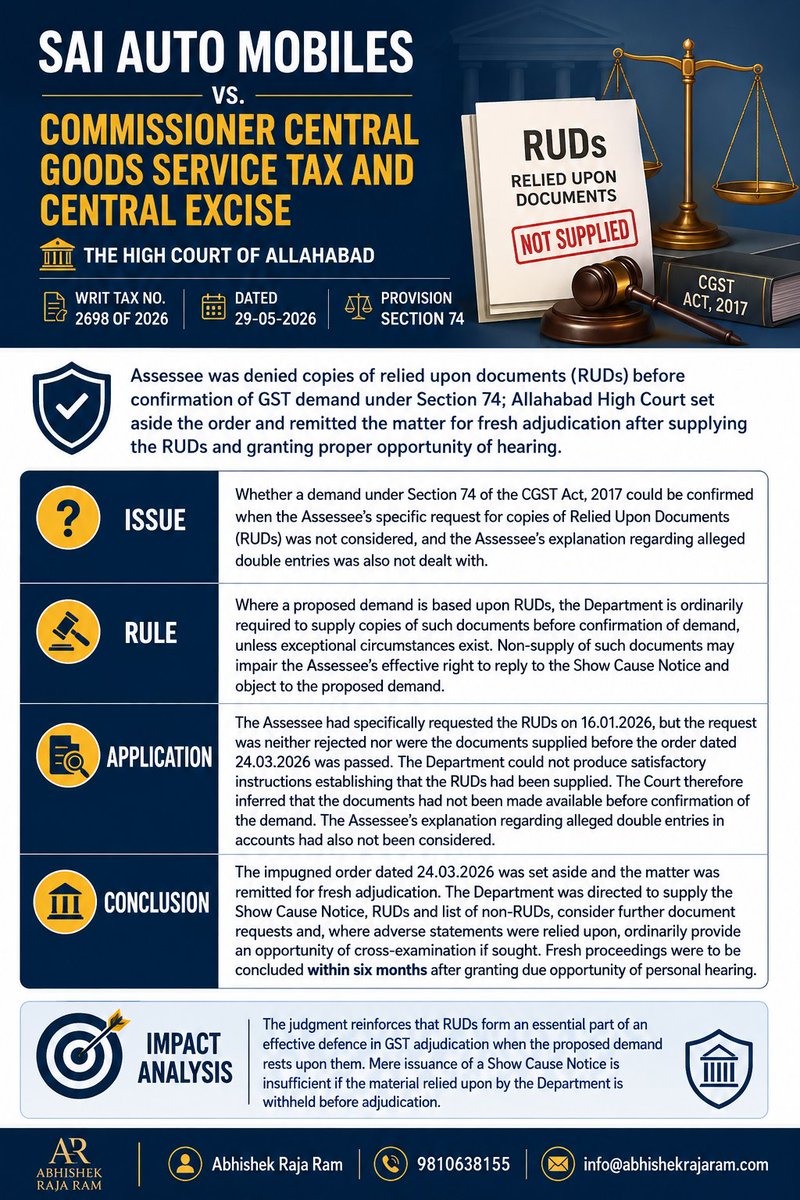
Assessee was denied copies of relied upon documents (RUDs) before confirmation of GST demand under Section 74; Allahabad High Court set aside the order and remitted the matter for fresh adjudication after supplying the RUDs and granting proper opportunity of hearing.
Issue:
Whether a demand under Section 74 of the CGST Act, 2017 could be confirmed when the Assessee’s specific request for copies of Relied Upon Documents (RUDs) was not considered, and the Assessee’s explanation regarding alleged double entries was also not dealt with.
Rule:
Where a proposed demand is based upon RUDs, the Department is ordinarily required to supply copies of such documents before confirmation of demand, unless exceptional circumstances exist. Non-supply of such documents may impair the Assessee’s effective right to reply to the Show Cause Notice and object to the proposed demand.
Application:
The Assessee had specifically requested the RUDs on 16.01.2026, but the request was neither rejected nor were the documents supplied before the order dated 24.03.2026 was passed. The Department could not produce satisfactory instructions establishing that the RUDs had been supplied. The Court therefore inferred that the documents had not been made available before confirmation of the demand. The Assessee’s explanation regarding alleged double entries in accounts had also not been considered.
Conclusion:
The impugned order dated 24.03.2026 was set aside and the matter was remitted for fresh adjudication. The Department was directed to supply the Show Cause Notice, RUDs and list of non-RUDs, consider further document requests and, where adverse statements were relied upon, ordinarily provide an opportunity of cross-examination if sought. Fresh proceedings were to be concluded within six months after granting due opportunity of personal hearing.
Impact Analysis:
The judgment reinforces that RUDs form an essential part of an effective defence in GST adjudication when the proposed demand rests upon them. Mere issuance of a Show Cause Notice is insufficient if the material relied upon by the Department is withheld before adjudication.
Title: SAI AUTO MOBILES vs. COMMISSIONER CENTRAL GOODS SERVICE TAX AND CENTRAL EXCISE
Court: THE HIGH COURT OF ALLAHABAD
Citation: WRIT TAX NO. 2698 OF 2026
Dated: 29-05-2026
Provision: Under Section 74


![caanupam7's tweet photo. Supreme Court delivers a major relief on Time-Barred GST Notices! 🏛️⚖️
In a landmark ruling (G.R. Infra Projects Ltd. v. State of Madhya Pradesh [[2026] 189 https://t.co/tWZypsMFYo 764 (SC)]), the Hon’TableHeader Supreme Court has set a firm precedent regarding Section 73 vs. Section 74 SCNs.
Key Takeaways for Tax Professionals & Assessees:
Boilerplate Allegations Won't Save a Time-Barred Notice: The Department cannot simply copy-paste generic terms like "fraud" or "suppression of facts" after the normal Section 73 limitation expires to invoke the extended timeline under Section 74.
The SCN Must Speak for Itself: The notice itself must explicitly state the material facts and show how the conduct amounts to wilful misstatement or suppression.
Defects Cannot Be Cured Later: Counter-affidavits or subsequent explanations before the court cannot repair a defectively issued SCN.
A crucial judgment to cite in ongoing reassessment and mismatch cases where extended limitation has been invoked without concrete factual backing!](https://pbs.twimg.com/media/HRBQMIrbkAAn98O.jpg)