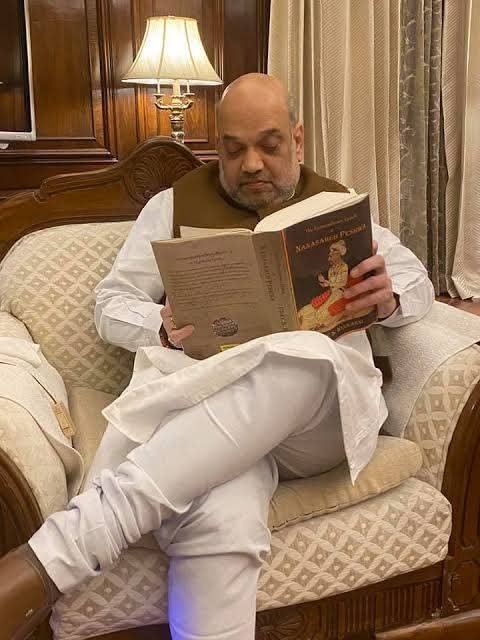
Every time observers think they have decoded Amit Shah Ji's political playbook, he unveils another layer of strategic thinking that few had anticipated.
The emergence of the Nationalist Citizens Party is a fascinating example. Established years before it became politically relevant, it reflects a mindset that does not merely react to events but prepares for multiple future scenarios long before they emerge. While most political actors focus on the next election cycle, strategic minds prepare for contingencies several moves ahead.
This is what separates tactical politics from strategic statecraft.
Great political operators do not ask what is happening today. They ask what could happen tomorrow, what legal challenges may arise, what institutional barriers may emerge, and how every possible scenario can be addressed before it becomes a problem. Preparation begins years before the public even notices the board has been set.
Whether one agrees with the politics or not, there are valuable lessons in leadership, planning, risk management, and execution. Successful leaders build options. They create alternative pathways. They prepare for opportunities before opportunities appear.
Amit Shah Ji's rise in Indian politics has demonstrated an extraordinary ability to combine organizational discipline, electoral strategy, cadre management, coalition building, and long-term planning. His political approach resembles the principles advocated by Chanakya, where preparation, patience, intelligence gathering, and strategic positioning matter more than short-term headlines.
History often remembers those who transform political possibilities into realities. In that context, Amit Shah Ji will undoubtedly be studied as one of the most influential political strategists of modern India. His methods offer lessons not only for politicians but also for business leaders, administrators, military planners, and organizational builders.
The partnership between Narendra Modi Ji and Amit Shah Ji has become one of the most consequential leadership combinations in contemporary Indian politics. Throughout history, transformative leaders have often been supported by equally capable strategists and executors. Vision and execution together create lasting impact.
As India moves toward a new generation of political leadership, it will be interesting to observe how future leaders adapt, evolve, and govern in an era shaped significantly by the strategic foundations laid during the Modi-Shah period.
Regardless of political affiliation, one thing is difficult to ignore: long-term thinking, disciplined execution, and relentless preparation continue to be among the most powerful forces in politics and governance.
ANNAMALAI : I won't change. I didn't come here for a tag of MLA or MP. I gave away IPS attached to my name. So I'm not here to beautify my name with another tag. Not to butter any leader, put shawl & pamper
I'm here for young of TN.
For their better life
The way things are shaping up, I wouldn’t be surprised if PM Narendra Modi ends up with the Nobel recognition that Trump once sought.
India and Modi could play a decisive role in mediating and pushing for peace in this conflict. 🇮🇳
Thoughts?
@narendramodi
My take on the latest development on US-Iran war.
Modi–Putin: The Only Duo That Can Stop the Iran-US war ?
During his conversation on Eid with Iran’s President Masoud Pezeshkian, Prime Minister Narendra Modi has been urged to use India’s BRICS Chairmanship to help end the ongoing hostilities.
This is not routine diplomacy.
This is a message.
A message that in a divided world, India is being seen as a country that can speak to everyone, and be trusted by all.
Today, there are only two leaders who realistically have the access, leverage, and acceptability to mediate in this conflict, they are Narendra Modi and Vladimir Putin.
So the question is not just whether Modi can mediate.
It is why Modi, and why Putin?
Start with Modi.
India’s position is uniquely balanced.
* Strong ties with the United States.
* Deep strategic partnership with Israel.
* Continued engagement with Iran even during the toughest phases.
* And equally important, Modi’s strong relationships with Gulf nations. From the UAE to Saudi Arabia, India today enjoys rare goodwill across the region.
And there is one more hard reality:
Nearly 1 crore Indians live in Gulf countries.
That alone makes India a direct stakeholder, not a distant observer.
Few leaders today can pick up the phone and speak to all sides without hesitation. PM Modi can.
His diplomacy is quiet but effective, no noise, no posturing, only calibrated engagement. And India’s stakes like energy, trade and diaspora are deeply tied to stability in this region.
Now look at Putin.
He brings two crucial advantages to the table:
First, he is Iran’s trusted partner.
Russia and Iran share deep strategic ties, giving Putin direct influence in Tehran.
Second, he has an open channel with Donald Trump.
And any real de-escalation ultimately requires Washington’s involvement.
In simple terms:
Putin can talk to Iran without suspicion.
And he can talk to the US without barriers.
That makes him a rare bridge.
So where does that leave PM Modi?
* Modi brings credibility across camps including the Gulf.
* Putin brings leverage within power centres.
Two different strengths.
One common possibility- mediation!
But here comes the real question.
Should India step into this role?
Because West Asia is not just about diplomacy.
It is about history, identity, and deep-rooted mistrust.
Yet, the signals are clear.
Iran is reaching out to India.
The Gulf trusts India.
And the world is looking for stabilisers.
In that search, Narendra Modi and Vladimir Putin are not just relevant.
They may be indispensable.
For most people, intelligence work is just headlines and rumors.
But for Ajit Doval, it was a life lived in the shadows where one mistake could cost everything.
There was a time when Doval didn’t operate from Delhi’s corridors of power…
he walked the dangerous streets of Lahore and Islamabad, undercover, unnoticed… or at least, almost unnoticed.
For nearly 6–7 years, he lived inside Pakistan disguised, patient, and razor-sharp.
Not as a diplomat… but as a spy gathering critical intelligence that would shape India’s security.
Twice, danger came terrifyingly close.
Once, near a famous shrine in Islamabad, a man stopped him… staring closely.
His eyes dropped to Doval’s ear piercing something unusual for the identity he was carrying.
A small detail… but in espionage, small details can kill.
Another time in Lahore, while blending into a crowd enjoying qawwali, someone leaned in and whispered:
“Your fake beard… it’s about to fall.”
Moments like these don’t come with background music.
They come with silence… and the instinct to survive.
But Doval wasn’t there just to survive.
He was there for something far bigger.
At the time, India had already conducted nuclear tests, and Pakistan was racing to catch up working with nations like China and even reaching out to North Korea.
Deep inside Pakistan, in places like the sensitive Kahuta region, a nuclear program was quietly advancing.
And Doval?
He moved through these areas in disguise even as a beggar observing, listening, connecting dots that others couldn’t even see.
The intelligence gathered during this time became crucial.
It wasn’t just information… it was strategic insight that helped India understand, prepare, and respond to a rapidly changing threat.
And among the many operatives sent into the field…
Ajit Doval stood out.
This is what makes him different.
Not speeches.
Not spotlight.
But years spent living as someone else, walking through enemy territory, collecting truths that couldn’t be found on paper.
Before he became India’s National Security Advisor…
he was a man who risked his identity, his life, and everything he had so the nation could stay one step ahead.
Facts have a way of bringing out the truth. In this conversation, the opposition itself seems to acknowledge realities when confronted with clear facts and logic. Their own words end up revealing many of their hidden contradictions.
The truth has a way of exposing everything, and opponents can never stand strong in front of facts.
Respected Prime Minister,
If we truly want India to be the future of the world, a few hard conversations are necessary.
> Ask ministers to lead by example, their children shouldn’t settle abroad while speaking of India’s future.
> Ensure government departments and municipal bodies actually work for citizens.
> Take concerns of the General Category and meritorious youth seriously.
> Stop the culture of endless freebies and political appeasement.
> Remove leaders with serious criminal cases from politics.
> Bring long-pending police and judicial reforms.
> Equip law enforcement with body cams and improve accountability.
> Prioritise basic schooling and healthcare like Japan, Korea and China.
> Build AIIMS-level hospitals in every state and UT.
> Strengthen surveillance, safety infrastructure, and strict punishment for heinous crimes.
India has the potential to lead the future, but governance, accountability and merit must come first.
Listen carefully to what Maulana Hasan Ali Rajani, VP of the All India Shia Personal Law Board says.
He clearly states: grief is understandable, but exporting protests into other countries is wrong. Shias follow Ayatollah Sistani of Iraq, not Iran. Loyalty must be to one’s own nation.
You won’t see this going viral amongst common Muslims because it disrupts a convenient narrative.
Look at these old hands carefully,
Zoom in, who do you remember? Your father or grandfather..?
Do you remember what they were doing at Modi's age...???
Most people's answer would be, "rest". Or, otherwise, they may be busy making a living for their families.
Senior citizens usually retire after 60 years.
But this man is tirelessly working 24×7 to rebuild a nation looted and plundered for over 1000 years i.e "India".
That too without any desire for reward or appreciation.
How many of us will be able to lead such a life..???
So, look carefully at wrinkles of these hands.
See what patience is.
See what penance is.
See what perseverance is.
This picture speaks for itself.
An extraordinary man who has breathed every ounce of air dreaming to restore lost glory and prosperity of India.
Let's praise and appreciate this person's efforts and achievements.
Leaving politics aside, let's stand firm with this pure heart, clear mind and a noble soul without prejudice.
Jai Hind 🇮🇳
I pay homage to Chhatrapati Shivaji Maharaj on his Jayanti.
His valour and visionary leadership laid the foundation for Swarajya, inspiring generations to uphold the values of courage and justice. He inspires us in building a strong, self-reliant and prosperous India.
Rahul Gandhi gets schooled in London by a retired journalist who knew Indira Gandhi 🔥🔥🔥
Wait for the end & watch RaGa’s expression… he didn’t see this coming & didn’t realise how hard it hit him … brutal
Isko viral banao mitron