On Khamenei's funeral in Iraq today and what it says about the "Axis of Resistance". My key points:
- The funeral is a political performance, but not everyone in it is performing the same script. The Islamic Republic and the Axis of Resistance carefully orchestrate the ceremonies to project transnational legitimacy and resilience. Yet the crowd itself is heterogeneous. It includes ideological loyalists, religious believers, institutional actors, opportunists, curious bystanders, and people motivated by grief or anger at Israel rather than allegiance to Iran. The spectacle succeeds not because everyone shares the same politics, but because it brings these different motivations together in a single public performance.
- The Axis thrives on ambiguity rather than ideological uniformity. Its influence does not depend on convincing every participant to embrace its worldview. Instead, it benefits from the inability to distinguish where religious obligation ends and political loyalty begins, where genuine mourning becomes political endorsement, or where social conformity shades into ideological commitment. These ambiguities are not accidental—they are among the Axis's most important political resources.
- Religious authority and political authority intersect without fully merging. This can be seen through Najaf's cautious engagement with Khamenei's death. Sistani's circle neither endorsed the Axis's political narrative nor distanced itself from the funeral. It expressed sympathy as a matter of religious obligation while avoiding ideological language. Even many supporters of Iraq's Tishreen movement may mourn Khamenei without accepting Iran's regional project. Such cases reveal that participation in the funeral cannot be read as a simple indicator of political alignment.
- The Axis expands not only through military power or ideology but through cultural adaptation and institutional embedding. It appropriates Shi'i rituals, symbols, and collective memories, reinterpreting them within its own political narrative while simultaneously adapting itself to local identities and national contexts. Its success lies less in imposing a rigid doctrine than in weaving together religious symbolism, patronage networks, state institutions, media, and everyday cultural practices into a durable ecosystem of influence.
- This flexibility coexists with an authoritarian impulse. The Axis negotiates with local identities when necessary, adopting nationalist language and accommodating existing religious authorities, but it also polices the boundaries of acceptable politics through intimidation, exclusion, and institutional control. Its durability therefore rests on a combination of persuasion and coercion, adaptation and domination, sincere believers and routinized public conformity. Khamenei's funeral in Iraq crystallizes all of these dynamics in a single event.
My latest article for @newlinesmag. I argue that upcoming Khamenei’s funeral ceremonies in Iraq are more than a moment of mourning. They offer a window into how the Axis of Resistance sustains its influence while navigating a complex social and political landscape in which solidarity is fraught with ambiguities. https://t.co/RAegLRAiHn
My latest article for @newlinesmag. I argue that upcoming Khamenei’s funeral ceremonies in Iraq are more than a moment of mourning. They offer a window into how the Axis of Resistance sustains its influence while navigating a complex social and political landscape in which solidarity is fraught with ambiguities. https://t.co/RAegLRAiHn
Cash, gold and arrests: Iraq's anti-corruption drive faces credibility test.
History says momentum fades. Is this time different? Selective justice or real change?
With @aveeenkarim and brilliant insights from @HayderSH and @harith_hasan
https://t.co/y9YXCg2sAc
I can't stress enough how much this tweet gets wrong.
First, Prime Minister al-Zaidi is hardly the person who initiated this campaign. At most, he is overseeing its implementation in his capacity as Commander-in-Chief. The more likely driving force lies within Iraq's judicial establishment. Anyone familiar with how the Iraqi judiciary operates knows that arrest warrants targeting figures of this political stature are highly unlikely to be issued without approval from the highest judicial authority.
Second, this is hardly a "coup." Most of those arrested occupy second- or third-tier positions in Iraq's political hierarchy. Even the most prominent among them, Muthana al-Samarrai, is far from politically indispensable. He heads a relatively small parliamentary bloc and has generally functioned more as a political broker than as a top-level decision-maker.
Third, the Iran angle is probably the weakest claim in the tweet. Most of those arrested are Sunni politicians or state officials and functionaries. The Shi'a figures involved are hardly hardline pro-Iran actors, let alone individuals closely associated with the IRGC.
What we are most likely witnessing is another episode of elite power struggles and factional politics. Among the major political players, the biggest apparent loser seems to be former Prime Minister Mohammed Shia al-Sudani, although it is still too early to draw firm conclusions.
It is not unusual for new Iraqi governments to launch anti-corruption campaigns at the beginning of their tenure, only for these efforts to lose momentum over time. What makes this episode different, however, is that it appears to have strong backing from the upper echelons of the judiciary and is unfolding in the context of mounting external pressure and growing economic challenges.
Given the enduring popularity of anti-corruption rhetoric in Iraq and the public's deep frustration with impunity for the "big fish," this could prove to be a politically astute strategy for enhancing the legitimacy of the new government—and, more broadly, the political settlement on which it rests.
BREAKING: Iraqi Prime Minister Ali al-Zaidi appears to have launched a coup d'état against elements within the Iraqi government in an effort to purge and arrest government officials with ties to the Islamic regime of Iran. Iraqi news media are claiming that the U.S. government is behind this coup d'état.
Tens of Iraqi government officials, politicians, and influential figures believed to have supported Iran have reportedly been arrested by Iraqi Special Forces and the Counter Terrorism Service (CTS), allegedly with the support of the United States. The operation is widely claimed to have been backed by the U.S. government.
Reports indicate that tanks from Iraq's Counter Terrorism Service have entered Baghdad's Green Zone and sealed off all access points. Iraqi Counter Terrorism Service units have also reportedly clashed with the 4th Regiment assigned to the Government Palace inside the Green Zone.
Heavy arrests have been reported inside Baghdad's Green Zone, including:
- Bahaa Al-Nouri
- Ziad Al-Janabi
- Muthanna Al-Samarrai
- Alaa Sukkar
- Mohammed Al-Karbouli
- Hassan Al-Khafaji
- Abdul Karim Al-Sudani
- Abbas Al-Sudani
- Mohammed Al-Sayhoud
There is no official confirmation yet of these reports. However, they suggest that a broad purge under Prime Minister Ali al-Zaidi may be intensifying.
Behind all this rhetoric about disarmament, there is likely planning for largely cosmetic measures resembling the manner in which the Badr Organization was integrated into the security apparatus after 2003, coupled with arrangements that would encourage militia leaders to withdraw from public visibility. Nothing substantial would change at the level of power relations. For that reason, I would not rule out the possibility that the Iranians may be willing to accept such arrangements, so long as they satisfy the Trump administration’s appetite for symbolic victories while preserving the flow of dollars into Iraq.
An Iraqi government committee including outgoing Prime Minister al-Sudani, the incoming al-Zaidi, and Hadi al-Amiri, is nearing completion of an "executive project" to disarm Iran-backed armed militias, in preparation to present it to the US in the coming days - Asharq al-Awsat
The nomination of Ali al-Zaidi—an individual with no political background—for the position reflects a compromise among factions of the Coordination Framework, one that is expected to further hollow out the state and undermine its institutional autonomy. Some observers interpret this choice as a maneuver by al-Sudani and the Coordination Framework to buy time, in the expectation that al-Zaidi may fail to form a government and in doing so allow the coalition a longer period to negotiate and manage its internal rivalries.
However, the possibility that al-Zaidi may succeed in forming a government cannot be ruled out, for a simple reason: the factions within the Coordination Framework appear to prefer transforming the office of the prime minister into an administrative, technocratic post, preferably occupied by a compromised figure and stripped of substantive political weight, thereby making it easier to control—an outcome that al-Zaidi’s nomination seems to convey.
More in my latest piece: Politics in a Parallel Universe: Iraq’s Leadership Crisis and the Iran War https://t.co/P5zP9ElYcF
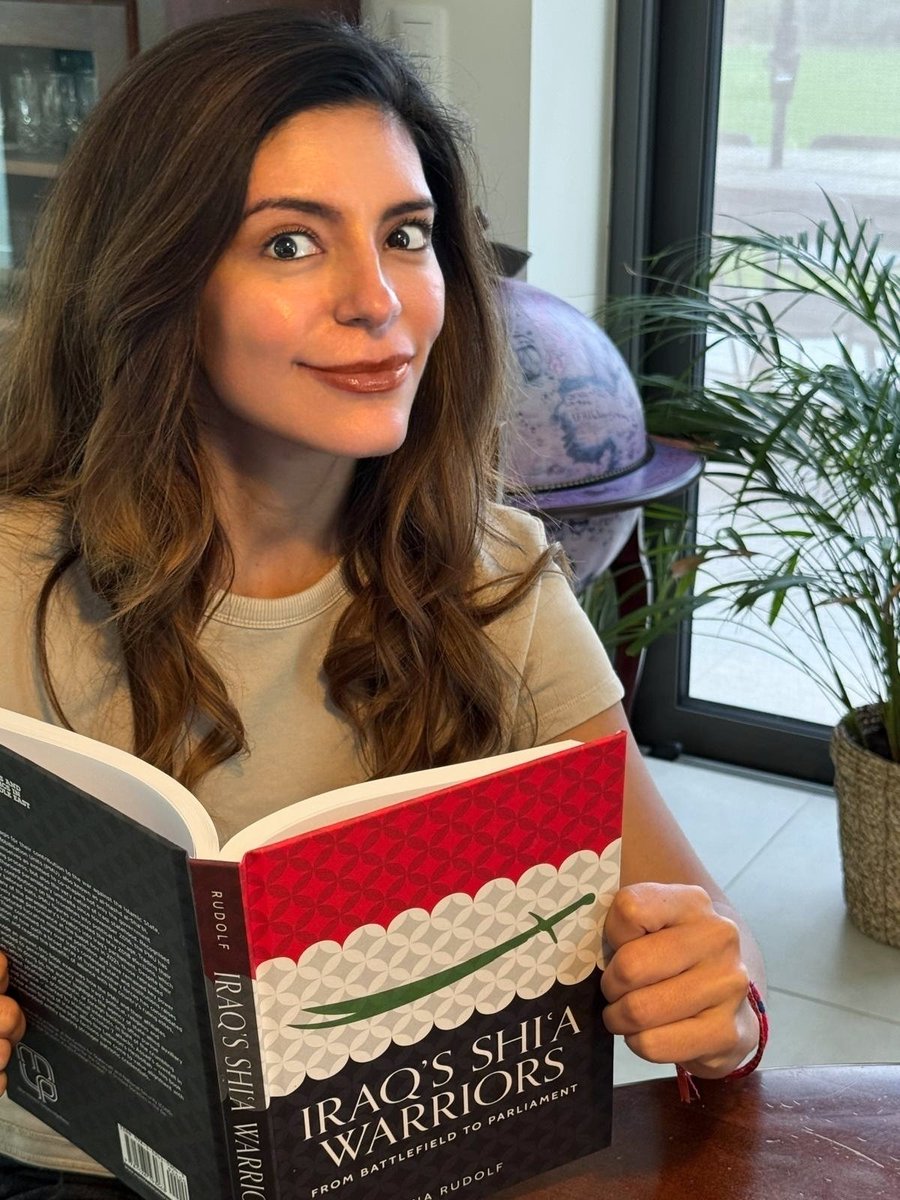
Happy to finally hold a hardcover copy of my new book, Iraq's Shi'a Warriors: From Battlefield to Parliament - part of @ManchesterUP Identities & Geopolitics in the #MiddleEast series. Launches at @warstudies & @StAntsCollege to follow. Order: https://t.co/wMhnLfK4sC #Iraq#PMF
New interview! @harith_hasan discusses the politicization of sectarian identities in the Middle East, the relationship between authoritarian leaders and neoliberalism, and more. Check it out! https://t.co/KaKCDZDawb @IERES_GWU@ArabCenter_en
بدأ المركز العربي للأبحاث منذ أسبوعين بنشر نماذج من مداخل الموسوعة العربية- أرابيكا، على موقع فرعي تابع للمركز ريثما يبدأ نشر الموسوعة على موقع خاص بها في بداية العام 2027. وأرابيكا هي موسوعة معارف شاملة يسهم في تأليفها مئات الباحثين العرب (وربما آلاف في المستقبل) من التخصصات كافة. وتقوم على تحريرها هيئة خبراء عمل المركز ثلاث سنوات على تشكيلها وتدريبها ووضع أنظمتها في التحكيم والتحرير والتدقيق. وتكون المداخل الطويلة والمتوسطة موقعة بأسماء كتابها. إنها المشروع الأضخم الذي يعكف المركز على تأسيسه منذ معجم الدوحة التاريخي للغة العربية.
فيما يلي رابط الموقع الفرعي الذي يتضمن مختارات من أرابيكا:
https://t.co/1fnhlqe1m1
Over 90% of Iran’s oil exports run through Hormuz—its main economic lifeline. In the end, it’s a war of endurance: can the US absorb higher oil prices and prolonged deployment, or can Iran survive losing its primary export artery?
1/10 The U.S. naval blockade of the Strait of Hormuz would cost Iran approximately $276M/day in lost exports and disrupt $159M/day in imports, a combined economic damage of ~$435M/day, or $13B/month.
Over 90% of Iran's $109.7B in annual trade transits the Persian Gulf. Oil/gas accounts for 80% of government export earnings and 23.7% of GDP. Kharg Island alone generates ~$53B/year, or as I noted to @TIME, "$78 billion a year in energy revenue.
The purpose of Shelly Kittleson’s kidnapping might be to use her as a bargaining chip to demand the release of all the Kataib Hezbollah detainees, including the one who was arrested in connection to Kittleson’s abduction, @Mikeknightsiraq told me yesterday. His prediction proved to be correct, The New York Times is reporting that Kataib Hezbollah is asking precisely that. https://t.co/M8upKHUfgN via @AlMonitor
Terrible news: Journalist @shellykittleson kidnapped by 4 men linked to Iraqi Hezbollah in central Baghdad. Officials had prior tip. The car flipped after police chase; second car driving at a distance snatched her while injured. Driver arrested. Kidnappers headed toward Babel.
تمادي هيئة الاعلام برئيسها بليغ ابو گلل انهم يطوقون كلماتنا وحريتنا لم يقدم تيار الحكمة وسيد عمار سوى المزيد من الشخصيات البائسة التي لا تمتلك اي مؤهلات حرية الرأي اصبحت مهددة اكثر من اي وقت مضى بزمن ابو كلل وسيطرة تيار الحكمة عليها ..