Next in the KBfT Series: Direct Instruction.
Nothing has taught me more about how to teach effectively than Direct Instruction principles.
Featuring:
@MrZachG@C_Hendrick@JakeCowling@Kris_Boulton@NIFDI@rastokke
Marcy Stein
Siegfried Engelmann
Douglas Carnine
@ddmeyer Depends who you mean by "the science of maths folks". Siegfried Engelmann, who designed "Direct Instruction" had quite a lot to say about how to elicit, understand and develop a student's understanding.
Direct Instruction (DI) as a formal method was designed by Siegfried Engelmann and Wesley Becker in the 1960s for teaching core academic skills. This was a structured, systematic approach which emphasizes carefully sequenced materials delivered in a clear, unambiguous language with examples.
It's designed to leave little room for misinterpretation and to ensure that all students, regardless of background or ability, can learn effectively.
It's also anything but boring. Here is a video from the 1960s of Englemann teaching Maths. Notice how interactive and fast paced the teaching is:
This is why @Carousel_Learn exists. To bring real solutions to real teachers in real classrooms, the next day.
The day I did the webinar was rough. It's such hard work. The day started at 0700, and was straight through till gone 1800. I'm basically in a permanent state of exhaustion trying to get stuff like this out to people.
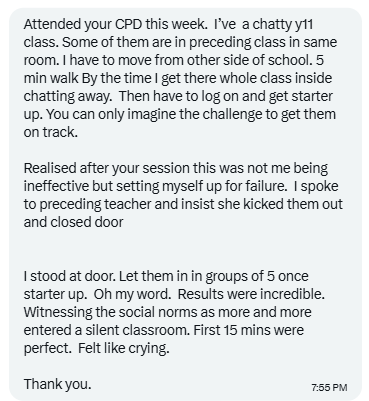
Receiving messages like this...it's a joy.
A question I’ve evolved on considerably is students taking notes. I can no longer advocate for, and, in good conscience, ask students to spend significant time, taking notes. If there is something I need students to refer back to later, I’ll put it on a reference page, sheet, slide, or knowledge organizer. And if there is something I need students to remember later without looking back at a reference, we’ll have done enough retrieval practice, spaced over time, interleaved, using varied conditions that the knowledge will be secure in their long-term memory. In other words, if they need to look at it later, I’ll provide them with a good reference. If they need to remember it later, I’ll teach it and they’ll retrieve it until they don’t need to look back.
It looks like Australia, Northern Ireland and the US are discovering the "Science of Learning."
I have a protip from someone who went through the same thing. It's important, it really is, but knowledge of the science of learning doesn't necessarily make a difference to what people do in the classroom.
Drawing a line from theory to practice is really really hard, but the process can be accelerated, by moving to concrete strategies and training faster. Of course, theory and practice is a "balance" and we "need both", but in a zero sum situation, try and get to the practice as quick as you can. People have worked a lot of this stuff out now, and you don't need to try and figure it out for yourself.
For a very long time, I was optimistic about the future of education in this country.
This time last year, @amymayforrester and I predicted that when the next round of PISA results came out, England would tick up. There had been 15 years of positive change in the sector, and we thought that would pay dividends.
That then came to fruition. England is doing well, especially compared to countries that are similar in many demographic and social respects, but have different education systems.
But now, I am worried. There are lots of things going on that I think are problematic. The current government and DfE seem hell-bent on reforming a sector that does not need reform, and introducing changes that will row back some of the gradual improvements we have seen. Ofsted seem stuck in a mire of unpopularity, and are unable to convince the profession or the public that they are a force for school improvement. Big, respected, organisations that hold government contracts and an important place in the sector do not seem to be delivering. None of these groups are bad actors, and I really do believe they all want what's best, but that isn't always enough.
Alongside that, we seem to now lack the public discourse infrastructure to adequately challenge these issues. The 2012-2019 years on Twitter were ones of fierce debate and criticality, and ideas could be well-tested before, during and after implementation.
That doesn't exist any more. The debate seems so much flatter. That's partly a numbers game: social media has become a less popular place. But also, politically and commercially, more and more "big voices" find it harder to make public statements and take strong positions on things. It's easier to get in line and bend with whatever winds happen to be blowing at the minute, and you often see people taking surprising and contradictory positions. Critically, I don't exempt myself from this, and know that there are things I would have said 5 years ago that I won't now.
For the first time in a while, I'm worried. I am certainly no longer optimistic.
Eenvoudig model van lesgeven
Het eenvoudige model van lesgeven, gebaseerd op wat de cognitieve psychologie ons heeft gebracht, is een krachtig kader voor lesgeven. @PepsMccrea
https://t.co/qTvwl3exnj
It's difficult to overestimate how damaging this view of teaching and learning has been for so many kids.
Virtually every teacher trained over the last 50 years was taught that knowing stuff is the least important part of thinking.
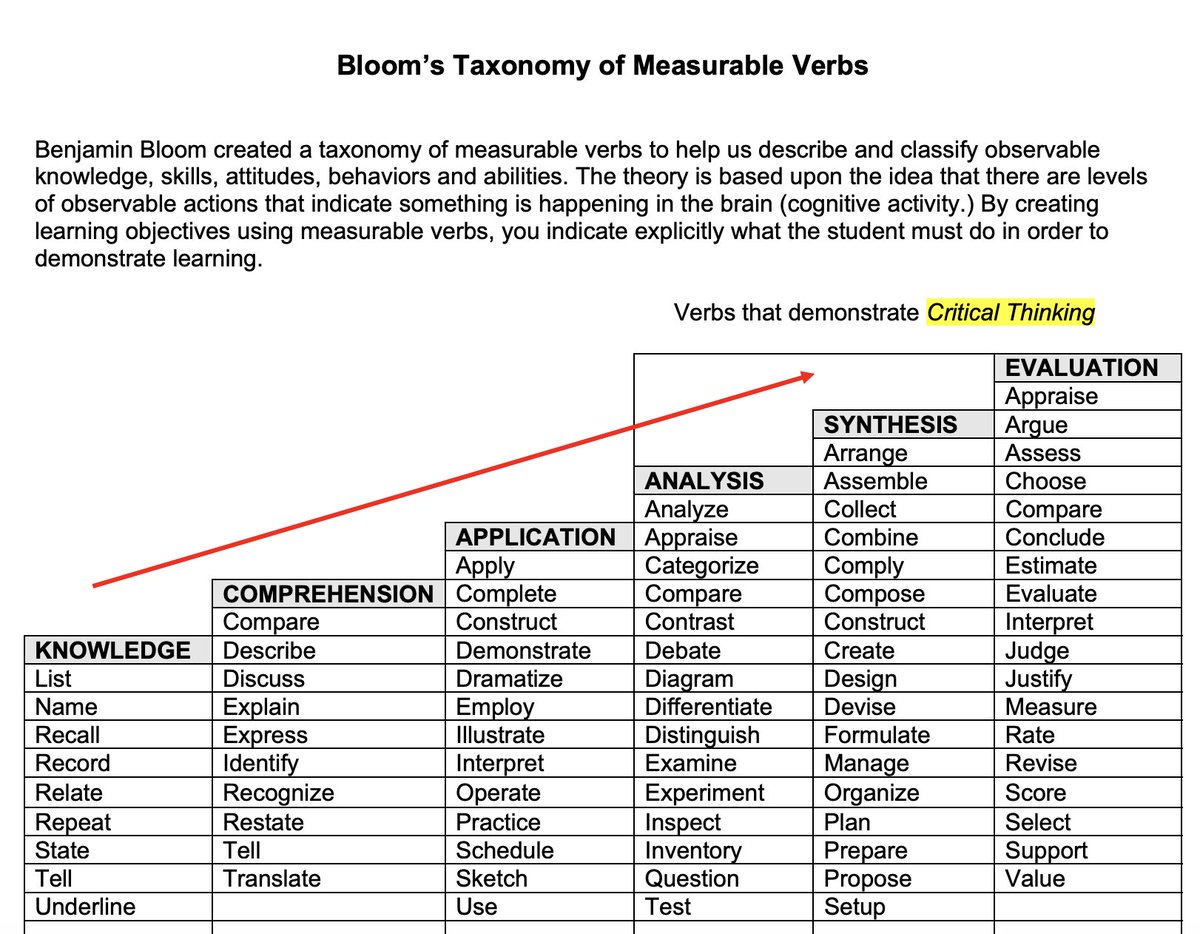
This image taken from Utica University's assessment resources for faculty:
https://t.co/HOigGyQgnf
a novice teacher with about 5 minutes of training in Blank Canvas modelling can do a better job than this imo
(it is better than a lot of educational videos, but low bar)
This is stupid.
Children don’t learn in different ways.
Pretty much everyone can do well at English and maths GCSE with the right teaching, as the best schools in England demonstrate. And they will be better off as a result, even if they go on to be plumbers and hairdressers.
Retro Burnham wants to take England back to 2005.
Unfortunately, Scotland has been minimising school exclusions already and this has contributed to rising violence in schools. Clear boundaries and consequences are the very things that keep children and staff safe.
No, it doesn’t prove causation. What’s more likely?
1. Suspending a student causes them to engage in crime.
2. Students whose behaviour causes them to be suspended are more likely to commit crimes.
Given many behaviours that a student would be suspended for—such as possessing a knife—are crimes in wider society, #2 seems far more likely.
Until we can rule out #2, no amount of research showing a correlation between suspensions and criminal behaviour will prove #1.
And the risk of listening to the people who want to convince policymakers of #1 is that schools will become unsafe and learning will be sacrificed.
Let’s all commit to minimising burglary arrests by putting the burglar first.
This will reduce burglary. It will empower young burglars. It will save young burglars and enable them to have positive lives.
Burglary arrests are failures.
An incredibly depressing article. A few points:
🔸If your kid can’t add fractions, they are not ready for algebra, even if the school is giving them A’s. It's an easy check. Make sure they can add, subtract, multiply, divide fractions.
🔸Lots of misinformed math education academics out there downplay the importance of foundational skills and tests. They are wrong. Note how her child developed test anxiety once she started doing poorly on tests b/c she had not acquired the knowledge to do well on the tests.
🔸Standardized test results probably do give a pretty accurate picture of how a school is performing in comparison to other schools. Testing matters, for so many reasons.
🔸High standards matter. Smart kids need to be challenged. Even her own daughter could see this.
I appreciate that the journalist shared her story and I hope other parents learn from the mistake she made. https://t.co/pMCaZnlznO