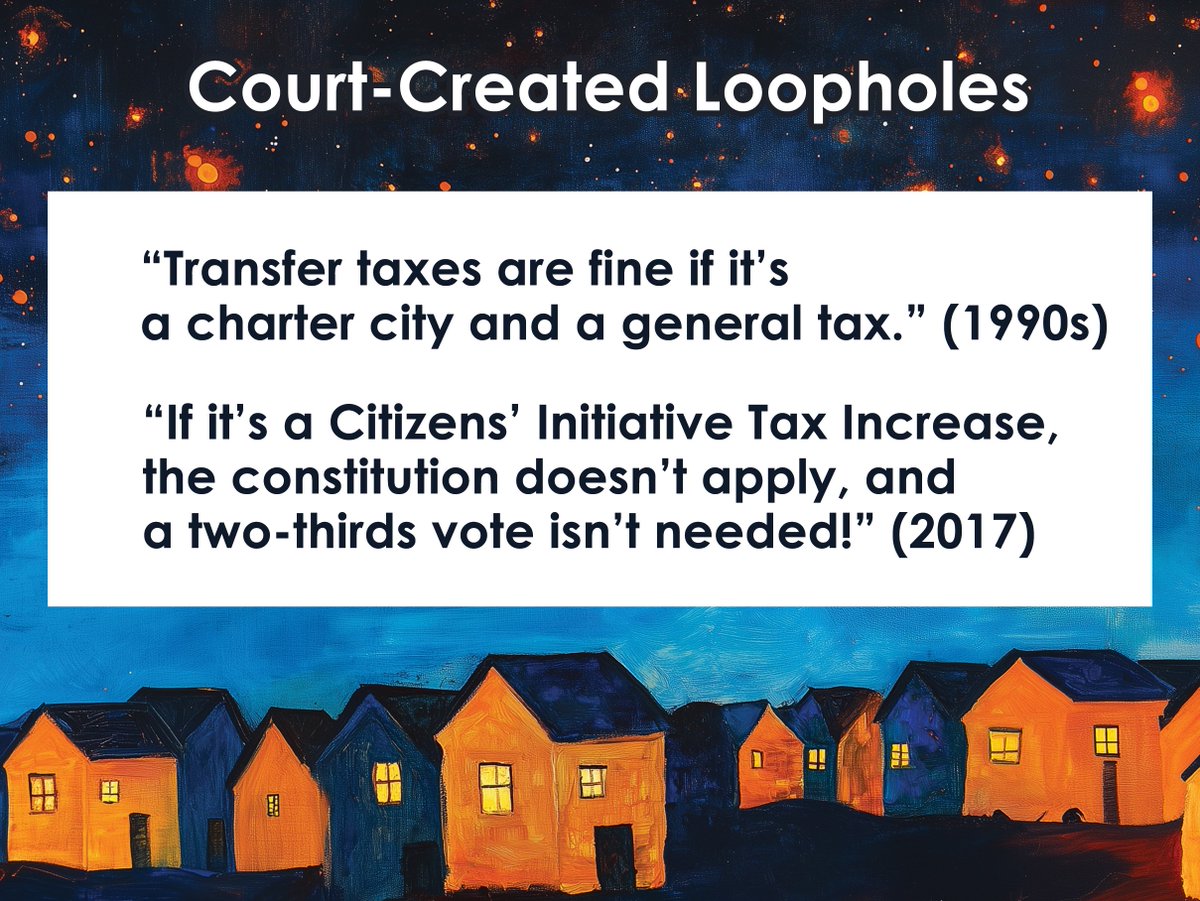
The Local Taxpayer Protection Act to Save Proposition 13 will be on the November ballot. It restores the 2/3 vote to pass all local special taxes, bans real estate transfer taxes, and repeals transfer taxes and some parcel taxes in 2 years. @hjta
Protect Traci at all costs
(And, yes, YIMBYs, I'm aware you dislike her land use positions. It turns out there are a lot of other issues that matter to our city, too.)
How Matt Mahan Thinks He Can Save California 🚨
San Jose Mayor and California Gov Candidate @MattMahanSJ joins @friedberg to talk:
-- State of California
-- Impact of public sector unions in CA politics
-- Pension time bomb
-- CA housing, energy crises
(0:00) Matt Mahan: Why He's Running for Governor
(1:51) How California Went From Bad to Worse
(12:05) Public Sector Unions & Lobbying in Sacramento
(19:05) California's Housing Crisis: Regulation & Fees
(34:52) California Energy Crisis: Gas Taxes & Green Policy
(43:57) The $1 Trillion Pension Time Bomb
(1:02:37) Trump, Tariffs & the Rise of Dangerous Populism
(1:09:14) Immigration Reform: ICE & the Path to Legal Status
What is shameful is not that the City wants to prevent homelessness. It is that the report presents the benefits of defending non-paying tenants as if those benefits exist in a vacuum, while failing to seriously account for the cost imposed on housing providers who are forced to absorb unpaid rent, concessions, delay, and legal expense. Even where the City points to rental assistance and negotiated settlements, the broader framing is still one-sided: tenant relief is counted as public benefit, while housing provider loss is treated as if it barely exists.
We have represented apartment owners for more than 30 years, from small family operators to the largest institutional owners. The overwhelming majority did not choose housing as an investment because they wanted conflict. They chose it because they believe in owning, operating, and improving housing over the long term. Most view themselves as stewards of their properties and work tirelessly to reinvest in their buildings, maintain quality housing, and improve the day-to-day experience of their residents. That is the reality in the vast majority of cases.
We need to move past this zero-sum political framing where tenants can only win if housing providers lose. Onerous eviction moratoriums are marketed as tenant protection, but the economic reality is more destructive. When housing providers are forced to absorb tens of thousands of dollars in lost rent, legal fees, delay, and uncertainty, those costs do not simply disappear. They flow back into the housing system through higher rents, reduced reinvestment, deferred improvements, and a more adversarial operating environment. The result is not protection. It is an unnecessary, self-defeating spiral that ultimately harms the very tenants these policies claim to help.
From what I heard, the @HJTA surprised everyone and turned in >1.3 million signatures yesterday for their ballot measure that would, among other things, repeal Measure ULA. The Sec of State needs to validate, but this almost certainly means it will qualify for the 11/26 ballot.
@SouthwestAir Years of flying, always loved the ‘customer-first’ culture… until today’s Flight 3505 gate agent went full Luggage Nazi on a small compliant carry-on. ‘Check it or else,’ served with maximum dismissiveness. Data point? More like a screaming red flag that the bin chaos and assigned seating ‘enhancements’ are breeding gate-agent tyrants.
Hoping isolated? Nah—it’s the new vibe: pay for priority, still get power-tripped. Bob Jordan’s customer-first glow-up: first to check your bag, last to care. Transfarency: transparently turning compliant bags into contraband. Bring back the old Southwest before more loyalists bail! 🧳🚫😤 #SouthwestFail #LuggageNaziGate #FireBobJordan
I’ve flown @SouthwestAir for many years and have always respected the company’s strong customer-first culture.
That’s why today’s experience on Flight 3505 (SFO → LAX, 2:10pm, 2/24) stood out. A gate agent required me to check a small, compliant carry-on and handled the interaction in a notably dismissive and unprofessional manner.
Sharing this as a data point for leadership awareness. Hoping this is an isolated incident, not a cultural shift.
@SouthwestAirHelp
Catastrophizing the world's problems doesn't motivate us to solve them. It robs us of hope.
Spreading doom and gloom is a self-fulfilling prophecy. Failing to see a way to change drains our will to act.
Progress doesn't require positivity. It rests on a sense of possibility.
https://t.co/ZVJHZndk6T
What everyone should know about housing policy:
1. Rents reflect the balance of supply of apartments and demand for those apartments in a given area. That’s it; there’s no magic. If you want lower rents, you can hope for a recession that destroys jobs and, therefore, demand. Or you can add supply.
2. There is no amount of money that any big city government could feasibly spend that would add materially to supply. This is because, depending on the location, new apartments cost $250,000-1,000,000 to develop… building even a few hundred of those starts to stress any city budget, and many big cities need tens or hundreds of thousands.
3. On the other hand, investors (including pension funds and endowments, insurance companies, rich families, etc.) can collectively **easily** provide enough capital to build as much housing as we need **so long as they are confident they can get a reasonable return**.
To get those investors to fund the creation of the housing our society so desperately needs, we must do two things:
1. Dramatically reduce the time & complexity associated with securing governmental permission to develop housing.
This means reviewing and simplifying the overlapping regulations that constrain housing production: zoning codes, building codes, parking, ADA, etc. But it also means changing the cultures within the relevant governmental agencies from “default no” to “how can we help you?”.
2. Provide certainty around on-going regulation of apartment operations.
The way investors get a return from building rentals is as follows: They hire managers to lease the apartments, collect the rents, pay operating expenses and any mortgage payments, and then send the investors the cashflow that remains.
But city governments all over the country have been restricting the manner in which apartment buildings can be operated in all kinds of ways.
For example: Cities have been making it harder to screen tenants, while also making it much harder to evict tenants who don’t pay. You can see why both of those measures are politically popular. After all, who doesn’t want people to get second chances? And who wants anyone to get evicted? But, as a manager, the combination of those two regulations makes it much harder to predict, with any certainty, that the rent will get paid… and that makes it very difficult to get investors to provide capital to create more housing.
Another example: Rent control. Again, I understand why renters love rent control and why politicians want to give it to them. But, if, as has been the case in NY, LA and San Francisco, city governments hold annual rent increases below the rate of growth in the operating expenses of the buildings, the cashflow payable to the investors shrinks… making them much less likely to invest capital in building more apartments.
In conclusion: For ~every other good or service in the economy, we allow the market to function, and the result is that we have a surplus of choice at all price points (think of food or clothes or cars), which is spectacular for the consumer. If we want a surplus of choice at all price points in housing, we need to get comfortable with the idea of allowing the market to provide it.
And that means allowing investors to build rental apartments *and* allowing them to operate those apartments in a manner consistent with making a reasonable profit.