The hardest conversation I have in my office isn't about surgery. It's about time.
A 58-year-old sat across from me with knee pain. She’s otherwise healthy, but menopause has been rough on her. Her MRI shows some cartilage changes — age-appropriate, and a typical meniscus tear... basically, nothing that requires surgery. But she hasn't done any physical work in 15 years. She stopped playing tennis at 43. Stopped walking regularly at 50. Now the knee hurts when she climbs stairs.
The knee isn't the problem. The knee is just the messenger.
What has really happened is fifteen years of progressive capacity loss. Muscle mass has declined while tendon capacity has dropped. Her metabolic health shifted, and menopause has contributed to these changes. The knee was affected secondarily. The knee doesn't require my attention... that needs to be directed elsewhere.
I can't give her those fifteen years back, but I can help her start from where she is. And starting from where she is still works.
An 85-year-old can still synthesize new muscle protein after a single resistance-training session. The window of opportunity does narrow with age, but it never closes. Recovery takes longer. The risk of injury is likely higher. Progress is slower. But the biology of adaptation doesn't abandon you at 58, or 68, or 78.
What changes is the cost of waiting. Every year of inactivity makes the starting point harder and the ceiling lower. The leverage you have at 40 is real and significant — and it's greater than the leverage you'll have at 60.
That's not a reason for despair... It's a reason to start, wherever you find yourself now.
3 months later, after a solid strength/power program, she's walking daily with her weighted vest and is back on the tennis court.
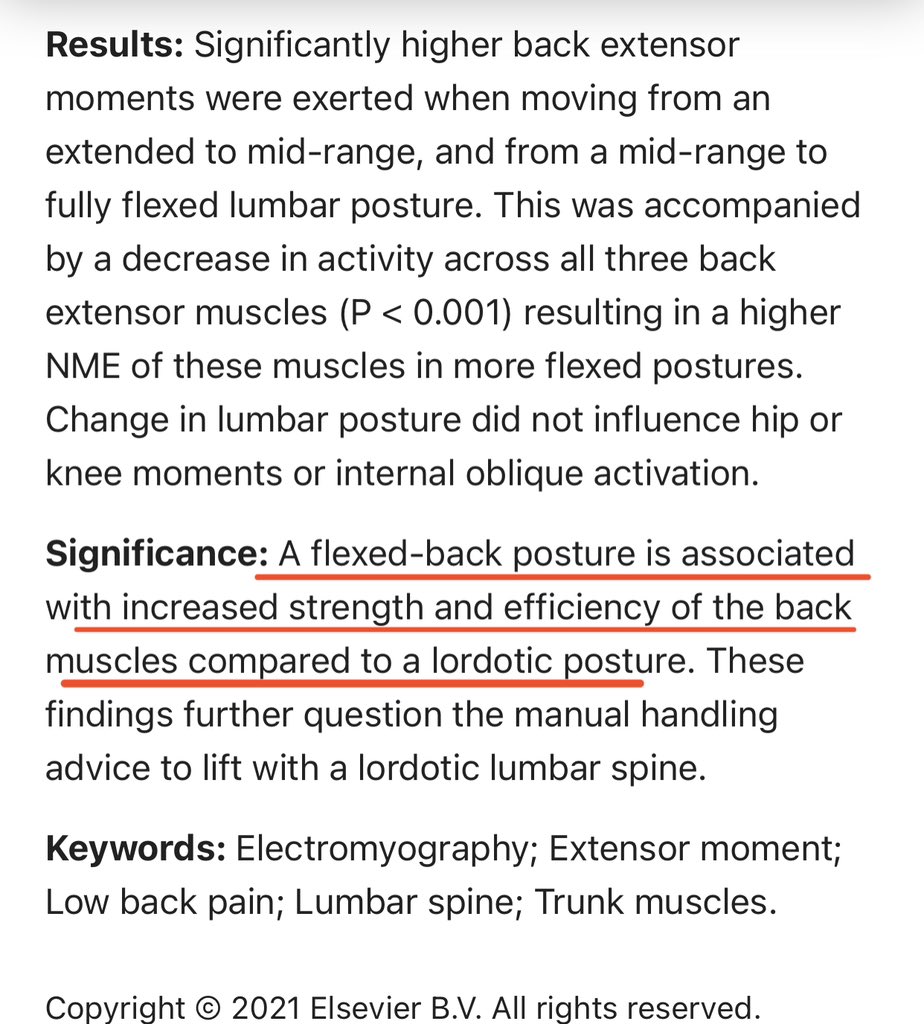
Flexed lumbar spine postures are associated with greater strength and efficiency than lordotic postures during a maximal lift in pain-free individuals https://t.co/lo7Of0soX0.
Would really encourage everyone to watch Samoa coach Ramsey Tomokino's answer to this question from @nickheathsport.
Forget the score. It was moving to see how much today meant to everyone connected with this Samoa side.
80% of all humans will experience back pain in their lives, so, almost everyone.
If we framed pain, especially new or episodic pain, as part of life’s events, we might develop a much healthier perspective.
Not damage.
Not forever.
Not because they played football in their youth.
Think of it like a really bad flu: your life is disrupted, it feels awful, but with time, and maybe some support — you recover, or at least move forward with recovery in mind.
There’s often no lesson to be learned. No activity to blame. Not even football. Instead a focus on behaviours and actionable steps.
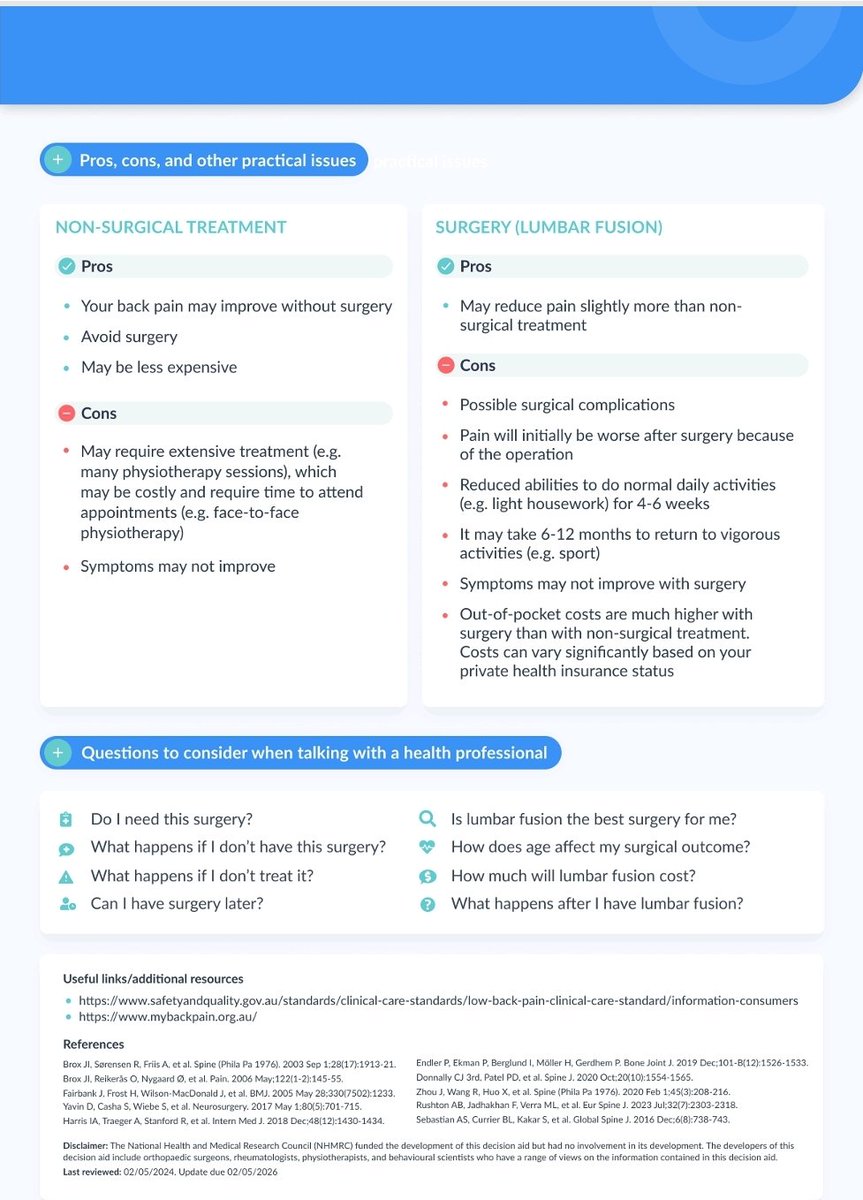
We developed a patient decision aid to help people with back pain considering lumbar fusion choose between surgery and non-surgical options.
Mixed-methods development described here (open access!) https://t.co/MsrCoAEsnM
@msk_health@Tammy_Hoffmann@ProfManuelaF
This review explores pubic apophysitis, a relatively under-recognised but important cause of groin pain in young athletes, particularly those aged 14–21 years. With increasing participation in youth sports, the study sheds light on this condition, which can significantly impact performance and recovery if not properly diagnosed and managed. By examining clinical features, imaging findings, and optimal diagnostic approaches, this research highlights the importance of understanding pubic bone maturation in tailoring effective care for young athletes.
Key findings :
1. Pubic Apophysitis in Young Athletes
Pubic apophysitis is identified as a significant cause of groin pain in young athletes, particularly in those aged 14–21 years. It presents with gradual onset groin pain, often exacerbated by resisted adduction or activities involving the pubic symphysis.
2. Key Diagnostic Features
Clinical signs include tenderness at the pubic bone and pain during resisted adduction. Imaging via MRI is most effective, revealing features like bone marrow oedema, delayed apophyseal maturation, and symphyseal widening, without the need for ionising radiation.
3. Differentiation from Other Conditions
It is distinct from "osteitis pubis," a term suggesting inflammation, as research indicates pubic apophysitis arises from bone stress and overload rather than inflammation. Proper diagnosis hinges on understanding pubic bone maturation patterns.
4. Optimising Imaging Approaches
Standard anterior-posterior (AP) pelvic radiographs can evaluate pubic bone maturity but may lack detailed visualisation. MRI with T2 fat-suppressed and ultrashort echo time (UTE) sequences is recommended for accurate diagnosis while minimising radiation exposure.
Link: https://t.co/8BzPoDd7SY
Recently I’ve had a lot of conversations with physios, IC players and some management members about the injury epidemic in Gaelic Football.
One thing that continually crops up is Osteo Pubis (a new more recent problem) and hamstring injuries. OP is an inflammation issue and a clear over use condition. The raise in it is very telling. Frankly it’s a bit mad this is happening now, but explainable.
The other rise is (apparently, the Gah doesn’t do data) is another rise in hamstring injuries added to more severe “hamstring off the bone” versions of hammy injury. It’s anecdotal, but I’ve heard about 10+ in 2023/24.
Inter County Management is still full of bluffers. People who wilfully endanger players with reckless training and lack of rest. We are all aware of the high profile ones, but it is happening in all 4 divisions.
One thing I’m aware of and visually have seen and been told about is the amount of weight training done seems to be excessive in many places. I’ve no doubt most of the professionals involved know this. This is pretty simple physics. My belief is majority do their best in terms of loading but are simply not willing to challenge managements.
Asking straight forward questions always helps.
Am I strong enough to carry the bodyweight I have around?
Am I strong enough to sprint repeatedly with the bodyweight I have?
Have I the capacity for repeat high speed running with the bodyweight I have?
Am I faster, and for more of the time?
Maybe momentum is a handy formula, speed x MASS
I would say a lot of players are right on the edge with this. And look on the edge is normally fine. Peaking and troughing is a skill for both coaches and players. High level sport is on the edge.
There is very little troughs in IC Gaelic Football now though.
Here is the issue:
Big game
Do I get 2-6 weeks (varies on age and body type) to completely regenerate my body after a season?
Small Game
Do I get 72 hours rest & recovery (and you can do some modalities of training) after a major athletic event? Like a game of heavy training?
Now a heavy S&C weight training sessions is a major athletic event.
So fusing together the knowledge I have of a few teams.
The broad idea is;
Saturday: Match
Sunday: Recovery session w/team
Monday: Gym Session
Tuesday: Football
Wednesday: Off (usually, but have seen gym again)
Thursday: Football
Friday: Off (and have heard video sessions)
Saturday: Game
I’ve seen gym sessions with excessive hypertrophy (muscle building) sessions in-season on a Monday and/or Wednesday in the last 3 years. What happens in hypertrophy sessions is the micro tearing of muscles. This takes 48 hours recovery, approx.
Now if we look at any reasonable science on recovery from hypertrophy https://t.co/74cSrWTZUs we know this makes an IC week even more bananas.
One other thing I correlate with these schedules is the consistency of performance of these teams. Or lack of.
This doesn’t even touch the tomfoolery with Sigerson players. Some have been told to train Tuesday, play Wednesday and be at training again (not taking part) on Thursday. Video Friday. Play Saturday.
And what’s often lost is the following week, and the week after. A cumulative nightmare. There are pockets of 3 games in 14 days presently.
Now the one thing I go against the players, GPA and others on this subject is the games are the problem. The mid week training is the problem.
In a period like that a week could look like this;
Saturday: Game
Sunday: Personal restoration
Monday: Personalised S&C Program. 45 mins or less
Tuesday: OFF
Wednesday: Main Session. 90 mins
Thursday: Off
Friday: Primer Session (with ball) & maybe video.
Saturday: Game
Players are together too much too. I think this adds to the intensity and hot housing. Managers don’t seem to trust players, which is crazy. The modern IC player, bar a very odd outlier, will do whatever is required. But many of these managers are control freaks, and that’s a gigantic issue.
👇👇👇
The ‘DO I NEED AN X-RAY OR SCAN’ infographic is now available - https://t.co/97OHI088h6
Inappropriate MSK imaging is a major issue🌎
This resource maybe useful
✔️To supplement MSK consults
✔️For waiting rooms
✔️For training clinicians and students
PDFs available via DM
Had a 62 yr old patient told by a rheumatologist they had hips of a 60 yr old and a back of a 120 yr old!! Very distressed 😫 How does this even happen??? Does my head in - senseless harm.
Can never be said enough. The draw for this World Cup is an utter disgrace - the best four teams in the world are so superior to the rest it's incredible and they have to play each other next week. It's wrong
LAST WEEK TO GET INVOLVED ✍️
Do you play CAMOGIE or LADIES GAELIC FOOTBALL? We want to learn more about your mental health - complete the survey at this link 👉 https://t.co/T97ma3x5YK
@dcu_shhp @OfficialCamogie@LadiesFootball@3rdLevelCamogie@LadiesHEC
How awesome to see 11+/@FootballAUS Perform+ drills integrated into elite football at the World Cup ⚽️
Shoulder contact a great way to integrate controlled contact into preparing for performance and injury prevention.
Fantastic for fans to see!
https://t.co/xlbuL2zRdK
Opioids NOT effective for acute back and or neck pain - placebo controlled trial - very important work with BIG implications for patient care!! Well done @Caitlin_Jones and team.