Today's event was so massive, even top leaders had no stage seats... concert-like crowd, 1 Lakh+ students turned up to support Rahul Gandhi ahead of Re-NEET exams.
📍Kota, Rajasthan:
Godi Media covered 500 "cockroaches" widely, but stayed silent on this historic crowd... yet the public is clearly with Rahul Gandhi.🔥
IMPORTANT: In this season of political splits and mergers, the Supreme Court’s questionable role has largely escaped scrutiny.
1) The SC is yet to deliver a final ruling on the Shiv Sena (UBT) appeal filed in January 2024 challenging the Maharashtra Assembly Speaker’s decision on the party split. That’s 30 months, four CJIs and counting.
2) The SC is also yet to rule on a petition filed by Goa Congress leader Girish Chodankar in March 2022 challenging a Bombay High Court order related to defections. More than four years have passed.
When the history of this period is written, the Supreme Court’s performance as a constitutional guardian must come under serious examination.🙏
My aunt passed away on 29 May in Delhi at the age of 85. I applied for her death certificate on 4 June. The application was rejected once, all requested documents were resubmitted, and since then there has been been no progress.
What is particularly troubling is that during follow-up, I was allegedly asked for a bribe, and officials have made unreasonable demands such as asking for her children to verify her death (she was unmarried) or for her father to verify it. Her younger sibling is 81 and immobile, while my father is 89.
This is not just about one death certificate. It is about the experience ordinary citizens face when dealing with public services. If an educated family with resources is struggling, I can only imagine what less privileged citizens go through.
I have already filed a complaint through the @LtGovDelhi Listening Post platform, but several previous complaints related to civic services remain unresolved. Complaint ID 2026016323
Requesting @MCD_Delhi, @gupta_rekha and @CMODelhi to look into this matter, ensure accountability, and help expedite a process that should not be this difficult for grieving families.
BREAKING: The US has released the full text of its 14-point "Memorandum of Understanding" with Iran.
Key terms include:
1. The US, Iran, and their allies agree to immediately and permanently end military operations on all fronts, including in Lebanon
2. The US and Iran agree to respect each other's sovereignty and territorial integrity and not interfere in each other's internal affairs
3. The US and Iran commit to negotiating and reaching a final deal within 60 days, unless mutually extended
4. The US will begin removing its naval blockade immediately and fully end the blockade within 30 days
5. Iran will use its best efforts to ensure safe passage for commercial vessels through the Strait of Hormuz for 60 days with no charge
6. The US and regional partners will develop a mutually agreed plan of at least $300 billion for Iran's reconstruction and economic development
7. The US will work toward terminating all types of sanctions against Iran, including UN, IAEA, primary, and secondary sanctions
8. Iran reaffirms that it will not procure or develop nuclear weapons and agrees to address its enriched material stockpile under IAEA supervision
9. Until a final deal is reached, Iran will maintain the current status quo of its nuclear program, while the US will impose no new sanctions and deploy no additional forces
10. The US Treasury will issue waivers for Iranian crude oil, petroleum products, derivatives, and associated banking, insurance, and transportation services
11. The US will make frozen or restricted Iranian funds and assets fully available for use
12. The US and Iran will establish an executive mechanism to monitor implementation of the MOU and future compliance with the final deal
13. After signing the MOU and implementing key ceasefire, blockade, shipping, oil waiver, and asset-release provisions, the US and Iran will begin final deal negotiations
14. The final deal will be endorsed by a binding UN Security Council resolution
The memorandum will trigger a 60-day window to negotiate a final deal.
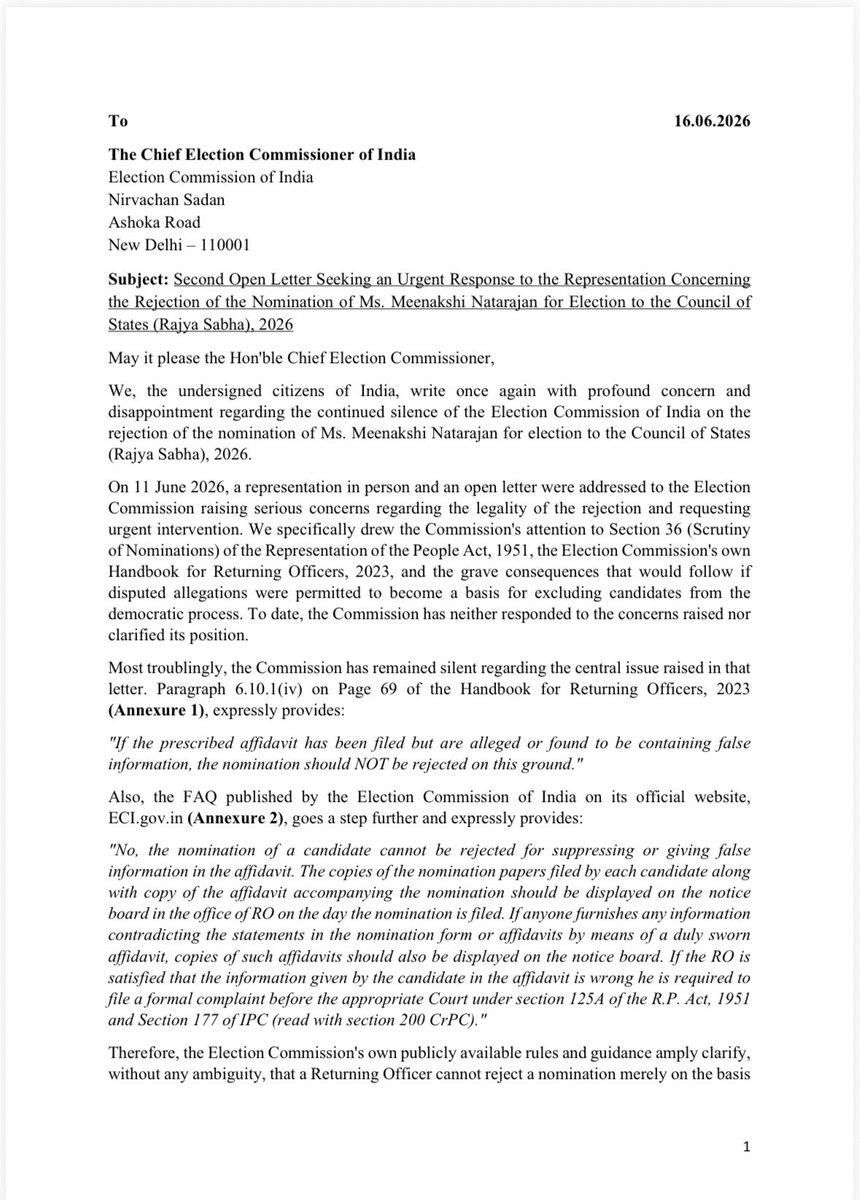
33 citizens from across India have written a second open letter to the Election Commission of India.
The ECI’s own Handbook for Returning Officers (2023) states that a nomination cannot be rejected merely because an affidavit is alleged to contain false information. Yet, Ms. Meenakshi Natarajan’s nomination was rejected, and the ECI remains silent.
Now, the Hyderabad complaint proceedings that allegedly formed the basis of the controversy have also been dismissed.
With Rajya Sabha voting scheduled for 18 June, we ask a simple question:
Will the ECI uphold its own rules and explain this rejection before polling takes place?
Democracy demands answers.
#CharkhaSatyagraha #FreeAndFairElections #DemocracyMatters
@ECISVEEP
China’d almost certainly have made deaths centrepiece of its public diplomacy. India made them one element of a larger conversation about maritime security, stability & protection of civilians.
That’s contrast in what was done, but in what was seen to be done
Read @DrSJaishankar
How would #China have put across the seafarer issue if they had been similarly targeted as Indian seafarers were?
Here’s my take:
China would almost certainly have handled it differently, though perhaps not in the way many Indians imagine.
I think there would have been three layers to the Chinese response.
Publicly
The Foreign Ministry spokesperson would likely have issued a statement within hours.
Something along the lines of:
“China expresses its strong dissatisfaction and grave concern over the loss of Chinese lives. We demand a thorough investigation, a full explanation, and effective measures to ensure the safety of Chinese citizens and commercial shipping.”
The key point is that China would probably have named the incident directly and made the nationality of the victims central to the story.
The deaths themselves would become the headline.
Diplomatically
The US ambassador would almost certainly have been summoned.
Beijing would demand:
an explanation,
an investigation,
assurances against recurrence,
and probably compensation.
Whether China expected all of those demands to be met is another matter.
The purpose would be to demonstrate that the Chinese state visibly protects Chinese nationals.
Politically
The Chinese system is highly conscious of optics.
State media would likely have:
profiled the sailors,
interviewed families,
highlighted China’s diplomatic actions,
emphasised the state’s determination to protect its citizens.
The narrative would be:
“The Chinese government is acting decisively.”
But here’s the important caveat
Would China actually have jeopardised its broader relationship with the United States over the incident?
Probably not.
That is where many comparisons become misleading.
When American aircraft collided with a Chinese fighter near Hainan in 2001, Beijing protested fiercely, but ultimately sought a managed outcome.
When Chinese citizens have been killed in Pakistan, Africa, or elsewhere, Beijing has often combined strong rhetoric with pragmatic diplomacy.
The public tone and the private calculations are not always the same thing.
The deeper difference
The real difference is not necessarily policy.
It is narrative.
China tends to project strength through public language.
India tends to project responsibility through restraint.
One can argue that China’s approach creates deterrence.
One can equally argue that India’s approach preserves flexibility.
But they are different traditions.
The awkward comparison for India
The reason many Indians are uncomfortable today is because we have spent years cultivating the image of a more assertive India.
That naturally invites comparison.
People ask:
If China would have publicly demanded accountability, why didn’t India?
The answer is probably that New Delhi judged that the larger stakes—Hormuz, Iran, trade talks, the Modi-Trump meeting, and the broader relationship with Washington—outweighed the benefits of public escalation.
Whether that judgment was correct is a legitimate subject of debate.
But if you ask me what would have looked different, it is this:
China would almost certainly have made the deaths the centrepiece of its public diplomacy. India made them one element of a larger conversation about maritime security, stability, and the protection of civilians.
That is the sharpest contrast. Not necessarily in what was done, but in what was seen to be done.
That gay PM of Britain too is screwing India’s energy survival; the monarch of which raised RSS - don’t blame the whimsical and lunatic Dolaand the Phreind.
रूस से भारत ला रहे तेल टैंकर को ब्रिटेन ने किया जब्त , भारतीय कप्तान अजय पंत गिरफ्तार
ब्रिटेन ने इंग्लिश चैनल में रूसी शैडो फ्लीट का तेल टैंकर MV Smyrtos जब्त कर लिया। जहाज पर लगभग 1 लाख टन रूसी कच्चा तेल लदा था, जो भारत आ रहा था।
भारतीय कप्तान अजय पंत को गिरफ्तार कर लिया गया। उन पर ब्रिटेन के रूस-प्रतिबंध तोड़ने का आरोप है और उन्हें 10 साल तक की जेल हो सकती है।
रॉयल मरीन कमांडो ने 6 घंटे के ऑपरेशन में जहाज पर कब्जा कर लिया। यह जहाज कैमरून फ्लैग वाला था, जो रूस के Ust-Luga पोर्ट से निकला था और गुजरात के सिक्का पोर्ट आ रहा था।
#Russia #India #OilTanker #Britain #UK #RussiaOil #EnergyCrisis #TCNLive
While that chap is trying to steal photo-opportunities for keeping his brain dead bunch something to fag to - this man is amongst the future demographic dividend, talking about their issues & not himself.
The contrast couldn’t have been more stark
WATCH: Trump on India's Modi:
He is the most beautfiul looking man. He looks so nice. He is like an angel.
But actually he is as tough as a killer. He is a killer.
But he looks so good, so he gets you by surprise.
भारत की शिक्षा व्यवस्था आज सिर्फ़ एक वसूली तंत्र बन गई है।
ज़रा सोचिए - देशभर के परिवार जितना पैसा सिर्फ़ NEET की तैयारी पर ख़र्च करते हैं, वो भारत सरकार के पूरे शिक्षा बजट के बराबर है।
आज कोटा से, और देश के हर कोने से, लाखों युवा एक सुर में कह रहे हैं - इस व्यवस्था ने हमारे साथ अन्याय किया है।
हर युवा अलग है, पर सबकी कहानी एक - या तो सपने देखने नहीं दिए गए, या देखे हुए सपने तोड़ दिए गए।
‘छात्रों की गूंज’ सिर्फ़ अभियान नहीं - एक क्रांति है। हमें एक ऐसी व्यवस्था बनानी है जो आपको बड़े सपने देखने का हक़ दे और आपकी ज़िंदगी गिरवी रखे बिना, उन्हें पूरा करने में आपका साथ दे।
#ChhatronKiGoonj
Tie @RahulGandhi ‘s efforts with Phriend Dolaand’s comment during G7 & you’ve a acceptance that not only the mosad but cia too is controlling India meaning #CompromisedPM - go take many walks but your head won’t be cleared.
Just one figure from @rahulgandhi ji’s talk at Kota says it all:
🔹Money extracted by the system from NEET students and their families (22 lakh students per year) = 1.32 Lakh Crore.
🔹India’s entire education budget = 1.40 Lakh Crore.
🔹I have only one thing to add to it: Loans forfeited by the government of India to its favourite businessmen: 16 Lakh crores.
#ChhatronKiGoonj
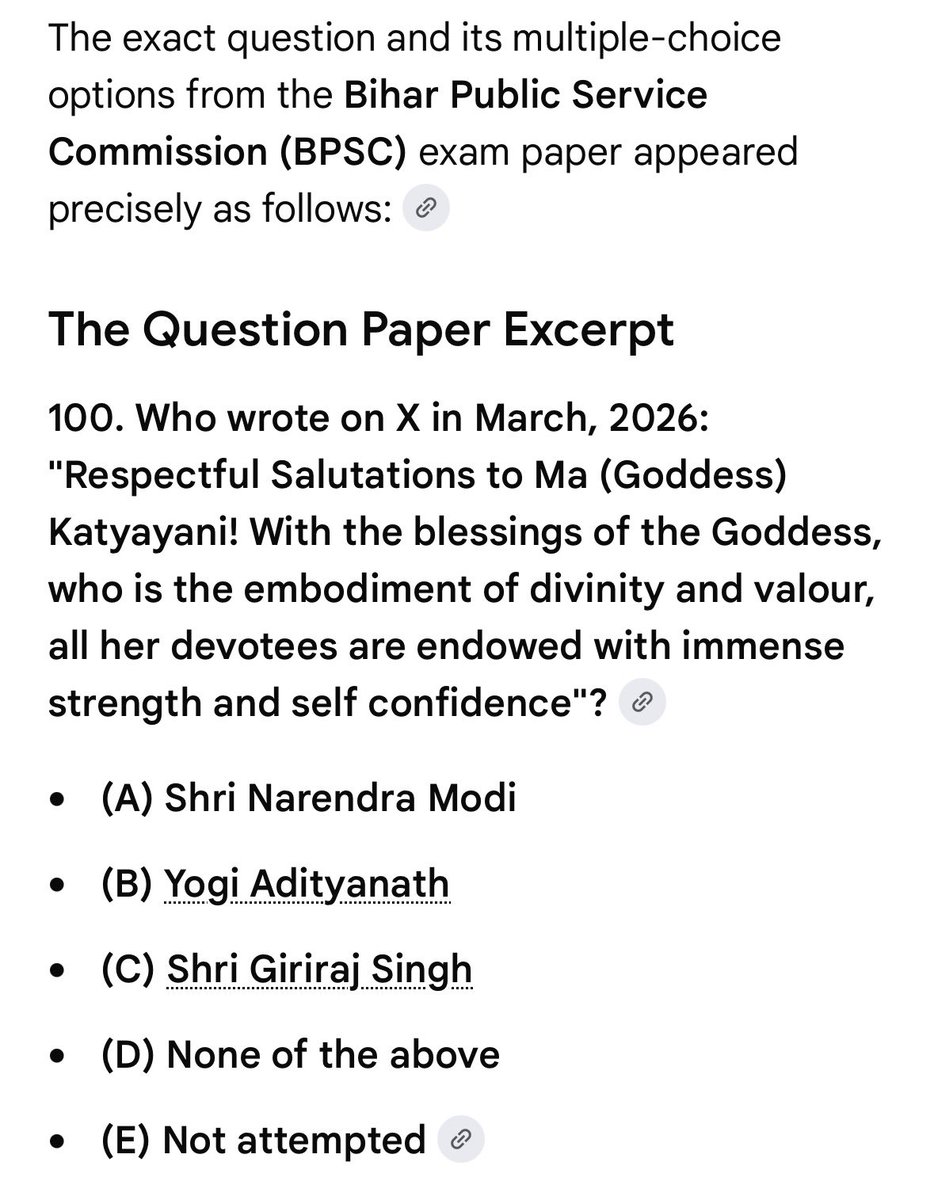
His @PriyankKharge concern on RSS is genuine. And this is also about the nation's security.
For example - An US researcher JA Curran in 1951 before election wrote a book on RSS. Here he whitewashed Godse's link with RSS.
Later it was revealed that Curran was a CIA agent. 🧵 1/8
For Israel, the Iranian issue has never been only about the nuclear programme. It has also been about the emergence of a large, populous, resource-rich, technologically capable regional rival at the centre of the Middle East.
Iran possesses attributes that no other regional state quite combines: A population of around 90 million.
A highly educated scientific and technical base.
Significant industrial capacity.
Vast oil and gas reserves.
Strategic geography linking the Gulf, Central Asia, the Caucasus and the Indian Ocean.
A deep civilisational identity and state tradition.
Even after decades of sanctions, war, and isolation, Iran has remained consequential.
The counterfactual is striking.
Had Iran not spent much of the last four decades under sanctions and geopolitical pressure, it might today resemble something closer to Turkey on a much larger scale, or perhaps even a Middle Eastern equivalent of a G20 power.
That is why many Israelis have long believed that sanctions were not simply a tool to constrain nuclear ambitions. They were also a means of limiting the emergence of a powerful regional competitor.
Now imagine a different future.
If sanctions are eased, oil exports resume, frozen assets are released, shipping normalises through Hormuz, and foreign investment gradually returns, Iran could regain significant economic momentum. Recent reporting suggests that any emerging US-Iran understanding may include substantial sanctions relief, particularly on oil exports and associated financial services.
For Israel, that prospect is strategically uncomfortable. Which explains the meltdown in Jerusalem.
For India, however, the calculus is different. India has never viewed Iran as a threat.
A stronger Iran does not automatically diminish India’s position.
Indeed, a reintegrated Iran could create opportunities for Indian trade, connectivity, energy security, and regional diplomacy.
That does not mean India would welcome an Iranian nuclear weapon or regional destabilisation. It would not.
But India has no structural interest in keeping Iran permanently weak. This is perhaps where Indian and Israeli interests diverge most clearly.
Israel’s ideal outcome has often been a non-nuclear, economically constrained Iran.
India’s ideal outcome is a non-nuclear, stable, economically integrated Iran.
Those are not the same thing.