You could literally just check Google trends, check what's printing in the next 3 months, open a Google store in that niche, start running ads every single day and make $300K in Q4.
Claude's watermark probably doesn't work how you think. As the CTO of GPTZero, I'll explain how Anthropic, Google and OpenAI are building text watermarking in this brief explainer and whether it can be defeated.
Almost all forms of watermarking that are fast and cheap enough for a frontier lab have the same formula, following the KGW method:
In generation:
1. Let's say you've generated n tokens so far. Take those n tokens + a secret key to generate a random hash
2. Use that hash to randomly reweight the probabilities for the n+1 token, and then sample from that new distribution. In the simple case, you could split 50% of all English words into a green or red set based on your hash, and boost the probability of words in the green set.
For watermark detection:
1. For each token, see if it was in the green or red set.
2. To do this, recreate the hash based on the secret key and the text preceding the current token. Then, recreate the green and red set of words.
3. Once you've checked all the words in the text, if the next token is selected disproportionally from the green set more than 50% of the time, you claim the text has the watermark.
I can tell you want to ask the following:
1) Isn't it easy to mess up the hash if you paraphrase the text? The answer is mostly yes, however, you can use a statistical model to get your hash instead of a deterministic function (SIR, Adaptive Watermark). Since the entire watermark is probabilistic, this is fine.
2) Doesn't this make the text much worse? The answer is yes, it does - Yes, it does – but for most people, it's imperceptible (Google claims in human feedback study with 20,000 texts), since there are exponentially many ways to write the same paragraph. DiPmark does something more sophisticated to avoid shifting the text distribution on average. Of course, watermarks fail on short text or highly predictable texts like "2+2=4".
3) Shouldn't it be easy to figure out the green and red sets? The answer is no. You would need an exponentially large number of samples from the watermarker to reconstruct those sets exactly, but it's a risk if the detector is open to the wild (Watermark Stealing)
Still, there are couple challenges that a frontier lab needs to overcome:
1. Their watermark needs to work token-by-token because they are streaming their text to users. Many watermark methods plan sentences or paragraphs at a time, or change the text after its entirely written, in order to make their watermark robust to paraphrasers, and a frontier lab cannot afford to do this yet (SemStamp, PostMark)
2. If the secret key leaks, the watermark is busted. To avoid a large blast damage from this, you need to have a couple secret keys in rotation.
3. There are some texts, like code, that cannot be arbitrarily changed, otherwise the code will break. In those cases, the watermark needs to selectively change words in parts of the text that can tolerate synonyms (i.e. like variable naming) - see SWEET, EWD, Invisible Entropy.
4. They will need to educate their users on how to deal with false positives and false negatives of a detector, which is a big challenge (one we put a lot of effort into)
So, how do I see this playing out in the next 6 months?
1. If Anthropic releases the watermark detector publically, I think they defeat their own watermark. People find reliable watermark removal strategies by testing against Anthropic (AI detectors like GPTZero have an advantage here because they can train against these adversaries once they become popular).
2. If they keep the detector private to the government, like Google has done, it's "safer". However, there are some papers showing trained approaches that work robustly to zero-shot break watermarks without any data, simply because they try to write the text just like a human (Zhang et al. 2024, Watermarks in the Sand). Also, making your detector makes it battle-tested and stronger long-term (my experience).
3. In my testing, the watermarks don't survive intense paraphrasing (especially if you combine word choice and syntax attacks), or human text substitution (rewrite your AI text by plagiarizing human authors). The free paraphrasers I've tried have quickly bypassed Google Deepmind's SynthId for what it's worth.
4. All-in-all, frontier labs are likely okay with this because they expect most users to not attack the watermark, and also because they + European regulators likely don't care past a certain point - its good enough.
5. Overall, I think users of frontier LLMs will not really care about this, because 1) they don't realize watermarks are there, 2) EU will force everyone to conform, 3) this seems more like regulatory hoop-jumping than an earnest effort from frontier labs to expose LLM use
Lastly, people's first concern shouldn't be watermarking, it should be AI detectors!
If you're posting, "its not X, its Y!!", I don't think the watermark is going to make a difference :)
Sarah who built a $340K/month app in just 60 days, says: the viral save-bait trick is almost too simple: tell people to repeat for seven days, and they'll save your video, feeding the algorithm exactly what it wants...
"When someone saves the video, then it increases engagement. There you go. And in general, this is very savable content, right? People want to like listen to an affirmation another day."
"If you can make content that naturally gets shares or saves, that's going to make it go viral every time."
We struggled for a whole year
to get to $150k/mo
to make a product loved
by our users.
4.9 stars out of 45,000 ratings.
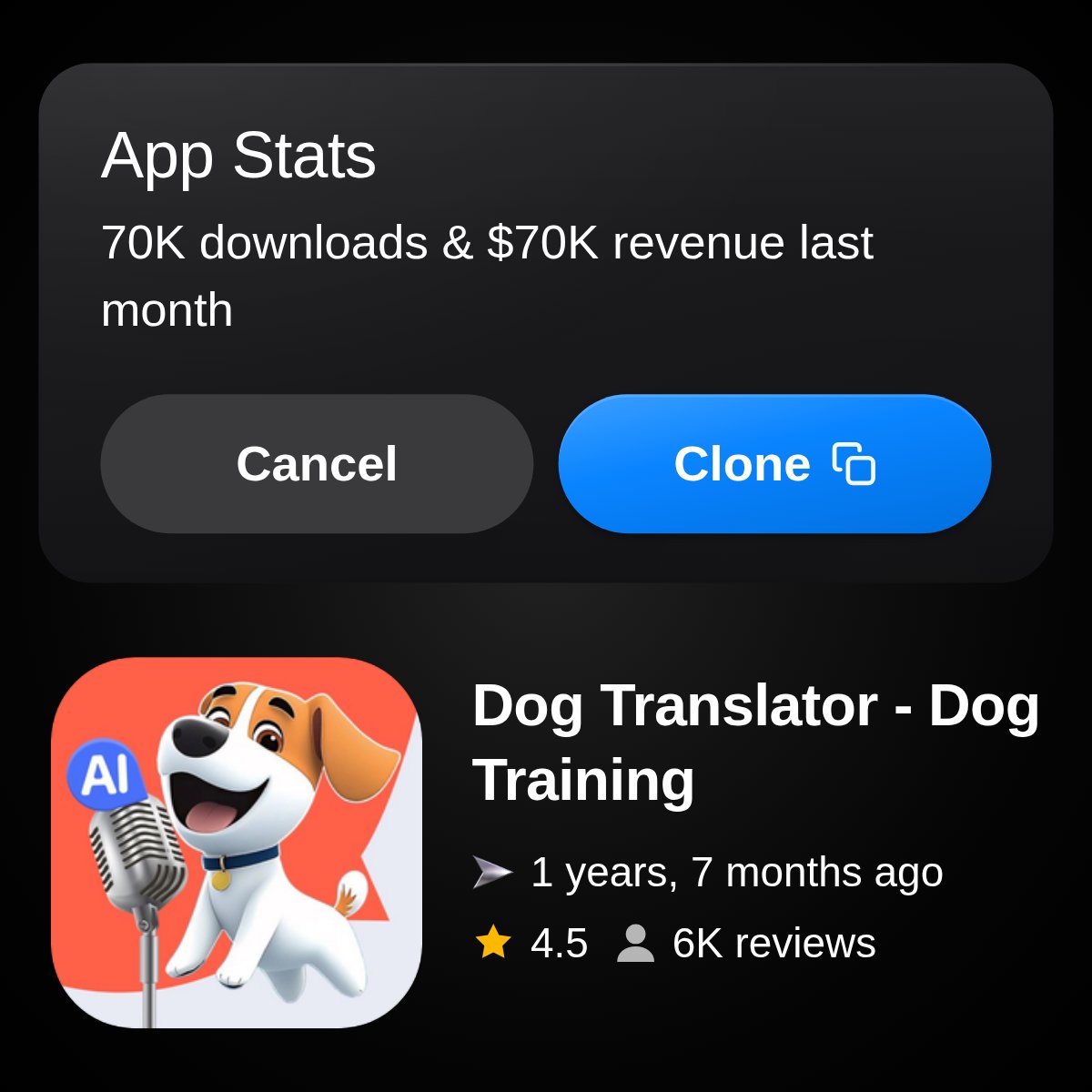
meanwhile theres a Dog translator app
non-chalantly making $70,000/mo
My tweets alone already reveal enough sauce to launch an app and get it to 100k MRR
I literally covered how to find the correct idea and how to get distribution, you don't need anything else
You just have to relentlessly execute it
I can confirm it worked.
Here’s another paywall version you can test if you’re aiming to grow your app to $10k MRR:
• $12/week
• $39/3 months
• $99/year
Not saying it’s the perfect setup for every app, but it’s worth A/B testing. Pricing often has a much bigger impact than people expect.
New in Claude Cowork: teach Claude a skill.
Record your screen while you do a task, talk through it as you go, and Claude turns it into a skill it can run again. Find it under Record a skill in the + menu of the Claude desktop app.
Available on Pro, Max, and Team plans.
Claude Code on desktop now works with the iOS simulator.
Build and run your iOS app, and the simulator opens in a panel right next to your conversation. Available today in public beta.
Introducing Honen
Turn your company context into interactive courses that self-improve over time
We partnered with NVIDIA to bring AI literacy to 250,000 learners
We're ensuring no person or company gets left behind
Get started at https://t.co/lXLZKgr8N5
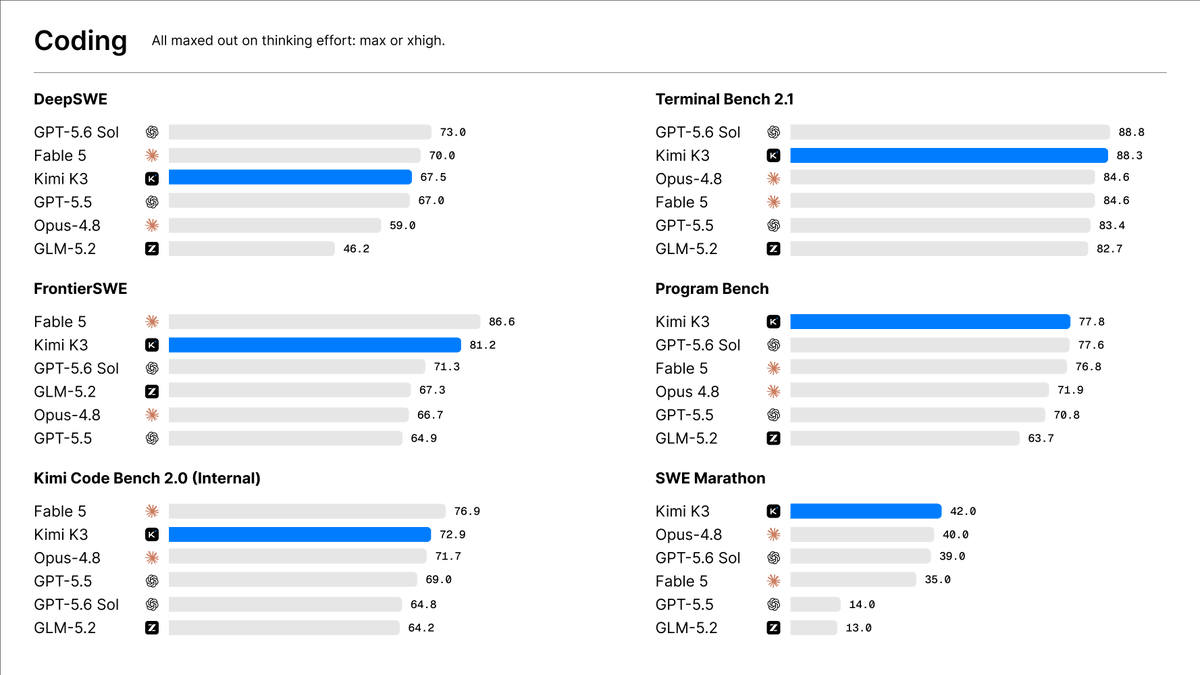
Introducing Kimi K3: Open Frontier Intelligence
🔹 2.8 Trillion Parameters, 1 Million Context, Native Multimodal
🔹 Kimi Delta Attention enables up to 6.3x faster decoding in million-token contexts
🔹 Attention Residuals deliver ~25% higher training efficiency at <2% additional cost
🔹 Built for long-horizon agentic coding and self-evolving workflows
Kimi K3 is now live on on https://t.co/zrk6zZxZUo, Kimi Work, Kimi Code, and the Kimi API.
Open Weights by July 27, 2026.
🔗 API: https://t.co/XCrgjXAqMw
🔗 Tech blog: https://t.co/YTfiMSNM1f
Making multiple apps is a
permanent mistake
I made this mistake 1 year ago
made like 12 apps
it split my focus too much.
theres so much to optimize
in 1 single app
and no time to be thinking about another one.
Just to name a few things:
→ Day 1, 7 , 30 retention
→ Onboarding completion rate
→ Conversion rate at paywall
→ Trial conversion rate
→ ARPU ( test best pricing )
→ CPA on ads ( tied to product )
→ Web funnels
→ Profit margins
→ UGC deals
→ Organic marketing systems
→ Team culture
and so much more.
there are infinite things to do with 1 app
making $10 - $20k/mo means nothing
because once said apps stop
running ads,
They will go to $0
and at that point you are not building an app that’s just a cash grab,
might as well pack it up and start drop shipping
so focus on 1 app, and make it generational.
thats the only way this business model makes sense.