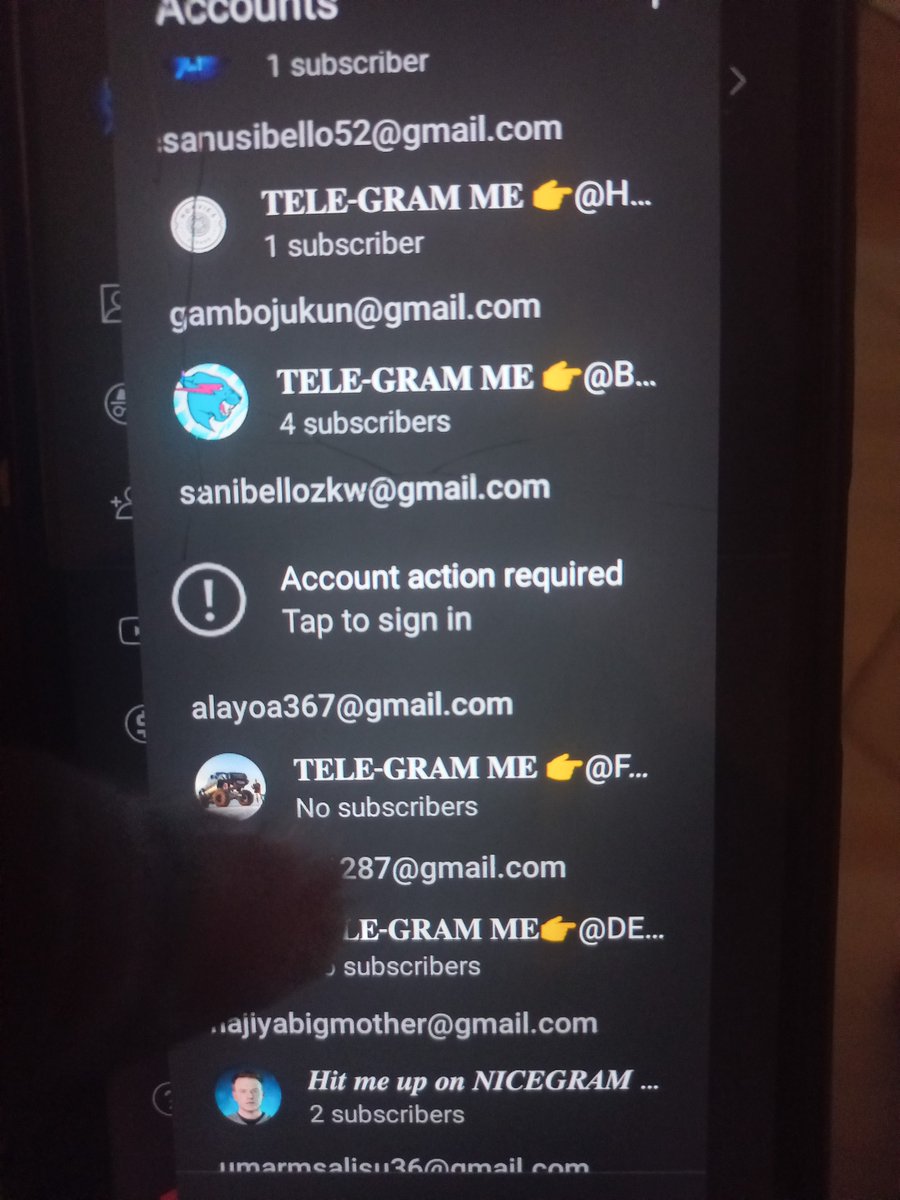
1/ Meet Kemi, He’s a Nigerian scammer who impersonates YouTubers like @MrBeast, @airrack, and even me.
He tried to scam me......but instead of paying him money, I hacked into his laptop and turned on his live webcam feed.
WTF 🚨 The Telsa Roadster just defied gravity by hanging upside down, then LAUNCHING off a ramp did a 180 in the air and levitated to the ground...
What did we just watch 👀
Gèlè is Gèlè. Names are how a culture keeps credit for what it made. Lose the name, and in one generation nobody remembers where it came from. #GeleIsGele
THIS IS THE MOST IMPORTANT POST YOU'LL READ TODAY.
This week, someone lost $6.6 Million in Ledger wallet drain.
He bought the dip, didn't panic sell, and then one wallet switch cost him all 80 $BTC.
Most drainers need your wallet to be online or need you to sign something you didn't read.
So here's how to set up a wallet on a spare iPhone that goes online once and never again.
1. Buy a new, sealed iPhone
The cheapest model works. Buy it from a store, never secondhand. A used phone could be tampered with before it reaches you.
2. Make a new Apple ID
Use it only on this phone. If your main Apple ID ever gets hacked, this phone stays out of it.
3. Turn off Face ID and Touch ID
Use a long passcode with letters and numbers. Face ID can be unlocked by holding the phone up to your face, even against your will.
A 6-digit code can be cracked in about a day. A 10+ character one would take thousands of years.
4. Turn on Lockdown Mode
Settings > Privacy & Security > Lockdown Mode. It switches off the features spyware usually uses to break in.
Also, in your passcode settings, keep USB accessories switched off. That stops the charging port from passing data while the phone is locked.
5. Download the wallet app
On your home WiFi, download an offline wallet app that signs with QR codes. Pick one that's open source. This is the last time the phone goes online.
6. Cut every connection
Remove the SIM and delete any eSIM. Turn on Airplane Mode. Turn off WiFi and Bluetooth. Leave it like this forever.
7. Create your wallet
Write the 24 words on paper or steel. Never take a photo of them, and never type them anywhere.
If the phone dies, those words are how you get your coins back.
8. Move coins with QR codes
On your normal phone, install that wallet's watch-only companion app. It can see your balance but can't spend anything.
To send coins, it shows a QR code. Scan it with the offline iPhone, check the details, and approve. The iPhone shows a QR back. Scan that with your normal phone, and the transaction goes out.
Your keys never leave the offline phone.
9. Store it switched off
Turn it fully off before putting it away. A switched-off iPhone is much harder to break into.
Every few months, charge it to about 50%. A battery left dead for years can get ruined.
It takes one afternoon. After that, your keys never touch the internet again.
Save this for later.
People must come to understand that many of the supposedly objectionable aspects of African traditional religions that critics like to single out are often more a reflection of the socioeconomic conditions surrounding their practice than of the philosophical essence of the religions themselves. I would argue that the hostility directed at Yoruba religion, in particular, is not always philosophical or theological. A significant part of it has to do with the socioeconomic environment in which the religion is encountered.
Yoruba religion has a rich philosophical tradition, a sophisticated cosmology, and a deep cultural heritage. Look at how Yoruba-derived traditions have evolved in Brazil, where they have, in some contexts, been syncretised with Christianity and developed into compelling, publicly visible religious cultures. Their rituals are visually striking, their ceremonies and communal gatherings can be deeply expressive, and their festivals, music, dress, and surrounding environments can make the tradition culturally attractive even to people who do not share its spiritual convictions.
This raises an important question: how much of our perception of a religion is shaped by its underlying philosophy, and how much is shaped by the material conditions, social environment, and cultural aesthetics through which we encounter it? The same religious tradition can be perceived very differently depending on whether it is encountered in an environment characterised by deprivation and social decay or one associated with cultural confidence, material prosperity, and public celebration.
Perhaps the broader point is that poverty can make almost anything look unappealing, including religion. When multidimensional poverty intersects with virtually any ideology, institution, or worldview, the outcome can be difficult to admire, and the addition of a spiritual dimension does not automatically change that. Deprivation can diminish the public expression of a culture, undermine its institutions, and distort how outsiders perceive its values.
None of this means that traditional religions should be exempt from philosophical scrutiny or that every criticism of them is merely socioeconomic prejudice. It means that we must learn to distinguish between a religion’s underlying intellectual and spiritual content and the material circumstances in which its adherents practise it. Otherwise, we risk mistaking the visible consequences of deprivation for the inherent deficiencies of an entire religious tradition.
Some meals are more than food; they're home, culture, and memories. 🥹💚 Afang soup will always have a special place in my heart.
Afang Soup Recipe
water leaves
Cooked beef
Epkoroko/stock fish
Crayfish
Palm oil
Meat stock (well seasoned, if not use seasoning cubes and adjust for seasoning when needed)
Afang
Snails
More crayfish
More palm oil
Smoked fish