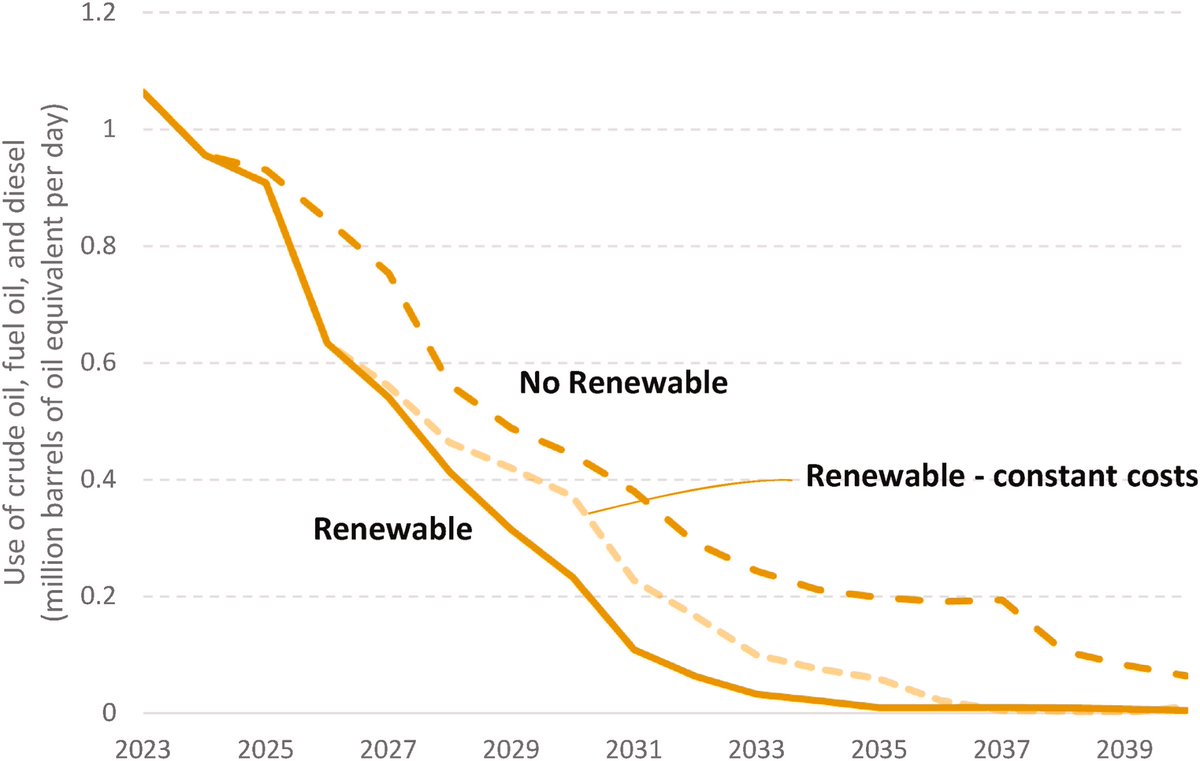
Oil use by Saudi utilities and industry will be primarily displaced by natural gas and renewable energy.
The easiest oil to displace will happen first. Then, as the marginal effort to displace oil rises, the pace of displacement will slow.
Source: https://t.co/JRW8CgGqF3
#oott
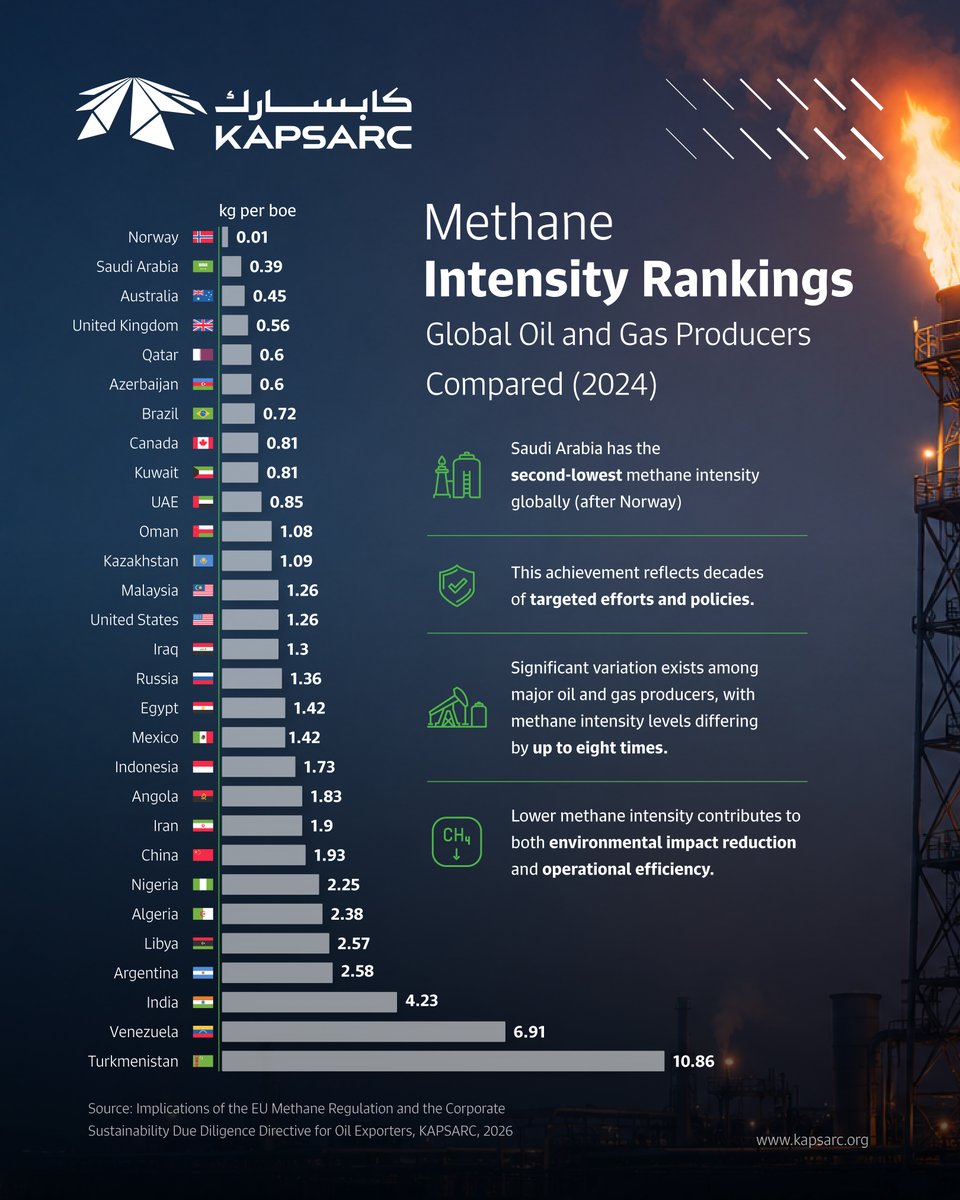
The fact that Saudi Arabia, Kuwait, and the UAE are reducing oil production means that the closure of the Hormuz Strait is removing some of the world's low-methane-emitting oil from the market.
#oott#climatechange
Methane intensity varies significantly across major oil and gas producers, by up to eight times between comparable countries.
This chart ranks 29 producers by methane intensity (kg per barrel of oil equivalent). Norway leads at 0.01 kg/boe, followed by Saudi Arabia at 0.39, Australia, and the United Kingdom.
As the EU's Methane Emissions Reduction Regulation (MERR) and Corporate Sustainability Due Diligence Directive (CSDDD) take effect, these differences will have growing implications for market access and competitiveness.
#KAPSARC examines what these EU regulations mean for major crude oil exporters.
Read the full paper: https://t.co/ks4dsVuGzR
During this legislative session the LSU Energy Institute was formally incorporated into Louisiana statute. The Energy Institute is now LSU’s long-term home for energy-focused research, public engagement, & applied analysis.
Follow us on our new social media channels!
Building something that is difficult to replicate takes time. While each additional feature may involve a manageable marginal effort/cost, the cumulative effect of many incremental improvements can create a barrier to replication.
Then, you’d have built something truly valuable.
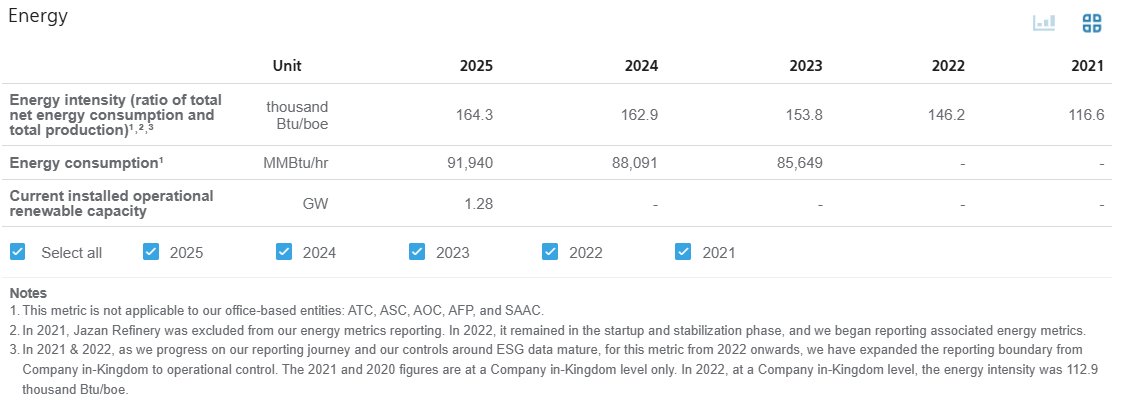
Aramco's data show that its energy intensity in 2025 was 164.3 thousand Btu per boe of oil and natural gas produced.
This means Aramco used approximately 0.028 boe of energy to produce 1 boe of oil and gas, up from 0.020 boe in 2021.
This 2017 paper finds that U.S. shale oil output may have permanently made oil markets more competitive: https://t.co/hezshyY1py.
Since, U.S. shale oil production has expanded, Qatar and the UAE have left OPEC, and OPEC+ has been formed. Has the market become more competitive?
Switching 48 million liters of diesel to LPG requires ≈72 million liters of LPG. It appears @TanmiahFood may not have accounted for that. Actual CO₂ reductions would be closer to 20,000 t/yr.
The 60,000 tCO₂ figure would only hold if 48 million L are assumed for LPG, as well.
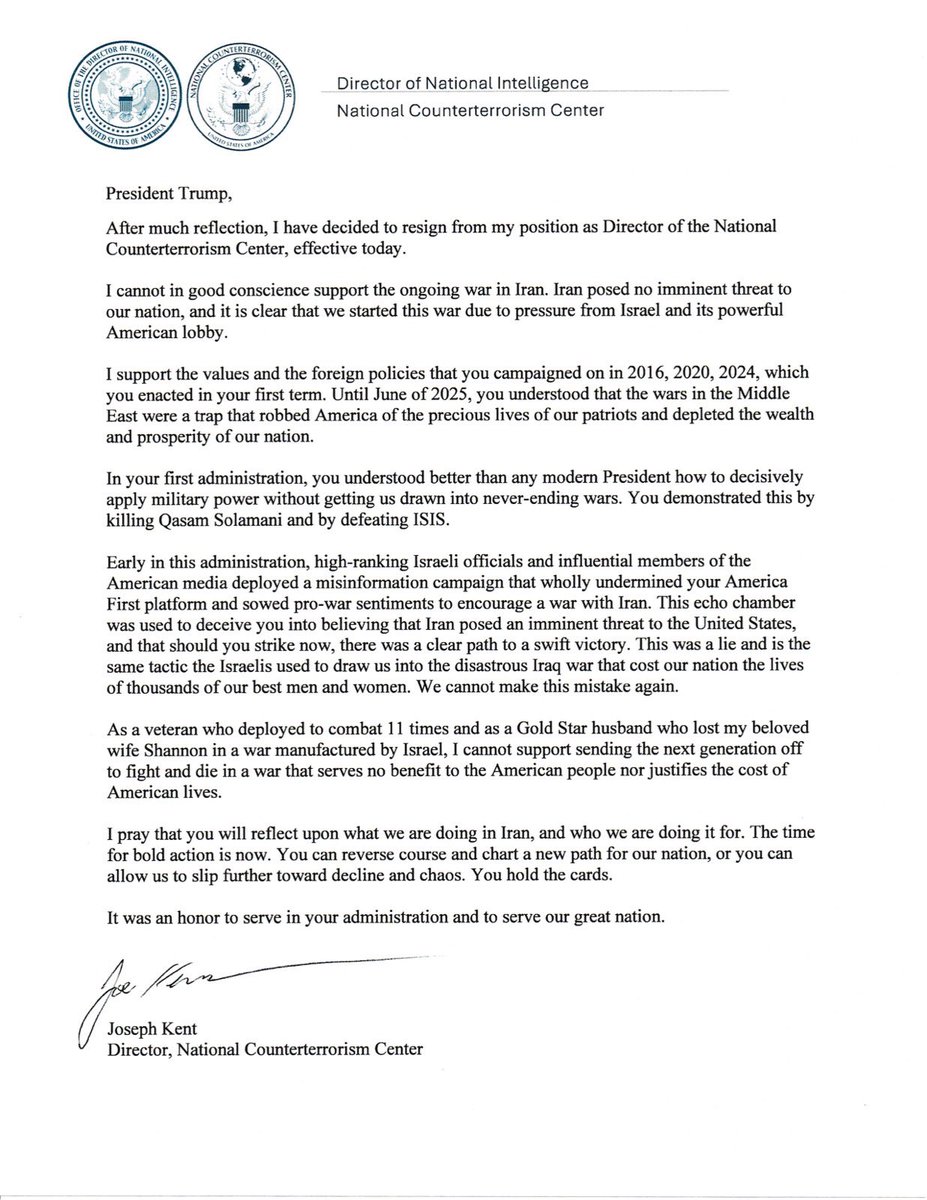
After much reflection, I have decided to resign from my position as Director of the National Counterterrorism Center, effective today.
I cannot in good conscience support the ongoing war in Iran. Iran posed no imminent threat to our nation, and it is clear that we started this war due to pressure from Israel and its powerful American lobby.
It has been an honor serving under @POTUS and @DNIGabbard and leading the professionals at NCTC.
May God bless America.
Aramco’s upstream carbon intensity was 10 kgCO2/boe in 2025. It was 9.1 in 2018. The rise is attributed to the expansion of natural gas.
The company is sticking by its 2035 target of 7.7 kgCO2/boe, which will be achieved by less flaring, carbon capture, and better monitoring.
Further, Aramco managed to reduce natural gas flaring by *up to* 1.3 billion scf (standard cubic feet) in 2025. This was mostly at the Hawiyah Gas Plant in Alahsaa area of Saudi Arabia.
Aramco’s upstream carbon intensity was 10 kgCO2/boe in 2025. It was 9.1 in 2018. The rise is attributed to the expansion of natural gas.
The company is sticking by its 2035 target of 7.7 kgCO2/boe, which will be achieved by less flaring, carbon capture, and better monitoring.
Physical laws and economics interact with one another all the time. In these papers, the author tries to embed an economic agent (that allocates funds given its preferences) inside a physical building energy model.
https://t.co/TA9V5uhgZI
https://t.co/K87OxQxswe
@GerberKawasaki Not meaningless. Some of lowest-cost oil, gas, petrochemicals, and fertilizers exit from the Strait of Hormuz. It’s not just about the quantity that is lost. It’s also about the cost to produce that quantity relative to other producers.
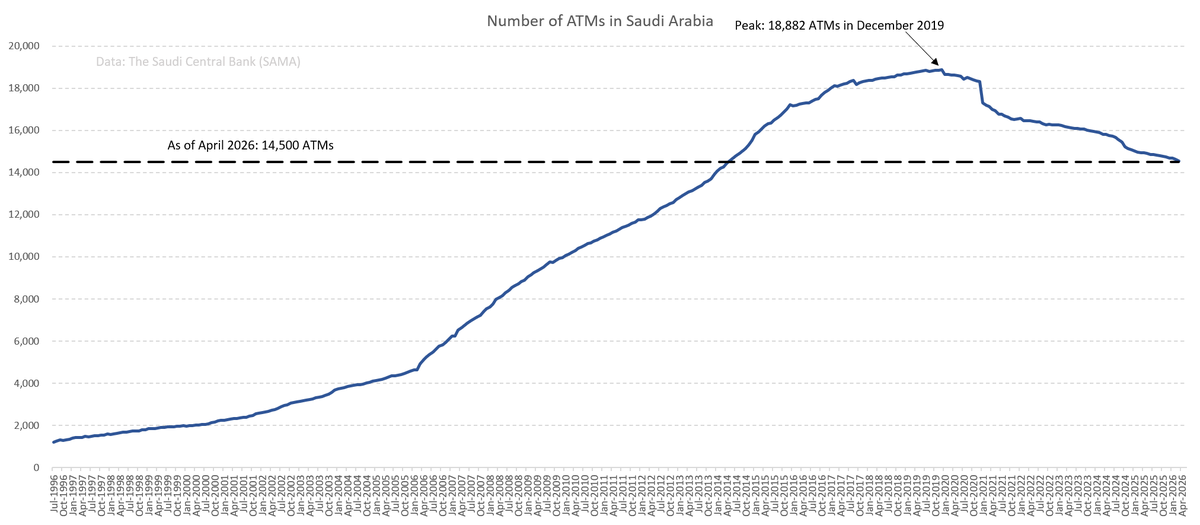
As cash usage gradually declines, so does the number of ATMs/cash machines in Saudi Arabia. In April 2026, there were 14,500 ATMs nationwide; the fewest since April 2014.