Hello X! We are Harvard FAS CAMLab #HarvardCAMLab
🏛Integrating humanistic inquiry with cutting-edge technology and design, CAMLab explores innovative, interdisciplinary ways of showcasing art and culture through multimedia storytelling.
💡More info: https://t.co/iXpOTTyxUS
CAMLab is pleased to announce our next Visiting Scholars in Dialogue lecture, “Stitching Sanctity: A Dunhuang Patchwork and the Refashioning of Authority in East Asian Buddhism,” featuring Wanni Wu. The talk explores how Buddhist patchwork transformed from an ascetic practice into a sacred visual form associated with religious and political authority.
⏰ November 20 (Friday), 12:00–1:30 PM ET
📍 Room 427, 485 Broadway, Harvard University, Cambridge, MA
🌍 Language: English
🎫 Free and open to the public. Only 20 spots available—register here: https://t.co/bHclrcrioM
In the Buddha’s life story, the bodhisattva retrieves a hempen shroud from a charnel ground, washes it, and stitches it into a “rag robe” (pāṃsukūla). Originally associated with death, impurity, and ascetic practice, patchwork gradually became a sacred visual form that could be reproduced and appropriated.
Dunhuang offers a vivid historical cross-section of this transformation. A patchwork textile from the Library Cave at Mogao (British Museum, MAS.856) consists of more than twenty fragments of brocade, gauze, and plain silk arranged in the seven-strip format of a monastic robe. Drawing on surviving textiles, monastic inventories, and chanted verses used to solicit clothing, this talk examines how the inherited practices of collecting and mending cloth could be adapted to local systems of robe solicitation, monastic administration, and devotional life.
From the ascetic tradition of rag robes in Indian Buddhism to luxurious robes and robe-shaped offerings preserved across East Asia, the talk explores how patchwork became a material means of consolidating religious and political authority. It also considers how written practices helped shape and sustain the sacred identities of these textiles.
Wanni Wu is a PhD candidate in Chinese Art History at Peking University and a Visiting Student (2026) at Harvard FAS CAMLab. Her research interests include medieval Chinese Buddhist art, as well as visual and material culture along the Silk Road.
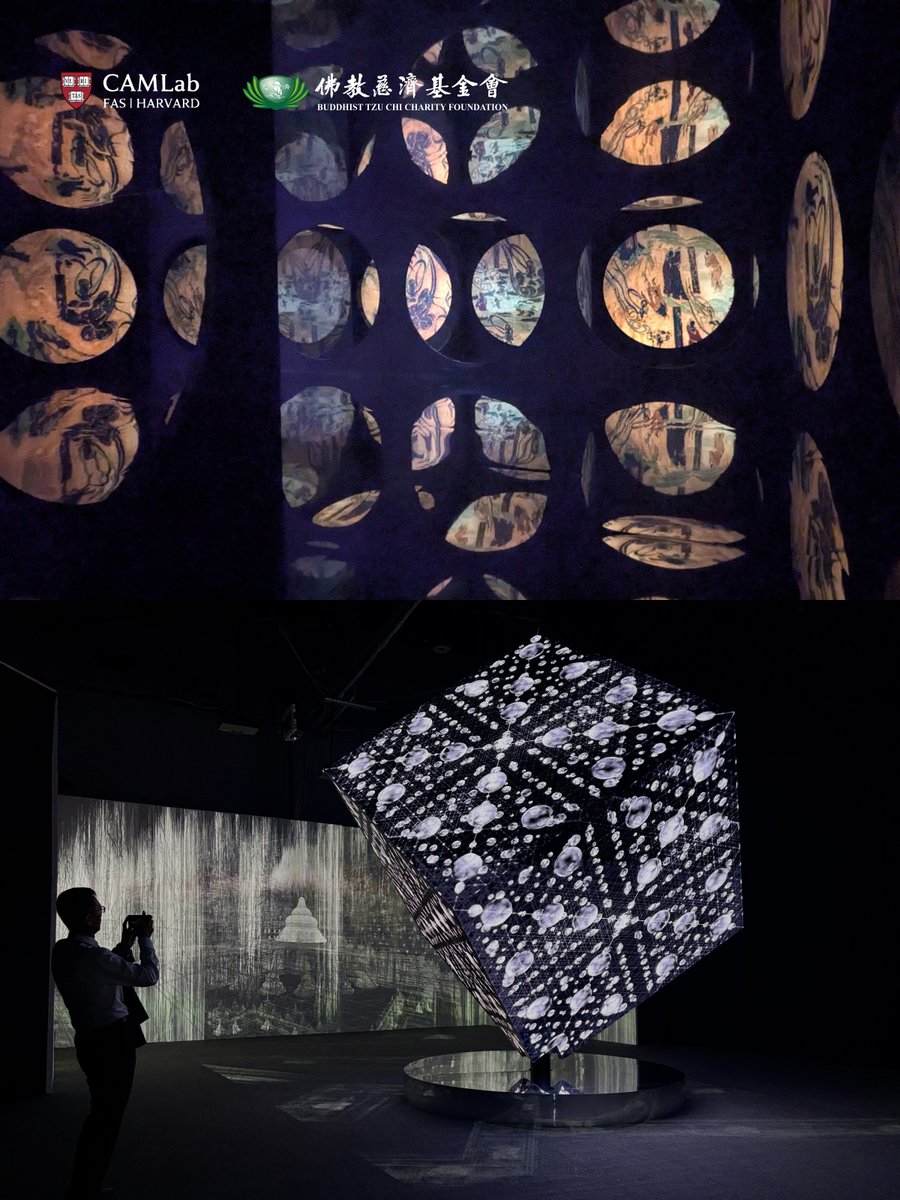
Last chance to experience “Journey to Enlightenment”! We invite you to this immersive journey through over 2,500 years of Buddhist art, history, and cultural heritage. Presented by Harvard FAS CAMLab and the Buddhist Tzu Chi Charity Foundation, the exhibition has been extended, with additional viewing dates through November 18!
Structured around eight thematic chapters spanning Buddhist sacred sites, artistic traditions, and philosophical thought, the exhibition traces the transmission and transformation of Buddhist culture across Asia. From the origins of Buddhism in India to the monumental architecture and artistic traditions of East and Southeast Asia, the journey brings together centuries of cultural history within a shared experiential space.
Through immersive projection, spatial audio, and digital reconstruction, ancient architecture, sculptures, and murals unfold in new dimensions. Visitors move through environments where historical sites and artistic traditions are reinterpreted through light, sound, and space, offering new perspectives on the relationship between art, history, and lived experience.
From scripture to image, from image to space, the exhibition invites visitors to encounter Buddhist cultural heritage beyond conventional forms of observation, opening new possibilities for perception, reflection, and discovery.
📅 Extended Exhibition Dates: November 10–15 & 17–18, 2026
⏰ Hours: 9:00 AM–5:00 PM (last admission at 4:00 PM)
📍 National Science and Technology Museum, Kaohsiung, Taiwan
🎟️ Free admission. Please register through: https://t.co/a56dueTj9P
Harvard FAS CAMLab is pleased to present “Measuring the Cosmos: From Mandala to the Latent Space,” a multimedia exhibition featuring works by seven international artists that engage with pre-modern cosmological traditions and contemporary artificial intelligence. The exhibition opens on November 7 and runs through November 21, 2026, at CAMLab Cave.
To measure the world is to generate it. Across Buddhist, Islamic, and other Asian traditions, astronomical, geomantic, and architectural calculations were never treated as neutral descriptions, but as ways of bringing a world into being. The Islamic astrolabe turns the sky into calculable coordinates. The Chinese revolving lantern sets a painted world in motion by heat and light.
Artificial intelligence performs that same operation today, under the sign of technical neutrality, occluding what these traditions held in full view. A generated image is the visible surface of a much larger, invisible act of measurement. Every time a machine learns, it measures: embeddings compute distance, loss functions minimize error, latent spaces propose coordinates that behave as worlds. A trained model is a cosmogram, an object that maps the universe and, in the same gesture, generates one.
The exhibition unfolds in three parts: “Apparatus of the Cosmos,” “The Measuring Body,” and “Cosmology of the Latent Space,” exploring the relationships between measurement, image generation, and cosmology.
Dates: November 7–21, 2026
Hours: Friday–Sunday, 11:00 AM–4:00 PM ET
Opening: November 7, 2:00–6:00 PM ET
CAMLab Cave, Lower Level, 485 Broadway, Harvard University, Cambridge, MA
Free and open to the public. To sign up for the opening reception, please visit: https://t.co/S9PUmKrOaM
For exhibition visits, please sign up through: https://t.co/NSDqogleMd
Opening Program | November 7
2:00 PM — Doors Open
2:30 PM — Opening Remarks
3:00 PM ��� Artist Remarks
3:30 PM — Live Performance by Maria Takeuchi and Alec Fellman
4:30 PM — Reception
6:00 PM — Closing
Harvard FAS CAMLab is pleased to announce our next Visiting Scholars in Dialogue lecture, “What Tea Made Visible: China, Knowledge, and Public Life, 1665–1914,” featuring Jing Sun. The talk explores the changing visual and social meanings of tea across three centuries of cross-cultural exchange.
⏰ November 13 (Friday), 12:00–1:30 PM ET
📍 CAMLab Cave, Lower Level, 485 Broadway, Harvard University, Cambridge, MA
🌍 Language: English
🎫 Free and open to the public. Only 20 spots available—register here: https://t.co/bHclrcrioM
What connects a seventeenth-century European engraving of a Chinese tea plant with a Chinese-style tea house associated with American women's suffrage in the early twentieth century? Drawing on botanical illustrations, European paintings of tea drinking, Chinese export paintings of tea production, and American political imagery, this talk examines how tea became more than a commodity traded around the world.
Tea also served as a means through which Europeans came to know and imagine China, and through which social identities and forms of public life were represented. Bringing together images and practices from different historical moments, the talk asks what tea made visible, to whom, and how it helped shape knowledge, sociability, and public life.
Jing Sun is an Associate Professor in the School of Humanities at Tsinghua University and a Visiting Scholar at Harvard FAS CAMLab. Sun holds a PhD in Art History from Leiden University. Sun's research focuses on art history, aesthetics, and visual culture, with particular interests in cross-cultural artistic exchanges and the relationships between art, knowledge, and society, especially between China and Europe from the sixteenth to the nineteenth centuries.
#HarvardCAMLab #AcademicTalk #Cambridge #HarvardUniversity #VSinDialogue
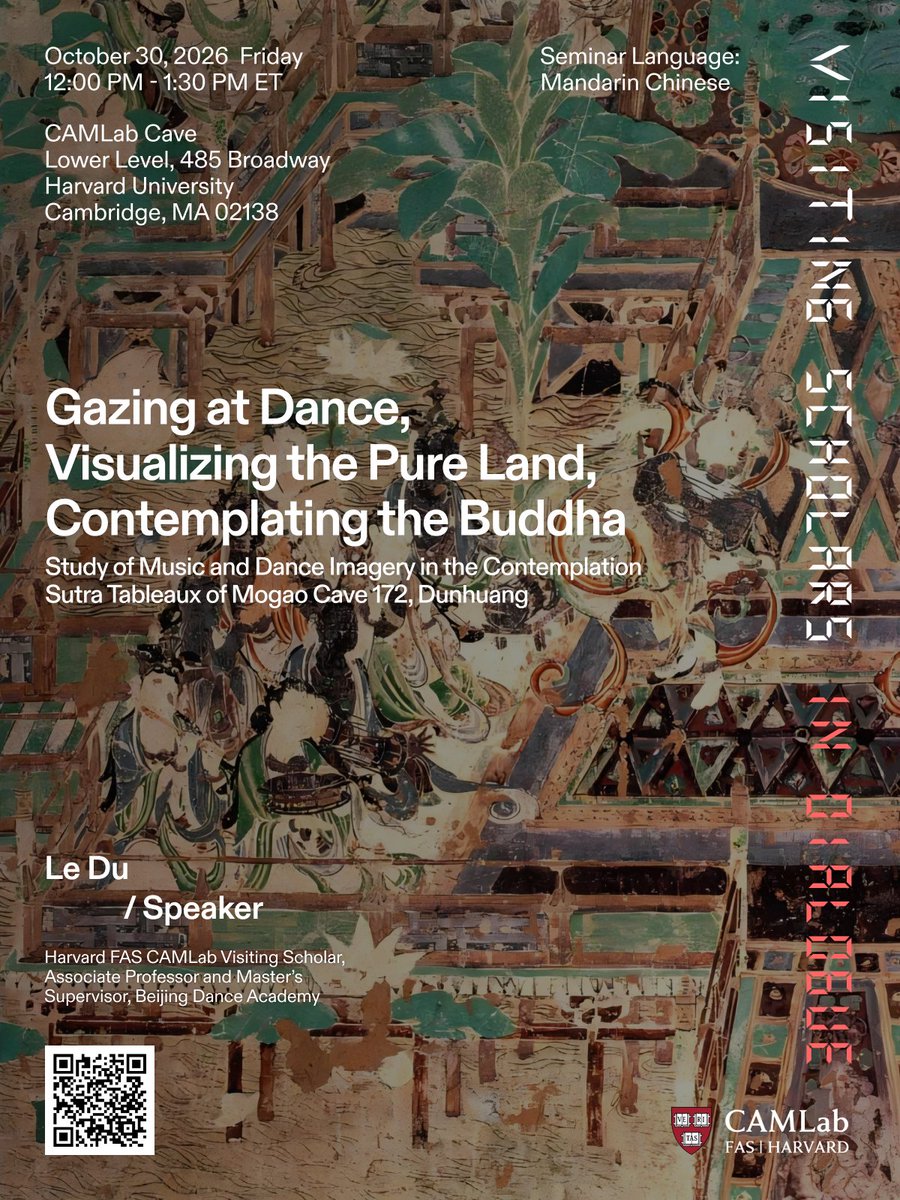
Harvard FAS CAMLab is pleased to announce our next Visiting Scholars in Dialogue lecture, “Gazing at Dance, Visualizing the Pure Land, Contemplating the Buddha: A Study of Music and Dance Imagery in the Contemplation Sutra Tableaux of Mogao Cave 172, Dunhuang,” featuring Le Du. The talk explores music and dance imagery in Chinese Buddhist art and its relationship to Pure Land visualization practices.
⏰ October 30 (Friday), 12:00–1:30 PM ET
📍 CAMLab Cave, Lower Level, 485 Broadway, Harvard University, Cambridge, MA
🌍 Language: Chinese
🎫 Free and open to the public. Only 20 spots available—register here: https://t.co/bHclrcrioM
Buddhist precepts include the rule “not to sing, dance, or perform, nor go to watch or listen to such performances.” Yet the murals of the Mogao Caves at Dunhuang depict music and dance in abundant and splendid forms. In Pure Land practice centered on visualization, what meaning does the dancing body hold?
Taking the Contemplation Sutra tableaux of Mogao Cave 172 as a case study, this talk draws on Buddhist scriptures, music and dance imagery, and cave space to examine how music and dance are visually presented within the depicted Pure Land and how they relate to the practice of visualization. Drawing on the Contemplation Sutra’s teaching that “this mind becomes the Buddha; this mind is the Buddha,” the talk further explores the relationship between music and dance as a sensory medium and the cultivation of the heart-mind, reconsidering their religious and humanistic significance in Chinese Buddhist art.
Le Du is an Associate Professor and Master’s Supervisor at Beijing Dance Academy and a Visiting Scholar (2026–2027) at Harvard FAS CAMLab. She holds a PhD in Philosophy from Peking University. Her research and teaching focus on the history, culture, and thought of ancient Chinese dance and music.
#HarvardCAMLab #AcademicTalk #Cambridge #HarvardUniversity #VSinDialogue
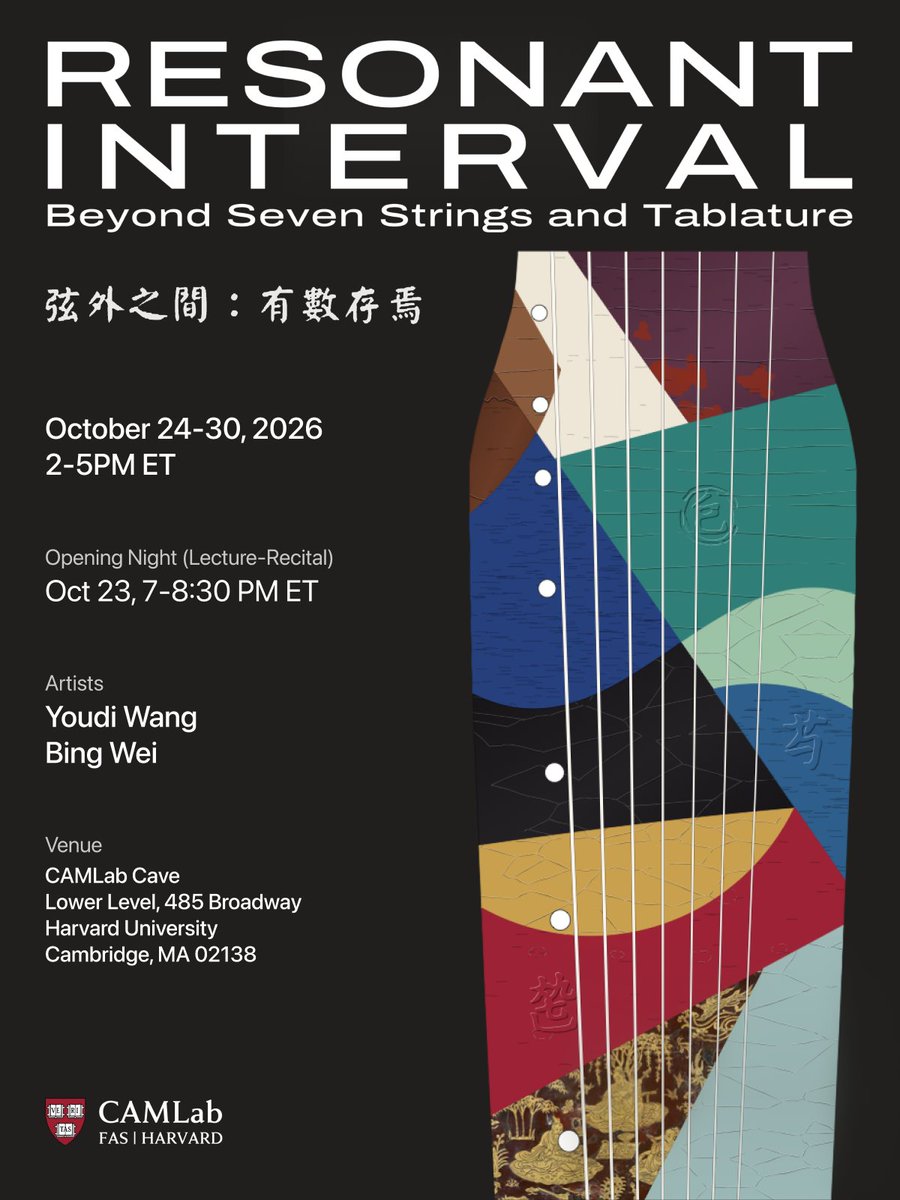
Harvard FAS CAMLab is pleased to present “Resonant Interval: Beyond Seven Strings and Tablature,” a pop-up exhibition jointly created by Youdi Wang and Bing Wei. Through interactive, immersive digital art, the exhibition explores civilizational continuity and the relationship between cultural transmission and new forms of creation in the age of artificial intelligence.
Opening Lecture & Guided Tour
October 23 (Friday), 7:00–8:30 PM
Exhibition Dates & Hours
October 24–30, 2026
2:00–5:00 PM
Visits outside regular exhibition hours are available by appointment. Please contact [email protected] at least one day in advance to arrange a visit.
📍 CAMLab Cave, Lower Level, 485 Broadway, Cambridge, MA
🎟️ Free and open to the public. The opening lecture and guided tour will be conducted in English. In-person seating is limited. Please register here: https://t.co/HDIDNoLV9T
The history of the guqin, the Chinese zither, reflects how a civilization sustains itself amid change. Its tablature preserves fingering while leaving rhythm and expressive proportion to the performer. Each interpretation allows the past to happen anew through another body, revealing how openness can sustain continuity.
Bringing ancient tablature, historical interpretation, contemporary performance, and AI generation into dialogue, the exhibition unfolds through layers of sound and moving image. Footsteps awaken the strings; stillness allows resonance to unfold. Visitors become part of this evolving experience, as their pauses and choices leave a new “score” that becomes the next visitor’s starting point.
Youdi Wang and Bing Wei are Visiting Scholars at Harvard FAS CAMLab (2026–2027). Wang is a guqin performer and Assistant Professor at the Xi’an Conservatory of Music. Wei is a curator and artist with PhDs in Engineering and Arts, and an Associate Professor at the Central Conservatory of Music.
#HarvardCAMLab #ResonantInterval #Guqin #DigitalArt #ImmersiveArt
CAMLab is pleased to announce our next Visiting Scholars in Dialogue lecture, “Making Landscapes through Painted Walls: Narrative, Space, and Viewing at Yongle Palace,” featuring Kang Huang. The talk explores the relationship between landscape, narrative, architecture, and viewing in fourteenth-century Chinese murals.
⏰ November 6 (Friday), 12:00–1:30 PM EST
📍 CAMLab Cave, Lower Level, 485 Broadway, Harvard University, Cambridge, MA
🌍 Language: English
🎫 Free and open to the public. Only 20 spots available—register here: https://t.co/bHclrcrioM
The fourteenth-century murals of the Chunyang and Chongyang Halls at Yongle Palace unfold the lives of Lü Dongbin and Wang Chongyang across more than one hundred scenes. Mountains, rocks, trees, streams, clouds, pavilions, and courtyards fill these painted worlds. Yet landscape here is more than scenery. Within the pictorial field, landscape organizes narrative: paths guide movement, axes structure encounters, and open grounds gather figures into shared events.
Across the walls of the halls, these painted landscapes extend beyond the image. Their scale, sequence, orientation, and relation to architectural elements shape how viewers move, pause, turn, and look. By shifting attention from the mural as an isolated image to the painted wall as a spatial medium, this talk explores how landscape is produced and experienced across image and architecture, situating these visual landscapes within a broader history of Chinese landscape and spatial practice.
Kang Huang is a PhD candidate in Architectural History and Theory at Tsinghua University and a Visiting Student (2025–2026) at Harvard FAS CAMLab. His research focuses on Chinese architectural history, landscape history, and spatial and visual culture. His work also contributes to heritage conservation and exhibition projects at sites including Yongle Palace and Kaihua Temple.
#HarvardCAMLab #AcademicTalk #Cambridge #HarvardUniversity #VSinDialogue
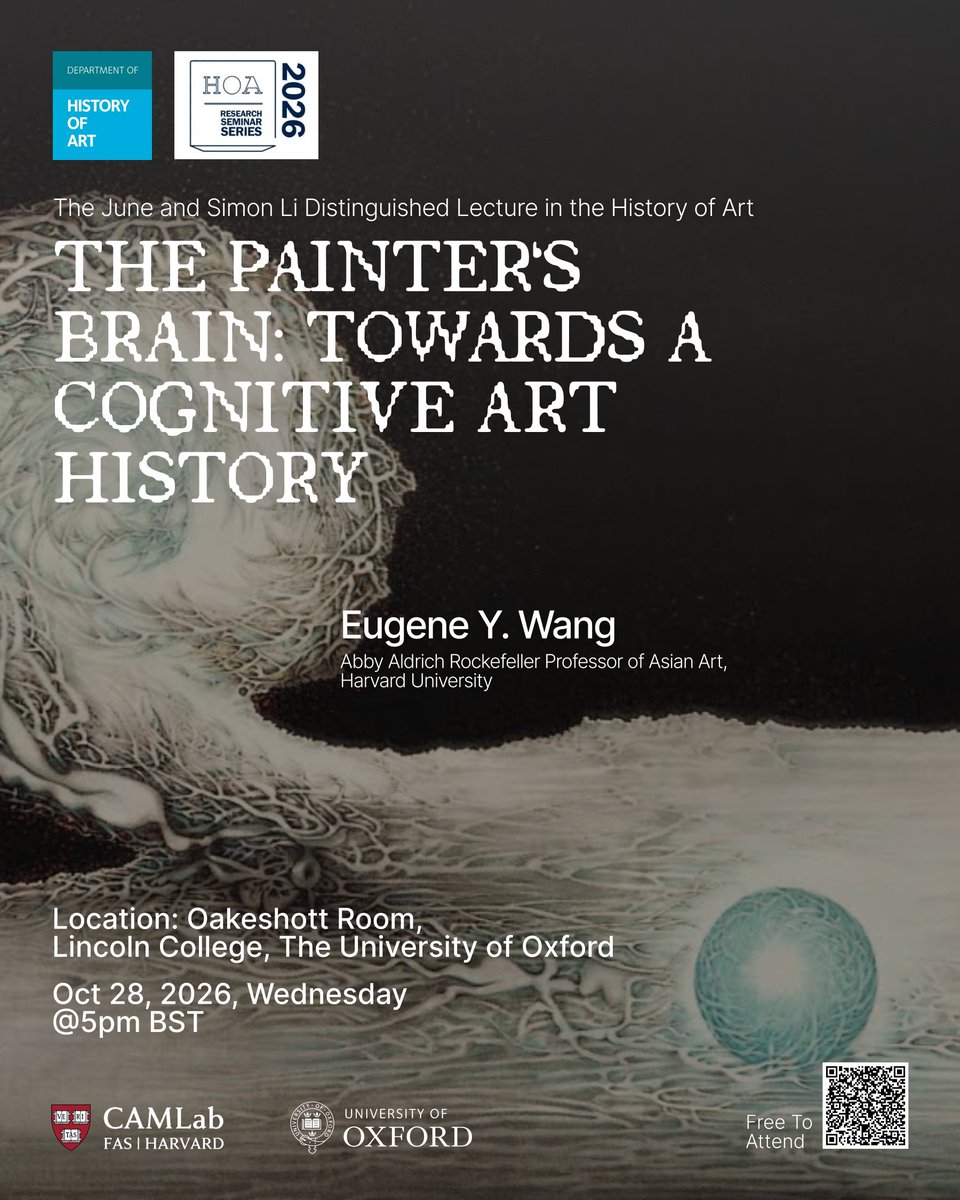
Please join us for “The Painter’s Brain: Towards a Cognitive Art History,” a lecture by Professor Eugene Y. Wang, Abby Aldrich Rockefeller Professor of Asian Art at Harvard University and Founding Director of Harvard FAS CAMLab. The lecture will take place at the University of Oxford on October 28, 2026, as part of the June and Simon Li Distinguished Lecture in the History of Art.
⏰ Wednesday, October 28, 2026, 5:00 PM GMT
📍 Oakeshott Room, Lincoln College, University of Oxford
🎟️ Admission: Free
It is rare for an artist to paint her own brain. Yet Irene Chou (1924–2011), a leading Hong Kong ink painter, did just that. Confronted with an X-ray confirming her diagnosis of cerebellar atrophy, Chou recognized within its branching patterns an image of her own life. Her artistic engagement with trees had begun decades earlier, through her practice of sketching “ten thousand trees” in Hong Kong’s forests.
In this lecture, Professor Wang traces how Chou’s evolving artistic practice weaves together calligraphic lines, meditative breathing, childhood memories, and modern brain scans. Through the lens of cognitive art history, he examines how her paintings challenge the notion of a self-contained individual, revealing instead a relational self in which the biological brain, technology, memory, landscape, and psychocosmic forces co-emerge.
Chou’s work offers a compelling example of how physical vulnerability and personal trauma can be transformed into an affirmative vision of resilience, healing, and becoming, opening new possibilities for cognitive art history and the New Humanities.
The lecture is presented by the University of Oxford’s Department of History of Art and generously supported by June and Simon Li.
#HarvardCAMLab #CognitiveArtHistory #ArtHistory #UniversityOfOxford #NewHumanities
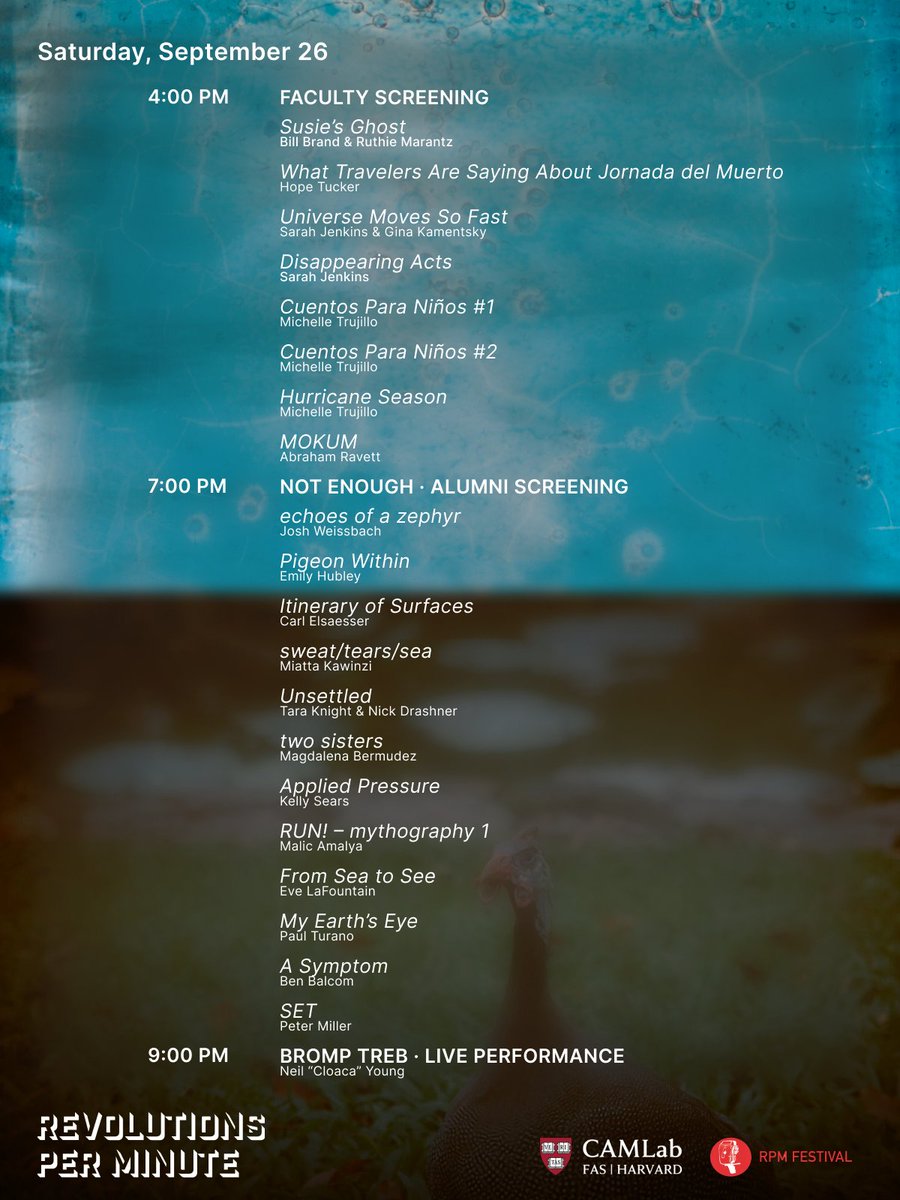
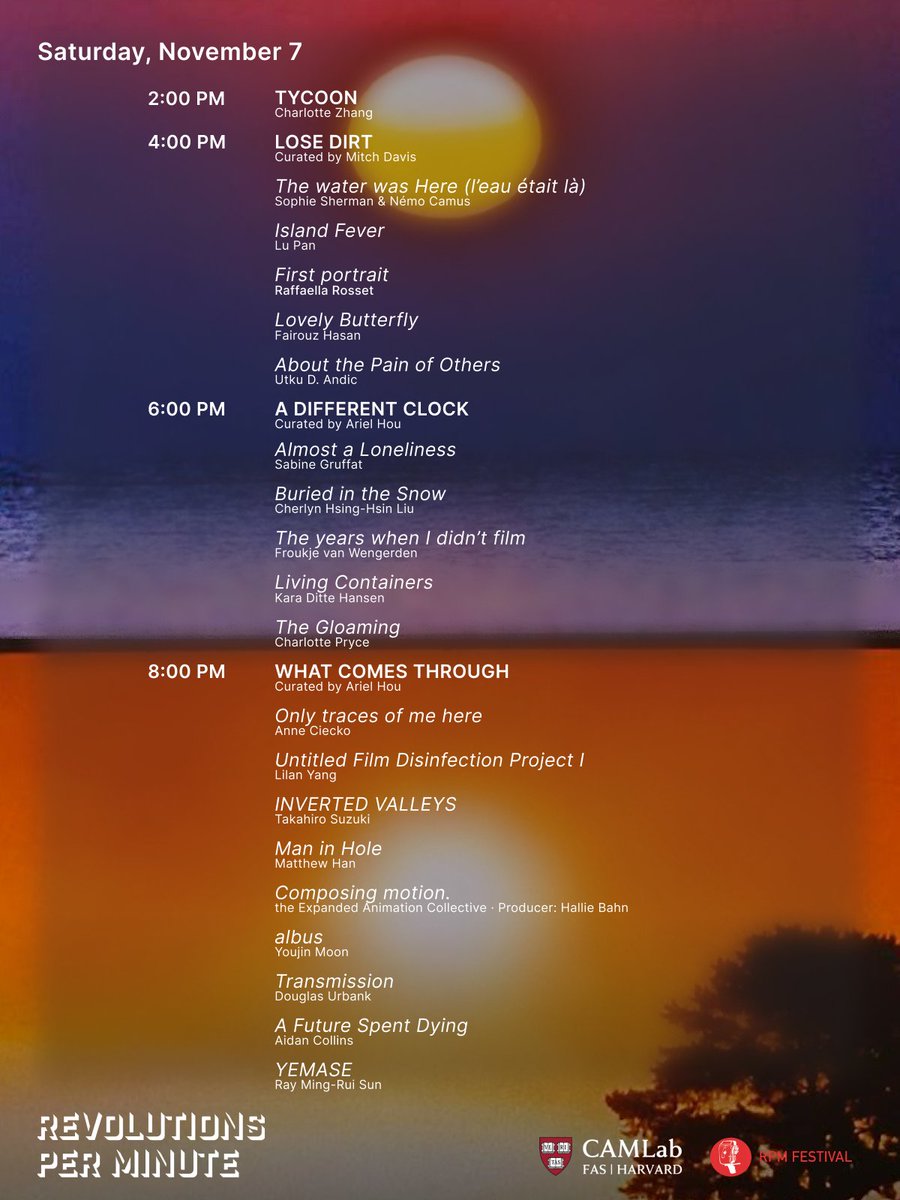
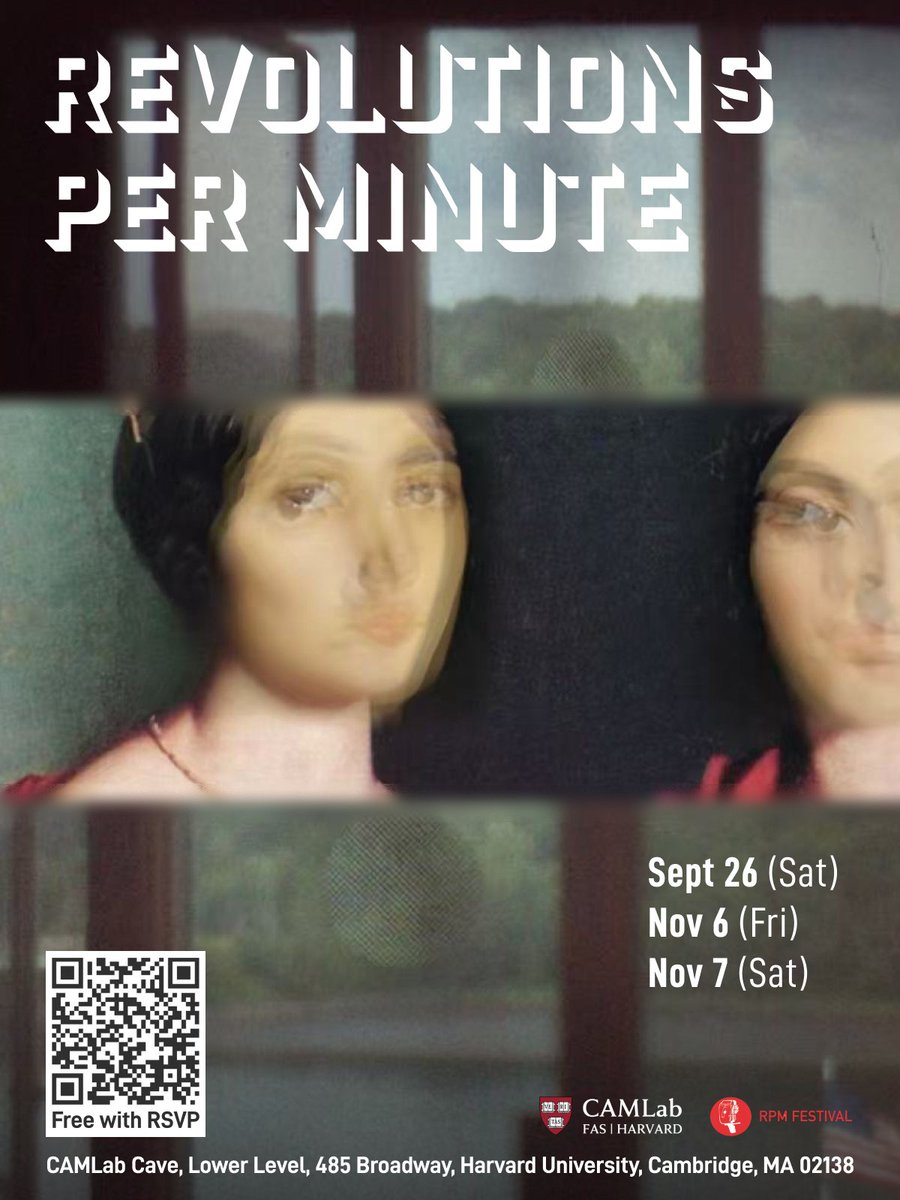
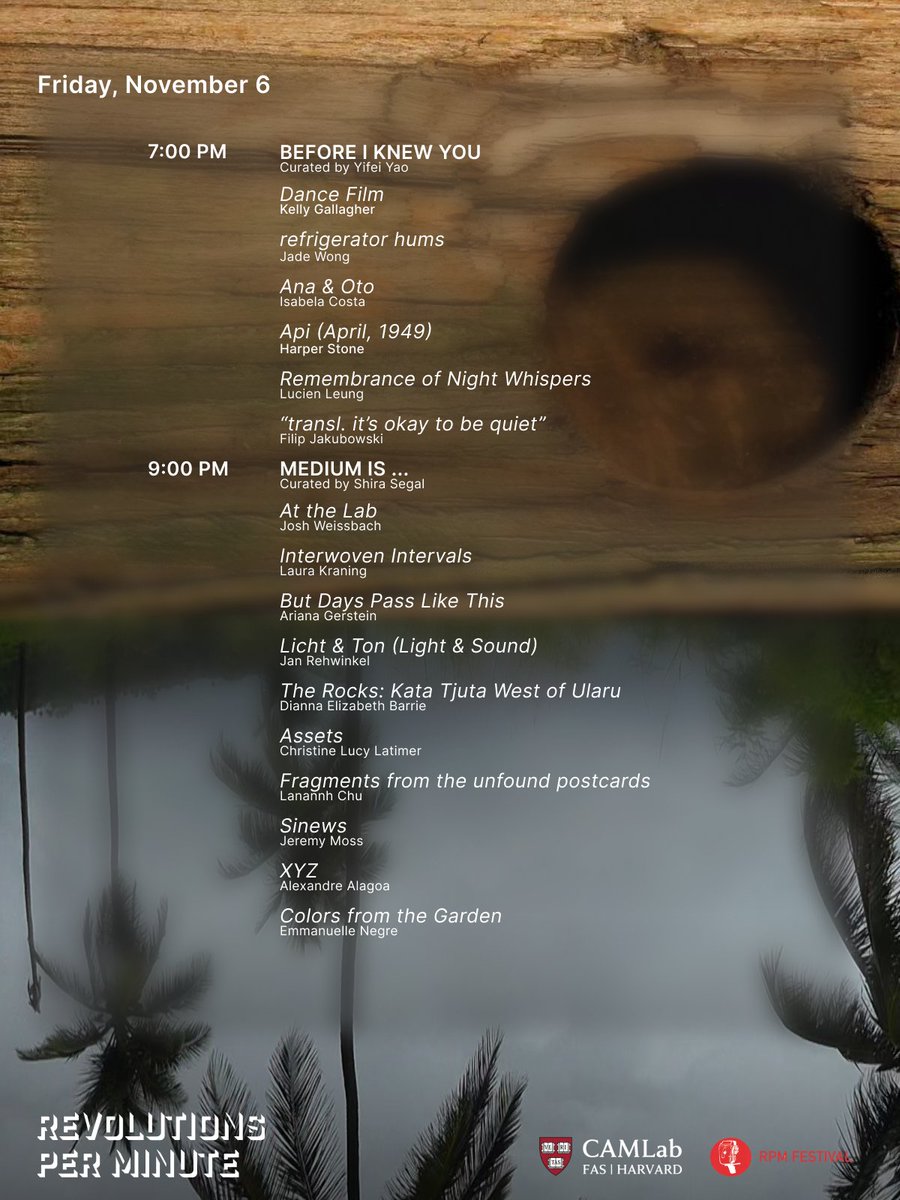
Harvard FAS CAMLab is pleased to welcome Revolutions per Minute (RPM), an artist-run festival dedicated to short-form poetic, personal, and cinematic work across experimental film, essay film, animation, documentary, video, and audiovisual performance.
Across three days, RPM Festival brings together filmmakers, artists, faculty, alumni, and curators for a series of thematic screening programs and special films. Each thematic program features a selection of experimental moving-image works exploring different approaches to image, sound, storytelling, and artistic practice. Please refer to the daily program schedules for details on individual films and participating artists.
September 26 | Films and Performance by Hampshire College Faculty and Alumni
4:00 PM — Faculty Screening
7:00 PM — Alumni Screening
9:00 PM — Bromp Treb (Neil “Cloaca” Young)
November 6
7:00 PM — “Before I Knew You”
Moving across historical periods, geographies, and domestic spaces, six short films turn toward the people we call family, tracing how emotional landscapes, generational legacies, and social changes become entangled with family histories.
9:00 PM — “Medium is …”
Featuring ten new works, “Medium is …” questions the current state of experimental film and considers the boundaries of different media—old, new, and obsolete.
November 7
2:00 PM — “Tycoon”
4:00 PM — “Loose Dirt”
6:00 PM — “A Different Clock”
8:00 PM — “What Comes Through”
📍 CAMLab Cave, Lower Level
485 Broadway, Harvard University, Cambridge, MA
🎟️ Free with RSVP. Please register here: https://t.co/hkW2R3VOYa
RPM Festival 2026 events will also take place at partner venues. Please visit the official RPM Festival website for the complete schedule across all participating locations.
#HarvardCAMLab #RPMFestival #RevolutionsPerMinute #ExperimentalFilm
CAMLab is pleased to announce our next VS in Dialogue lecture, “From Page to Stage: My Experience Directing the National Theatre of China’s The Swallow Tower,” offering an exclusive look inside the making of contemporary Chinese theatre.
⏰ September 21 (Monday), 5:00–6:30 PM ET
📍 CAMLab Cave, Lower Level, 485 Broadway, Harvard University, Cambridge, MA
🌍 Language: Chinese
🎫 Free and open to the public. Only 20 spots available—register today: https://t.co/bHclrcrioM
Every play begins as text on a page, yet the alchemy that brings it to the stage remains one of theatre's most compelling mysteries. How does a director's vision take shape through rehearsal? How do classical Chinese narratives find contemporary expression in performance?
This talk explores the artistic process behind “The Swallow Tower”—from script development and directorial concept to the intensive work of rehearsal and its ultimate realization on stage. Drawing on the intersection of academic research and practical stagecraft, the lecture offers insights into the creative processes that shape contemporary Chinese theatre.
Yihao Xu is a professional director, a visiting student at Harvard FAS CAMLab, and a PhD candidate at Peking University. He has been selected for the National Theatre of China's Young Director Support Program and the Publicity Department's National Young Playwrights Program.
#HarvardCAMLab #AcademicTalk #Cambridge #HarvardUniversity #VSinDialogue
CAMLab is pleased to present “Tending,” a film and sound installation by Shariq Shah that follows shifting conditions of childhood, land, and climate crisis in Nepal’s Rolwaling Valley, in the shadow of one of the country’s largest and most precarious glacial lakes, Tsho Rolpa.
📅 September 18, 2026
5:30 PM ET — Panel Discussion
6:30 PM ET — Screening
📅 September 19, 2026
11:00 AM–5:00 PM ET — Screening
📍 CAMLab Cave, Lower Level, 485 Broadway, Harvard University, Cambridge, MA
🎟️ Registration is required: https://t.co/8QAWt0rASG
As landslides, floods, and glacial melt accelerate, “Tending” explores changing spatial and sonic relationships with the environment. Moving across the scales of mountain valley, village, and body, the film considers what it means to stay amid intensifying climate risk. What does it mean to tend to the land on which you stand? And how do we collectively tend to a planet in crisis?
A panel discussion will bring together scholars, organizers, media artists, and environmental specialists to explore the idea of “tending” through spatial, sensory, political, and environmental perspectives. A small reception will follow.
Shariq Shah is a designer, cartographer, and researcher whose interdisciplinary practice examines ecology, technology, and intergenerational memory. He currently practices as Senior Cartographer at National Geographic.
“Tending” was created in collaboration with Robyn Wang and Ignacio Toro, with support from the Harvard Asia Center. Special thanks to ICIMOD (International Centre for Integrated Mountain Development) for subject matter consultation and RØDE Microphones for audio support.
#HarvardCAMLab #CAMLabCave #Tending #ClimateCrisis #ClimateArt #SoundArt #MediaArt #EnvironmentalArt
On September 4, Kaiyue Yu, PhD candidate in Art Theory at Zhejiang University and CAMLab visiting student (2025–26), delivered a talk drawn from her new book, “The Appeal of Things: Dong Qichang's ‘Use of Things’ and the Intentions of Painting and Calligraphy.” Starting from concrete “things”—brush, ink, paper, and inkstone—she revisited the material conditions underlying Dong Qichang's art.
Chinese literati painting has long privileged brushwork and spiritual expression, treating materials as mere media. But can art’s “spirituality” truly transcend matter? Yu argued that Dong Qichang’s “plainness and naturalness” was both an aesthetic ideal and the fruit of sustained mastery of brush behavior, ink method, paper character, and inkstone use. The artistic “mind” does not float above matter; it emerges through constant human-material interaction.
Through brushes tested, inks chosen, and papers sourced via networks of friendship, she showed how the “four treasures” became active media for knowledge, taste, and literati identity in late-Ming Jiangnan.
Revisiting the “Northern and Southern Schools” theory, Yu further demonstrated that media differences, such as silk vs. paper and ink vs. color, also shaped aesthetic hierarchy and artistic orthodoxy. Behind every style and theory lie concrete materials and practices: art history is a continuing entanglement of humans and things, technology and culture.
A lively discussion followed on material culture methods, Ming–Qing connoisseurship and the art market, and the cross-cultural circulation of painting materials. We extend our warm thanks to Kaiyue Yu for her insightful lecture and to everyone who joined us. Stay tuned for more CAMLab events!
#DongQichang #ChineseArt #ArtHistory #MaterialCulture #HarvardCAMLab #LiteratiPainting #InkPainting #Connoisseurship
CAMLab is excited to kick off a new season of Visiting Scholars in Dialogue with our first session of the semester: “The Universe in One’s Hand: What Is Dong Qichang’s Art Made Of?”
Join us for a lecture by Kaiyue Yu, who invites us into Dong Qichang’s world—not through abstract philosophy alone, but through the very materials he held: brush, ink, and paper.
⏰ September 4 (Friday), 12:00–1:30 PM EST
📍 CAMLab Cave, Lower Level, 485 Broadway, Harvard University, Cambridge, MA
🌍 Language: Chinese
🎫 Free and open to the public. Only 20 spots available—register today via: https://t.co/bHclrcrioM
The literati tradition has long celebrated “blandness and naturalness” (pingdan tianzhen 平淡天真), treating brushwork as a trace of the mind—as if art could transcend the world of things. Yet Dong Qichang (1555–1636) declared that in painting, “the universe rests in one’s hand, and nothing before the eyes is without life.” If the universe rests in the hand, then the hand holds a brush, ink, and paper.
This talk dives deep into the material media behind Dong’s masterpieces—his trials of brushes, his choices of ink, the paper sourced through friendship networks, and the paper–silk divide that underlies his famous Southern–Northern Schools theory. Materiality was never a transparent medium of spiritual expression, but the very condition and path through which it took form.
Kaiyue Yu is currently a Visiting Student at Harvard FAS CAMLab and a PhD Candidate in Art Theory at Zhejiang University. Her research focuses on painting and calligraphy connoisseurship in the Ming–Qing dynasty.
#HarvardCAMLab #AcademicTalk #Cambridge #HarvardUniversity #VSinDialogue
Digital Gandhara: Winner of the 2026 AWHEIC
We are thrilled to share that Harvard FAS CAMLab’s “Digital Gandhara” project has been selected as a winner of the 2026 Global Challenge for World Heritage Education Innovative Cases (AWHEIC).
The project was awarded in the “Star of Outstanding” category for its interdisciplinary and innovative approach to digital heritage preservation and education. Selected as one of 30 awardees from a highly competitive global field, this honor marks a milestone of international recognition and a testament to the power of digital innovation in safeguarding and sharing cultural heritage on a global scale.
The announcement was made on July 23 at “World Heritage Education towards the Future — Innovation by and for Young People,” a thematic side event during the 48th session of the UNESCO World Heritage Committee at BEXCO in Busan, Republic of Korea, co-organized by WHITR-AP and WFUCA.
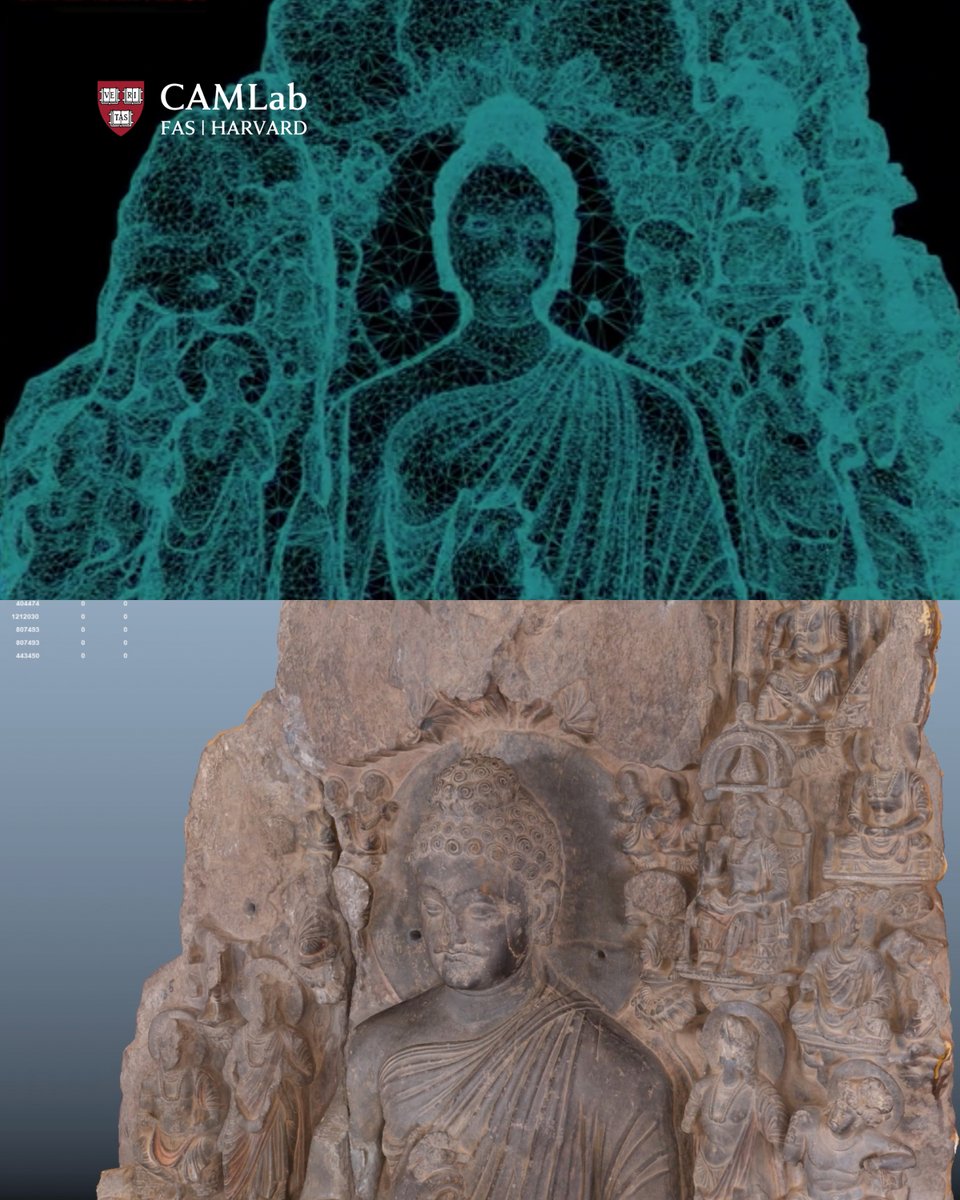
“Digital Gandhara” applies 3D scanning, digital reconstruction, machine learning, and immersive storytelling to document and reconstruct endangered sites and artifacts across the Greater Gandhara region. Through this work, CAMLab has produced 3D models, scholarly publications, and multimedia narratives, all gathered on an open-access platform for researchers and the public worldwide.
Moving forward, CAMLab is advancing new publications, platform upgrades, and deeper global partnerships to ensure that Gandharan art transcends physical boundaries and reaches ever broader audiences. Stay tuned for what’s next.
#HarvardCAMLab #DigitalGandhara #UNESCOWorldHeritage #CulturalHeritage #DigitalHeritage
"Journey to Enlightenment: A Multimedia Exhibition on Buddhist Cultural Heritage" is now open at the National Science and Technology Museum in Kaohsiung, Taiwan! Presented by Harvard FAS CAMLab and the Tzu Chi Foundation, the exhibition unfolds across eight thematic chapters, tracing the development of Buddhist art and thought across Asia through sacred sites, artistic traditions, and cultural exchange.
1️⃣ Bodh Gaya — The Origin of Awakening
The journey begins at Bodh Gaya, the site of the Buddha’s enlightenment. Centered on the Bodhi tree and the Vajrāsana, or Diamond Throne, this chapter explores a foundational site in Buddhist history and the ideas of awakening associated with it.
2️⃣ Sarnath — The Turning of the Wheel of Dharma
At Sarnath, the Buddha delivered his first teaching after enlightenment. The "Turning of the Wheel of Dharma" marks the beginning of a tradition that would be transmitted and transformed across regions, cultures, and generations.
3️⃣ Lotus Sutra Traditions — Scripture, Image, and Spatial Practice
From Xiangtangshan to Dunhuang, the Lotus Sutra inspired a rich visual culture of sculpture, murals, and inscriptions. Here, scripture took on visual and spatial forms, transforming text into image and opening new modes of interpretation and experience.
Our sincere thanks to everyone who contributed to this journey and made the exhibition possible. We look forward to welcoming you in Kaohsiung!
📅 August 1 – November 1, 2026
📍 National Science and Technology Museum, Kaohsiung, Taiwan
🕘 Monday – Sunday: 9:00 AM – 5:00 PM (last admission at 4:00 PM)
☀️ Weekends in August: 9:00 AM – 6:00 PM (last admission at 5:00 PM)
🎟️ Free and open to the public. Please register through https://t.co/GF1G6Q85QC
Sacred Sites Revisited at CMA | Xiudingsi
Harvard FAS CAMLab and the Cleveland Museum of Art (@ClevelandArt) present “Sacred Sites Revisited,” a series of collaborative digital installations. Building on the collective expertise in research, curatorial practice, and immersive storytelling of CAMLab and CMA, the project proposes a new approach to cultural heritage interpretation, as part of the #ArtLensReimagined program.
Centered on a molded architectural brick in CMA's collection, this installation digitally reconstructs the richly decorated pagoda of Xiudingsi Monastery in northern China. As visitors move slowly forward, dancers, musicians, guardians, and mythical creatures gradually emerge along the pagoda's decorative surface, allowing audiences to experience the ritual scene of ancient devotees circumambulating the pagoda in reverence.
The installation is based on CAMLab's research on the Xiudingsi Monastery site and its pagoda. Combining archaeological evidence with digital reconstruction, it restores and represents the pagoda's former majestic appearance, architectural form, and decorative system while exploring the artistic, religious, and cultural exchanges that connected communities across the Silk Roads.
Together with the Hadda and Xiangtangshan installations, “Sacred Sites Revisited” situates works of art back within the historical and cultural settings that originally shaped their meaning. Objects now dispersed across museums are reconnected with their original sites through digital reconstruction, inviting audiences to engage with a shared cultural heritage that spans centuries and extends across Eurasia.
📍 The Cleveland Museum of Art, 001 ArtLens Gallery (Maltz Family Foundation ArtLens Gallery)
📅 Free admission beginning Tuesday, July 28, 2026
Special thanks to the Xiangtangshan Grottoes Research Institute, Harvard Art Museums, Victoria and Albert Museum, the John C. and Susan L. Huntington Photographic Archive of Buddhist and Asian Art at the University of Chicago, Peshawar Museum, and the Special Collections of the Harvard Fine Arts Library.
#CAMLab #ClevelandMuseumofArt #DigitalHeritage #DigitalHumanities #Xiudingsi
Harvard FAS CAMLab and the Cleveland Museum of Art (@ClevelandArt) present "Sacred Sites Revisited," a series of collaborative digital installations. Across three sites in Asia, visitors encounter a monastery, pagoda, and cave temple that once functioned as pilgrimage, ritual, and sacred spaces.
This installation follows a Buddha head in CMA's collection back to its original setting in the Xiangtangshan cave temples of northern China. It builds upon years of research on the Xiangtangshan caves by an international network of scholars, museums, and cultural institutions, including CAMLab's recent collaboration with the Xiangtangshan Grottoes Research Institute.
Since the early twentieth century, sculptures and architectural fragments from Xiangtangshan have been dispersed across collections around the world, including the Cleveland Museum of Art. Drawing on archaeological research, historical photographs, archival records, and digital technologies, the project traces connections between these scattered remains and the caves from which they originated.
Together with the Hadda and Xiudingsi installations, "Sacred Sites Revisited" seeks a possibility beyond traditional museum display, revealing relationships between sculpture and architecture, ritual practice and physical space, and local traditions and wider networks of cultural exchange.
📍 The Cleveland Museum of Art, 001 ArtLens Gallery (Maltz Family Foundation ArtLens Gallery)
📅 Free admission beginning Tuesday, July 28, 2026
Special thanks to the Xiangtangshan Grottoes Research Institute, Harvard Art Museums, Victoria and Albert Museum, the John C. and Susan L. Huntington Photographic Archive of Buddhist and Asian Art at the University of Chicago, Peshawar Museum, and the Special Collections of the Harvard Fine Arts Library.
#CAMLab #ClevelandMuseumofArt #DigitalHeritage #DigitalHumanities #Xiangtangshan
Harvard FAS CAMLab and the Cleveland Museum of Art (@ClevelandArt) are delighted to present "Sacred Sites Revisited," a series of collaborative digital installations that reconnect artworks from the CMA collection with the architectural, ritual, and cultural milieu for which they were originally created.
Centered on CMA's Hadda sculptures, the installation reconnects them with their original historical environment—the Hadda region in present-day Afghanistan, once one of the great centers of Gandharan Buddhist art. Following the journey of the Chinese monk Xuanzang, visitors enter a landscape shaped by centuries of intercultural exchange between South Asia, Central Asia, and the Mediterranean world, where Greco-Roman and Indian artistic traditions came together in distinctive new forms.
The installation emerges from CAMLab's ongoing Digital Gandhara project. Drawing upon years of documentation, research, and digital reconstruction, the Hadda installation leverages digital technologies to place CMA's sculptures back within the landscape of monasteries, stupas, and pilgrimage routes that once connected Gandhara to the wider Buddhist world.
Together with the Xiangtangshan and Xiudingsi installations, "Sacred Sites Revisited" transforms scholarly discoveries into visible, audible, and explorable experiences, opening new pathways between academic research and museum audiences.
📍 The Cleveland Museum of Art, 001 ArtLens Gallery (Maltz Family Foundation ArtLens Gallery)
📅 Free admission beginning Tuesday, July 28, 2026
Special thanks to the Xiangtangshan Grottoes Research Institute, Harvard Art Museums, Victoria and Albert Museum, the John C. and Susan L. Huntington Photographic Archive of Buddhist and Asian Art at the University of Chicago, Peshawar Museum, and the Special Collections of the Harvard Fine Arts Library.
#CAMLab #ClevelandMuseumofArt #DigitalHeritage #Gandhara #Hadda
On June 18, Anjing He, Associate Professor at the University of Science and Technology Beijing and Visiting Scholar at CAMLab, presented an engaging lecture and a pop-up exhibition at CAMLab Cave.
The lecture explored a core question: When language and historical records reach their limits, what can images do? Drawing on theoretical concepts such as "Graphic Pressure," "Complicit Archive," and "Differential Reproduction," Anjing He examined Xiao Yuncong’s woodblock albums, arguing that in late imperial China, images were not merely supplementary to text, but vital mediums for historical knowledge production.
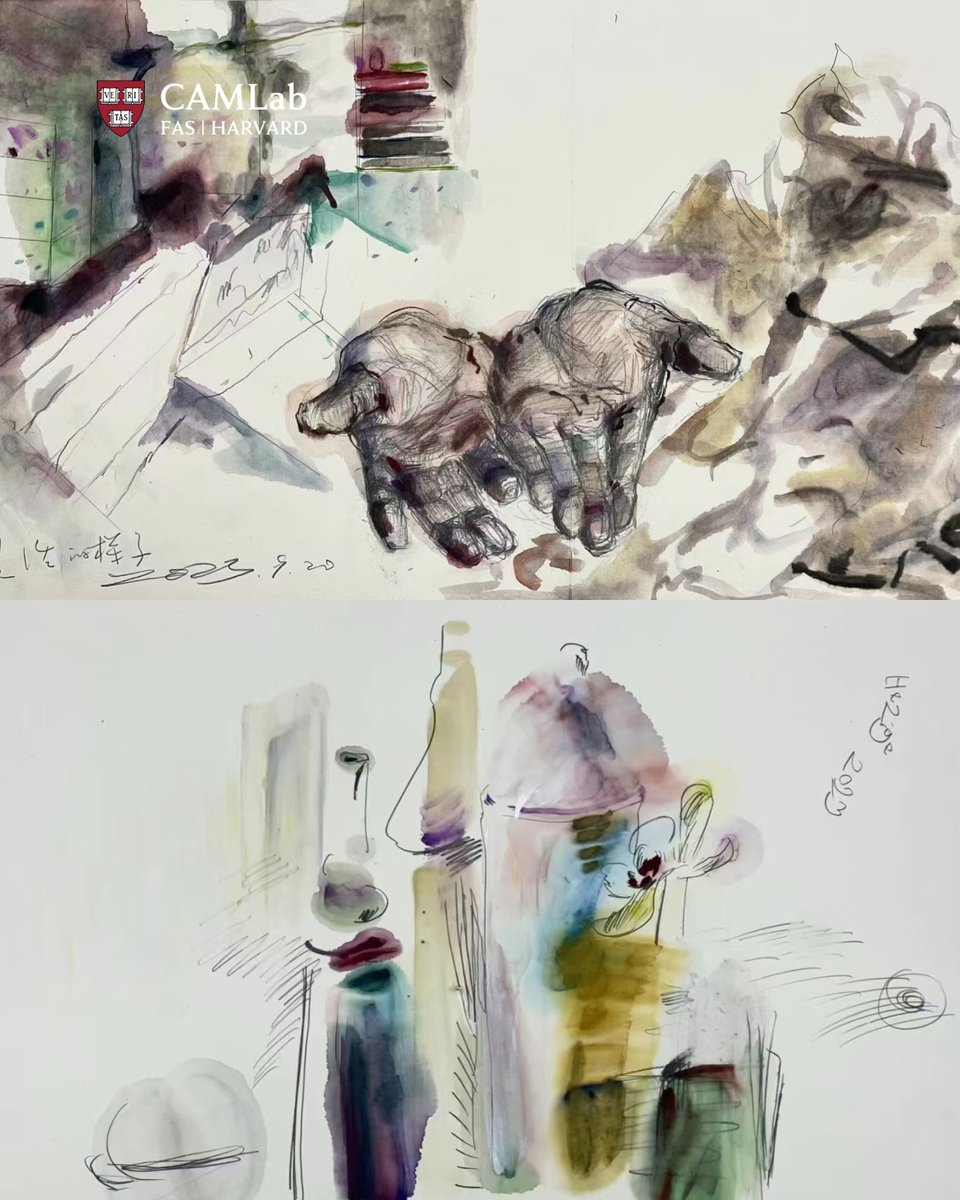
Running alongside the lecture, the exhibition featured 30 works across four series: "Traces," "The Appearance of Time," "Growth of All Things," and "Life and Vessels." These works engaged with contemporary questions: How does time transform the world? What endures after people, sounds, and civilizations fade? In this context, painting becomes a way to organize experience and generate new knowledge.
The event sparked thoughtful dialogue on art history, print media, and contemporary painting, bringing together diverse perspectives on how we archive time and memory. For Anjing He, the event marked both a milestone and a new beginning, and we look forward to seeing how this exploration of the space between art history and painting practice continues to evolve.
#HarvardCAMLab #ArtHistory #ArtExhibition #HarvardUniversity #ContemporaryArt