I actually think that our biggest problem as Zimbabweans is our culture of dissing others who come up with solutions to the local problems we face. This culture of kushora is one of our biggest weaknesses.
This is a young man who lives in Gutu. He does not live in London or Johannesburg. He has come up with an innovation that solves a local problem in his community. Whether this innovation exists somewhere else in the world does not matter. What matters is that it did not exist where he is, and it does not exist where it is needed most.
We must learn to uplift and encourage one another instead of being dismissive of people who try to make a difference. If you think there is a better idea, then build on and refine what has been put on the table. Do not try to tear someone down, ridicule them, or make them look stupid for trying to solve a problem.
A society progresses when it encourages innovation and celebrates problem-solvers, not when it discourages them through cynicism and mockery.
This is deeply distressing for any African who cares about our continent. Leaders should not be populists. Leaders should lead through ideas, principles, wisdom, and foresight.
I call upon our African leaders to resist the temptation of responding to difficult problems with emotion and instead reflect on the role they are meant to play for us, the ordinary citizens of this beautiful continent. I hope and pray that they will find it within themselves to engage with one another rather than respond to challenges in ways that only make them worse.
It is profoundly sad to see two African presidents reach a point where they can no longer engage with each other. Problems are resolved through dialogue, diplomacy, and communication, not through isolation or a refusal to engage.
There is a fundamental difference between leaders, particularly presidents, and ordinary citizens who may be swept along by populist demagoguery. That difference should be evident in the way our leaders resolve problems on behalf of the people they serve. Leadership is about rising above emotion, resisting populist pressure, and making decisions that secure peace, stability, and long-term prosperity.
True leadership does not merely dwell on what has happened. It seeks to understand the root causes of problems and resolve them in a way that prevents further deterioration. That is the standard we should expect from those entrusted with leading our nations.
It is also important for Africans, especially those of us in journalism, scholarship, academia, and other fields of serious thought, to resist inflaming already difficult situations. Our responsibility is to encourage dialogue, promote reason, and create an environment in which our leaders pursue lasting solutions rather than deepen divisions.
Africa has too much at stake for us to allow emotion, populism, and political point-scoring to replace wisdom, diplomacy, and constructive engagement. Our leaders should build bridges, not walls, because even the most difficult disagreements can only be resolved through dialogue.
Ghana was the first country in Africa to gain independence from colonial rule, while South Africa was the last African nation to emerge from institutionalised colonialism and apartheid. As two of Africa’s historic giants, and with South Africa being the continent’s largest industrial economy, their relationship carries immense significance, not only for their own citizens but for Africa as a whole.
It is therefore important for people on both sides to encourage their leaders not to be incorrigible, but to bend to reason, embrace dialogue, and resolve these challenges with wisdom and statesmanship. Africa has overcome far greater obstacles in the past, and there is no dispute that cannot be resolved through honest engagement and mutual respect.
We pray for wisdom, humility, and the courage to choose unity over division, because the future of our continent depends not on confrontation, but on our ability to solve problems together.
It is people like you, my brother, who are tarnishing the reputation of your country, South Africa. There is a great deal at stake when it comes to African integration and cooperation, particularly in trade, investment and economic development.
You may think this is all a joke today, but you will feel the consequences if prices begin to rise, companies lose contracts across the continent, and South African businesses are forced to cut jobs because markets that once welcomed them no longer do.
It is easy to shout populist and demagogic slogans on social media. It is much harder to understand how economies actually function. The social grants that many people receive do not appear out of thin air.
They are funded largely by taxes generated through economic activity, with the private sector playing a critical role. Individual taxpayers alone cannot sustain the modern state without a productive and growing economy.
South Africa’s private sector is deeply invested across the African continent. Many of the country’s largest companies have built successful businesses throughout Africa, generating billions of rands in revenue, profits and tax contributions that ultimately support jobs, investment and public finances back home.
That is why responsible leaders and citizens should value African cooperation rather than undermine it with populism and hostility. It is one thing to score political points on social media; it is another to safeguard the long-term economic interests of your own country.
Things have fallen apart for this scammer president and his corrupt sidekick at @FIFAcom, they wanted USA to cheat its way through.
Well done, Belgium. Justice has been clinically delivered, justice has been done.
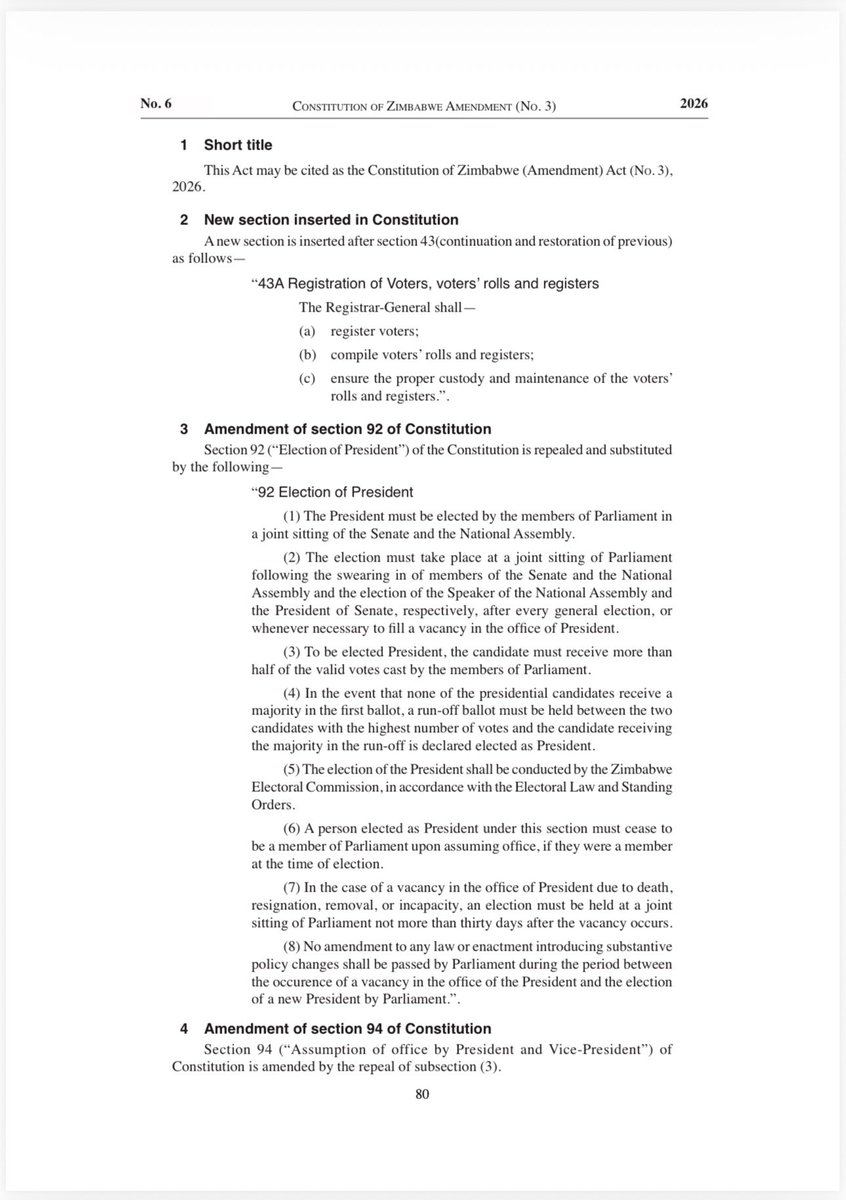
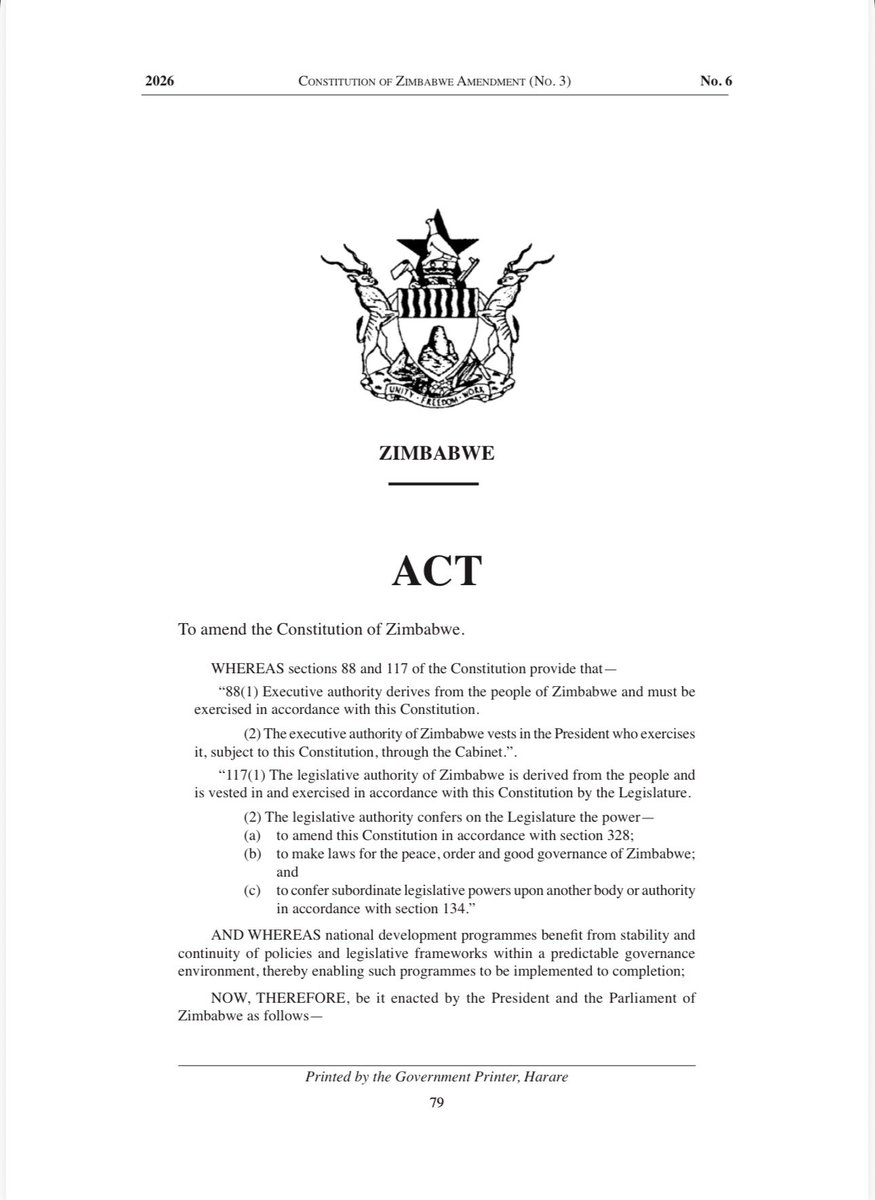
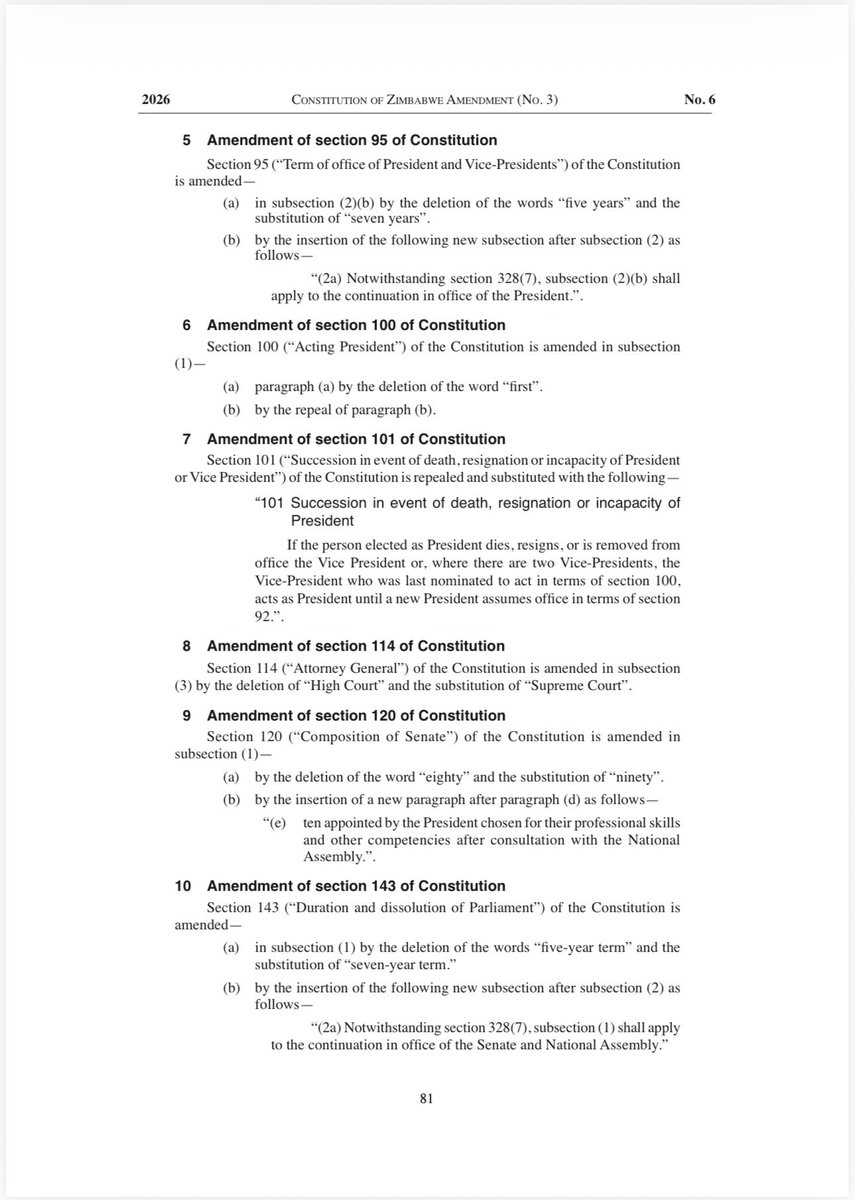
President Emmerson Mnangagwa of Zimbabwe has signed into law the controversial Constitutional Amendment (No. 3) Act, which extends his term of office by an additional two years until 2030, cancels the general elections that were due in 2028, abolishes the direct election of the President by the electorate by transferring that responsibility to Members of Parliament, and extends the presidential term of office from five to seven years.
The Act effectively ends the presidential ambitions of Vice President General Constantino Chiwenga through the electoral process, leaving a military coup as the only conceivable route to the presidency outside the constitutional framework.
It also significantly diminishes, for the foreseeable future, the prospects of an opposition leader being elected President, given ZANU-PF’s parliamentary majority and the electoral advantage it has secured through the 2022–2023 delimitation of electoral boundaries (constituency delimitation), which redrew constituency boundaries ahead of the 2023 general elections.
You can read the Government Gazette containing the full text of the Constitutional Amendment (No. 3) Act via the link below on my Telegram channel.👇🏿👇🏿
https://t.co/f3TcNRwoAl
@UEFA has issued a scathing statement against the disgraceful decision by @FIFAcom to give in to the corrupt American president Donald Trump who requested that the automatic one-match ban for America’s Folarin Balogun’s red card be suspended.
Statement 👇🏿
Yesterday’s decision to suspend for a probationary period of a year the implementation of the one-match automatic suspension following the red card issued to the player Folarin Balogun crossed a red line.
Football, like any other sports, relies on rules, which are the basis for fair, honest and transparent competition. Sometimes rules are open to interpretation. In this case not. A minimum automatic suspension of one match following a red card is not a discretionary option and does not require the decision of a competent body to be enacted. It is a principle embedded in regulations, which cannot be made subject to exceptions, let alone in the middle of a tournament where several other players have been in the same situation and regularly served their suspension.
When the certainty of rules is no longer guaranteed by its guardians, the integrity of the game is at stake and the credibility of a competition is undermined. Equally, such decision creates a precedent in the ongoing tournament, where similar situations will now require an equal treatment, to the detriment of the competition.
Football is the most loved sport in the world because it is a beautiful game and is trusted because it is played everywhere with the same laws. A tournament is never a pure standalone and, if the tournament in question is the World Cup, it has the power to drive positive or negative consequences on the game as a whole.
We express our disbelief at such an unprecedented, incomprehensible and unjustifiable decision.
The corrupt @FIFAcom president, Gianni Infantino, and the corrupt American president, Donald Trump, have dragged the World Cup and the game of football into disrepute.
Their political interference has tarnished the integrity of the tournament and undermined the principles of fair play. It is shameful, but then again, shame is something neither of them appears to possess.
If we saw “Lost Ancient Technology” would we recognize it?
This object was pulled from the seabed at the sunken port of Thonis-Heracleion in Egypt.
Noted as a scepter the relic displays multiple features of some kind of drive shaft.
I could think of multiple mechanical functions for this object.
LIVE EVENT - SUNDAY 12TH JULY - Sign up to learn more: https://t.co/jZFLlSbJmf
In 2007, Bill Napier published a paper questioning why so little effort had been made to connect known crater fields with periods of enhanced cosmic activity. That same year, Firestone, Kennett, and West published their landmark paper proposing an extraterrestrial impact at the Younger Dryas boundary. The timing is striking. Napier was asking why the scientific community wasn't looking for these connections, while simultaneously, evidence for exactly such an event was being presented. It raises questions about how research priorities get set and why certain lines of inquiry remain unexplored until someone forces the issue. The convergence of these two papers in the same year suggests the field was on the cusp of a major shift in thinking about cosmic impacts and their role in Earth's recent history.
This is Jacob Zuma, the former President of South Africa, whose political party, MK, has been encouraging South Africans to chase not only undocumented immigrants out of the country, but even black Africans who are legally living and working in South Africa. His campaign vehicles have been driving around KwaZulu-Natal with loudspeakers urging people to drive black Africans out of the country, regardless of whether they are in South Africa legally or not.
And then, after all of that, he flew to India to meet the Gupta family, the very people accused of helping to orchestrate the industrial-scale corruption that nearly bankrupted South Africa through state capture. When they faced accountability, they ran away from South Africa, first for Dubai and then for India.
Think about the contradiction. A man whose campaign encourages hostility towards fellow Africans is, at the same time, embracing foreign friends who became synonymous with one of the biggest corruption scandals in South African history.
By his own admission in this video, he has made it clear that he is unhappy with the direction the country took in pursuing those implicated in state capture.
Meanwhile, ordinary black South Africans are being mobilised against fellow black Africans who are living in South Africa legally, while the political battle being fought is, in reality, about power, accountability and the legacy of state capture.
They are being drawn into a campaign that serves political interests rather than addressing the country’s real challenges.
History should record this moment. It should record the irony of fellow Africans being turned against one another while those accused of presiding over one of the darkest chapters of corruption in South Africa seek a return to political power. That is a tragedy that future generations should never forget.
Imagine dehumanising fellow black Africans who look like you, speak languages like yours, and share the same continent, all so that Jacob Zuma’s Indian friends can return and loot South Africa again.
One of South Africa’s biggest newspapers, The Times, filmed this barbarism today, where a car belonging to a foreign African national was set on fire in South Africa.
These are the kinds of idiotic, backward and criminal acts that destroy a country’s standing within the family of nations. This is not a fight against illegal immigration. This is a campaign to dehumanise and terrorise black Africans who look exactly like the people burning this car.
This has nothing to do with immigration law. These are petty criminals using immigration as a cover for violence, looting and hatred. What happened today was pure criminality, and it must be treated as such.
This is what we have been warning about: vigilante groups mobilising unemployed and unemployable people to go into the streets and burn other people’s property. No civilised society should tolerate this. No responsible government should allow this kind of lawlessness to take root.
What do tourists watching this think of South Africa? What do other nations watching this think of South Africa? What do investors think when they see mobs burning cars in the name of politics?
Because of a senseless minority with no sense of proportion, South Africa’s reputation is being dragged through the mud. The economic damage from this kind of lawlessness can run into billions of dollars, because no serious person anywhere in the world watches such scenes and says this is normal.
Yet this happened today in South Africa, in 2026.
Nobody civilised can defend this. Nobody decent can justify it. It is wrong, it is criminal, and it must be condemned without hesitation.
These people are uncouth, ignorant and too uneducated to understand the stupidity and cruelty of their Afrophobia. Only an idiot would tell another African to “Voetsek”. Only a fool would refer to fellow Africans with derogatory slurs such as “Kwerekwere”. And only a clown would defend such hateful behaviour.
“Voetsek” is an Afrikaans word traditionally used to chase away dogs. The deliberate choice of that word to address fellow Africans is therefore not accidental, it is a deliberate act of dehumanisation.
That said, these clowns do not represent South Africa and should never be used to define South Africans as a whole.
The overwhelming majority of South Africans are decent, cultured and measured in how they treat others. It would be unfair and inaccurate to judge an entire nation by the actions of a hateful minority. These are fools, and every country has them! Only a fool would openly utter such hurtful words!
The South African Police Service preparing for tomorrow’s anti-immigration marches. The tragedy is that the R600 million (approximately US$33 million / £24 million) used to put this much-needed security apparatus in place could have been used to create jobs, provide training opportunities, and assist the unemployed.
I call it a tragedy because on 1 July, after the marches, the same people who are unemployed today will still be unemployed. Their lives will not have changed despite the R600 million (approximately US$33 million / £24 million) that will be spent on policing and other related issues tied to these marches.
He points to a three-year field study testing whether a static neodymium magnetic disk placed beneath beehives could improve colony resilience and overwinter survival. The results were consistent across multiple seasons, not a single anomaly or one-off observation. The researchers deliberately avoided drawing conclusions from isolated data. They wanted repeatability, the kind of signal that holds up under scrutiny year after year. That consistency matters when you're trying to understand whether an intervention is actually influencing biological systems or just riding statistical noise. The study found that it did enhance survival, and that pattern repeated. It's the kind of methodical approach that builds confidence, not hype.
Thank you to @joerogan for having me on the JRE podcast.
Would you like to explore the subterranean shaft beneath the Great Pyramid? The subterranean shaft in the Great Pyramid of Giza (also known as the "well shaft" or "service shaft") is a complex, 200-foot (60 m) passage connecting the upper chambers to the descending corridor.
Join me on my next Egypt tour. LINK IN COMMENTS.
Thank you for that important question, my brother.
There are a few realities we must understand. Illegal immigration in South Africa is not driven by one factor; it is the result of several interconnected problems. If we are serious about solving it, we must first address its root causes rather than simply its symptoms.
The first root cause is failed governance in neighbouring countries, particularly Zimbabwe and Mozambique, from where a large proportion of undocumented migrants originate. These countries have suffered decades of economic decline, corruption and disputed elections. Unfortunately, successive South African governments have often acted as political cheerleaders for these failed regimes instead of holding them accountable.
The close historical and political relationships between the ANC and parties such as ZANUPF in Zimbabwe and FRELIMO in Mozambique have meant that democracy and good governance have too often taken a back seat. When economies collapse, people do what human beings have always done throughout history, they migrate in search of work and a better future for their families. In Southern Africa, South Africa is naturally the primary destination, followed by Botswana and Namibia.
The second issue is border management. Illegal migrants do not simply walk into South Africa on their own. They cross through borders that are controlled by South Africans. Many cannot even afford passports. In Zimbabwe, a passport costs R5000. Instead, they pay small bribes to corrupt officials, police officers, border personnel or criminal syndicates who facilitate illegal crossings. That means every successful illegal crossing involves someone on the South African side who has accepted money to make it happen. You cannot solve illegal immigration without dealing decisively with corruption within your own institutions.
The third issue is history. South Africa’s economy was built, in large part, on migrant labour. Anyone who understands South African history knows about WENELA, the Witwatersrand Native Labour Association, which recruited workers from Zimbabwe, Mozambique, Malawi, Lesotho, Eswatini and other neighbouring countries to work in South Africa’s mines. During apartheid, agreements were signed with countries such as Malawi specifically to supply cheap labour. Many South Africans of prominence today like Ray Phiri are descendants of those migration patterns. Large sectors of South Africa’s mining and agricultural wealth were built on the backs of migrant workers.
The irony is that many people shouting “Abahambe!” do not understand how dependent parts of the South African economy remain on undocumented labour. Large commercial farms, particularly in provinces such as Limpopo, rely heavily on migrant workers. If, hypothetically, every undocumented worker on those farms disappeared overnight, food production would immediately decline, labour shortages would emerge, and the price of food would rise sharply. Consumers would ultimately pay the price.
We have already seen similar dynamics elsewhere. In parts of the United States, immigration crackdowns created severe shortages of farm labour, leaving crops unharvested and increasing pressure on food prices. Agriculture cannot function without workers.
This does not mean South Africa should tolerate illegal immigration. Every sovereign country has the right to secure its borders and enforce its immigration laws. But enforcement without planning is reckless. You cannot remove hundreds of thousands of workers overnight without understanding the economic consequences or putting alternative labour systems in place. Otherwise, you risk damaging the very economy you are trying to protect.
That is why serious people should stop reducing this complex issue to slogans and start discussing practical solutions. Address failed governance in neighbouring states. Eliminate corruption at the borders. Modernise immigration management. Create legal labour migration systems where appropriate. Invest in skills development for South Africans. Most importantly, undertake proper scenario planning before implementing policies whose unintended consequences could be catastrophic.
Complex problems require intelligent solutions, not emotional slogans.
He begins with a fork in the road metaphor: one path leads to greatness, the other to oblivion. The question is not whether we face a choice, but whether we possess the knowledge necessary to choose correctly. He turns to the fourth chapter of Hosea, where the prophet warns that people are destroyed for lack of knowledge. This is not metaphor or philosophy. It is a direct statement about cause and effect. The critical question becomes: what knowledge? What specific understanding separates survival from collapse? He leaves the question hanging deliberately, because the answer requires examining what we have forgotten, what we have dismissed, and what the evidence of Earth's history has been trying to tell us all along.
Namibia has generated $25 million in just 11 months from its new visa-on-arrival system.
Namibia removed visa-free access for citizens of 33 countries, including the United States, Canada, France, the United Kingdom, and Germany, because those countries did not offer the same privilege to Namibians.
Now the policy is bringing in millions while sparking debates about fairness and reciprocity in international travel.