🚀 HASHRANCHOGPU PROMO!
————————————————
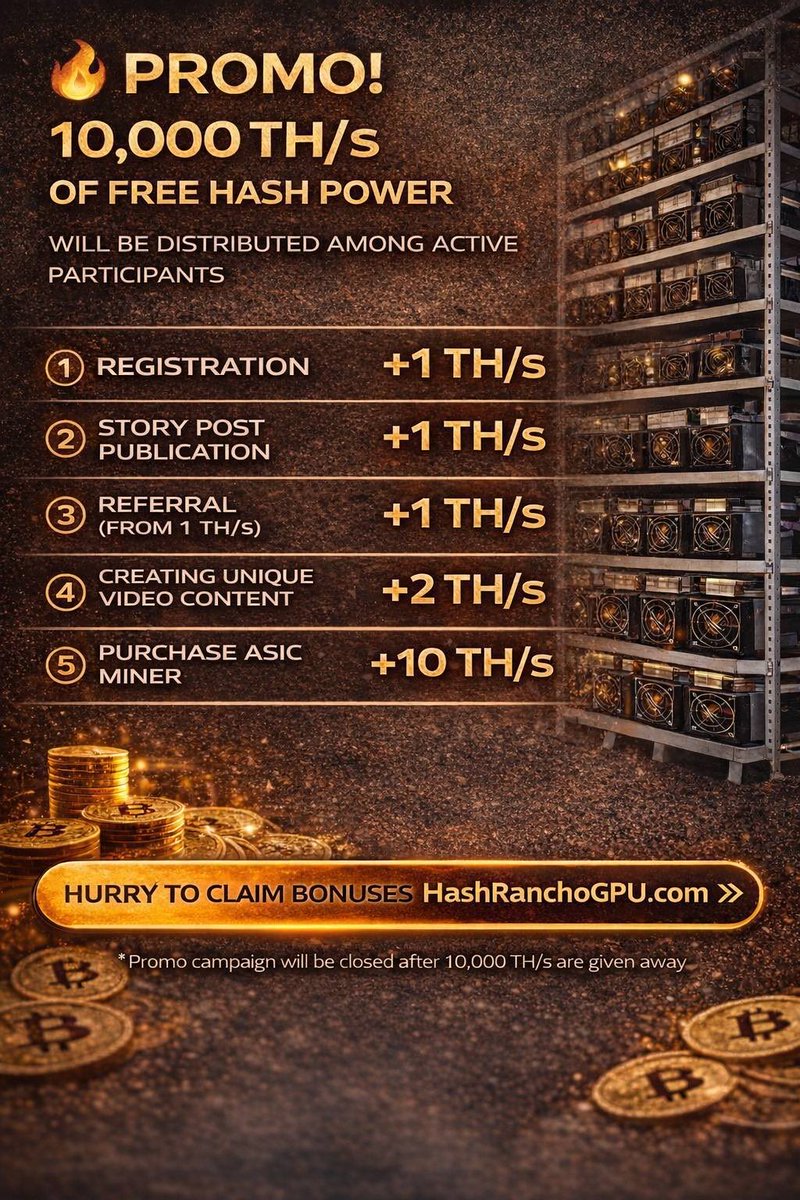
🔥10,000 TH/s FREE HASHPOWER CAMPAIGN
(Equivalent ~150,000$ )
To celebrate our expansion, HashRanchoGPU is allocating 10,000 TH/s of promotional hashpower to the community.
Once the allocation is fully distributed — the campaign ends.
No extensions. No resets.
————————————————
🎁 How to Earn Free HashPower :
1️⃣ Register an account → +1 TH/s.
2️⃣ Post about HashRanchoGPU in your social media → +1 TH/s
(Instagram / Twitter / Telegram / TikTok etc.)*
3️⃣ Invite 1 active referral
(Referral must purchase minimum 1 TH/s) → +1 TH/s.
4️⃣ Create unique video content about HashRanchoGPU
Format: humor / educational / FOMO / animated / informative
Post it on your social media → +2 TH/s. **
5️⃣ Purchase any ASIC miner → +10 TH/s.
* Do not delete the post.
** Do not delete stories or posts.
Please send the report using this form:
1. Registration username.
2. Link to your social media post.
3. Link to content created by you and posted on social media.
————————————————
🌐 Join now: https://t.co/bC7Wlzbh0T
🏭 How many ASICs in one room?
~50–150 units in 50–100 m²
But:
⚡ 100 ASIC ≈ 300 kW
🌡 massive heat
📊 Mining = infrastructure
🚀 HashRanchoGPU handles it all
🌍 Bitcoin cannot be stopped
Bitcoin is not a server or a company.
It’s a network of thousands of miners worldwide.
No central point.
No off switch.
Even if part of the network goes down — the rest keeps running.
⚙ That’s what makes Bitcoin resilient.
🚀 With HashRanchoGPU
⚙ Why ASIC hashrate can fluctuate
Even if a miner is rated for 200 TH/s, the actual hashrate can slightly change.
Common reasons include:
• device temperature
• firmware performance modes
• pool connection stability
Mining efficiency depends not only on hardware but also on reliable infrastructure.
🚀 At HashRanchoGPU, miners run under continuous monitoring.
How many chips actually work inside an ASIC miner?
When people imagine an ASIC miner, many assume there is just one powerful processor inside. In reality, the architecture is very different.
A modern ASIC is not a single chip - it’s a system of multiple computing boards.
Most miners used on the Bitcoin network contain three hash boards.
Each board is filled with dozens of specialized ASIC chips.
In total, a single miner can contain 100+ chips, all performing billions of hash calculations every second.
⚙ Why this matters
Each hash board works as an independent computing module.
If one board becomes unstable or fails, the total hashrate of the device immediately drops.
That’s why engineers closely monitor the status of every chip and every board through monitoring dashboards.
📊 On the screenshot you can see the status of all chips inside the ASIC - panels like this help quickly detect instability or hardware issues.
🚀 At HashRanchoGPU, all miners are constantly monitored, including chip status, board temperatures, and hashrate stability.
This ensures stable mining performance without technical hassle for users.
Mine with us! https://t.co/bC7Wlzbh0T
What is mining difficulty and how does it work?
In the Bitcoin network there is a parameter that directly affects how hard it is to mine new blocks. It’s called mining difficulty.
Simply put, difficulty determines how hard it is to find the correct hash for a new block.
When more miners join the network and total hashrate increases, blocks start being found faster. To prevent the network from speeding up, the protocol automatically increases the difficulty.
If miners leave the network and the total hashrate drops, the difficulty decreases.
⚙ How the adjustment works
The network recalculates difficulty every 2016 blocks, which is roughly every two weeks.
The goal is simple:
to keep the average block time around 10 minutes.
📊 This means that even if the total network power grows significantly, blocks will still be produced at roughly the same pace - mining simply becomes harder.
📉 Why this matters for miners
As difficulty increases, each ASIC receives a smaller share of the reward, because competition between miners becomes higher.
That’s why over time miners must:
• use more efficient hardware
• reduce electricity costs
• maintain stable operation of their equipment
This is why efficiency and stability are critical in industrial mining.
🚀 At HashRanchoGPU, the entire infrastructure is built around these principles - efficient ASIC hardware, continuous monitoring, and stable mining operations without technical hassle for users.
Mine with us! https://t.co/iXAPv5YMIc
⛏ Where do mining payouts actually come from
Every second, an ASIC performs hundreds of trillions of hashes for the Bitcoin network.
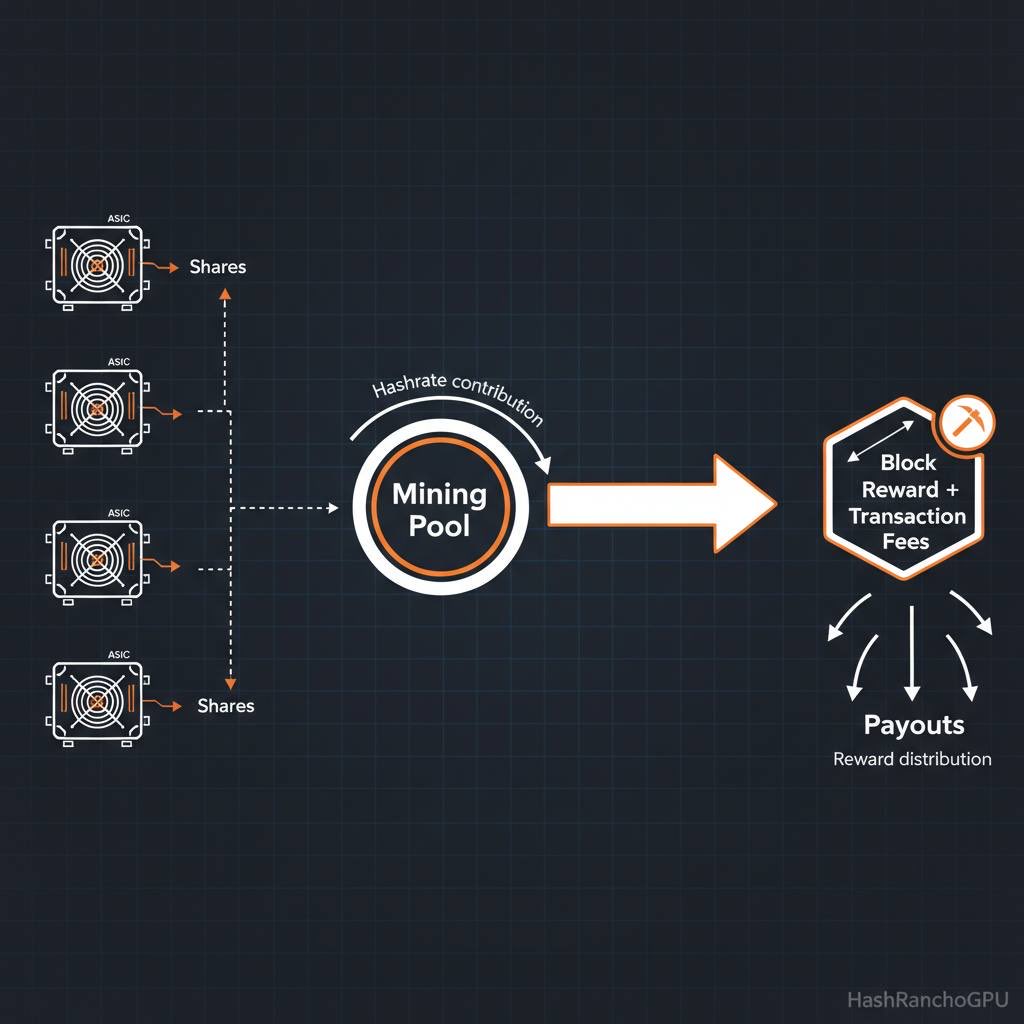
But the chance of a single miner finding a block alone is extremely small. That’s why miners join mining pools.
ASICs submit shares to the pool - proofs of work completed.
When the pool finds a block, the reward (block reward + transaction fees) is distributed among miners based on their hashrate contribution.
📊 That’s where mining payouts come from.
At HashRanchoGPU, miners run stably and continuously submit shares to the network.
Mine with HashRanchoGPU.
⚡️ Why J/TH matters more than TH/s
Many beginners in mining focus only on TH/s (hashrate).
But in industrial mining, engineers always look at J/TH first.
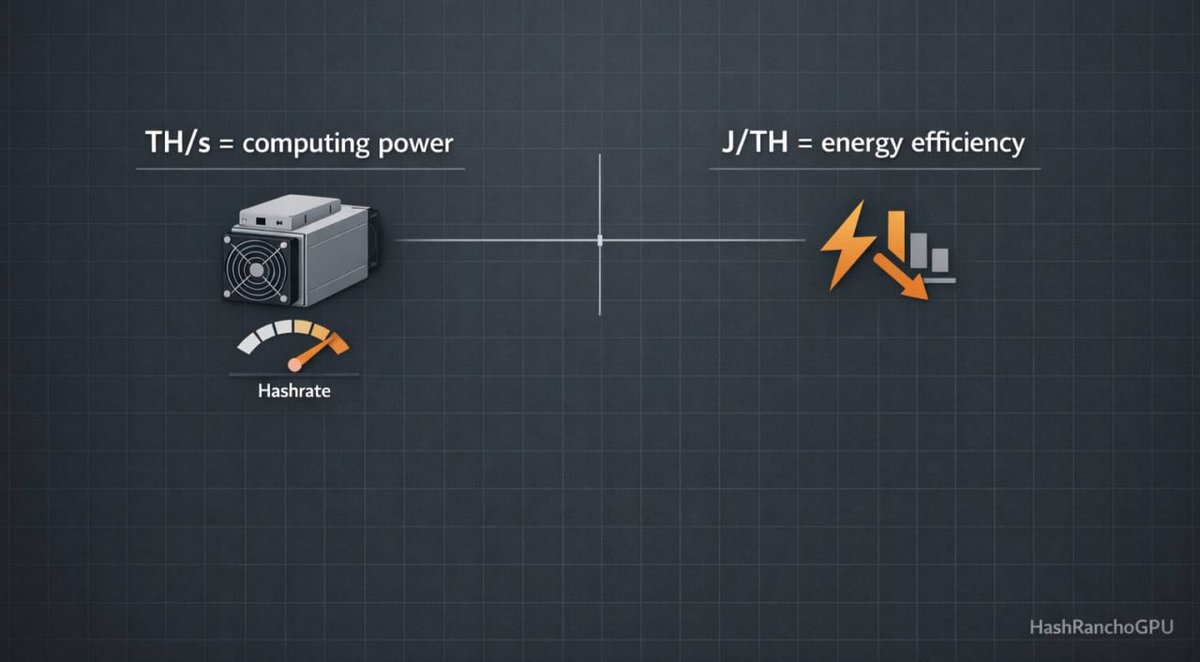
TH/s (terahashes per second) measures how much computing power a miner produces - how many hashes it can calculate per second.
But there is another key metric.
J/TH (joules per terahash) shows how much energy is required to produce 1 terahash of work.
This is where efficiency becomes important.
📊 Higher TH/s = more computing power
⚡️ Lower J/TH = better energy efficiency
On the Bitcoin network, electricity is the main operational cost.
That’s why an ASIC with slightly lower TH/s but better J/TH efficiency can often be more profitable in the long run.
This is why professional miners evaluate not only hashrate but also energy efficiency.
🚀 At HashRanchoGPU we operate modern ASIC infrastructure optimized for efficiency and monitored 24/7.
Mine with us! https://t.co/bC7Wlzbh0T
❓Why a Bitcoin ASIC can’t mine Litecoin, but a GPU can switch between networks
In mining, everything depends on the algorithm. The Bitcoin network runs on SHA-256, while Litecoin uses Scrypt. This is where the key difference between ASIC miners and GPUs appears.
⚙️ ASIC - built for one job
For example, the Antminer T21 is designed specifically to compute SHA-256 hashes. Its chips are physically engineered for that single algorithm. Because of this, it can mine Bitcoin and other SHA-256 coins - but it cannot switch to Litecoin, since the hardware does not support Scrypt.
🎮 GPU - a general-purpose processor
Graphics cards like the NVIDIA GeForce RTX 5090 work differently. They are designed for parallel computations rather than a single algorithm. That’s why GPUs can run many different mining algorithms.
A GPU can switch networks depending on which one is more profitable.
📊 But flexibility comes with a trade-off
ASIC miners dominate in efficiency. A modern Bitcoin ASIC can deliver hundreds of TH/s with optimized power usage. GPUs cannot reach that performance on SHA-256 because they are not specialized hardware.
That’s why ASIC = maximum efficiency for one network, while GPU = flexibility across multiple algorithms.
🚀 At HashRanchoGpu we use professional ASIC infrastructure optimized for Bitcoin mining performance.
Mine with us! https://t.co/oZX3jnxTks
🔥 Antminer T21 vs WhatsMiner M60S+ - Detailed Comparison
If you’re choosing an ASIC for mining on the Bitcoin network, two popular options often come up: Antminer T21 and WhatsMiner M60S+. Both are industrial-grade SHA-256 miners - but they have key differences.
⚙️ Hashrate
Antminer T21 delivers around 190 TH/s.
WhatsMiner M60S+ goes up to ~212 TH/s.
The M60S+ offers higher raw power, which can matter as network difficulty increases.
🔋 Energy Efficiency
T21 operates at roughly 19 J/TH.
M60S+ ranges around 17–18 J/TH.
Lower J/TH means better efficiency - a critical factor for long-term 24/7 operations.
🔥 Power & Operational Requirements
Both units consume several kilowatts and are designed for industrial environments. These are not home-friendly devices - they require stable power distribution and proper cooling systems.
🛠 Practical Positioning
Antminer models are often appreciated for widespread adoption and ecosystem familiarity.
WhatsMiner units are known for strong efficiency and stable performance under heavy load.
📊 So which one is better?
T21 - a balanced and solid performer.
M60S+ - higher performance with stronger efficiency metrics.
The right choice ultimately depends on infrastructure conditions and power strategy.
❓ By the way - want to understand the difference between SHA-256 miners (used for Bitcoin) and Scrypt miners (commonly used for Litecoin)? Or why an ASIC cannot simply switch algorithms like a GPU? Let us know - we’ll break it down in the next post!
🚀 And yes - both Antminer T21 and WhatsMiner M60S+ are available at HashRanchoGpu. You can host them in industrial infrastructure, monitor performance online, and test real hardware yourself.
Mine with us ⚡️https://t.co/bC7Wlzbh0T
⚡️ Why Industrial Electricity Matters
⚡️ In mining, hardware is only part of the equation - electricity defines the foundation of the entire infrastructure within the Bitcoin.
🏠 Residential electricity is designed for homes and apartments. It supports regular appliances and daily usage. ASICs, however, run 24/7 and consume significant power continuously. Constant high load means wiring stress, power limits, and higher residential rates.
🏭 Industrial electricity is built for continuous heavy equipment operation. It supports large-scale consumption, stable supply, and scalable capacity without household restrictions.
🔌 Reliability is just as important as cost. Industrial environments use dedicated power lines, load management systems, and outage control. In mining, downtime means lost operational time.
📊 That’s why modern mining operates where electricity is part of the strategy - not just a utility bill.
🌐 At HashRanchoGpu, equipment is hosted in infrastructure powered by industrial-grade electricity, ensuring stable performance without residential limitations.
Mining is about resource optimization - and electricity is at the core of it 🚀
https://t.co/oZX3jnxTks
⚠️ 5 Common Mistakes New Miners Make
❌ Many people enter mining expecting “passive income,” but forget that it’s an infrastructure process within the Bitcoin. Here are 5 common mistakes that kill profitability.
🏠 1. Mining at home
ASICs are not quiet PCs. Noise, heat, wiring load, and residential electricity rates often make home setups inefficient.
⚡ 2. Wrong electricity tariff
A few cents difference per kWh can completely change profitability. Industrial and residential rates are two different worlds.
📈 3. Ignoring network difficulty
Mining difficulty increases over time. Revenue is not fixed and changes with network hashrate.
❄️ 4. Poor cooling setup
Overheating reduces efficiency, increases failure risk, and causes downtime. Temperature directly impacts ASIC performance.
🧮 5. Blind trust in ROI calculators
Calculators show “today’s” numbers. They don’t account for rising difficulty, downtime, or market volatility.
🏭 Mining is about infrastructure, not pressing a “profit” button. That’s why HashRanchoGpu hosts equipment in industrial environments with controlled electricity, cooling, and uptime.
If you want to mine smarter - start with the right foundation 🚀
https://t.co/oZX3jnxTks
🧠 What Is an ASIC and Why It’s Not a Regular Computer
💻 Many people still think mining runs on a “powerful PC,” but that era is long gone. In the early days of Bitcoin, mining was done using CPU — the standard computer processor.
🎮 Then came GPU mining. Graphics cards handle parallel calculations much better, making them significantly more efficient than CPUs.
⚙️ Today, mining relies on ASICs (Application-Specific Integrated Circuits). These devices are built for one single purpose — calculating the SHA-256 algorithm as efficiently as possible. ASICs can’t browse the web or run games. They only calculate hashes 24/7.
📊 The difference is simple:
CPU — universal but slow for mining.
GPU — faster but still universal.
ASIC — specialized and dramatically more efficient.
🏭 That’s why modern mining is industrial infrastructure, not a home PC setup.
🌐 At HashRanchoGpu, ASICs are hosted in optimized environments with controlled electricity, cooling, and uptime. This is real specialized hardware — not abstract hashpower.
🚀 Start mining with us! https://t.co/oZX3jnxTks
⚙️ What Is Mining?
💡 Mining isn’t a “money - printing computer.” It’s the process of validating transactions and securing the Bitcoin. Miners group transactions into blocks and compete to solve complex mathematical problems. The first to find the solution adds the block to the network and earns the reward.
💻 Why It’s No Longer a Home PC
🖥️ Today mining runs on ASICs - specialized devices built for one single purpose: calculating hashes 24/7 at maximum efficiency. They consume significant power, generate heat, and produce noise, which makes home setups inefficient.
🏭 Why Mining Moved to Data Centers
⚡ Electricity cost, cooling systems, network stability, and uptime define profitability. Mining is an infrastructure business where efficiency matters most.
🌐 How to Participate Without Household Risks
🚀 HashRanchoGpu lets you acquire an ASIC, host it in industrial infrastructure, and monitor everything online. Real hardware, transparent structure, and the option to resell through the platform’s marketplace. If you’d like to learn more - we’re ready to show you how it works.
Stay with us! https://t.co/oZX3jnxTks
What does the market have in store for 2026?
Don't risk your money - now is the time to start mining cryptocurrency and increasing your wallet balance!
If you have any questions, feel free to ask 😉
#mining#Cryptocurrencies#HashRanchoGPU
The real constraint isn’t geology - it’s capital discipline, permitting timelines, and downstream capacity.
If we need 60+ new mines by 2030 and potentially 200 by mid-century, the question isn’t “Is there copper?” - it’s “Can projects clear ESG, water, community, and financing hurdles fast enough?”
And in the US, the refining bottleneck is strategic. Without domestic smelting & refining, adding upstream supply doesn’t translate into supply chain security.
Energy transition + AI + electrification = structurally tighter copper markets. The winners will be jurisdictions that align policy, capital, and processing - not just those with ore in the ground.