Trying to analyze a situation without enough data was like looking at a photograph of a ball in flight and trying to gauge its direction. Is it going up,down, sideways? Is it about to collide with a baseball bat? With enough datapoints, you could predict just about anything #Data
For Africa, where many economies are fuel‑import dependent, this means weaker currencies, higher pump prices, and inflation piling on top of already strained household budgets. The East African Community (EAC) is particularly exposed.
Rising oil costs will ripple through transport, food, and manufacturing, intensifying inflationary pressures. Somalia, with its fragile economy and high reliance on imports, could see sharp spikes in consumer prices in the coming days.
The escalating Iran war is already shaking global oil markets. Brent crude surged past $80 a barrel within days of renewed conflict, raising fears of prolonged disruption in the Strait of Hormuz — a route that carries about 20% of global supply.
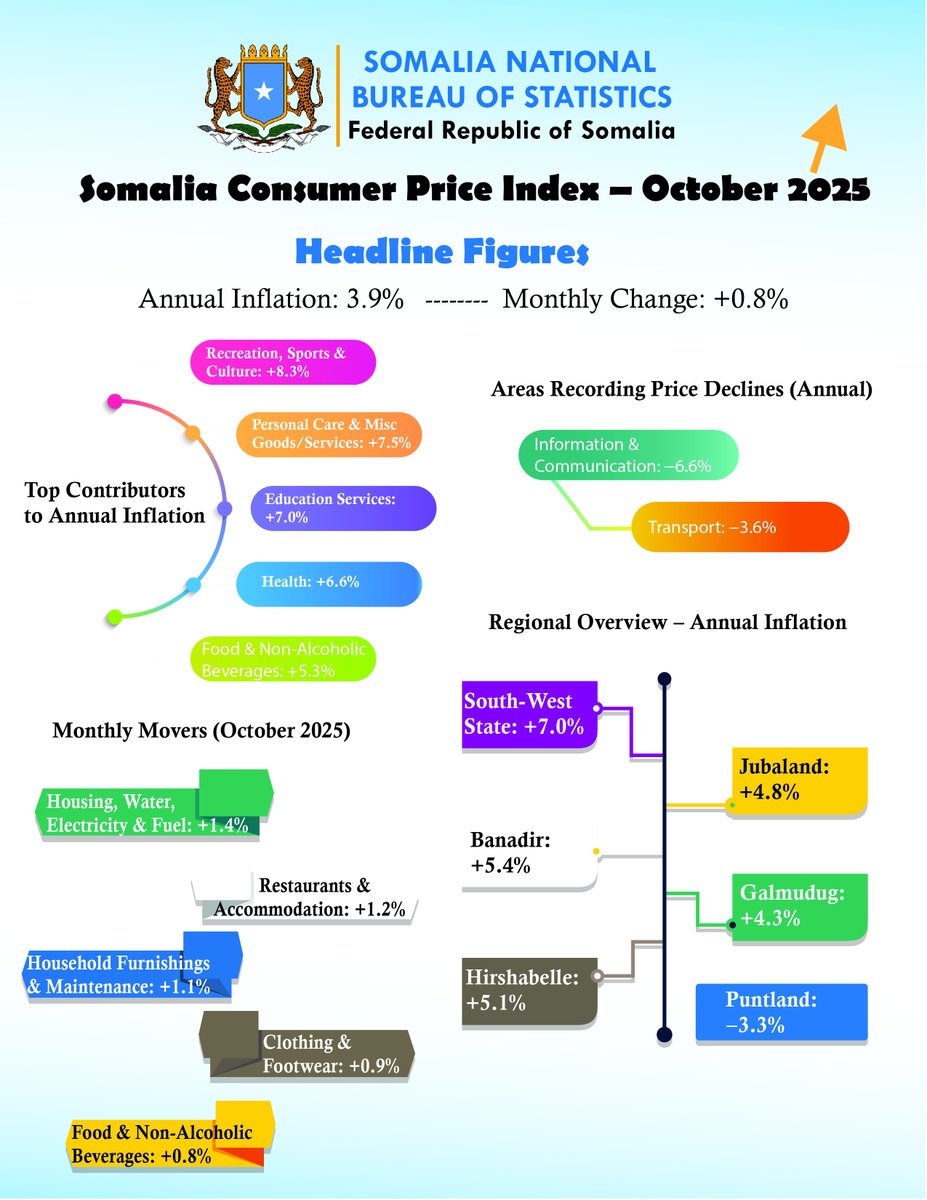
The latest SNBS October 2025 CPI data indicates an easing of food inflation both at the National level (+5.3% annually, +0.8% monthly) and across Federal Member States. While overall inflation rate stood at 3.9% in October 2025
#Somalia#CPI#Inflation#SNBS
SNBS releases October 2025 Consumer Price Index
Somalia’s annual inflation rate stood at 3.9% in October 2025, mainly driven by rising costs in Recreation, Sports & Culture (+8.3%), Personal Care & Miscellaneous Services (+7.5%), Education (+7.0%), Health (+6.6%), Food & Non-Alcoholic Beverages (+5.3%). Price reductions were recorded in Information & Communication (-6.6%), Transport (-3.6%), helping ease the upward pressure on overall inflation.
Month-on-month inflation increased by 0.8%, largely influenced by higher prices in Housing, Water, Electricity & Fuel (+1.4%), Restaurants & Accommodation (+1.2%), Household Furnishings (+1.1%), Clothing & Footwear (+0.9%), Food & Non-Alcoholic Beverages (+0.8%).
Regional inflation remained elevated in most Federal Member States (FMS) , with notable increases in SouthWest State (+7.0%), Banadir (+5.4%), Hirshabelle (+5.1%), Jubaland (+4.8%), Galmudug (+4.3%), while Puntland recorded a decline of -3.3%, helping moderate national average. Fore more information, visit SNBS website via the link below. https://t.co/LWcf7KBAc3 @AbdisalamHumbul@abdirahm_omar
Excellent work!. @NBS_Somalia It is an indispensable tool for Somalia's progress. It was a fantastic experience co-authoring this important brief with you DG @AbdisalamHumbul and Dr. @Hassanyarre2023. Thank you for your leadership and dedication.
Proud to co-author SNBS’s first Policy Brief with Hashim Sheikh & Dr. Hassan Aden—made possible by the dedication of our entire SNBS team. I urge policymakers & stakeholders to utilize this brief as an imperative reference for crafting informed, forward-looking economic policies.
Finally, 👇the court has declared the 2019 census report unconstitutional. Court orders fresh census in Mandera, Wajir, Garissa. KNBS asked to revert to 2009 census data.
I HAVE carefully read the recently released Kenya Housing Survey 2023/24 by KNBS. Well, I found some findings perplexing, intriguing and as well refreshing.
Here are a few interesting of findings from the survey report:-
1/2 🚀 This week marks the end of an incredible journey at @NIRASomalia, where I had the privilege of serving as Deputy DG and Acting DG for ~ 2 yrs.
I'm thrilled to announce the start of an another exciting chapter as the Managing Director of the Somali Payment Switch! 🌟
SNBS is pleased to announce the release of the much-awaited Gross Domestic Product (GDP) report for 2023, providing an insightful overview of Somalia's economic performance amidst global challenges.
The 2023 GDP report reveals Somalia's robust economic resilience, with GDP reaching USD 10.969 billion, marking a significant 4.2% increase from 2.7% in 2022. This growth was driven by thriving sectors such as construction, investment, and resilient livestock exports, underpinning Somalia's capacity to seize emerging opportunities.
Despite global uncertainties, Somalia maintains stable international trade dynamics, prominently supported by resilient livestock exports.
Equally, household consumption saw a notable 4.5% rise, reflecting growing domestic demand, while enhanced government revenue collection and prudent fiscal policies improved critical investments in infrastructure, education, and healthcare.
Looking ahead, Somalia remains well-positioned to enhance global competitiveness through sustainable development initiatives and inclusive growth strategies. For a comprehensive review of the report and detailed insights, please visit the SNBS website at https://t.co/4H1OmHnhIC
This report not only reaffirms Somalia's dynamic resilience but also underscores commitment to sustainable development and inclusive economic growth @SomaliPM@MoPIED_Somalia@MoF_Somalia@CentralBankSo@SharmarkeFarah@abdirahm_omar
#SomaliaEconomy #GDP2023
In April 2024, Somalia's All-Groups CPI decreased to 148.42 from 145.34 in March 2024, marking a monthly change of -2.12%. Significant increases were noted in Miscellaneous Goods & Services by 10.98%, primarily driven by a surge in Personal Care prices (19.55%), and in Furnishing, Housing, and Maintainers by 3.72%, led mainly by Glassware, Tableware, & Household Utensils (12.90%).
Over the twelve months to April 2024, the All-Groups CPI decreased to 5.21% from 5.86% in March 2024. Notably, Food & Non-Alcoholic Beverages experienced a 2.55% increase in April 2024, resulting in a year-on-year inflation decrease to -3.97% from -2.04% in March 2024. Similarly, Housing, Water, Electricity, & Gas saw a 1.56% increase, raising the year-on-year inflation to 10.58% in April 2024 from 8.88% in March 2024. For more on the monthly CPI Report, visit the SNBS website at https://t.co/F07XZoWU1E
@SharmarkeFarah@abdirahm_omar #SomaliaCPI #InflationAnalysis
Demographic data is very vital for all development planning in a country, because it provides detailed bench-mark data on all population characteristics. Despite the importance of census data, data consistency and credibility has been questioned in developing countries.
Kenya has carried out eight censuses; two pre and six post-independence censuses. These successful censuses have been held consistently every 10 years until the most recent of 2019, which recorded 47.6 million people. #Census2019Results
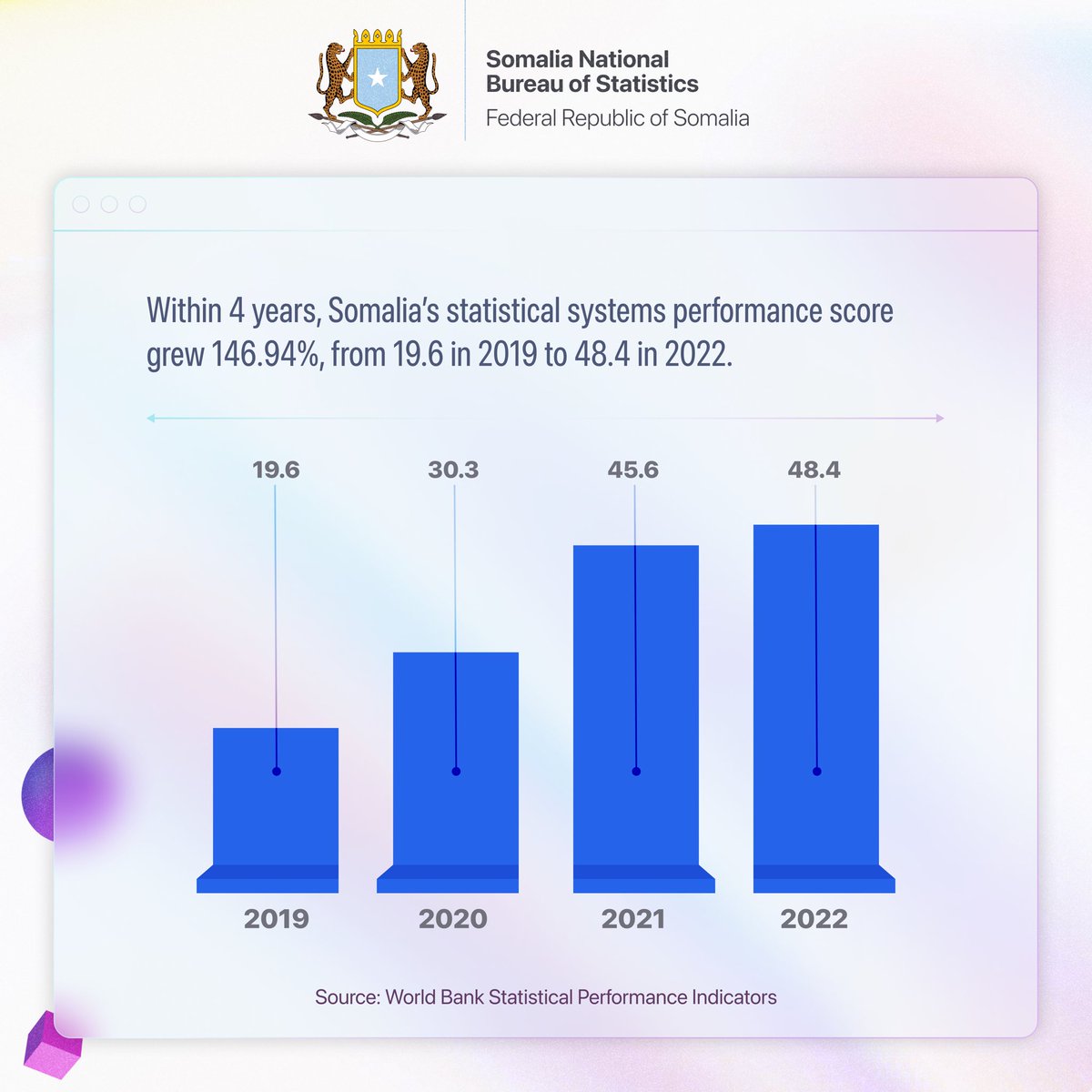
Huge progress as @WorldBank Statistical Performance Indicators Report shows Somalia’s SPI grew by 146.94%, from 19.6 in 2019 to 48.4 in 2022, thus moving continental ranking up to 39th place in 2022, from 2nd to last in 2019 @SharmarkeFarah@abdirahm_omar
https://t.co/KAcuYxTMgQ