Do you want #Kaspa#marketing at the top universities of the world? #KUDOS is organizing it.
The brightest minds coding with #Kaspa! This can be reality at the end of this month!
If you support this initiative, go to the $KAS Discord and give it a like: https://t.co/qCAshiRCfd
Many people say they want #Kaspa $KAS to go to the Imperial College London.
Yesterday we filed a proposal for funding, and overnight it has reached the needed threshold.
This means today there is a new formal vote to fund this event.
Go vote here:
https://t.co/cR8ECSdSaI
Take 35 seconds and vote on discord:
Establish a major #Kaspa presence at the Imperial College London AI Agent Hackathon, one of Europe's largest university-led AI and developer events.
**The Goal:** Bring $KAS directly to builders, researchers, founders, and students at leading global blockchain and AI hubs, securing a Gold Sponsorship slot at the event.
Click link to vote!
Another week, another sticker, another reminder to study #kaspa.
Slapped this one up at the local football field. Now every player, coach, group of friends or patent, young or old, is getting the message and asking the question... "what is $kas?"
@KarolPryka@tamy_mammi Nice. Airports are great for sure. Only problem is the cleaning teams there are ruthless ... but that's probably a good thing. They don't last too long but they still hit hard if they're big airports.
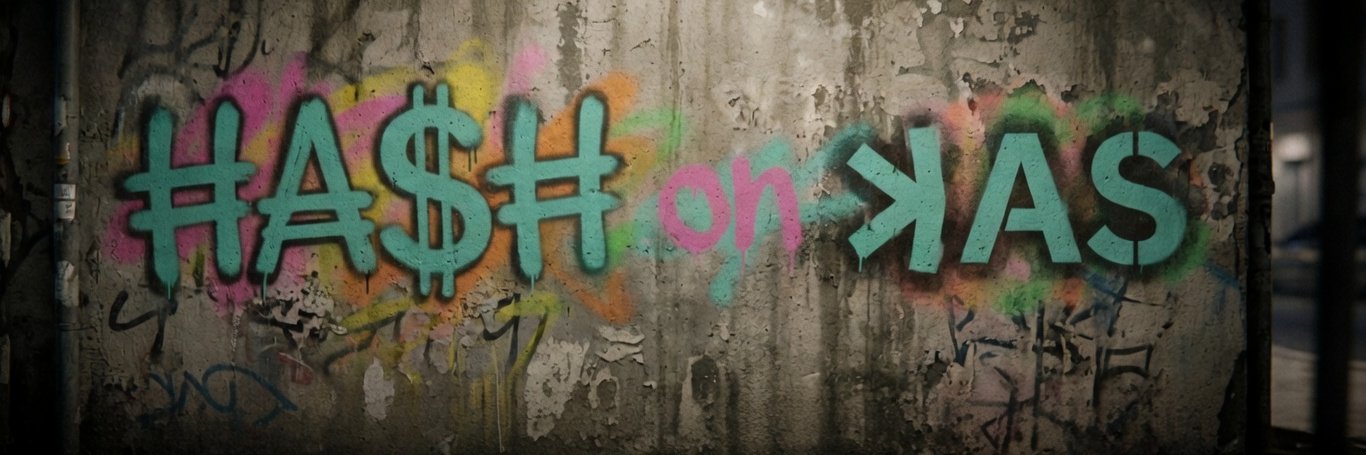
"So I've minted a #HASH NFT. You happy Gonzo? Now what?"
Happy to help. A few people have asked how the rewards system will actually work, so here's the high-level overview.
At the base level, every NFT holder gains access to the HASH ecosystem. From day one, that means eligibility for weekly giveaways simply by marketing #Kaspa in your day-to-day life.
Put up a sticker. Leave a poster. Draw some chalk art. Start a conversation. Snap a photo and submit proof through the channels we'll be launching soon. Then, every week, a winner will be selected.
No complicated scoring systems. No gatekeeping. Just proof that you're out there making noise.
Then come the monthly competitions, with larger rewards.
These will be larger campaigns focused on creativity and content. Poster design contests. Sticker packs. Infographics. Short-form videos. Educational content. Maybe a stunt or two.
And then, my favourite, the seasonal "Hash-athons".
The flagship events. Think hackathon energy, but for marketing.
Several times per year, the community will be given a shared objective and a fixed date. The challenge is simple: generate as much visibility for Kaspa as possible.
Maybe it's projection art. Maybe it's banners. Maybe it's a coordinated stunt across multiple cities. Maybe it's something none of us have thought of yet.
The goal is simple: make Kaspa impossible to ignore. So, these will carry the largest rewards and will require greater participation thresholds.
NFT holdings will act as the access mechanism for different reward tiers. One NFT gets you through the door and into the weekly giveaways, community activities, and smaller opportunities.
Higher-tier competitions, larger rewards, Hashathons, and major campaigns will require greater participation in the ecosystem through additional NFT holdings.
The bigger the mission, the bigger the reward, the more skin in the game. But that's only half of the picture.
Once Covenants arrive, HASH will begin rolling out marketing bounties. These will function like open contracts for visibility. A reward is posted. A goal is set. The $KAS is locked.
Maybe it's placing 500 stickers across New York. Maybe it's getting Kaspa mentioned on local television. Maybe it's something much bigger.
Complete the objective. Submit proof. Claim the bounty.
Simple.
Most importantly, none of this requires a full mint before it begins. If we mint out, great. We go bigger. If we don't, we start with what we have. The first NFT minted is enough to begin.
The giveaways start. The missions start. The momentum starts. And between the giveaways, competitions, Hashathons, and future bounty system, there should be no shortage of opportunities to earn $KAS while helping put #Kaspa in front of the world.
I'm just finishing setting up all the channels. Making some launch content. And polishing the NFT's. Stay tuned on for a timeline on launch. But currently targeting before June 19! Watch this space.
Put in the proof of work.
Create visibility. Generate attention. Make noise.
Every sticker. Every poster. Every campaign. Every conversation.
And earn $KAS.
#on𐤊
"... because Kaspa is a grass-roots movement, that responsibility does not belong to a marketing department, or a single leadership team. It belongs to the community. That also means the community has a different role to play."
#Kaspa. Powered by community.
That's a really good question, but it's hard to answer in a single tweet because our mission is quite extensive, and it requires a lot of background knowledge to really understand what sets Kaspa apart.
Currently, a lot of people see Kaspa as “Bitcoin’s crazy little brother” that improves time-to-finality by leveraging the benefits of DAG-based consensus protocols without accepting their traditional drawbacks, such as decreased decentralization or a limited validator set.
This perception is somewhat accurate, but it falls short of conveying the full picture, because Kaspa’s vision extends far beyond just trying to be a better Bitcoin.
Anyone willing to study Kaspa and its broader vision will discover similarities to nearly all major existing DLT designs: from Bitcoin, to Ethereum, to Solana, Sui, Celestia, and beyond.
My personal view is that “research” in the DLT space is approaching a point of convergence. We increasingly understand how to push distributed systems close to the limits of what physics permits. The frontier is no longer only about raw throughput or faster finality. The attention is shifting toward game theory, incentives, sequencing, MEV, alignment, and how to build systems where the economic incentives of users, builders, miners, validators, applications, and infrastructure providers do not work against each other.
That is why debates like based rollups versus arbitrary sequencing, shared sequencing, MEV mitigation, proposer-builder separation, and execution-layer incentives matter so much. These are not niche technical details. They determine whether a network can remain neutral, decentralized, and aligned while scaling to global usage.
And this is where I think Kaspa is pushing the boundaries in a very important way.
Kaspa is not merely trying to be “fast.” The goal is to build an L1 where speed, decentralization, security, and incentives are aligned at the base layer. A system that does not scale by hiding complexity behind trusted committees, privileged sequencers, centralized validator sets, or opaque coordination mechanisms, but instead tries to preserve the spirit of proof-of-work while extending what an L1 can realistically do.
Because Kaspa arrived later than many other major projects, it does not carry the same degree of technological debt. It can absorb lessons from Bitcoin, Ethereum, rollups, modular blockchains, high-throughput monolithic chains, DAG research, MEV research, and the broader history of decentralized systems, and combine those lessons into something more optimal.
To me, that is what Kaspa is building: not just a faster blockchain, but a more incentive-aligned decentralized infrastructure layer.
But this also creates a different challenge.
Kaspa’s biggest problem today is not its technology. It is the lack of centralized coordination around communicating the vision. And because Kaspa is a grass-roots movement, that responsibility does not belong to a marketing department, or a single leadership team. It belongs to the community.
That also means the community has a different role to play.
There will always be holders who are mainly interested in price, and that is completely fine. But there also need to be people who are here because they want to use the technology to build a different future. People who care about the architecture, the incentives, the open questions, the trade-offs, and the long-term trajectory of decentralized infrastructure.
I am one of those people.
I am not interested in DLTs merely as a way to generate wealth. I am interested in them because I believe they can change the trajectory of humanity as a whole.
For that reason, I want to use this opportunity to announce a regular community hangout where we discuss the current state of development, the open questions, and where we can align our vision together.
The first session will be on Tuesday, June 9th, 2026.
We will talk about the vProgs framework, how the codebase works, what sets Kaspa apart, where we improve on existing solutions, and what still needs to be done. The goal is for this to become a regular, possibly bi-weekly, event where we as a community come together to discuss the future and understand the technology.
Eventually, we can invite people from other projects as well, but the main focus at the beginning will be explaining and communicating how things work under the hood.
There is still a lot of work to be done, and I do not want to waste precious time. So the first sessions may feel a little improvised, but we can improve as we go.
The important thing is that we start.
So mark the date: Tuesday, June 9th, 2026.
@CodesXBT@Dr_Gonzo_K@tamy_mammi@realvijayk Heres an example of what to expect. Goal is eye catching. A simple message that translates. And creates curiosity.
Will make some QR code ones too.
Great lines too. Will add to the list.