Since June, lld has been getting AI-drafted bug reports in batches. Since late October they end with "a possible fix", and some rando turns each into an AI-assisted PR: the suggested fix verbatim, the reproducer pasted in as the test. Review lands on the maintainer twice.
https://t.co/BfqvnqOd1q "Unfortunately comments from Disqus have not been migrated yet" => I imported the comments from the Disqus export (`comments.xml`) with an Opus 5.5-written Python script that calls the GitHub GraphQL API via `gh api graphql`.
Google's requirements have drifted away from the already very broad range that lld, and llvm-project at large, serves. A feature only one company's internal pipeline might need should prove itself there before it lands upstream, where everyone maintains it.
In 2020, reviewing lld's --optimize-bb-jumps (https://t.co/sD35KLTMJu), I asked that the pass run inside finalizeAddressDependentContent "to accommodate thunks and linker script symbol changes." The author replied: "Could we do this in a later patch?" There was no later patch.
and another lld maintainer independently flagged the misplacement and found my 2020 comment.
When I left Google in 2024, --optimize-bb-jumps still had no users. The answer was always "we will use it." Today nothing in llvm-project passes the flag; only three lld tests do.
I was junior; he was far more senior. Landing a feature on a promise of future use, and deferring the reviewer's design concern to "a later patch", is not how open source should work.
That placement was a wrong-code bug from day one: the pass shrinks .text after .relr.dyn is computed, so RELR entries point at the wrong words.
Since a change this year, .eh_frame_hdr search keys go stale too.
An AI-assisted patch surfaced it recently,
https://t.co/gOAU1Mh1j6 Who pays for Clang
Another AI slop post. Commits by employer, What each funder works on, Review, Shared and vendor-specific work
I spent many hours driving the agent through Discourse threads, slides, source trees, and LinkedIn profiles to generate this AI slop: https://t.co/fwtUrRQD1O ClangIR and the cost of MLIR
For C++ programmers who were Clang's main constituency, CIR has to earn its place by being better at what the AST, the CFG, and classic CodeGen do today: diagnostics, safety analyses, and optimizations that need C++ semantics, without making the compiler slower to build or run
The new funders build GPU and accelerator compilers, and their other compilers (Flang, Triton, IREE, their own stacks) are built on MLIR. For them, a Clang that emits an MLIR dialect is the point, not an implementation detail.
https://t.co/WnMmvk6wup
Indexed forwarding functions such as std::make_unique<A>(...) and std::vector<A>::emplace_back(...).
Hover on an auto variable in a function template shows the deduced type when the template has exactly one instantiation.
Adapt to LLVM 22, 23 and 24.
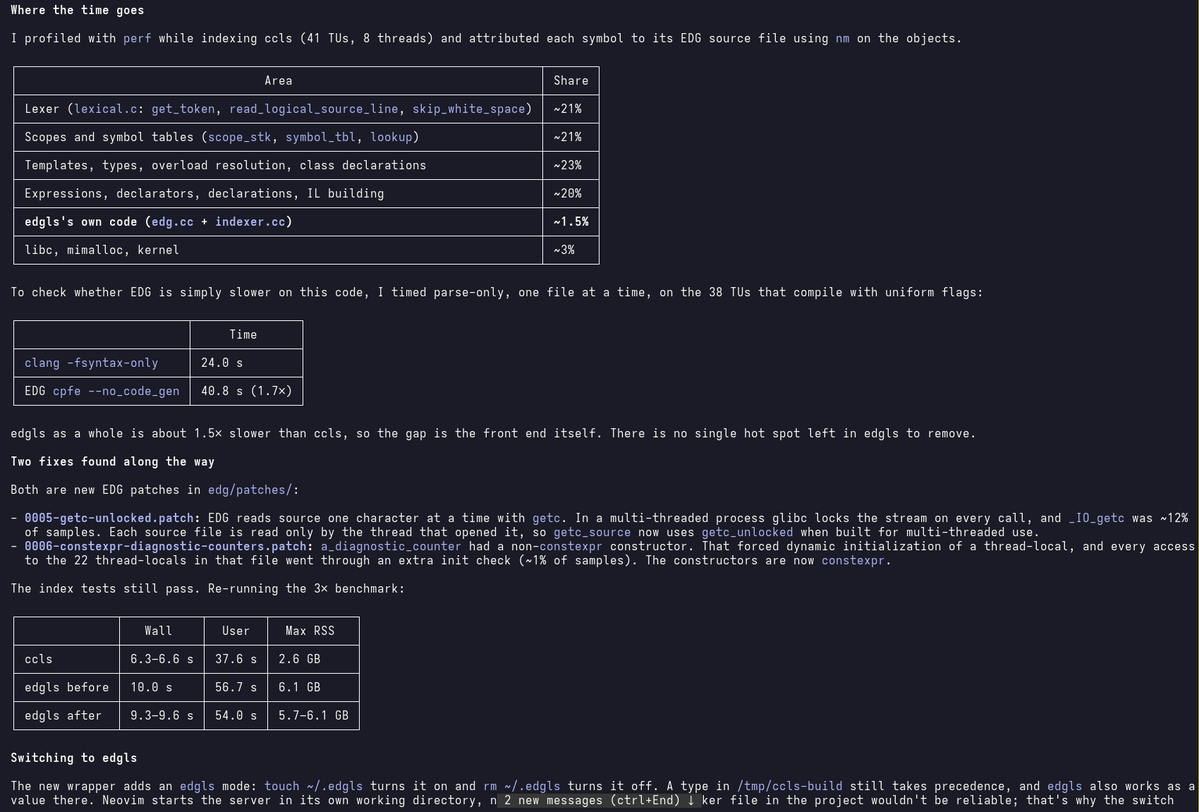
edgls is a C/C++ language server built on the EDG C/C++ front end. It is a fork of ccls with the clang-based parts replaced: the indexer, diagnostics, compile command handling, code completion, signature help, and formatting. https://t.co/cTkRjMA5rq
Verdict: Slower than clang