Hawks Fans: Would You Want the Front Office to Decline Kuminga’s $24.3M Team Option and Pursue a Longer-Term, Team-Friendly Extension?
2025-26 Atlanta Sample (post-GSW trade, Feb 24 debut): 16 GP, 22.1 MPG → 12.3 PPG, 5.3 RPG, 2.1 APG, 0.9 SPG on 47.6 FG% / 34.6 3PT% / 70.2 FT%.
Per-36: ~19.9 PTS, 8.6 REB, 3.4 AST. TS% 57-59%, strong rim (~55% on 2s), DREB% spike.
Advanced Impact: Elite ~104.5 DRTG (98th percentile) with JK on floor; strong rim protection, TO forcing, rebounding. Team 8-0 in his early games; multiple efficient 20+ PPG outbursts (e.g., 27 PTS debut, 9-12 FG).
Playoffs (6 GP, ~26 MPG): 13.7 PPG on 48.3/20.8/73.1 with modest secondary stats—typical small-sample volatility for a 23-year-old in first deep run.
Contract Context: $24.3M team option for 2026-27 (decision by June 29). Declining makes him UFA, opening path to negotiate a multi-year deal at lower AAV than the option year (BORD$ values ~$9.4M as high-end reserve).
Case for Decline + Long-Term Extension: At 23, Kuminga’s 6’7” explosive wing tools (athleticism, switchability, secondary creation) delivered positive on/off and lineup impacts in limited minutes.
A 3-4 year structured extension (e.g., front-loaded or incentive-heavy) could secure him below $20M AAV while preserving cap flexibility for contending-adjacent moves—better long-term financial sense than a one-year $24.3M commitment or letting him walk for nothing.
Hawks fans: Pick up the option for another eval/trade year, or decline now and lock in a value extension? What’s your preferred path?
#TrueToAtlanta
The 2025-2026 season was not a failure or a retreat from an otherwise stellar rookie season from the former #1 overall draft pick in the 2024 NBA draft. It was merely a “tactical withdrawal” for Zaccharie “The RZA Man” Risacher to reposition, regroup, assess the changing terrain of the NBA, strengthen his body, and return with a renewed strategic advantage.
Rookie Season (2024-25): Strong foundational 3&D emergence with late surge
Risacher played 75 games (73 starts), averaging 24.6 MPG, 12.6 PPG, 3.6 RPG, 1.2 APG, 0.7 SPG, 0.5 BPG, on 45.8% FG, 35.5% 3P (4.6 3PA), 71.1% FT. He finished 2nd in ROY voting and made All-Rookie First Team.
What he did very well (technical strengths):
• Catch-and-shoot/off-ball shooting (core skill): ~90% of 3PA were catch-and-shoot. He shot ~36.7% on these overall (improving to ~42.5% post-Jan 15). Strong from corners; above-the-break (ATB) threes were initially poor (~18% early) but rose to ~38% later. Shot quality was high (83rd percentile among movement shooters), with most looks wide-open due to smart selection and Hawks’ spacing. Quick release, high release point.
• Off-ball movement and cutting: Excellent timing/angling for cuts (45° or baseline), relocation, and screening actions. High assist rate on 2P makes (>70% assisted). Creative finisher in transition and at rim with either hand or mid-air changes. Floater development showed flashes.
• Defense and versatility: Solid perimeter defender for a 19-year-old rookie. Good lateral quickness, help defense, isolation defense (0.94 PPP allowed), low foul rate. Versatile switching (wings, some guards/forwards). Contributed blocks/steals for position; not a liability in team schemes despite advanced metrics reflecting rookie adjustment.
• Decision-making and efficiency surge: Slow start (first ~39 games: ~40/28/71, poor TS%). Post-adductor strain (second half, 36 games): 14.8 PPG on 51/42/71, Rookie of the Month (Feb/Mar). TS% jumped dramatically. Sound passer in drive-and-kick/spotting cutters (low volume but quality). Rebounding neutral-positive for role.
Areas of limitation in Year 1: Low creation/usage (~20-21% USG). Drive finishing weak (~42% on drives). Early inefficiency, especially ATB threes and rim/floater. Limited on-ball creation and strength in traffic.
Advanced context: Positive eFG% (~.537), but BPM/WS/48 reflected rookie variance and team context. High minutes/starter load for a young wing showed coach confidence.
Second Season (2025-26): Role compression but efficiency/versatility holds
67 games (46 starts), 22.4 MPG, 9.6 PPG, 3.8 RPG, 1.1 APG, 0.9 SPG, 0.5 BPG, on 45.5% FG, 36.8% 3P (3.9 3PA), 64.4% FT. Usage dropped (~17.7%), points per game fell with deeper Hawks roster, but efficiency was stable/slightly improved in spots amid fluctuating minutes/role.
Improvements/continuations:
• Slight 3P uptick and consistency: 36.8% on lower volume; maintained catch-and-shoot threat while adapting to shared spacing/creation.
• Defensive activity: Steals up to 0.9 SPG; continued versatility without major regression.
• Rebounding: Modest bump (3.8 RPG), showing physical/positional growth.
• Adaptability: Handled inconsistent role/minutes better than expected. TS% held near prior levels (~55-56%). Per-36 scoring dipped but with lower usage/load.
Challenges: Fewer opportunities in competitive lineup; FT% dip; overall “step back” narrative due to raw counting stats despite efficiency. Playoff minutes/role were limited in some series.
Jonathan Kuminga’s 2025-26 season with the Atlanta Hawks: A strong case for exercising the $24.3M team option + extension.
Acquired midseason from Golden State (debut Feb 24), the 23-year-old athletic wing delivered in a limited but impactful sample: 16 GP, 22.1 MPG → 12.3 PPG, 5.3 RPG, 2.1 APG, 0.9 SPG on 47.6% FG / 34.6% 3P / 70.2% FT.
Key efficiencies & advanced metrics (Hawks tenure):
• TS% in the 57-59% range in Atlanta (stronger than several prior GSW windows), with solid rim finishing (~55% on 2s) and improved 3PT volume.
• Per-36/100: ~19.9 PTS, 8.6 REB, 3.4 AST; strong rebounding impact (DREB% spike, team DREB% reached 99th percentile with him on floor).
• Defensive impact: Hawks posted elite ~104.5 DRTG (98th percentile lineup) with JK on court, plus strong rim protection, turnover forcing, and defensive rebounding.
• Early surge: Team went 8-0 in his first games played; multiple 20+ PPG efficient outbursts (e.g., 27 PTS debut on 9-12 FG).
Playoffs context (6 GP, ~26 MPG): 13.7 PPG on 48.3/20.8/73.1 splits with modest rebounding/assists. Small-sample volatility typical for a young player in his first deep playoff run with a new team.
Why pick up the option & extend? At 23, Kuminga offers high-upside 6’7” wing traits (explosive athleticism, secondary creation, switchable defense) with proven positive on/off and lineup impacts in Atlanta. His contract control gives flexibility—exercise for another evaluation year at a team-friendly number or use the option year to negotiate longer-term security before UFA. Production + age trajectory screams value for a contending-adjacent Hawks core.
Lock in the athleticism and two-way potential now. #TrueToAtlanta
Hawks Nation: Which ATL #Hawks player has the highest MIP upside for 2026-27?
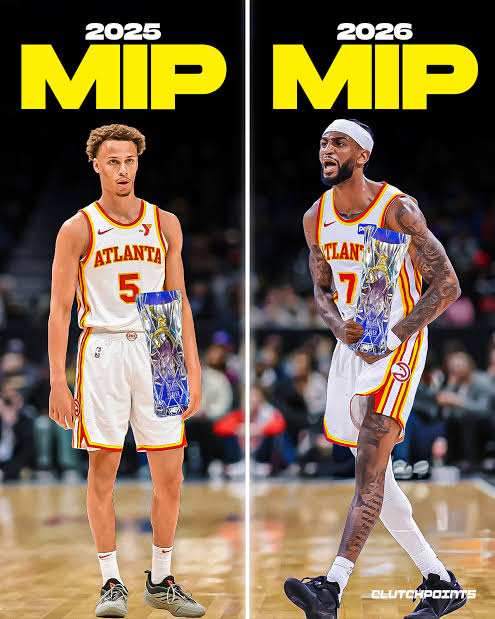
Atlanta has now produced back-to-back MIP winners for the first time in NBA history — Dyson Daniels (2024-25: massive leap in scoring to ~14+ PPG, steals leadership, defensive impact, and playmaking) followed by Nickeil Alexander-Walker (2025-26: career-high 20.8 PPG on .459/.399/.902 with huge usage/volume jump, +11 PPG YoY improvement, career-best efficiency and minutes). This underscores Atlanta’s proven player-development machine turning high-upside talent into award-winning breakthroughs.
Who would you MOST want to see take that leap and win Most Improved Player next season — and more importantly, who puts the Hawks in the BEST position to compete in a stacked East?
Let’s break it down technically
1. Zaccharie Risacher (2nd-year wing, 6’8”, 21 y/o)
Coming off a solid rookie foundation: 9.6 PPG, 3.8 RPG, 45.5 FG%, 36.8 3P% in ~22 MPG. Elite frame, length, and defensive versatility already. The leap looks like 18-20 PPG on 48/38/75+ splits, expanded playmaking (1.5+ APG), and becoming a two-way wing who spaces the floor next to Trae while guarding 1-4. If his handle tightens and he adds strength, he’s a future All-Star candidate. MIP favorite for continuity.
2. Mouhamed Gueye (PF/C, 6’11”, athletic rim protector)
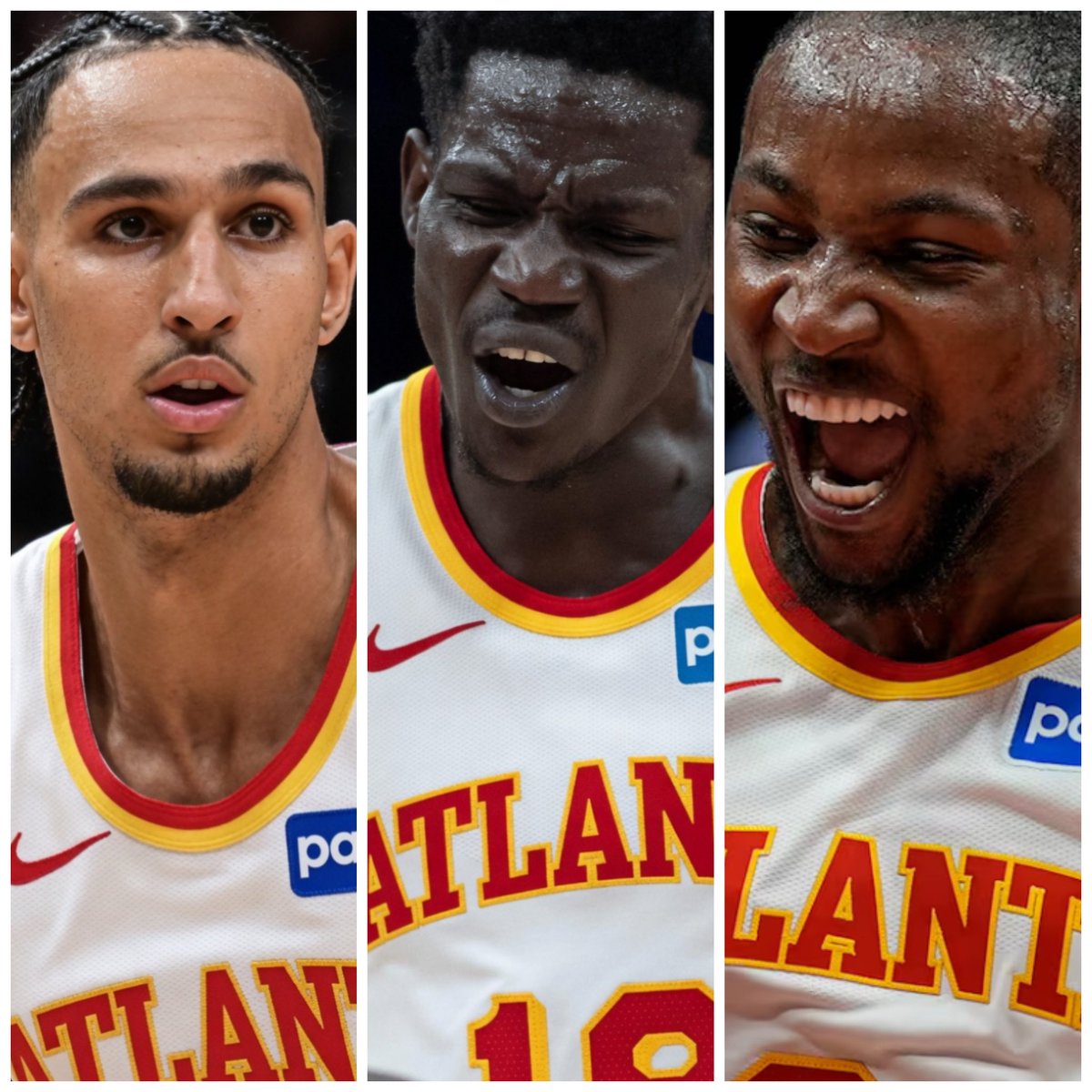
Underrated glue guy: 4.4 PPG, 3.6 RPG, 0.9 APG, 0.5 BPG in 15 MPG with solid efficiency (~45% FG). High motor, switchable defense, and rebounding pop. Next-level version: 10-12 PPG, 7-8 RPG, 1.5+ BPG as a starter/6th man, improving stretch (better than 31% from 3), and becoming Onyeka/Jalen Johnson’s perfect complement or backup. Rim-running + perimeter D could anchor a better Hawks bench/2nd unit.
3. Jonathan Kuminga (Athletic forward, 23 y/o, post-trade addition)
Explosive finisher with star tools. In limited ATL action post-trade: strong scoring bursts (~12+ PPG in ~22 MPG sample). Raw but elite athlete — if he refines decision-making, adds consistent 3PT shooting (currently ~33-35%), improves FT%, and channels that burst into efficiency + playmaking, he could explode to 20+ PPG, 6+ RPG, All-Star trajectory. Highest raw ceiling but biggest “if” on consistency & fit.
Who do you like for 2026 Hawks MIP⁉️
#TrueToAtlanta
Hypothetical Hawks Front Office Memo: Operation “Grit in the A” – Acquiring Ja Morant
In a league where athleticism is the ultimate cheat code and the Eastern Conference remains a chaotic arms race, the Atlanta Hawks should aggressively pursue a blockbuster trade for Memphis Grizzlies superstar Ja Morant. This isn’t just splashy headline bait—it’s a high-upside, technically sound roster retool that leverages salary matching mechanics under the current CBA while injecting elite explosiveness into a Hawks squad built for transition and versatile defense.
Salary Matching Breakdown (Very Technical Edition)
Ja Morant’s current deal (5-year, $197M extension) carries a 2025-26 cap hit of ~$39.45M and escalates to $42.17M in 2026-27. That’s a massive anchor, but the Hawks’ flexible cap sheet post-Trae Young era makes it feasible.
Proposed Framework (Balanced for both sides):
• Hawks send out: CJ McCollum (~$30.67M in 2025-26) + salary filler (e.g., a combination of Onyeka Okongwu ~$16M range contracts or expiring deals + young assets like a protected first-round pick and seconds).
• Incoming: Ja Morant + minimal salary ballast from Memphis to hit the 125% + $100K matching rule (or closer to 100% post-deadline depending on apron status).
Under CBA trade rules, teams can aggregate salaries with padding: outgoing ~$30-35M+ can absorb up to ~$42M incoming without triggering hard apron restrictions if Atlanta stays below the second apron threshold. Memphis, sitting with significant cap space and a rebuilding posture after injuries and a tough season, gains veteran leadership/scoring plus future draft capital to pair with their lottery assets and young core.
No apron overages for Atlanta if structured cleanly—McCollum’s deal comes off the books soon-ish, preserving flexibility for Jalen Johnson’s extension window and Onyeka Okongwu’s deal. This keeps the Hawks under the tax while upgrading talent. Fun fact: It’s like swapping a reliable mid-range sedan for a Lamborghini that occasionally does backflips—risky, but the torque is undeniable.
How Ja Makes Atlanta a Better Team (The Fun + Technical Upside)
The current Hawks roster—headlined by Jalen Johnson (All-Star caliber stretch-4/5 hybrid), Dyson Daniels (elite 6’7” defensive guard), Onyeka Okongwu (rim protector/roller), and wings like Risacher/Kuminga—has size, switchability, and spacing. But they lack a true alpha creator who can generate gravity in transition and collapse defenses vertically.
1. Explosive Transition & Rim Attack (The “Dunk City 2.0” Factor)
Ja’s elite burst (pre-injury career ~70th+ percentile in drives and rim frequency) pairs perfectly with Atlanta’s length. Imagine Daniels and Johnson setting up Ja in semi-transition—Morant’s 1.2+ points per drive potential would feast on Okongwu’s elite screening and Johnson’s playmaking. Hawks currently rank solid but not elite in pace; Ja pushes them into top-5 territory by forcing help rotations that open 3s for Risacher and Kuminga. Slightly fun visual: Ja doing a 360 off the glass while the State Farm Arena crowd loses it—pure electricity.
2. Defensive Synergy (Technical Fit)
Memphis has struggled with consistency around Ja, but Atlanta’s scheme under a modern coach thrives on versatile 1-5 switching. Pairing Morant’s improving POA defense with Daniels’ elite wingspan creates nightmare backcourt pressure. Johnson’s help-side instincts + Okongwu’s drop coverage cover Ja’s occasional gambling. Net rating boost projected: Hawks’ current ~+2.4 could jump significantly with an upgrade at the point of attack.
The Knicks will lose the series.
They lost 2 games to Atlanta & the Hawks have yet to play a good offensive game.
A Nickeil 30 ball is sending them home atp.