Axis Robotics is building the backbone of the Physical AI economy, commercializing robot intelligence as infrastructure that benefits both developers and contributors, helping accelerate the future of autonomous robotics.
@plpiaoliang@iamlogtun
How Axis Commercializes
@axisrobotics isn't focused on selling robots, it is building the infrastructure that enables the next generation of intelligent machines. By combining AI, simulation and decentralized coordination, it is transforming how robot intelligence is created.
Instead of commercializing individual robots, Axis commercializes the entire robot training pipeline. By providing scalable data infrastructure and simulation-powered datasets, it lowers development costs while giving companies access to diverse, high-quality training data.
Update!!
@axisrobotics just dropped something huge for the Physical AI community!
The Policy Checker Page is LIVE — transparent, interactive and running in your browser.
Check intermediate policies, watch real-time inference (dice into bowl demo is wild), view success heatmaps, and see exactly how these models perform.
This level of openness on training + failure recovery groundwork is next-level.
The future of robot intelligence truly is built by all.
How Axis Robotics Turns Physical AI Infrastructure Into a Business
Building robot intelligence is only valuable if it can solve real-world problems.
This is why @axisrobotics follows a PMF-first (Product-Market Fit) approach, focusing on commercial demand rather than relying solely on speculative incentives.
At the center of this model are Task Packages.
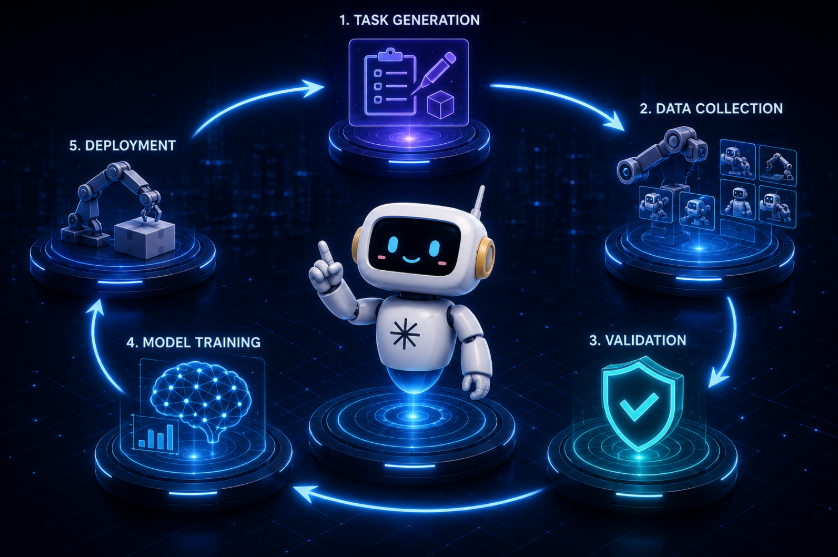
Enterprise customers can request customized datasets tailored to specific robotic tasks, environments, and embodiments. These task packages are generated through Axis' simulation infrastructure and distributed contributor network, producing the data required to train and improve robotic policies.
The process forms a complete loop:
Task Generation → Data Collection → Validation → Model Training → Deployment
As enterprises purchase these datasets and services, a portion of the revenue generated from those tasks flows back to contributors who helped create the underlying data. This aligns incentives between customers, builders, and the community.
Axis is also expanding beyond data collection. Its roadmap includes the Task Generation Engine API, an end-to-end data-to-model pipeline, and an open ecosystem where users can train models directly on the platform.
Rather than competing with robotics companies building embodiments or foundation models, Axis aims to become the infrastructure layer that powers them.
In this model, Physical AI becomes a network where commercial demand drives data creation, contributors supply intelligence, and models continuously improve.
For Axis Robotics, commercialization is not about selling robots. It is about building the data and simulation infrastructure that enables robots to learn at scale.
@plpiaolian @Rainhoole@0xsexybanana@iamlogtun
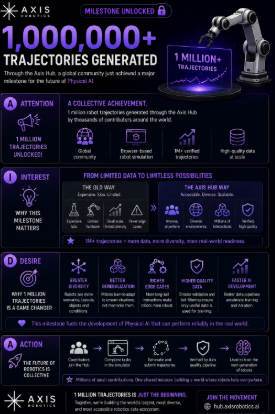
1 million robot trajectories.
It is more than a milestone, it is proof that robotics data can now scale like software.
Every trajectory represents a robot completing a task, capturing movements, decisions, and environmental interactions that can be used to train Physical AI.
The 1M milestone signals a shift from isolated data collection to scalable robotics infrastructure.
Because the future of Physical AI won't be built by a single lab. It will be built by millions of verified interactions.
@iamlogtun@plpiaoliang
1 million robot trajectories.
It is more than a milestone, it is proof that robotics data can now scale like software.
Every trajectory represents a robot completing a task, capturing movements, decisions, and environmental interactions that can be used to train Physical AI.
But the value isn't just in the number.
More trajectories mean greater task diversity, richer edge cases, and better generalization, helping robots adapt to unfamiliar real-world environments instead of memorizing fixed scenarios.
That's why Axis also applies strict bot filtering and quality validation, removing low-quality submissions before they become part of the training dataset. More data isn't the goal. Better, diverse & verified data is.
Because smarter robots start with smarter training.
@iamlogtun
Most robots don't fail because of bad AI. They fail because of bad training data.
Training the same task in the same environment teaches robots to memorize, not adapt.
@axisrobotics tackles this with in-task randomization.
1/3
Instead of repeating identical scenarios, object positions & environments change while the task stays the same. Every successful interaction adds more diverse experience, helping robots generalize beyond simulation. But scale is only useful if the data is trustworthy.
2/3