This is not a photograph.
Every leaf and every reflection was put there by hand, in oil, by the Danish painter Peder Mørk Mønsted in 1894.
It is called Wooded path by a river, and it captures the hardest thing there is to paint: a forest in full sunlight. Light through trees never falls evenly. It scatters into countless flecks of brightness and shadow, a glow on one leaf, darkness on the next, a glint on the water that would vanish the moment a cloud passed. Get those even slightly wrong, and the whole thing collapses into a green blur.
Mønsted got every one of them right, and in doing so he captured something anyone who has stood alone in a wood will recognize immediately: that hush that falls over you, the sense of being completely at peace, and the feeling that the whole world has paused to breathe…
In 2016, a dog slipped into a steep concrete channel in Kazakhstan and couldn’t get back out.
A young man climbed down to save it and got stuck too.
Strangers along the bank linked arms, made a human chain down the wall, and pulled them both out.
Ten years later, Kazakhstan put the whole thing in bronze.
But look at the last hand.
It reaches past the railing so anyone walking by can grab it and become the next person in the chain.
What a great idea for a monument.
They say the devil hates his servants the most.
Here's why...
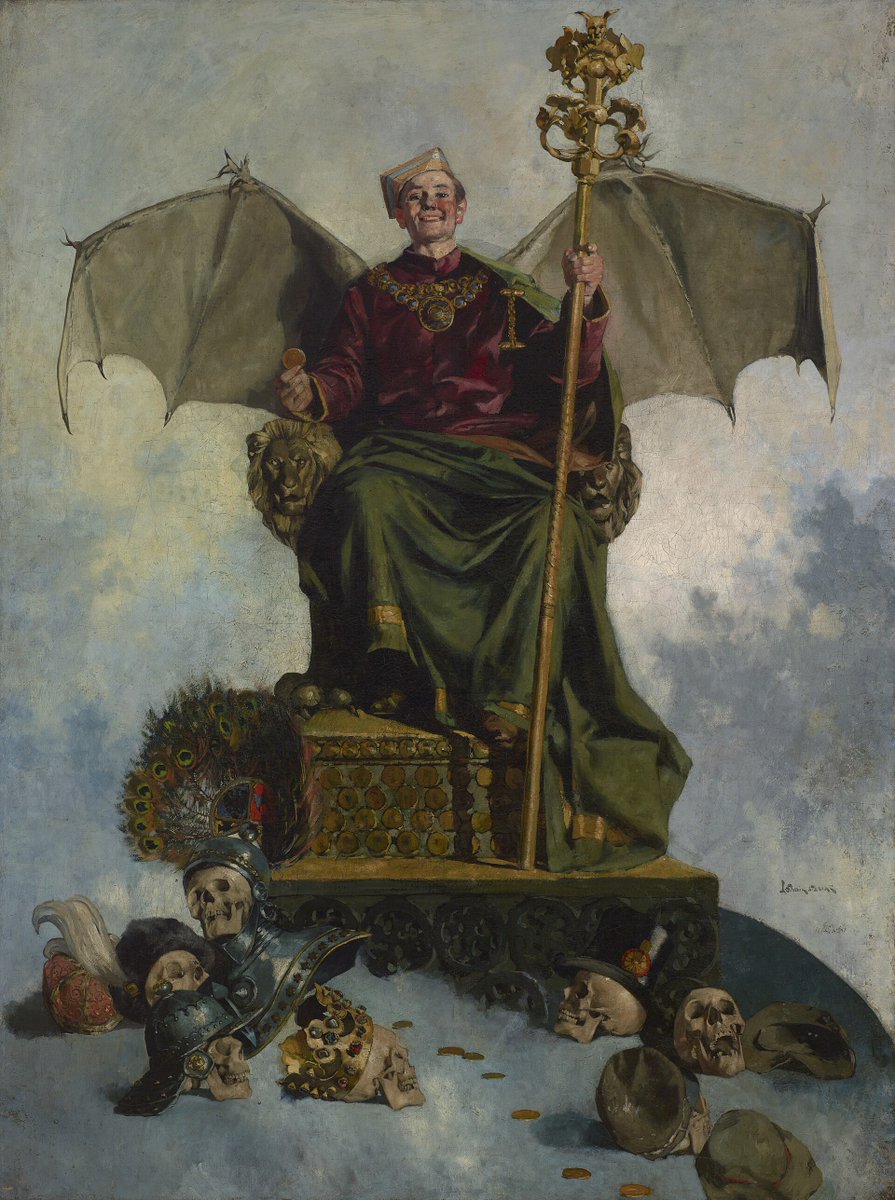
This painting is called Allegory of Satan, or Lord of the World, painted around 1900 by the Polish artist Ludwik Stasiak. It is not the devil you might expect. There are no flames, no chaos and no horns leering out of the dark. Stasiak painted something far more unsettling.
Here the devil sits enthroned like a ruler of the world, with a sardonic grin on his face, surrounded by the symbols of earthly power: wealth, ambition, domination. Evil, he suggests, never arrives as something horrifying that we instantly reject. It arrives as something attractive. It looks like success. It looks like money, and status, and control. It looks like everything the world tells us to want.
And that is what makes the painting feel so modern, more than a century after it was made. Stasiak was working at the turn of the twentieth century, an age obsessed, like ours, with progress, fortune and getting ahead. And he was warning that the most dangerous evil is not the kind that frightens us, but the kind that seduces us, the kind we serve willingly because it promises to make us powerful.
Which brings us back to the old saying: "the devil hates his servants the most." Look closely at what lies beneath his throne. Scattered at its base are the skulls of the powerful, still wearing their crowns and their helmets in death, the very people who traded their souls for money and power. And he sits above them, amused, because the joke is on them. This is why the devil hates his servants the most: he does not respect them for serving him, he despises them for it, because they handed over the only thing that ever mattered in exchange for things that rot.
It's my favorite depiction of Satan because Stasiak did not depict a devil we would run from, he painted a devil we would kneel to, and follow, and call our lord, mistaking our own chains for a crown. And I think that comes much closer to the truth. The artist was giving form to a warning as old as the Gospels themselves:
"No one can serve two masters. You cannot serve both God and money."
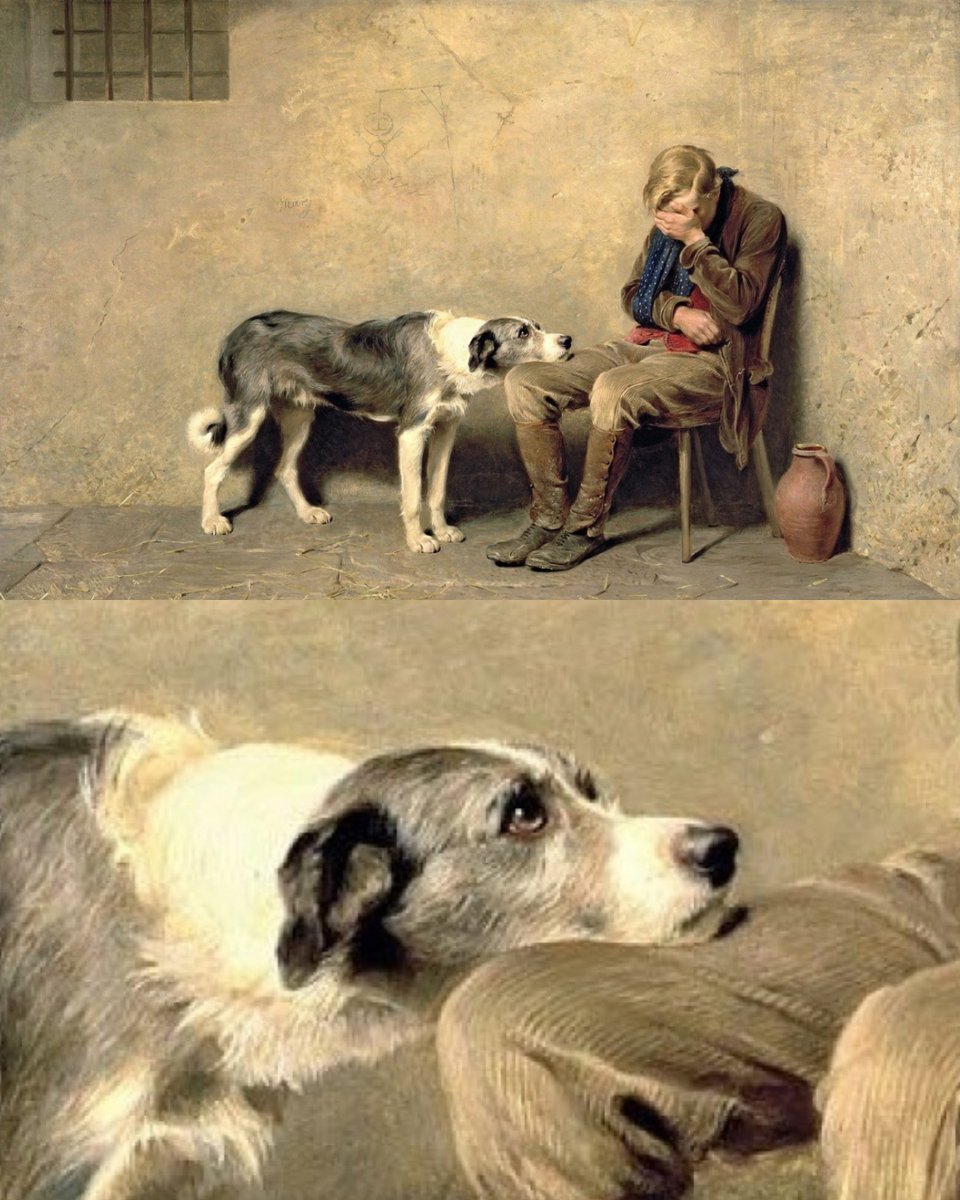
Anyone who has ever had a dog knows this look. It's the one they give you when they can tell something is wrong, and they have decided they are not leaving your side...
This beautiful painting is called Fidelity, and it was made by British artist Briton Rivière in 1869. A young man sits in the corner of a cold prison cell, awaiting trial. He is a poacher, caught taking game in an age when that could ruin a life. And pressed against his knee, gazing up into his face, is his dog, who has followed him even here.
You cannot see the man's face, Rivière hides it so that the entire emotional weight of the painting falls onto the dog. We are left to read the man's sadness in the animal's eyes.
The dog knows nothing of poaching or laws. It only knows that its person is hurting. And anyone who has ever loved a dog knows that look: "I don’t understand what has happened, but I know you are sad, and wherever you go, I will go too." The cold, the fear, the locked cell, none of it matters. Leaving him was never even a choice...
That is the meaning of the title Rivière chose for the painting: Fidelity. Faithfulness that asks for no reason and no reward. As American humorist Josh Billings once said: "A dog is the only thing on earth that loves you more than he loves himself."
In 1963, an archaeologist walked into a cave and stumbled upon something that shouldn’t have existed.
Hidden behind decades of dirt and fallen rock sat Gümüşler Monastery - a massive Byzantine sanctuary carved directly into a single block of volcanic rock, completely untouched for years.
When the dust cleared, researchers found a world-first: the only known Byzantine depiction of the Virgin Mary holding a subtle, unmistakable - 🧵 /1
This is not a photograph, and it's not an oil painting. It might be the most unbelievable watercolor ever made...
It's called Sommarnöje, which means something like Summer Delight, and Anders Zorn painted it in 1886. Look at the water, the gentle ripples, the reflections, the wet sheen of it, and then look at the two people, the fine detail of the wooden rowboat, the woman's white dress, the light on her face.
It has the near-photographic realism of an oil painting, and it was done in watercolor, a medium so unforgiving that a single wrong stroke ruins the entire piece.
Zorn painted this in the first summer of his marriage: the woman in white waiting on the pier is his new wife, Emma, whom he had married only months before. They had just come back from their honeymoon and were staying with her family at Dalarö near Stockholm, still looking for the home where they would spend their life. The man rowing toward her is their friend Carl Gustav Dahlström. It is a real moment from the happiest season of a young couple's life, caught and held forever.
In 2010 this single sheet of watercolor sold for twenty-six million Swedish kronor, over three million dollars, the highest price ever paid for a Swedish painting.
In his own lifetime, Zorn was celebrated above all for two things: his handling of light, and his ability to paint water. Sommarnöje is where you see exactly why...