@RetirementTales Schools out by Alice Cooper seems apt
An orange juice and lemonade with loads of ice
A smoked salmon sandwich to celebrate a few good years
@thebowlerhatman@MichaelRosenYes The obituary section of awards ceremonies inevitably leave out some important contributors that died. It must be a blow to those who have worked with or are related to them. The organisers of these events need to do better to avoid offence.
@shadylady222 Good luck to all the students and teachers who are facing their GCSE and A level exams this spring/summer. You’ve all worked really hard to get to this point. Students care and their teachers care about how they do. I know how much work and effort it takes 🤞🏼
@jennyeclair They’ll die back but come next year and spread so keep them. Possibly put them in a bigger pot together. You can always split them up into smaller pots in the winter/early spring next year
SIR IAN MCKELLEN. He is doing so many things here at once: giving an acting lesson, giving a history lesson, emphasizing the power of arts, AND eloquently speaking against ICE & silencing anti-immigrant bigotry.
Wow…..
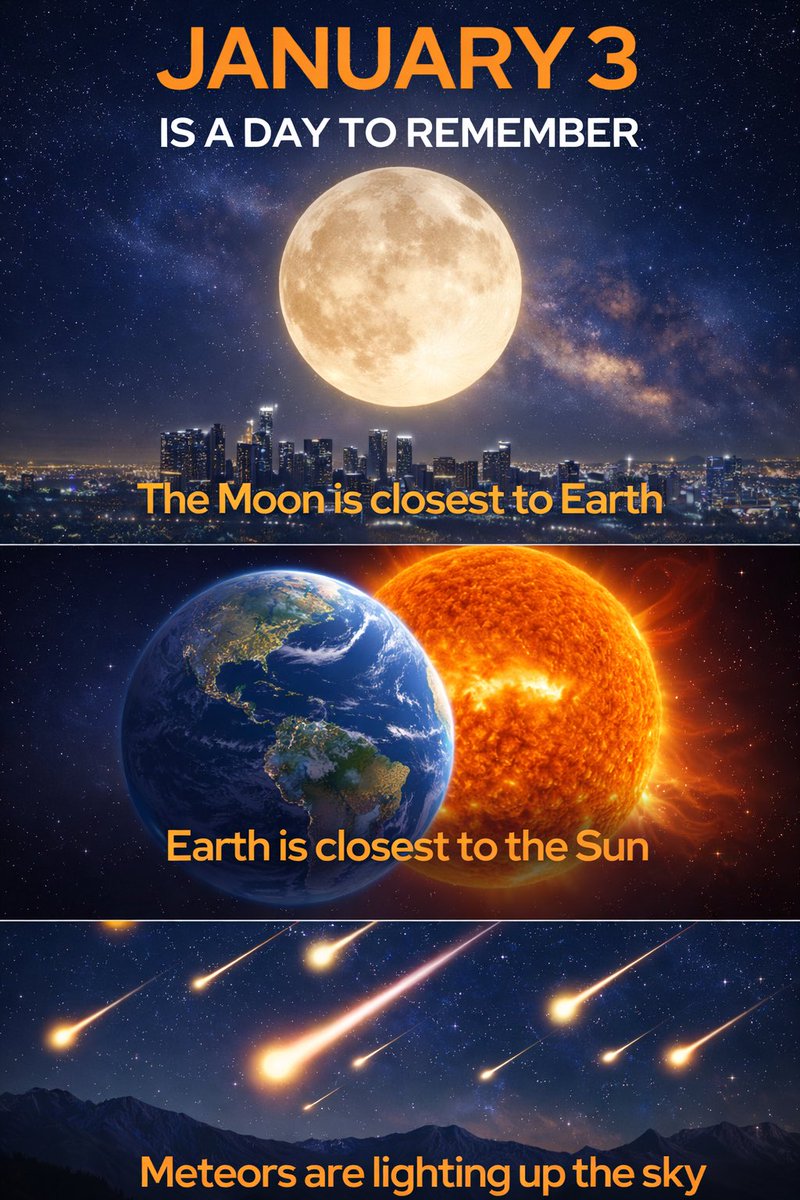
January 3 is an extraordinary day.
Three major celestial events reach their peak at once: a Supermoon, Earth’s perihelion, and the Quadrantids meteor shower. Each is impressive on its own. Together, they’re a powerful reminder that we’re passengers on a moving world, traveling through a beautifully precise solar system.
First, the Supermoon. The Moon reaches perigee—its closest point to Earth—at the same time it becomes full. This Wolf Moon will appear unusually large and bright, up to 14% bigger and 30% brighter than a full Moon at its farthest distance. Its intense glow sharpens shadows and floods the night sky with light.
Next, Earth itself reaches perihelion, its closest point to the Sun for the entire year. At about 91.4 million miles (147 million kilometers) away, we’re roughly 3 million miles closer to the Sun than we are in July. At this point in its orbit, Earth is moving at its fastest—nearly 67,000 miles per hour (107,000 kilometers per hour). Despite winter in the Northern Hemisphere, this moment highlights an important truth: seasons are shaped by Earth’s tilt, not its distance from the Sun.
Finally, the Quadrantids meteor shower peaks. Caused by debris from asteroid 2003 EH1, the Quadrantids are famous for their brief but intense displays—and for producing the occasional brilliant meteor. The Supermoon’s brightness will drown out many faint meteors, but a few bright streaks may still cut through the glare.
Take a moment to notice it all today. These alignments are fleeting, and they remind us just how dynamic our place in space truly is.
First they said they needed data about the children to find out what they’re learning.
Then they said they needed data about the children to make sure they are learning.
Then the children only learnt what could be turned into data.
Then the children became data.
-Michael Rosen