Heart attack and stroke are often the event. They are not the whole risk.
What builds and triggers them?
High blood pressure. Plaque. Clot. Insulin resistance. Smoking. Poor sleep. Inherited risk like Lp(a).
If we only think about the event, we arrive late.
#HeartHealth#LpA
The 3 I’s are important.
So are 2 more:
4. Inherited risk
Lp(a), FH, and family history can change risk before symptoms appear.
5. Incomplete interpretation
A normal lipid panel may not show ApoB discordance or plaque burden.
Baseline lipids matter. They are not the whole story.
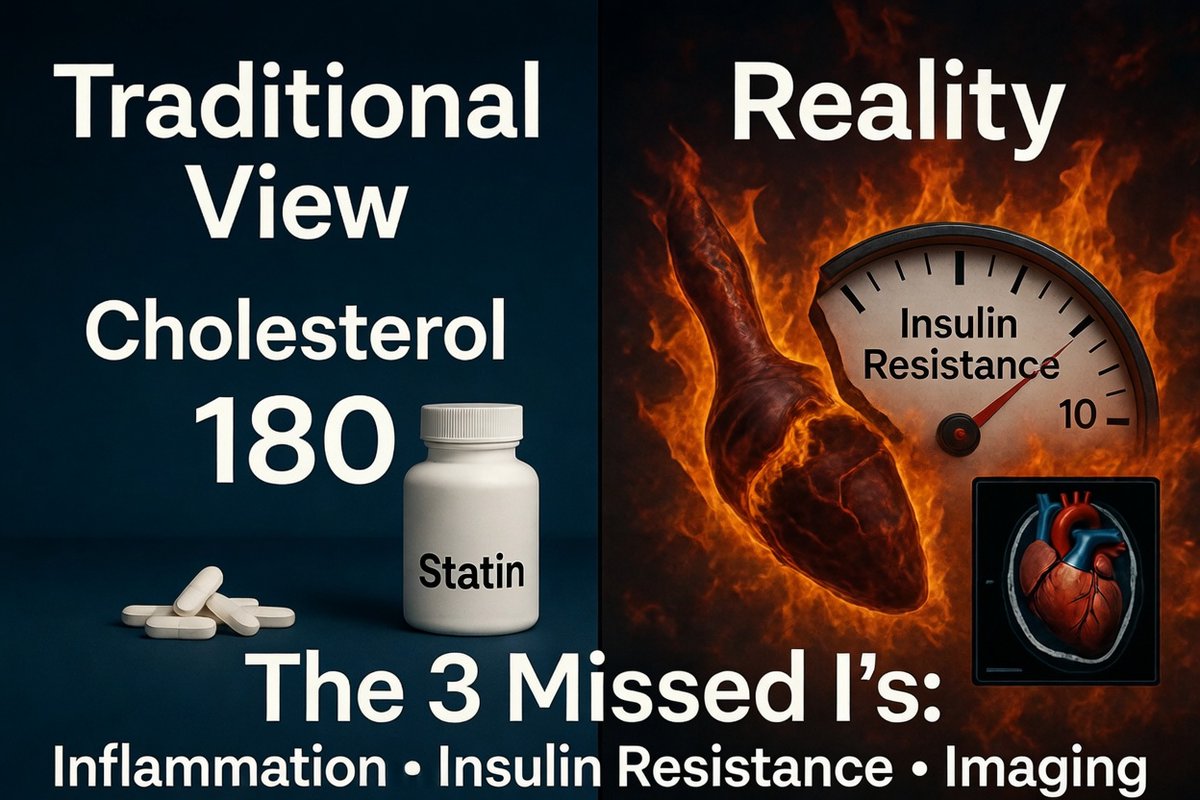
Most cardiologists still tell patients: “Your cholesterol is the problem. Take this statin.”
After operating on thousands of hearts, I can tell you that’s incomplete at best — and dangerous at worst.
The real drivers of heart disease are what I call The 3 Missed I’s.
🧵 1/8
5/5 New evidence review:
"From Routine to Baseline: Cholesterol Testing"
Why the standard lipid panel remains foundational, and why it should be understood as the first layer of heart risk assessment, not the whole picture.
Read/download:
🔗 Zenodo: [https://t.co/T13r8erZcT]
Your 'normal' cholesterol test might not be the full story.
Modern prevention treats the standard lipid panel as a baseline, not a finish line.
Here's why → [Thread] 1/5
4/5 The fix is not more testing for everyone.
It's layered assessment:
baseline lipids
• risk context
• selective enhancement when evidence, risk, and resources justify it
This is how cholesterol testing becomes more useful, not less.
“I feel fine.”
That’s what most people say before their first heart attack or stroke.
A heart attack shouldn’t be the first symptom.
See the risk earlier.
What to do:
Ask your doctor for an Lp(a) test.
It's:
• One blood draw
• Usually covered
• Measured once in a lifetime
• Can change everything
Don't settle for a 'normal' but incomplete risk picture.
Demand a complete picture.
One Life. One test
Your cholesterol result came back 'normal'.
Great news, right?
Not necessarily.
Research shows one particle can be 7x more dangerous than LDL,
and standard panels don't test for it.
Here's what 'normal' may be hiding 🧵👇
The brutal truth:
'Normal cholesterol' ≠ 'No risk'
It means:
✓ Standard risks look okay
✗ But Lp(a) wasn't measured
✗ And it's 7x more dangerous per particle
A normal result is useful.
It is also incomplete.
Your cholesterol panel tells you something real.
It doesn’t tell you everything.
Speak with your doctor: "I want to reduce my heart risk. Should we measure my Lp(a)?"
12/13