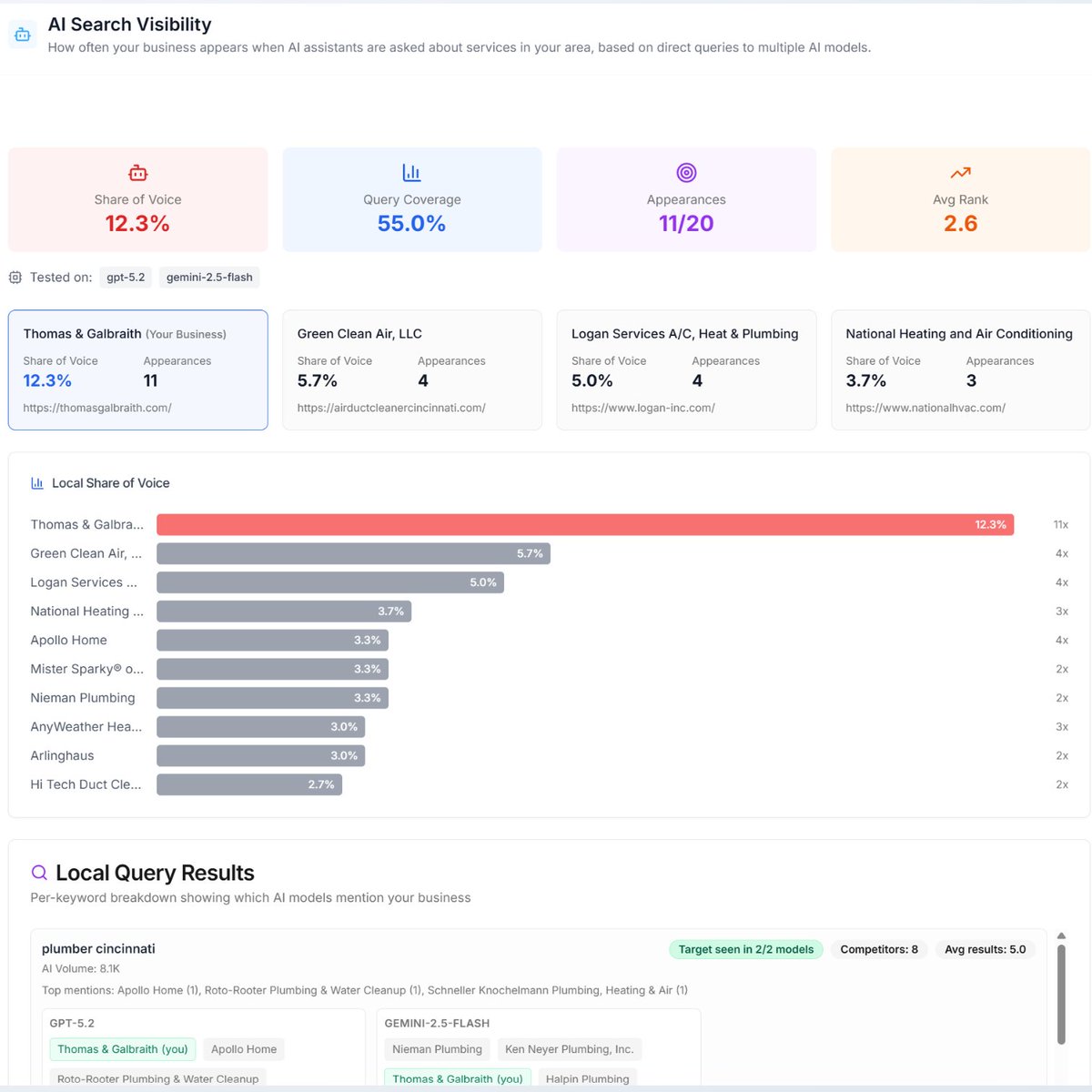
Wondering if your business shows up in ChatGPT for potential customers?
If your business serves customers near you, this report will tell you.
Get a FREE report from https://t.co/D2I1FxHwkq
Most agencies hire specialists to fill roles. The best agencies hire one strategist to own outcomes.
The difference isn't headcount. It's who makes decisions and how fast they get made.
Here's the structure that actually works. A thread.
Most agency reports are built around one goal: making the agency look busy enough to justify the invoice.
Impressions went up. Rankings improved. Traffic is trending positive.
None of that tells you if you made money.
Your agency sends you a report every month. It's full of charts, rankings, and impressions. And you have no idea if your marketing is actually working.
That's not an accident.
Most "AI-powered" agencies can't answer one simple question:
What decision does your AI make that a human couldn't?
Not faster. Not cheaper. What actual decision.
Because here's the dirty secret of the AI agency boom right now.
The majority of agencies slapping "AI-powered" on their website did this:
1. Bought ChatGPT subscriptions for the team
2. Built a shared Google Doc of prompts
3. Updated their homepage
4. Raised their prices
That's not AI-powered marketing. That's a typing shortcut with better branding.
A prompt library is a tool. It's useful. But it's not a strategy any more than owning a hammer makes you an architect.
Here's what actually matters. Can the agency explain how AI changes the strategic decisions they make for your business? Not the speed of content production. The quality of thinking.
Real AI integration in marketing looks like this:
Using AI to identify patterns in your lead data that change where you spend budget.
Using AI to stress-test positioning before you commit to a campaign direction.
Using AI to compress feedback loops so you're adjusting weekly instead of quarterly.
None of that comes from a prompt library. It comes from marketers who understand strategy and then figure out where AI gives them an edge humans alone don't have.
The uncomfortable truth is that most agencies adopted AI as a cost reduction play, not a client results play. They produce the same work with fewer people and pocket the margin.
If your agency can't walk you through a specific example of how AI changed a strategic recommendation they made for you, not just how it sped up delivery, you're paying an AI tax on the same service you had before.
Ask your agency this week: "What has AI changed about the strategy you're running for my business?"
If the answer is just "we write content faster now," what are you actually paying for?
Google is force-upgrading your DSA campaigns. You don't get a vote.
Google confirmed that every eligible DSA campaign auto-converts to AI Max. If you don't migrate manually, Google does it for you.
For most advertisers, that's an inconvenience. For contractors, it's a potential disaster.
Here's why.
Contractor campaigns live and die on intent-based landing page routing. Someone searching "emergency garage door repair" needs to land on your repair page. Someone searching "new garage door installation" needs the installation page. Different intent, different page, different conversion path.
Auto-migration doesn't care about that distinction. It collapses your carefully mapped DSA structure into a generic asset group. Your emergency repair traffic could start landing on your installation page. Your driveway resurfacing queries could route to a general "services" page.
The fix isn't avoiding AI Max. AI Max itself actually works well for local service businesses. It expands query coverage into conversational searches like "who fixes cracked driveways near me" that standard keyword campaigns miss entirely. And exact match keywords still take priority, so your core terms stay protected.
The problem is letting Google handle the migration instead of doing it yourself.
The manual migration playbook for contractors:
- Audit every account for active DSA campaigns now
- Build separate AI Max asset groups mapped to each service type (repair, installation, commercial, residential)
- Use exact match keywords as guardrails for your highest-value brand and service terms
- Match landing pages to intent at the asset group level
- Get it done before your account gets auto-migrated
This is a 4-6 hour project per account if you do it right. It's also the difference between keeping your conversion routing intact and watching Google flatten it overnight.
The transition is already underway. The clock is running.
Is your agency already migrating your DSA campaigns, or is this the first you're hearing about it?
If your agency can't produce a report that a business owner with zero marketing background can read in five minutes and walk away knowing what to do next, the report isn't for you.
It's a shield.
Ask your agency to rebuild reporting around decisions, not dashboards. Their response will tell you everything.
If this hit home, repost the first tweet. What's the most useless metric you've seen on an agency report?
Your agency's monthly report is 15 pages long and you still can't answer one simple question: what should we do differently next month?
That's not a reporting problem. That's a design problem.
A thread.
Here's what a report designed for your business looks like:
Where did leads come from this month?
Which ones turned into actual revenue?
What's working that we should double down on?
What's not working that we should cut?
What are we changing next month and why?
Five questions. One page.
Your agency's monthly report is a magic trick. Look over here at impressions. Don't look at your pipeline.
The metrics that fill most reports are chosen for a reason.
Impressions. Sessions. Engagement rate. Click-through rate.
All of them feel like progress. None of them are what you actually hired an agency to move.
The real question is always the same: did more qualified people call, book, or buy this month?
If your report can't answer that directly, it wasn't built to inform you. It was built to keep you.
There's a version of reporting that starts with your business goal and works backward. What does a win look like? What moved toward that? What didn't, and why?
That kind of report is uncomfortable to write. It requires honesty when things aren't working. It invites hard conversations.
Which is exactly why most agencies don't write it.
The best agency relationships I've seen are built on reports that surface failure as fast as they surface wins. Because if an agency is only showing you what's working, they're managing your perception, not your growth.
What's the one metric your agency reports on that you've never actually asked for?
Every new AI tool your agency adds is a tiny bet against your own team's judgment.
And most agencies are losing that bet badly.
Here's the contrarian take nobody in the AI marketing space wants to hear: the agencies pulling ahead right now aren't the ones with 30 tools in their stack. They're the ones who went from 30 down to 6.
The logic is simple but uncomfortable.
Every tool you add creates:
- Another login to manage
- Another workflow to maintain
- Another integration that can break
- Another "expert" on your team who only knows that one platform
- Another monthly bill that needs justifying
But here's what actually kills you. Every tool you add is a decision you're outsourcing. You're letting software decide how to structure a campaign, how to analyze performance, what to prioritize next.
Stack enough of those micro-decisions together and your agency isn't running strategy anymore. It's just babysitting dashboards.
The agencies I respect most right now are doing something that feels counterintuitive. They're canceling subscriptions. They're picking two or three tools they understand deeply and building real expertise around them instead of surface-level familiarity across dozens.
Because mastery of a few tools beats shallow competence across many. Every single time.
The uncomfortable truth: most tool adoption isn't strategic. It's anxiety. Someone on the team saw a demo, got excited, bought a subscription. Nobody ever audits whether it actually improved outcomes. It just... stays.
If you run an agency, try this exercise. List every AI tool you pay for. Next to each one, write the specific client outcome it drives. If you can't name one in under 10 seconds, that tool is costing you more than its subscription price. It's costing you focus.
The winning move in AI marketing isn't accumulation. It's subtraction.
What's the last tool you cut from your stack, and did anyone even notice it was gone?
The lean version: one strategist per vertical or client tier, supported by systems and fractional specialists brought in only when the strategy demands it. Not a permanent seat for every discipline. Pull in expertise when needed, keep strategic ownership tight. That's how you grow revenue without growing your org chart at the same pace. What's the biggest bottleneck in your agency right now, people or process? Repost the first tweet if this hit home.
Most agencies hire their way into chaos. More clients means more people means more overhead means thinner margins. The cycle never stops. But the agencies that actually scale? They run a completely different playbook. Here's the structure that works.
Where agencies bloat: they add a "specialist" for every channel. Separate person for SEO. Separate person for ads. Separate person for content. Now you need a project manager to coordinate them all. Nobody owns the outcome. Everyone owns a task. That's how results slip through the cracks while headcount climbs.
Every AI content tool promises the same thing: more content, faster.
And every agency is buying in.
Here's the problem nobody wants to talk about.
When everyone can publish 50 blog posts a week, the content itself stops being the differentiator. Your paving company's blog sounds like every other paving company's blog. Your garage door content reads like it came from the same machine as your competitor's.
Because it literally did.
The brands winning right now aren't the ones producing the most content. They're the ones with a point of view that can't be replicated by prompting ChatGPT.
Speed is table stakes. Perspective is the moat.
Think about the service businesses you actually remember. They don't stand out because they published more frequently. They stand out because something about their message felt specific, opinionated, human.
AI can generate volume. It cannot generate:
A founder's actual philosophy on how the work should be done.
Real opinions that risk alienating some customers to attract the right ones.
A brand voice built from years of solving specific problems in a specific market.
The agencies flooding their clients' blogs with AI content are accidentally commoditizing the very brands they're supposed to differentiate.
We use AI constantly in our workflow. But we treat it as a production tool, not a strategy tool. The thinking, the positioning, the voice. That still has to come from somewhere real.
If your marketing could be copy-pasted onto a competitor's site and nobody would notice the difference, you don't have a brand. You have a content calendar.
What's the one thing about your business that AI could never write for you?
You wrote a great blog post. Nobody read it.
Not because the content was bad. Because you posted it once and moved on.
This is the distribution problem that kills most service business content.
Here's what actually happens:
You spend hours writing a solid piece. Maybe it's about choosing the right garage door material, or when to repave a parking lot. Genuinely useful stuff.
You publish it. Share it once on social. Maybe send it in a newsletter.
Then you start writing the next one.
Meanwhile, that first piece sits on your site collecting dust. No internal links pointing to it. No repurposing into other formats. No updating it six months later when it starts to age.
One post, one share, one chance. That's not a content strategy. That's a lottery ticket.
The pattern that consistently works for service businesses:
Write less. Distribute more.
One strong piece can become a social post, a Google Business Profile update, an email, a short video script, and a FAQ answer on your site. Each of those creates a new signal that tells Google this content matters.
Most businesses treat content like a factory. Produce, produce, produce.
The ones winning organic traffic treat it like a network. Every piece connects to and supports every other piece.
Your best blog post from six months ago is probably more valuable than the one you're about to write. But only if you actually put it back in front of people.
What's your ratio of creating vs. distributing content right now?
Google is about to freeze your DSA targeting rules and hand you a campaign you can't edit.
This isn't speculation. Google confirmed that "page contains" URL rules are not supported in AI Max. Ginny Marvin verified the parity gap is real.
Here's what that means in plain English:
If you run DSA campaigns that use "page contains" rules to route queries to specific landing pages, those rules become read-only after the forced September migration. Not deleted. Not converted. Frozen. You can see them, but you can't touch them.
This is a bigger deal than most advertisers realize.
Service contractors use "page contains" targeting for a specific reason. A paving company routing "commercial parking lot" queries to their commercial page and "driveway" queries to their residential page? That logic lives in URL text rules. A garage door company separating "repair" from "installation" traffic? Same setup.
After September, that targeting logic turns into a museum exhibit. You can look at it. You cannot change it.
The migration path exists, but it requires manual work before the forced upgrade window closes. Page feeds and custom labels can replicate some of this targeting inside AI Max. But you have to build that structure yourself, test it, and confirm it routes correctly before Google flips the switch for you.
What you should do right now:
Pull every DSA campaign. Identify which ones use "page contains" or "page title contains" rules. Document exactly what each rule is doing and which landing pages it routes to. Then start rebuilding that logic using page feeds or custom labels inside AI Max on your own timeline.
Waiting means inheriting a campaign with frozen settings you never chose to lock in.
Google is not going to fix this for you. They confirmed the parity gap and moved on.
Are you running DSA campaigns with URL text rules? What's your migration plan look like?