One of Sir Arthur Bliss’s seminal works is featured in this afternoon’s Composer of the Week on R3 at 4pm: Morning Heroes, his great choral symphony in memory of his brother killed in WW1 and all his dead comrades. Wonderful music - and a great exploration of Bliss all week.
Just adding to my post about the new Bliss and Dance book (ran out of characters) that of course it should be of real interest to lovers of dance and all interested in Bliss’s music. Don’t forget he is Composer of the Week from tomorrow on R3 at 4pm daily!
I have just received my copy of this beautiful and informative book about Sir Arthur Bliss and the Dance edited wonderfully by Jennifer Jackson. I have contributed two chapters. Full of wonderful photos and illustrations. A must for all interested in dance!
We are now in a weird era where a guy gets publicly shamed for running his sprinklers on a Tuesday, while a data center the size of a Costco quietly drains a reservoir so AI can generate a picture of your cat as a medieval knight. And the data center gets a tax incentive for it.
Do tune into Radio 3 every afternoon at 4pm from next Monday if you can. Sir Arthur Bliss is Composer of the Week and I am in conversation with Donald Macleod every day. It was fun making the programmes and I hope will turn people on to Bliss’s great music.
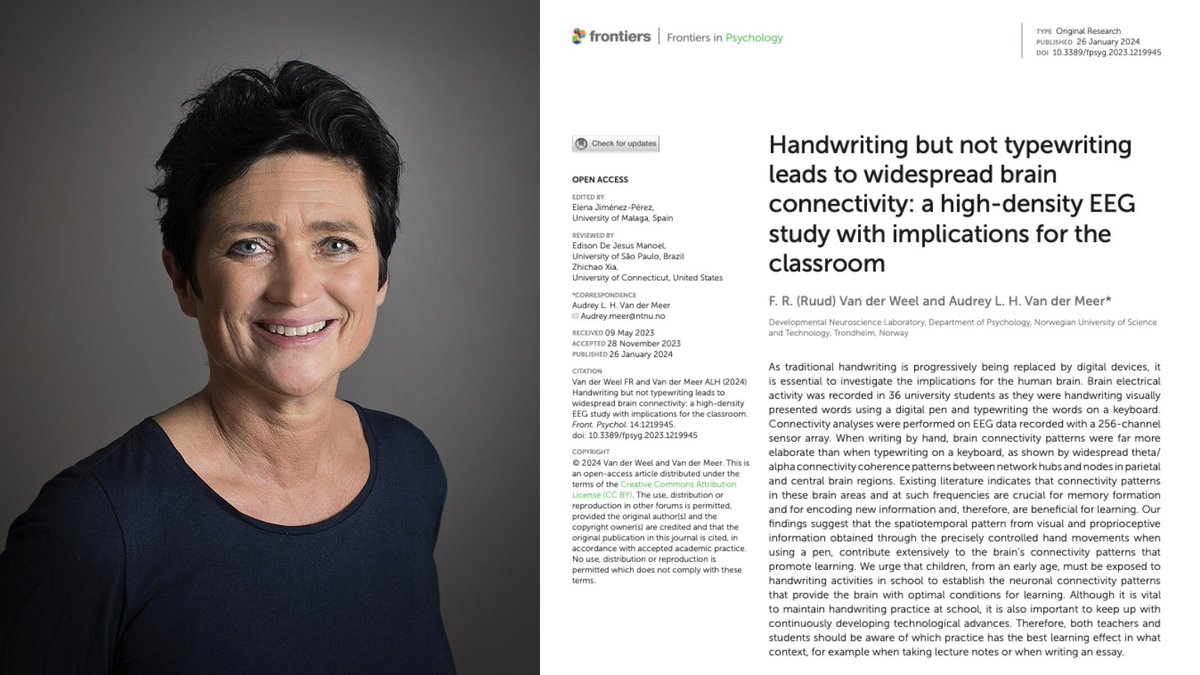
This is fascinating on the complexity of brain processing when we write rather than typing.
In perplexity & when a new idea hovers on the brink of clarity, I reach for a pencil & paper. Always.
I know it helps me to think.
Typing only lets me record.
Nowhere near the same.
A Norwegian neuroscientist spent 20 years proving that the act of writing by hand changes the human brain in ways typing physically cannot, and almost nobody outside her field has read the paper.
Her name is Audrey van der Meer.
She runs a brain research lab in Trondheim, and the paper that closed the argument was published in 2024 in a journal called Frontiers in Psychology. The finding is brutal enough that it should have changed every classroom on Earth.
The experiment was simple. She recruited 36 university students and put each one in a cap with 256 sensors pressed against their scalp to record brain activity. Words flashed on a screen one at a time.
Sometimes the students wrote the word by hand on a touchscreen using a digital pen, and sometimes they typed the same word on a keyboard. Every neural response was recorded for the full five seconds the word stayed on screen.
Then her team looked at the part of the data most researchers had ignored for years, which is how different parts of the brain were communicating with each other during the task.
When the students wrote by hand, the brain lit up everywhere at once.
The regions responsible for memory, sensory integration, and the encoding of new information were all firing together in a coordinated pattern that spread across the entire cortex. The whole network was awake and connected.
When the same students typed the same word, that pattern collapsed almost completely.
Most of the brain went quiet, and the connections between regions that had been alive seconds earlier were nowhere to be found on the EEG.
Same word, same brain, same person, and two completely different neurological events.
The reason turned out to be something nobody had really paid attention to before her work. Writing by hand is not one motion but a sequence of thousands of tiny micro-movements coordinated with your eyes in real time, where each letter is a different shape that requires the brain to solve a slightly different spatial problem.
Your fingers, wrist, vision, and the parts of your brain that track position in space are all working together to produce one letter, then the next, then the next.
Typing throws all of that away. Every key on a keyboard requires the exact same finger motion regardless of which letter you are pressing, which means the brain has almost nothing to integrate and almost no problem to solve.
Van der Meer said it plainly in her interviews.
Pressing the same key with the same finger over and over does not stimulate the brain in any meaningful way, and she pointed out something that should scare every parent who handed their kid an iPad.
Children who learn to read and write on tablets often cannot tell letters like b and d apart, because they have never physically felt with their bodies what it takes to actually produce those letters on a page.
A decade before her, two researchers at Princeton ran the same fight using a completely different method and ended up at the same answer. Pam Mueller and Daniel Oppenheimer tested 327 students across three experiments, where half took notes on laptops with the internet disabled and half took notes by hand, before testing everyone on what they actually understood from the lectures they had watched.
The handwriting group won by a wide margin on every question that required real understanding rather than surface recall.
The reason was hiding in the transcripts of what the two groups had actually written down.
The laptop students typed almost word for word, capturing more total content but processing almost none of it as they went, while the handwriting students physically could not write fast enough to transcribe a lecture in real time, which forced them to listen carefully, decide what actually mattered, and put it in their own words on the page.
That single act of choosing what to keep was the learning itself, and the keyboard had quietly skipped the choosing and skipped the learning along with it.
Two studies. Two countries. Same answer.
Handwriting makes the brain work. Typing lets it coast.
Every note you have ever typed instead of written went into your brain through a thinner pipe. Every meeting, every book highlight, every idea you captured on your phone instead of on paper was processed at half depth.
You did not forget those things because your memory is bad. You forgot them because typing never woke the part of the brain that would have made them stick.
The fix is the thing your grandmother already knew.
Pick up a pen. Write the thing down. The slower road is the faster one.
I don’t think “prolonged close contact” is what people think it is. In epidemiology it’s being within 6 ft for cumulative 15 minutes in a 24 hour period.
A Cornish open-air theatre has
cancelled an opera following a single
complaint about its ‘colonial themes’.
Just when you may think things have turned a corner: you get slapped in the face with this nonsense
Delibes Lakme is a masterpiece @minacktheatre show some backbone - for the sake of the best of what has been written thought made and performed.
Let’s put cancel culture to bed
Hahahahah! Just seen this on FB:
----
Have you found yourself in the hideous position of having a Reform councillor?
Here’s how you can help your brand new councillor settle into local government properly: email them this week with an actual council problem to solve.
Got rubbish piling up? Email them.
Bus vanished from existence? Email them.
Streetlights dead? Email them.
Care package delayed? Email them.
Pavement like the Somme? Email them.
Send them in by the hundred. Make sure they’re made very clear on what their job is.
Being a councillor is not standing in front of the Union flag shouting about dinghies on GB News. It’s reading committee papers at midnight, attending meetings nobody enjoys, holding surgeries in church halls, and dealing with the endlessly glamorous world of drains, social care budgets and recycling disputes.
Welcome to local government.
The boats are in Kent. The bins are in your ward.
The email address for your ward councillor can be found on your local council website as soon as it’s updated.
Feel free to copy and paste to share wider.
Is this the first time this has happened - an opera production actually *pulled* because someone takes offence at the subject matter?
https://t.co/qTQuB8QZ03
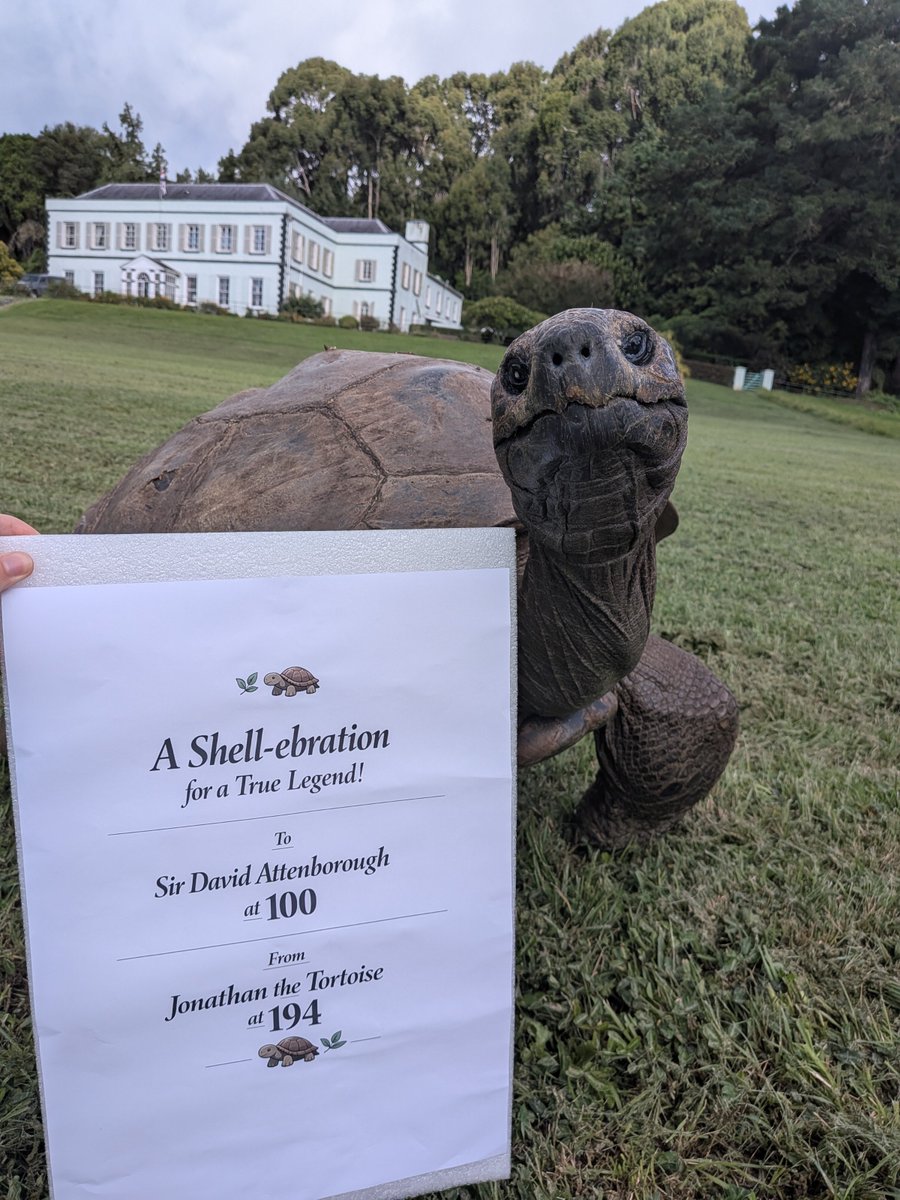
Dear David Attenborough,
Congratulations on reaching your 100th lap around the sun, young man!
Thank you for sharing the wonders of our world with such care and curiosity.
Here’s to many more years, slow and steady wins the race!
With admiration,
Jonathan the Tortoise
Dear @BBCNews
I notice you've suddenly started using the word 'homicide' in your reports on the BBC app.
Stop this nonsense - you and I are British, and I have absolutely no desire to talk more American. It's called murder, and in the UK always has been.
#ShakespeareSunday
The gates of monarchs
Are arched so high that giants may jet through
And keep their impious turbans on, without
Good morrow to the sun.
Cymbeline 3:3
The arms of Charles I above the high arch of the hefty screen in St Mary’s church Abbey Dore.