@DrHelenFry No, but I have family that served in WW2. I have made a life of meeting hundreds of WW2 veterans of all nations. I strongly recommend visiting the National World War II Museum in New Orleans @WW
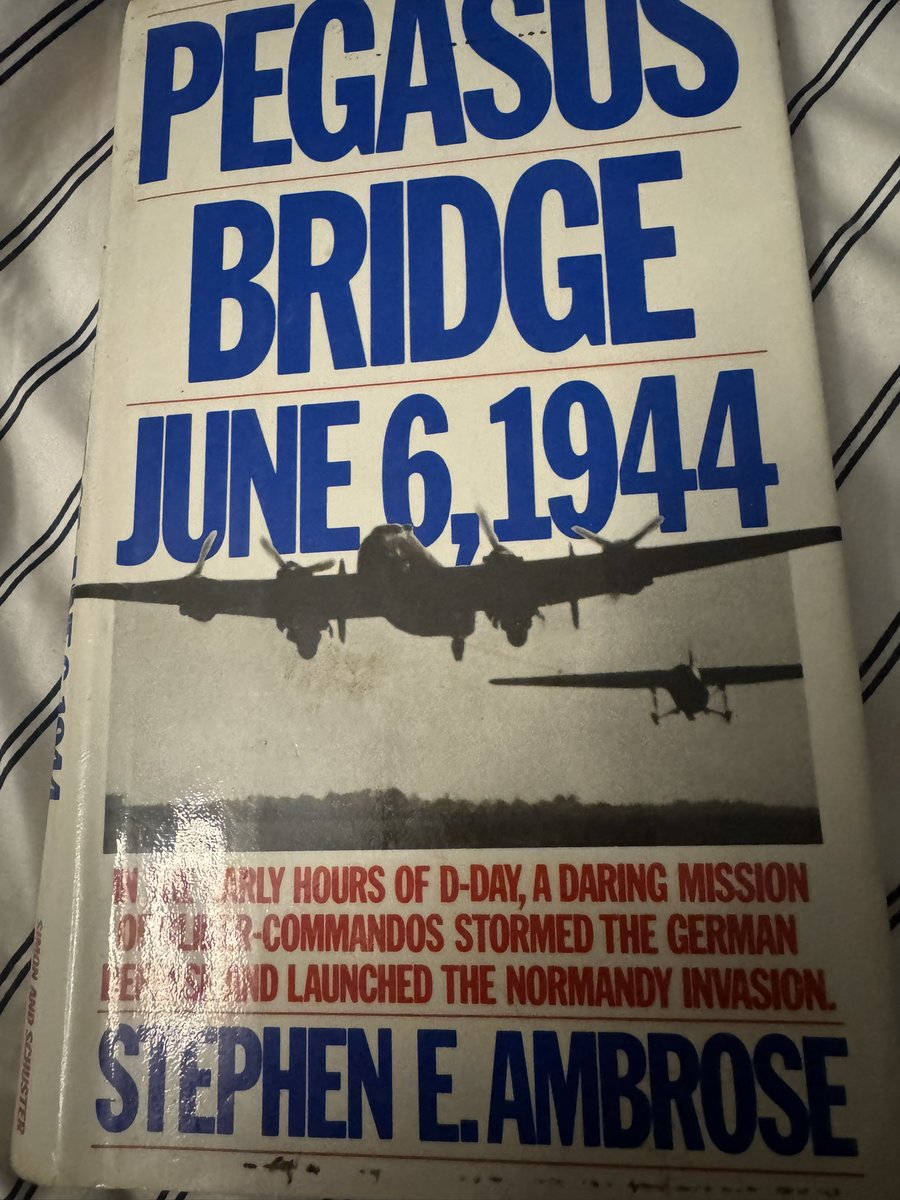
Had the distinct honor to spend time with Col. Howard and men from the Ox & Bucs many years ago with historian Steven Ambrose. Soldier Wally Parr shed tears as he recounted to me the death of Lt. Brotheridge, some 50+ years after the June 5/6 date. His signature at bottom left while Major Howard’s second from top (below German officer Hans von Luck who opposed the allies that day.) A very special collection of heroes.
@EchoesofWarYT@VoicesofWW2 I have often read that the pictures and films the Japanese took during the attack on Pearl Harbor sit at the bottom of the Pacific because the carriers never returned to Japan after Dec 7 1941 and were ultimately sunk at Midway.
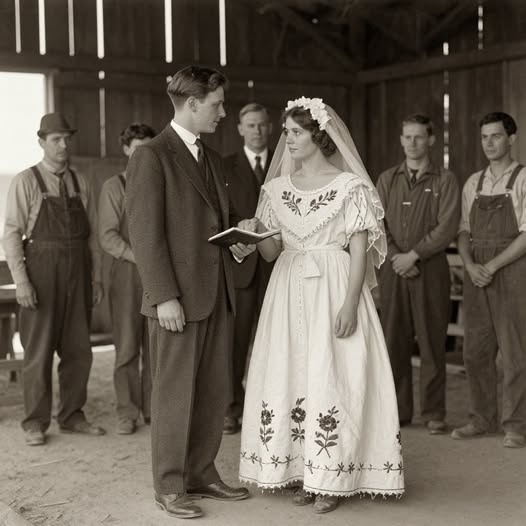
En 1932, les fermes du Dakota du Sud étaient saisies les unes après les autres. Ingrid Olsen, 19 ans, était fiancée à Lars, fils de fermier. Sa famille avait tout perdu, sauf six sacs de farine et la fierté de son père. Pas d'argent pour une robe. Aucune église ne voulait les marier — ils ne pouvaient pas payer les frais.
Alors Mama Sigrid lava les sacs de farine jusqu'à ce que le logo "Gold Medal" s'efface. Elle les assembla à la lueur d'une lampe. Elle broda des roses sauvages des prairies sur les coutures avec du fil tiré d'une vieille nappe. Cela prit trois semaines.
Ils se marièrent dans la grange. Lars portait le costume d'enterrement de son père. Le juge de paix célébra la cérémonie gratuitement quand il vit la robe. Cet hiver-là, ils vécurent dans un poulailler. Mais Ingrid dit : « J'étais la plus belle mariée du Dakota. Parce que ma mère m'a fait une robe à partir de rien. »
Ils restèrent mariés 71 ans. Quand Ingrid mourut en 2003, son arrière-petite-fille porta cette robe. Les fleurs de sacs de farine étaient toujours là. Le musée la réclama ensuite. La famille refusa. « Ce n'est pas une robe », dit son fils. « C'est notre histoire. »
#1932 #GrandeDepression #DakotaDuSud
Hundreds of people show up for the funeral of a World War II veteran with no family in Massachusetts.
WWII Veteran John Bernard Arnold III, a 98-year-old living in East Bridgewater, was only 6 when his mother died. His father passed away when Arnold was in his 20s.
Arnold never married and never had kids.
The veteran planned his own funeral about 10 years ago, wanting people to know about his deep faith and his love for the United States.
By the time of his death, Arnold had no remaining blood family, but started a "new family" with his friends at the Garrison Veterans Home.
"He walked into the room and he lit up the room. No matter what you are going through, he always knew how to bring a smile, make you laugh," said caretaker, Hailey Munroe.
When information about his funeral was posted online, hundreds of people in the community decided to show up and honor his life.
"Nobody should have to go alone, I don’t care who you are," one attendee said.
Rest in peace, John.
Two nine-year-old girls stood in a Berlin schoolyard in May 1939, holding each other and crying like the world was ending. For them, it was.
Annemarie Wahrenberg and Ilse Kohn had been best friends since they were six. They went to the same school, the same synagogue, the same ballet classes. They spent afternoons in each other’s apartments eating too much candy, laughing until they got in trouble, and dreaming about ordinary things little girls dream about. But by 1939, the Nazi laws had already stolen the city from them. No parks. No pools. No theaters. Just each other’s company in a shrinking world.
That morning, their fathers walked them to school for the last time. In the yard, the girls clung to one another and made a promise: they would stay in touch. They would find each other after the war. Then their fathers gently pulled them apart and led them in opposite directions.
Ilse’s family had scraped together enough to buy passage on a freighter from Italy to Shanghai — one of the last places on Earth still accepting Jewish refugees without visas. Annemarie’s family was still desperately searching for any exit.
A few weeks later, Ilse wrote her best friend a letter from Shanghai. She told her where she was. She said they would see each other again someday.
Annemarie never wrote back.
For the next eighty-two years, each woman carried the quiet grief of believing her best friend had been murdered in the Holocaust.
Ilse — who later became Betty Grebenschikoff — survived the war in Shanghai with about 20,000 other Jewish refugees. She eventually moved to Australia, then New York, then Atlantic City. She married, raised five children, and had seven grandchildren. She became a Holocaust educator, wrote a memoir for her family, and spoke in schools for decades. In nearly every talk, she mentioned her childhood best friend by name: Annemarie Wahrenberg. She recorded it in her 1997 USC Shoah Foundation testimony, hoping against hope that somewhere, somehow, Annemarie might hear her voice.
Annemarie — who became Ana María — escaped with her family to Santiago, Chile, in November 1939. Her father had been arrested and released by the Gestapo; they knew time was running out. She learned Spanish, built a life, married, had two children, six grandchildren, and ten great-grandchildren. She too became a Holocaust educator, speaking to students about what it meant to be a Jewish child in Berlin in those final months before the world caught fire. She searched databases. She asked questions. She never stopped wondering.
Both women had changed their names. Both had moved across continents. The spellings and surnames no longer matched. Search after search turned up nothing. Over time, each quietly accepted that the other had not survived.
Then, in November 2020, in the middle of the COVID pandemic, an archivist named Ita Gordon at the USC Shoah Foundation was watching a virtual Kristallnacht event from the Interactive Jewish Museum of Chile. A 90-year-old woman from Santiago began speaking about fleeing Berlin as a little girl. She talked about her best friend. The schoolyard. The goodbye.
Something clicked in Ita’s memory. She went into the archive, typed in names, schools, and synagogues. She found Betty’s 1997 testimony — the one where she spoke Annemarie’s name with such longing.
Ita made the call. She connected them.
In December 2020, Betty and Ana María saw each other on a Zoom call for the first time in eighty-two years. Their families gathered around, crying. The two old women looked at each other, started speaking German — a language Betty’s grandchildren had rarely heard — and then they began to laugh. Not polite laughter. Real, giddy, nine-year-old laughter.
“We’re not the girls we used to be,” Betty later told a reporter. But in that moment, they were.
They started weekly Sunday phone calls. They talked about the old neighborhood, the candy, the ballet, the people they lost. In November 2021, Ana María flew from Chile to Florida. At the airport, two 91-year-old women hugged for the first time since that terrible morning in 1939. They drank champagne. They appeared together at the Florida Holocaust Museum. They held on to each other like they were making up for eight decades in a single year.
Betty Grebenschikoff passed away in February 2023 at the age of 93. Ana María still lives in Chile.
Of all the millions of painful goodbyes said in 1939 — on schoolyard pavement, train platforms, and doorsteps — these two found their way back to each other before the end. Not because of fame or fortune, but because one persistent archivist refused to let a small detail in a testimony disappear.
Their story wrecks me every time I think about it. Not just because it’s a miracle of survival and reunion, but because it shows how stubborn love can be. How two little girls who promised to find each other kept that promise across continents, name changes, wars, and decades of assumed loss. How the human heart can hold onto hope long after logic says it should let go.
In a world that often feels divided and cruel, this story whispers something powerful: some bonds refuse to die. Some friendships are stronger than history. Some promises outlive the people who tried to break them.
The schoolyard in Berlin is still there. There’s a memorial stone listing the names of the children from that school who never came home. It’s a long list. Annemarie’s and Ilse’s names are not on it.
They got to say hello again.
In April 1945, a young British soldier walked across a field in Bavaria and handed a starving young woman a small parcel of food.
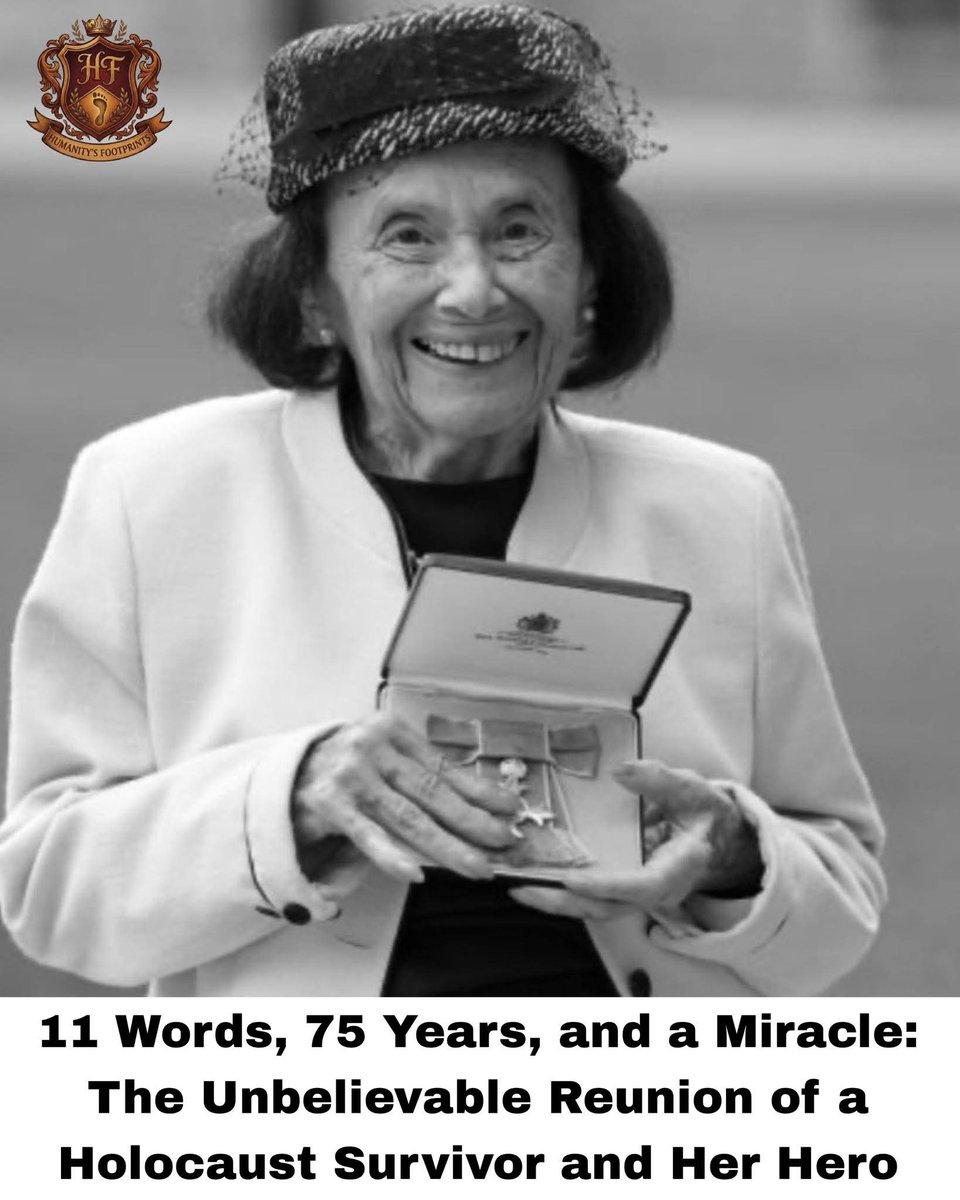
She was 21 years old. Her name was Lily Ebert. She had survived Auschwitz. Her mother and two younger sisters had been murdered in the gas chambers within hours of their arrival. She had endured a forced death march in the final weeks of the war and had collapsed in a field, close to death, when liberation came.
The soldier said nothing. But wrapped around the food was a German bank note — and written on it, in pencil, in English, were eleven words:
"A start to a new life. Good luck and happiness."
He walked away. She never saw him again. She never knew his name.
She kept the note.
Through refugee processing in Switzerland. On a boat to what would become the State of Israel. Across the ocean to England in the 1950s, where she settled, married, and built a life from almost nothing.
She raised three children in London. She had ten grandchildren. She had thirty-eight great-grandchildren.
Through all of it, the note stayed in a drawer in her bedroom. She showed it to her family every so often. She told them the story. For 75 years, no one had ever been able to identify the soldier or trace his handwriting.
Then came lockdown. And a 16-year-old great-grandson named Dov Forman.
In 2020, while the world went quiet, Dov began posting Lily's story on TikTok — short videos, filmed at the kitchen table, his great-grandmother speaking directly to the camera about Auschwitz, about survival, about what she had seen and lost and somehow outlived. Within months, she had two million followers. She wrote a memoir. She received the British Empire Medal. She became one of the most recognised Holocaust survivors in the world.
And in one video, Dov held up the old German bank note. He showed the handwriting to the camera. He asked — to no one in particular, to everyone at once — if anyone recognised it.
A British family watched the video. They recognised the handwriting immediately.
Their grandfather had been a young Jewish soldier serving with British forces in Germany in 1945. He had written those eleven words on a bank note before he left home, carrying it in his pocket as a small private act of hope — a message ready for whoever needed it most. He had given it to a young woman he encountered in a field in Bavaria and thought nothing more of it.
He had come home, raised a family, grown old, and died. He had never told his children the name of the young woman he had given the note to. He may never have known she survived.
His family contacted Dov. In 2021, on a video call, Lily Ebert — then 97 years old — met the grandchildren of the man who had once handed her the will to live.
They showed her photographs of him as a young soldier. They told her stories about who he had become. They cried together across the screen.
Lily said: "For 75 years, I held this note in my hand. I never knew who he was. Now I know. He was a kind young man. He thought of me before he ever met me. He wanted me to live. I have lived. I lived for him."
The two families became close in the final years of Lily's life.
Lily Ebert died in October 2024, at the age of 100.
The bank note is now on loan to the Imperial War Museum in London — considered one of the most significant small Holocaust artefacts in private hands.
A soldier wrote eleven words on a piece of paper, handed it to a stranger, and walked away.
A teenage boy with a phone refused to let his great-grandmother's story disappear.
And after 75 years, a single act of quiet human kindness finally found its way home.
🇺🇸UNKNOWN NO MORE🇺🇸
For 85 years, they were buried as UNKNOWN.
For the past 3 years, Operation 85 fought to give them their names back.
Today, DPAA officially confirmed the DNA threshold has been met to begin the identification process for 141 U.S.S. Arizona unknowns buried in commingled graves at the National Memorial Cemetery of the Pacific in Honolulu, HI.
FOLLOW US along this journey.
For more info: https://t.co/UR8YJCN7W1
@RealAirPower1 There were those in command positions who counseled against the ambush on the assumption that the Japanese would have grave doubts in was just luck but the result of Americans breaking their codes