Some women take DHEA and finally get a positive pregnancy test. Others take the exact same supplement and see zero change.
Why? 🤔
We’ve been asking the wrong question about DHEA for years. Here’s what the latest research actually shows 🧵👇
1️⃣ DHEA is not just a supplement—it’s a hormone precursor.Most DHEA is semi-synthesized from plant sterols, converting into testosterone and estrogen in your body. (And no, wild yam won't convert on its own).
2️⃣ DHEA drops earlier than you think.Our research at HelenHealth shows DHEA & testosterone decline alongside ovarian age. The key isn't just having low AMH—it's knowing if your DHEA has actually declined.
3️⃣ More is NOT better.Unchecked DHEA can lead to androgenic side effects (acne, hair growth) and impacts immune pathways.
The future of fertility is Precision Medicine: 🔬 Measure first. 🧠 Understand second. 💉 Treat third.
🎥 Watch our 3-minute breakdown on how DHEA impacts ovarian aging—and why one size never fits all.
Next week: Can Melatonin protect the mitochondria in your eggs? 🥚✨
#Fertility #IVFJourney #DHEA #EggQuality #PrecisionMedicine #WomensHealth #HelenHealth
Aging isn’t one process.
It’s twelve hallmarks happening at once — and they form a network.
New Research Friday breakdown of the 2023 Cell paper (López-Otín et al.):
Damage → dysregulated responses → loss of coordination.
Plus why ovarian aging often shows up earlier.
Full short video ↓
#HallmarksOfAging #AgingScience #Longevity #CellularAging #ResearchFriday
Late nights destroy your ovaries?
Bubble tea ages them?
Stress causes failure?
We ranked them all by scientific evidence.
Spoiler: one factor is far stronger than the rest.
Over 40 and keep waking up at 5 AM for no reason?
No nightmare. No alarm. Just… awake.
It’s not stress.
Something else is quietly changing — and most women never expect it.
Watch the full breakdown 👇
#WomensHealth#Over40#SleepProblems#EarlyWaking
You slept for 9 hours.
So why are you still exhausted?
A 2026 Nature study using 23 biological ageing clocks found a U-shaped association: both shorter and longer sleep were linked to older biological profiles.
But long sleep may not be the cause.
Sometimes, it may be a signal that something else has already changed.
#SleepHealth #BiologicalAge #HealthyAging
9 HOURS OF SLEEP.
STILL EXHAUSTED?
Long sleep does not automatically mean better recovery—and it does not necessarily cause faster ageing.
Sometimes, it may be a signal.
🎥 Full episode tomorrow on HelenHealth.
#SleepHealth#ResearchFriday
You’re eating about the same.
The scale has barely changed.
But your waist feels different.
After 35, the hidden change may not begin with weight—it may begin with muscle.
As muscle declines and body composition shifts, fat can become easier to accumulate, especially around the waist.
Don’t just try to become lighter.
Protect your muscle. Build strength.
🎥 New HelenHealth Women’s Health episode
Correction: The testosterone curve in Image 3 is aligned with ovarian endocrine age—not chronological age.
#WomensHealth #MuscleHealth #OvarianAge #HealthyAging
"Staying up late for a year ages your ovaries by ten years."
You've probably seen some version of this. It isn't what the evidence shows.
What the human studies actually find — and why regular sleep still matters anyway 👇
A 2025 analysis in Science Advances covered 528 mammal and 648 bird species in zoo populations, where predation and starvation are largely removed.
Females outlived males in over 70% of mammals. In birds the pattern reverses — as does which sex carries two matching sex chromosomes.
The gap is not only environmental.
#Longevity #WomensHealth
Longer life. More years unwell.
Why does the female longevity advantage come with a healthspan paradox?
Short today. Full episode tomorrow.
#WomensHealth#Longevity#Healthspan#HelenHealth
"Ovarian age 42 at chronological 35" is habitually interpreted as fixed state. Mechanistically, that conflates two distinct compartments.
AMH and AFC quantify the recruited antral cohort — a downstream readout of cyclic recruitment, not the resting primordial pool.
🧵
Ovarian age older than your actual age isn't a verdict. It's a signpost.
Here's what you genuinely can't change — and the part that's still in your hands today. New HelenHealth episode is coming tomorrow.
"You're 33. Your ovarian age is 43."
That sentence sends a lot of women into panic. But an older ovarian age isn't a verdict — it can't predict pregnancy, and it can't tell you exactly when menopause starts.
Here's what it actually means 👇
#OvarianAge
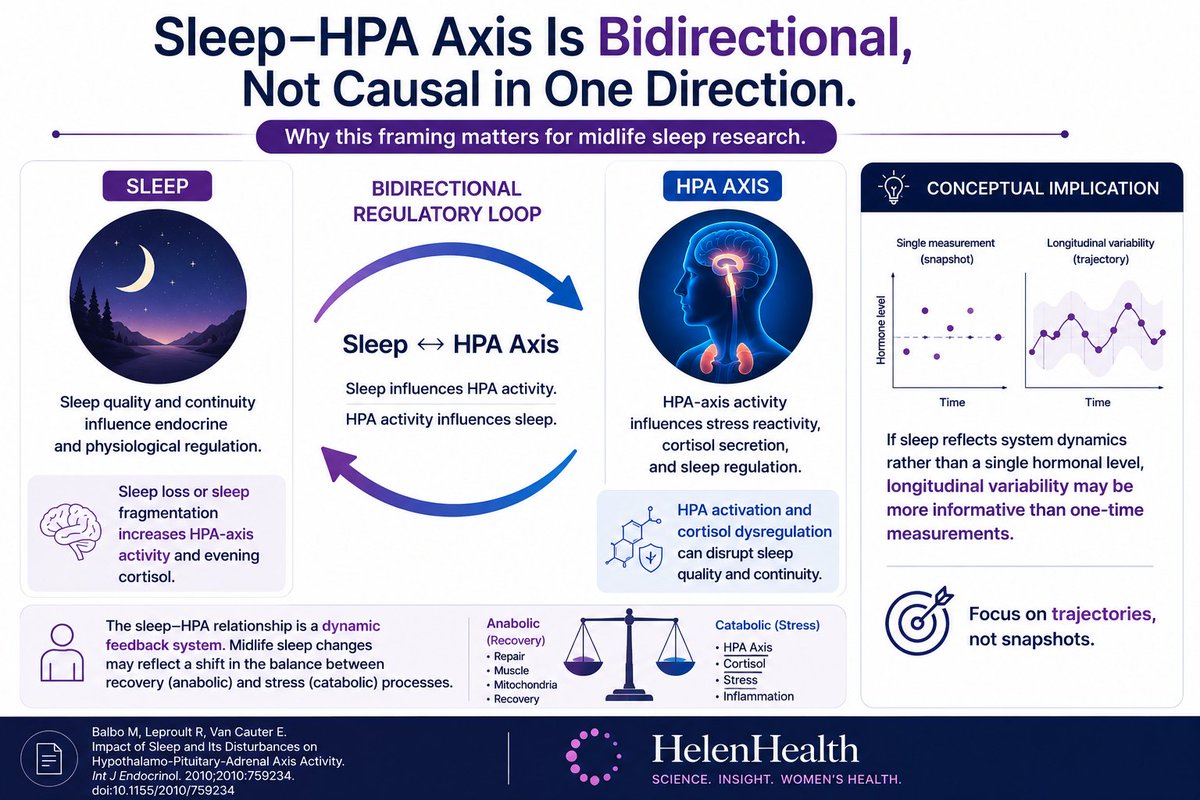
Balbo, Leproult & Van Cauter (2010) framed sleep–HPA as bidirectional, not causal in one direction.
That framing matters for midlife sleep research: cross-sectional hormone measurements may be poorly suited to a system where the perturbation is the variability itself, not the level.
4:52 AM. No alarm. No nightmare. Just awake.
4:52 AM. No alarm. No nightmare. Just awake.
Many women notice sleep changes around 40. The usual answer is "estrogen."
But during the menopausal transition, estrogen doesn't just decline — it becomes unpredictable. And sleep may reflect a bigger shift: recovery vs. stress.
Research Friday · 003 👇
#Perimenopause #WomensHealth
4:52 AM. No alarm. No nightmare. Just awake.
4:52 AM. No alarm. No nightmare. Just awake.
Many women notice sleep changes around 40. The usual answer is "estrogen."
But during the menopausal transition, estrogen doesn't just decline — it becomes unpredictable. And sleep may reflect a bigger shift: recovery vs. stress.
Research Friday · 003 👇
#Perimenopause #WomensHealth
4:52 AM. No alarm. No nightmare. Eyes just… open.
If this started happening to you after 40, it's probably not "stress" — and probably not simply "low estrogen" either.
Full Research Friday episode drops tomorrow.
🔬
#WomensHealth#Perimenopause#Sleep
May, 38, with an ovarian age of 44. A lot of you asked — so what happens next?
The full episode is up tomorrow. Three things it answers:
what ovarian age actually is, how it's assessed (age + AMH), and whether a higher ovarian age still leaves you time.
Not to create fear — to help you see first, then choose
#OvarianAge #WomensHealth
wo women. Both 40.
One feels energetic. One feels tired all the time.
Same age—but their ovaries may be biologically 10+ years apart.
The fatigue many women notice after 35 may be less about age, and more about what's changing inside. New video 👇
#WomensHealth#Perimenopause