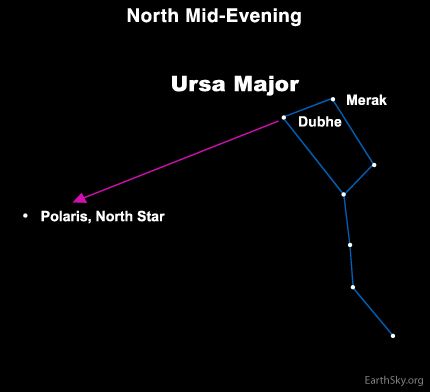
Tonight ...Big Dipper stars point to North Star 🌌🌟
The 2 outermost stars in the bowl of the Big Dipper always point to the North Star, aka Polaris. That's why astronomers call these stars The Pointers. Read more: https://t.co/jPAsEQyM2P 👓
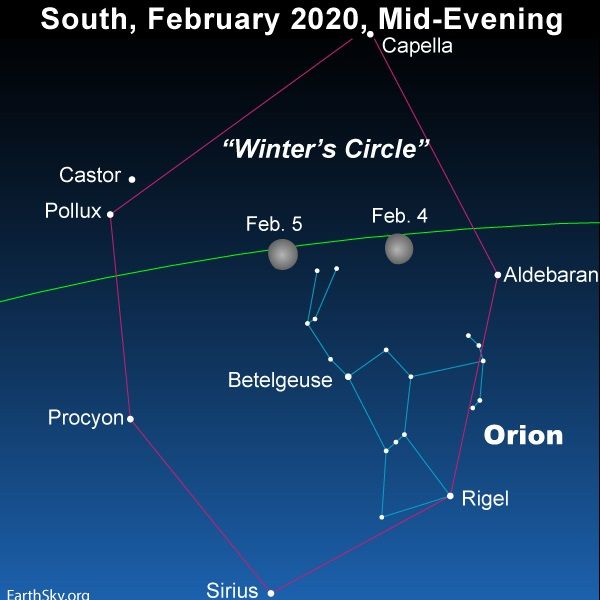
The Winter Circle (or Winter Hexagon) is a very large star pattern made of brilliant stars. Around the world on this night, the moon shines inside the Circle. Read more https://t.co/PB45hHST77
How big is the solar system? If you shrunk the Sun to the size of a dime on the goal line of a football field, Earth would be on the two-yard line…and Pluto would be almost 80 yards away. More: https://t.co/HSzDzeQlT4 #SuperBowl
Fans in Manila have painted a
tribute mural to Kobe Bryant
and his daughter Gianna at
the famed court in Taguig.
“It’s the one thing you can
control. You are responsible
for how people remember
you... or don’t. So don’t
take it lightly.”
- Kobe Bryant
1978 - 2020
#GirlDad
Look east before sunrise Wednesday. The lit side of the waning moon will point to Jupiter, which is very bright, but very near the sunrise glare. Notice that the lighted portion of the waning moon will be pointing to it!
When is the next Blue Moon? 🌔
According to folklore, the next Blue Moon will come on October 31, 2020. It'll be called a Blue Moon because it'll be the 2nd of 2 full moons in a single calendar month. Read more: https://t.co/66sByHOMXZ 👓
Image via our friend Jv Noriega. 📸
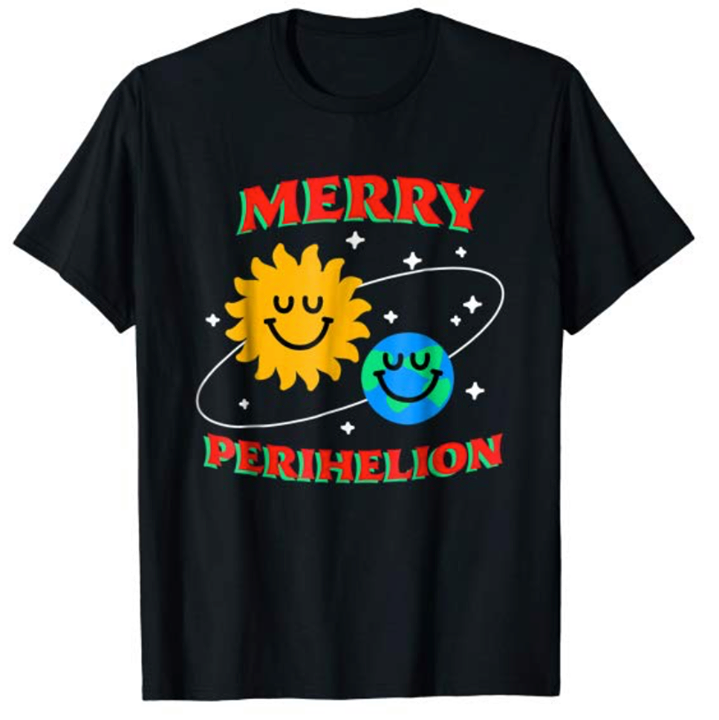
Overnight January 4 / 5 - Earth at Perihelion - The closest distance to the Sun in our annual elliptical (oval-shaped) orbit.
If you see astrophysicists dancing in the streets, this could be why.
https://t.co/DQm3X8YQ2Q
No need to panic, but the red supergiant star Betelgeuse (yes there is a star with that name), one of the brightest in the nighttime sky, marking the left armpit of the constellation Orion, is mysteriously dimming, having lost 60% of its brightness across the past six months.
Like Earth's orbit around the sun, the moon's orbit isn't a perfect circle. The moon will swing to its farthest from Earth for 2020 on March 24, and then comes closest to Earth about 2 weeks later, on April 7. 🌕 Read more: https://t.co/rwhmMmVsW3 👓
Image via Muzamir Mazlan.
“Twenty years from now you
will be more disappointed by
the things you didn’t do than
by the ones you did. So throw
off the bowlines. Sail away
from the safe harbor. Catch
the trade winds in your sails.
Explore. Dream. Discover...”
- Mark Twain
Popular at EarthSky: Why the New Year begins on January 1 🎉
Celebrating the New Year on January 1 is a civil event, not an astronomical one. And yet nature cooperates to make January 1 a satisfying time to start anew. Read more: https://t.co/N5ia8HXjFz 👓
Image via NASA.
Betelgeuse is 'fainting' but (probably) not about to explode 🌌💥
The well-known bright red supergiant star Betelgeuse - which will explode some day - has become noticeably dimmer since late October. Read more: https://t.co/AZpOodlzrA 👓
Image via NASA/ ESA. 📸
Last full moon of the decade.* Read more: https://t.co/y6dCcc0qlc
Angela Demetriou McClain of Botetourt County, VA caught last night's moon and wrote: "Taken at 12:12 a.m. EST ... the moment the moon became full." Thanks, Angela!
*Except for purists: https://t.co/D7zQuzlecr
Here's something to see on a 1st quarter moon...
Tim Yacyshyn in Richmond, BC, Canada captured it Oct 5. He wrote: "Taken exactly 12 hours after 1st quarter. As you can see, the famous Lunar X stands out quite prominently." Thanks, Tim!
What is Lunar X? https://t.co/aSjCvVK6Sn