It is wild that the EU demands respect for international maritime laws to open the Strait of Hormuz, while remaining completely silent about the kidnapping of EU citizens in international waters trying to deliver food to the starving people of Gaza.
Happy International Women’s Day! I hope today and everyday you are reminded of the strong and incredible women in this world.
There are many things I wish for on this day, but the one I’ll mention now is for parents and coaches in chess: Please stop putting different goals for young girls and boys. I still see so many parents being more “ambitious” with their sons and not giving the same opportunities to their daughters. I believe this change in mentality would go a long way - everything starts from home!
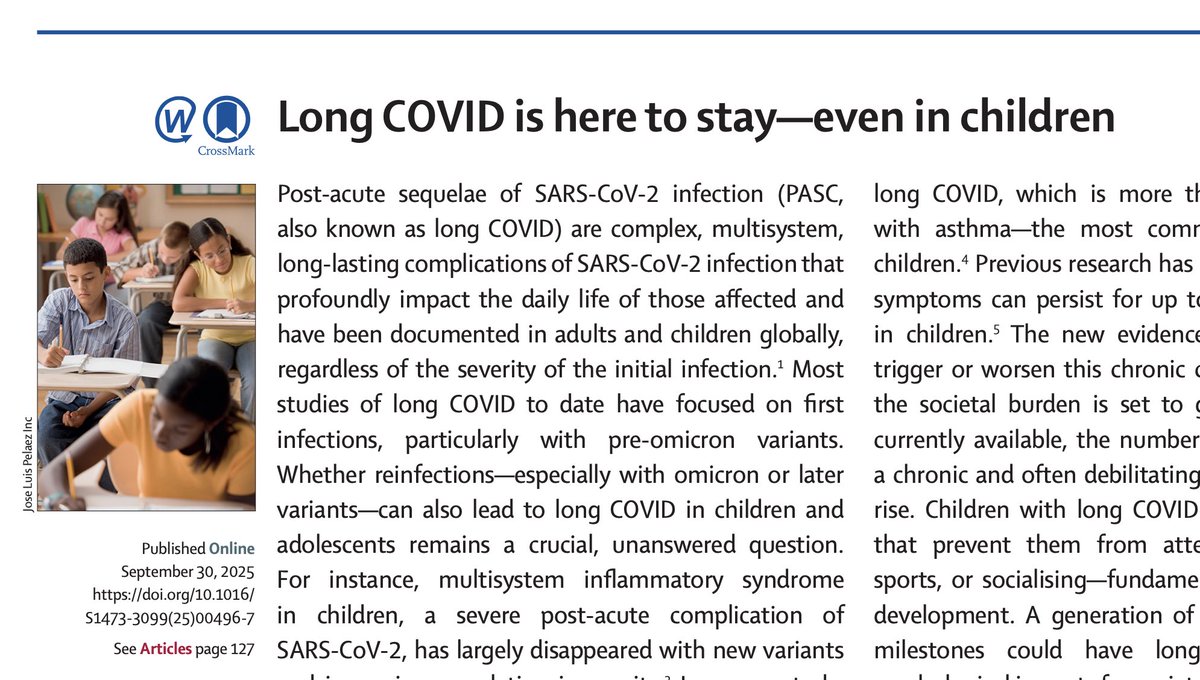
I've seen this Lancet article going around recently, and to be honest, I find it horrifying. Imagine a researcher in 1965 looking at the rising tide of lung cancer and declaring: "People are just going to smoke. It’s human nature. Let’s stop talking about prevention and just focus on curing cancer."
If we had adopted that strategy ("The situation is hopeless, focus on treatment") it would have led to the deaths of literally tens of millions of people over the last 50 years. Why? Because medicine still cannot fix the damage smoking causes. We didn't beat lung cancer with chemotherapy; we beat it by taxing tobacco and banning smoking in restaurants.
Yet, this is exactly the strategy we are currently adopting for Long COVID. We are told that mass infection is inevitable, masks are "too hard," and our only hope lies in finding a cure for a complex neuro-immune disease that we have virtually no understanding of whatsoever.
Never in the history of medicine have we successfully dealt with a public health issue by abandoning prevention. A few examples:
1. In the 1950s, highways were slaughterhouses. We didn't solve this by training better trauma surgeons to stitch people back together. We solved it with airbags and seatbelts. If we had relied solely on "better treatments" for car crash victims, the death toll would still be astronomical.
2. When people got sick of condoms, we didn't say, "Oh well, let everyone get AIDS." We continued to encourage them, and also developed PrEP. We didn't abandon the goal of stopping HIV transmission; we just built better tools.
3. We didn't stop Cholera by inventing better rehydration fluids. We cleaned the water. We built sewers. They didn't ask every citizen to "boil their water responsibly"; they engineered the risk out of the system.
Currently, we are accepting the mass disablement of children and adults based on the arrogant assumption that future medicine will be able to "fix" their broken immune systems. But ask anyone with any chronic illness: medicine is terrible at treating it, let alone fixing it.
To bet our children’s futures on a non-existent cure while refusing to implement the one thing that actually works (prevention) is appaling.
For those who think COVID is a hoax or a cold, I can sort of understand not caring about prevention - because at least it is internally consistent. But people who understand the risk and still don't emphasize prevention are either immoral or just haven't thought too deeply about the problem.
It was around midday, that hour when the body continues out of habit but the soul has already collapsed. I remember thinking, without surprise, that exhaustion has its own clarity, a cruel lucidity in which illusions no longer survive.
That was when she entered.
I did not recognize her. And yet she was familiar, because suffering here has a single face, endlessly replicated, as if stamped from the same mold. She held her child close, not with tenderness alone, but with caution, as one carries something already threatened by the world.
She hesitated before speaking, and when she did, her voice was so quiet it seemed almost ashamed of itself.
“How much does the examination cost?”
I have learned to fear this question more than any symptom. It is asked only when a person has already calculated the price of despair, when illness must be measured against hunger, and a child’s right to care is weighed against the arithmetic of survival.
I told her the clinic was free. She entered my room carrying a four-month-old infant. Four months, an age at which a human being should know only warmth, rhythm, and protection. Instead, this child had been born into a time that recognizes none of these things. A time that devours even its infants without apology.
The complaints were ordinary. Difficulty breathing. Persistent crying. Diarrhea that had not stopped. I listened, nodded, examined, as I have done hundreds of times. Illness here has become routine, and routine is the most frightening thing of all.
But then I noticed the clothing. Or rather, the absence of it. The baby wore a single winter pajama, and over it a thin short-sleeved shirt. That was all. Two inadequate layers on a body that had barely begun to learn how to survive cold. Outside, the wind clawed at the walls of the clinic, carrying with it something harsher than weather, something almost intentional.
I did not ask the mother why. I have stopped asking such questions. Not because I lack curiosity, but because I lack the strength to receive the answers. Each explanation here is not an explanation at all. It is an accusation, and I already feel accused enough.
I gave what medications we had. For the child. For the mother. The act felt mechanical, almost dishonest, as though I were performing medicine while knowing it was not medicine that this child required.
She turned to leave. Then stopped. I recognized that pause. It is the pause of someone who has already decided to speak, but still hopes not to need to.
She came back.
“I have been displaced for a long time,” she said. She spoke carefully, as if each word might be taken from her. “This is the only clothing I have for my baby. A charity gave it to us. I am not asking for anything.”
She paused, and I could see that what followed cost her more than pride.
“At night, in the tent, I wake up and find her very cold. Sometimes her skin looks bluish. Dry. Fragile. As if it might break. Is this dangerous for her? Is there anything I can do? Anywhere I can go?”
The truth was not complicated. It was not hidden behind medical terminology or ethical uncertainty. It was simple, and because it was simple, it was unbearable. There was nothing she could do.
And there was nothing I could do either.
This child was not merely her mother’s responsibility. That was a convenient lie we tell the poor. This child belonged to everyone who made this war possible, to everyone who justified it, to everyone who watched displacement unfold and called it inevitable. She belonged to those who speak of policy while infants turn blue in the dark.
I gave her an emergency thermal blanket.
I handed her the blanket as one might place a cloth over a corpse. Not to reverse death, but to acknowledge it.
And the question that followed me, long after she was gone, was not whether I had done my duty.
It was whether you are truly doing all that you can.
#WoundedGaza
Today at 34 & Park in Minneapolis, a woman tried to drive down the street where a protest had broken out in front of a home ICE was raiding, saying she had a doctor apt to get to. ICE agents busted out her windows, cut off her seatbelt, and pulled her out before arresting her.
I owe a huge debt to AJ Leonardi.
He gave the scientific explanation for the phenomenon I had been witnessing since February 2020, and he was absolutely right the whole way along.
He never caved despite massive attack.
The man is a living legend.
❤️👇
When terrible things happen it can be easy to believe the world is terrible; it's important to remember that there is far more good than evil.
While there are a small number of people who commit horrific acts, there are many more people who will save others from them.
43 year old father of two Ahmed al Ahmed tackled one of the terrorists and disarmed him. He was shot twice. His act of incredible heroism saved lives today. He is the best of us.
I was sitting in the clinic on the first morning of the cold wave, the kind of cold that does not merely touch the body but gnaws at the soul. A journalist had written to me earlier, asking about the weather and its effects on patients. I read the message and thought I would answer later. I believed, foolishly, that one could still think calmly in a world like this.
Then I raised my eyes.
Before me sat a woman, silent and exhausted, with two small girls clinging to her. They were dressed in thin clothes, the sort one might wear on a mild spring day, not in the cruelty of winter. Over them hung a jacket so worn and torn that it mocked the very idea of protection. On their feet were flimsy plastic slippers, the kind meant for tiled bathrooms, now forced to confront mud, cold, and misery. I felt a strange shame for my own shoes.
I took the hand of one of the girls and placed it on the table. Her fingers were small and delicate, still belonging to a child who should have been learning to draw or to write her name. Instead, they were wounded. The skin was broken. The injuries were deep despite their size and dirty despite their simplicity. They resembled disease, yes, but not a disease I had learned about, not one with a Latin name that could be explained away.
As I examined her hand, she spoke.
She said that while she was sleeping in the tent the night before, rats had eaten her fingers.
She did not cry. She did not dramatize. She stated it as one might state that it had rained, or that the night had been cold. And because the mind rebels when confronted with absolute obscenity, I asked her again, almost angrily, almost begging reality to contradict itself.
“Rats?”
“Yes,” she replied at once, surprised by my surprise.
In that instant, something inside me collapsed. Not slowly, not philosophically, but violently. The world shrank and became cramped and airless, as though God Himself had stepped back to avoid witnessing what His creation had become. I had read about suffering. I had studied it. I had admired its descriptions in books. But this was not suffering. This was humiliation elevated to a principle of existence.
A rat. A living creature driven by hunger and filth, gnawing on the fingers of a sleeping child. And the greater horror was not the rat. It was that this act had become ordinary. That the child found my disbelief strange. That the universe had trained her to accept the unacceptable.
I wanted to scream. I wanted to accuse someone, anyone. Humanity, governments, history, God. But there was no one to accuse. There was only the child’s hand resting quietly on the table.
I realized then that I did not know what to do. No textbook had prepared me for this. No lecture, no exam, no brilliant professor had ever spoken of rats eating children alive while they slept. And even if such a chapter had existed, I am certain I would have skipped it. Who could read such a thing and still believe they lived in a civilized world?
This was not poverty. This was not war. This was moral collapse.
Later, when I remembered the journalist’s question about the cold wave and its impact, I almost laughed. To answer such a question requires no intellect, no statistics, no expert commentary. One must simply walk through the streets of Gaza for an hour. One must look carefully and honestly, without averting the eyes.
The answer will be there, breathing, bleeding, and waiting quietly for someone to finally admit what this world has allowed itself to become.
#WoundedGaza
With profound sadness, the International Chess Federation (FIDE) and the Asian Chess Federation mourn the passing of Casto Abundo, Executive Director of the Asian Chess Federation. His departure follows an exceptional career dedicated to the service of chess at both the continental and international levels.
Casto Abundo was a model of professional integrity, administrative excellence, and visionary leadership. He played a pivotal role in strengthening the Federation’s institutional framework, and his initiatives and pioneering contributions have left an enduring legacy for the development of Asian chess—one that will continue to guide future generations.
His passing represents a great loss to the Asian and global chess community. He was renowned for his outstanding leadership and remarkable ability to build bridges of cooperation among national federations, fostering a spirit of mutual respect and shared responsibility.
FIDE and the Asian Chess Federation extend their heartfelt condolences and sincere sympathy to his family, colleagues, and loved ones. His profound professional and human legacy will remain deeply cherished in memory and will continue to inspire our path forward.
Hundreds of naked bike riders have now joined the protest in front of the ICE Facility and now there’s a massive turnout of people here. Portland PD has issued multiple warnings asking protesters to clear the road or they would be subject to arrest and crowd control munitions
@NewsNation
The last public message from the late Jane Goodall. The 2nd half really hit me
“We all must play our part. There is hope”
“we have to do everything in our power to make the world a better place for the children that are alive today and for those children that will follow” ❤️
Four years ago, I rode a water jet upon the Caspian Sea. The instructor called out to me: “Scream. Let the water take your howl. No one will hear, but perhaps your soul will breathe.”
And yet, I could not. I opened my mouth, but the voice was dead before it left me. My silence was heavier than the sea, thicker than the air. I did not know, oh, God, I did not know! That this silence was prophecy, that one day I would dwell in a place where every throat is strangled, where every scream is stillborn, where the silence of humanity itself has become more terrible than any cry.
That place is Gaza.
Here the world has ended, and only corpses walk. Here children are born already condemned, their first breath a debt to death. Here men claw through filth to find bread for their little ones, and children lick the dust for flour laced with sand. Here women tear their clothes to shreds, shrieking over the shattered flesh of their sons. Here fathers stare into their children’s lifeless eyes until their own souls bleed out of them.
I have seen the mutilated bodies of children scattered like broken dolls.
I have seen young girls begging for rags of dignity, shrapnel having robbed them of even the right to stand.
I have seen men crawling, halves of men, dragging their ruined bodies across the rubble.
I have seen teachers, once apostles of wisdom, reduced to beggars at the stalls of hunger.
I have seen honor desecrated, dignity butchered, the very image of man trampled into the mud.
And I tell you: even Hell could not imagine this. The God of mercy has turned His face away. The Devil himself has fled, unable to abide a cruelty that eclipses his own. What is Gaza, then? It is not a city. It is not even Hell. It is something beyond: a theatre where humanity rehearses its final extinction. A place where silence has grown fangs, where the absence of God screams louder than all the bombs, where man has become more monstrous than his darkest dream.
And I, am screaming as I write. My blood drips with every word. These lines are not ink, they are wounds. They are the howl that never left my throat at the Caspian, now forced upon the page with a violence no silence can contain.
Do you hear it? Do you hear me? Not with your ears, they are useless, but with your trembling heart, with your marrow that shudders as you read. Do you feel this scream tearing through you, searing your chest, clawing at the root of your soul? Do you smell its ash, taste its bitterness, choke upon its smoke?
This is the scream of Gaza. This is the scream of mankind standing upon the ruins of itself. This is the scream that has no end.
And if you do not scream with me, if you read and remain silent, then you too are complicit in the murder of the world.
#GazaGenocide
For days I cannot breathe. My chest burns, my throat closes. We wander like madmen, deranged, waiting for the blow, for the command that will tear us away again. We have known war, yes, two endless years of it, gnawing at us like rats gnaw at the bones of a corpse, but this… this is worse, infinitely worse. They tell us to leave. Again. For the fifth time. Do you hear? The fifth! And this time, O God, this time, we know it is the last. The last. We will not return. Never. Not tomorrow, not in ten years, not even in the fading memories of our children.
The door I shut behind me now will never open again to my hand. That sound, wood against wood, is not a door closing. It is my soul being nailed into its coffin. I am alive, yet I am already buried.
And what is this exile? It is not a journey, no! It is the stripping out of the last trembling thread of the human soul. They do not want men, or women, or children. They want shadows. Shadows crawling over dust, faceless, nameless, memoryless. A people of tents! Yes, tents! A nation whose destiny is canvas and rope, whose highest ambition is a rag flapping in the wind. Lord, is this not a death more merciless than the grave? To leave a man breathing, but rob him of all that makes him man, to condemn him to walk as a ghost who cannot even die.
The city, our city, beloved, betrayed, will be erased, levelled, spat into dust. Its stones scattered like ash in the wind. The houses where children quarreled, where mothers sang, where bread rose warm from the oven, all gone, gone forever. And then, O merciful God, we will forget. Yes, we will forget! In the torment of thirst, clawing for one drop of water, we will forget our streets, our walls, our keys, our doors. We will forget the warmth of winter, the sting of summer nights. We will forget neighbors, quarrels, weddings, songs. We will forget even that we were human.
Tell me, Lord, how can man forget himself? How can memory be ripped from the soul like flesh from bone? Remember us! Remember us before the breaking is complete. Remember the eyes of the children before their light is extinguished. Remember the tears of the mothers, the same as your mothers’ tears. Remember that we screamed, that we did not fall silent, that we tried with the last shreds of our strength.
And look, look with horror, at the abyss of history: how those who once wept in ghettos, who staggered through camps, who suffocated in ovens, now see their leaders prepare our exile. Auschwitz, do you hear its echo? It has not ended. It returns, it mutates, it reappears in new masks. And now the victim wears the face of the executioner. This is the most infernal blasphemy: that those scarred by the Holocaust now see their leaders fashion a Holocaust anew.
Write our names, I beg you, I cry to you, on your walls, in your books, in your prayers. Carve them into stone, before they vanish into dust. For tomorrow even you will doubt we ever walked the earth. And when your children ask: were they ever a people? Did they breathe? Did they love? Were they human? What will you answer then, when your own memory betrays you?
And Gaza, my Gaza, is ending. Yes, ending. This is the fifth exile, and the last. The last! An end blacker than the blackest pages of history, darker than the darkest prophecies ever dared to imagine. And yet, even as I write, through tears that blind me, something remains. A silence. A silence heavier than stone, heavier than tombs, heavier even than God’s gaze. A silence that devours the cry itself, that roars louder than all screams combined. That silence will not die. It will haunt you. It will haunt the world. It will haunt God Himself.
#GazaGenocide