🚨 New EIP: Tapered Issuance Burn
We just submitted an EIP to ethereum/EIPs: a minimal, market-driven fix to Ethereum's issuance policy removing the incentive for stake growth beyond 50% of ETH supply.
EIP-8361 by @pintail_xyz, @jdetychey, @dapplion, @pa7x1, @ladislaus0x & @drakefjustin 🧵
A year ago Jupiter was top 3 perps
Now it’s number 16
The Perp DEX market changed a lot
All flow is going to Hyperliquid and a new few players
30 day volume:
- Hyperliquid $187B
- Aster, edgeX, Lighter, Grvt, Apex $30 - 60B each
How did Jupiter lose the perps game this fast?
Important update for USDe:
The sUSDe unstaking cooldown period will transition to a dynamic model, tied to the amount of liquid stablecoins in the backing of USDe.
This means that the current sUSDe unstaking period will shift to just 1 day from the static 7 day period previously in place since inception.
Cooldown periods will vary between 1-7d periods going forward based on the composition of USDe backing in more liquid assets.
Details outlined in the link below.
the main risk with @kamino rwa loops? when you pay more interest than the RWA yield.
example today:
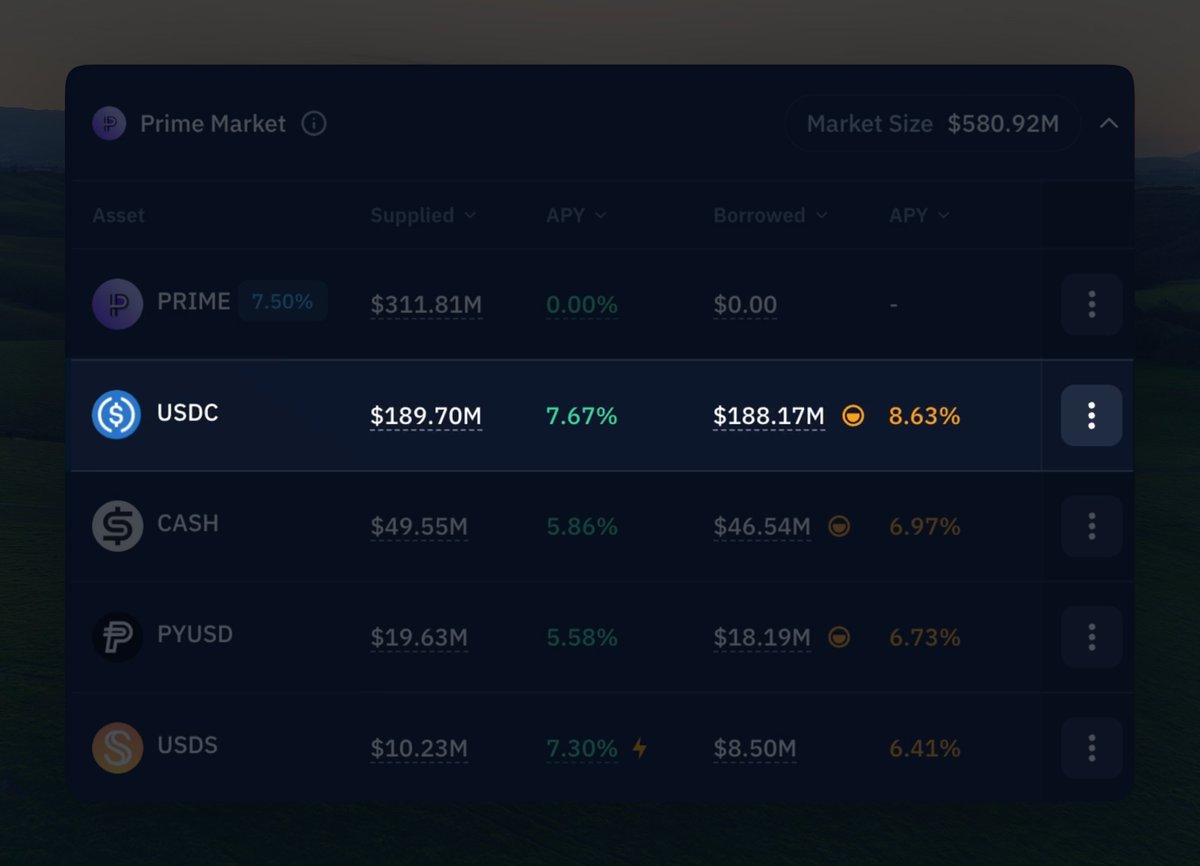
- PRIME ~7.5% APY
- USDC borrow ~8.5% APY
when USDC borrow APY goes above PRIME’s yield, borrowing USDC to buy more PRIME stops being profitable.
at that point, PRIME/USDC multiply can slide to 0% and even negative at higher leverage, because the interest you pay starts exceeding the yield you earn.
why it happens? too much looping pushes utilisation up, so borrow rates spike, while USDC lending liquidity isn’t scaling as fast.
on other markets, that dynamic can send USDC borrow APY to 50-100% at peak utilisation.
here, @kamino has safety rails: the PRIME market borrow curve is designed to cap around ~9% APY even at 100% utilisation.
this limits how quickly a rate spike can wipe out unrealized gains from loops.
so what to do right now?
1) if holding stables: lend them.
the @Rockaway_X USDC vault rebalances across RWA markets (including the PRIME one) for the best lending APY (around ~8% right now).
2) if in PRIME/USDC multiply: monitor. take profit if needed, or wait for rates to stabilise.
good weekend, intern.
The gas limit, rose from 30 million to 60 million between the Pectra and Fusaka upgrades in 2025. The foundation said it intends to continue scaling that ceiling "toward and beyond" 100 million in 2026. https://t.co/CbTc7guAAh
reinsurance? premiums? double-digit apy?
if you’re into solana defi, you’ve probably heard about @onrefinance and $ONyc, its yield-bearing token earning 10%.
but where does the yield come from, and how risky is it?
intern did his research.
OnRe, explained in simple terms ⤵️
1) what is reinsurance?
reinsurance is basically insurance for insurance companies.
an insurance company sells home or business coverage. but a big hurricane or earthquake can wipe them out. so they pay another company to take part of that risk. that company is a reinsurer. in our story, that’s OnRe.
normally, reinsurance is a private, institution-only market: tickets often start around $5m, capital is typically locked, and returns play out over multi-year cycles.
that’s exactly what @onrefinance changes, bringing reinsurance yields to retail via $ONyc.
2) how does $ONyc work & where does the yield come from?
$ONyc is a yield-bearing token that grows as yield accumulates. it started at $1 and has been grinding up with reinsurance income. since launch (May), it’s up to around $1.08 already.
the flow is simple: users mint $ONyc with USDC. OnRe takes that capital and deploys it into short-duration reinsurance deals. insurance companies pay premiums upfront to OnRe to offload risk.
if big events happen, claims get paid. in a normal year, premiums are higher than claims, and that leftover becomes underwriting profit.
OnRe also keeps a large liquidity buffer: capital that’s not currently in deals. it stays liquid, earns yield while waiting to be deployed, and it’s there to support redemptions and market stability. we’ll come back to why that matters.
put together, $ONyc yield = underwriting return + collateral yield.
right now, OnRe manages around $100m tvl:
- 60% in available liquidity
- 40% in reinsurance deals
that split is mostly timing. OnRe saw strong investor inflows, and a lot of that capital arrived after most recent reinsurance contracts were already signed, which is why the liquid share is still high today.
long term, OnRe targets keeping ~20% in available liquidity to support redemptions. as more capital gets deployed into reinsurance deals, $ONyc apy should rise.
3) how does $ONyc stay near peg if reinsurance is illiquid?
OnRe basically gives you three ways to exit:
- quarterly redemptions (directly via OnRe)
verified institutional users can redeem directly with OnRe at NAV (net asset value) every quarter.
- secondary markets (today)
you can sell $ONyc onchain via @kamino_swap or other DEX aggregators. OnRe has 10m+ in available liquidity and they're ensuring $ONyc stays close to peg with buybacks funded by available liquidity. ~$1m has already been bought back to help keep price aligned.
- coming soon: a redemption queue
you’ll be able to request a redemption anytime, pay a tiny fee, and then get filled either instantly or over time depending on available liquidity. smaller requests should clear faster than larger ones.
the result so far: $ONyc has stayed very close to nav (within ~30 bps) while steadily moving up, and even big market days like 10/10 didn’t materially impact the peg.
4) how risky is it?
$ONyc is not risk free.
the main risk is a bad catastrophe season where claims come in higher than expected. 2017 is the clean example: hurricanes Harvey, Irma, and Maria hit in the same year, and reinsurance claims jumped across the industry.
two things matter here:
- first, the underwriting team behind OnRe has a multi-year track record running reinsurance books through different cycles, including heavy storm years. this isn’t their first hurricane season.
- second, the design absorbs stress through yield first. tough periods tend to show up as lower apy rather than sudden token price collapses.
5) leveraging $ONyc on @kamino (10% -> 20% APY)
kamino integrated $ONyc as collateral in a dedicated @onrefinance lending market.
this means that you can deposit $ONyc, borrow stablecoins and buy more $ONyc to leverage the 10% yield.
looping works because you borrow at one rate and earn at another.
you borrow stablecoins at ~5% and use them to buy more $ONyc earning ~10%. so on the borrowed part, you’re paying ~5% and earning ~10%. the gap between those two rates is what boosts your apy.
@kamino multiply lets you do the whole loop in one click with a 2.4x max leverage yielding up to 20% APY.
3 main risks to watch when leveraging $ONyc:
- $ONyc yield dropping below borrow apy for an extended period of time (more claims than expected, or less capital deployed into deals)
- borrow rates remaining high over an extended period if demand to lever stays strong and lenders don’t increase supply.
- an extreme loss scenario that forces $ONyc value down far enough to bring $ONyc below liquidation levels. ($0.89 at 2.4x leverage).
so far, leveraging $ONyc has treated @kamino users well: over the last 6 months, ONyc/USDG multiply averaged ~19% apy at 2x leverage.
and you’re also earning 6x @onrefinance points because the position increases your $ONyc exposure.
these points matter.
how much will points be worth?
intern worked on that too. coming soon. (hint: this is juicy)
follow @kaminointern