The Oort Cloud: Our Solar System’s Invisible Frontier
Far beyond the planets, at the outermost edge of the Sun’s domain, lies a realm so vast and remote that it challenges the imagination: the Oort Cloud.This enormous spherical shell of icy comets and frozen debris forms the true boundary of our solar system. While Neptune orbits at about 30 AU and Pluto at roughly 40 AU, the Oort Cloud begins thousands of astronomical units from the Sun and may extend out to 100,000 AU or farther. (One AU — the average Earth-Sun distance — is roughly 150 million kilometers.)To grasp this scale: light, traveling at 300,000 km per second, takes just eight minutes to cross one AU. Yet it requires weeks to reach the inner edge of the Oort Cloud and more than a full year to arrive at its outermost fringes — over one light-year away.Human technology barely scratches this frontier. Voyager 1, our most distant spacecraft, would still need roughly 300 years just to reach the inner Oort Cloud and another 30,000 years to cross https://t.co/R6T3FjqdHD, the Sun’s gravitational grip grows incredibly weak. Icy bodies drift in a loosely bound swarm, easily nudged by the gravity of passing stars or the subtle tides of the Milky Way itself. Occasionally, one of these frozen wanderers is disturbed from its ancient orbit and sent plunging inward — becoming the long-period comets that streak dramatically across our night skies millions of years later.The Oort Cloud isn’t just far away; it represents a conceptual edge. Our solar system doesn’t end neatly at the planets or even at the Kuiper Belt — it fades gradually into interstellar space across a volume so immense that it underscores both our isolation and our subtle connection to the rest of the galaxy.A vast, invisible reservoir of ice and history, silently guarding the outer limits of the Sun’s realm — the Oort Cloud reminds us just how breathtakingly large our cosmic backyard truly is.
Visualizing a Black Hole
Because the force of gravity near its boundary (the event horizon) is so strong that it bends the trajectory of light, we can see not only the foreground portion of the accretion disk but also the portion that would otherwise be hidden from us by the black hole.
Visualizing a Black Hole
Because the force of gravity near its boundary (the event horizon) is so strong that it bends the trajectory of light, we can see not only the foreground portion of the accretion disk but also the portion that would otherwise be hidden from us by the black hole.
Saturn doesn’t just have rings — it rules an entire miniature solar https://t.co/MrqpkqJLDA of 2026, the ringed giant boasts 292 confirmed moons, far more than any other planet, with the number still climbing as astronomers keep spotting tiny new ones. Dominating them all is Titan, a colossal world larger than the planet Mercury. With a thick nitrogen atmosphere, rivers and lakes of liquid methane, and a diameter of 5,150 km, Titan feels more like a planet that got captured than a mere moon.Titan orbits Saturn at a safe distance of about 1.2 million kilometres — well beyond the outer edge of the famous ring system. Those dazzling rings, made of countless icy particles and moonlets, are confined much closer to the planet, while Titan sails majestically around the entire sprawling family of satellites. The sheer crowd of moons — from planet-sized Titan down to kilometer-scale irregular rocks — reveals just how gravitationally chaotic and crowded Saturn’s neighborhood truly is. It’s a dynamic, ever-evolving system where collisions, captures, and gravitational dances continue to shape one of the most spectacular regions in our Solar System.
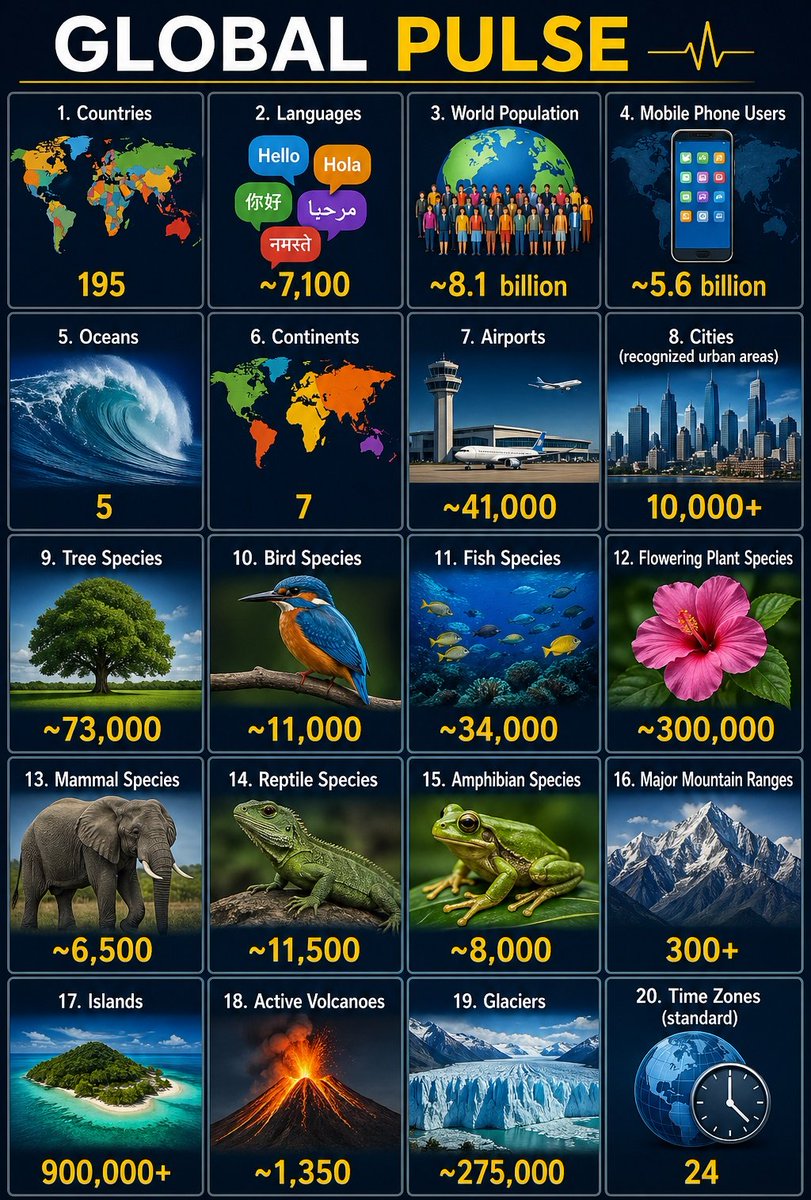
🌍 Total Counts in the World
🌐 Countries — 195
🗣️ Languages — ~7,100
👥 World Population — ~8.1 billion
📱 Mobile Phone Users — ~5.6 billion
🌊 Oceans — 5
🗺️ Continents — 7
✈️ Airports — ~41,000
🌆 Cities — 10,000+
🌳 Tree Species — ~73,000
🐦 Bird Species — ~11,000
🐟 Fish Species — ~34,000
🌺 Flowering Plant Species — ~300,000
🐘 Mammal Species — ~6,500
🐍 Reptile Species — ~11,500
🐸 Amphibian Species — ~8,000
🏔️ Major Mountain Ranges — 300+
🏝️ Islands — 900,000+
🌋 Active Volcanoes — ~1,350
🧊 Glaciers — ~275,000
🌍 Time Zones (standard) — 24