@paulg This is the real problem with using AI as a research tool. It sounds right often enough that you stop checking. We catch this constantly with legal agents. The ones that sound most confident are the ones you have to verify the hardest.
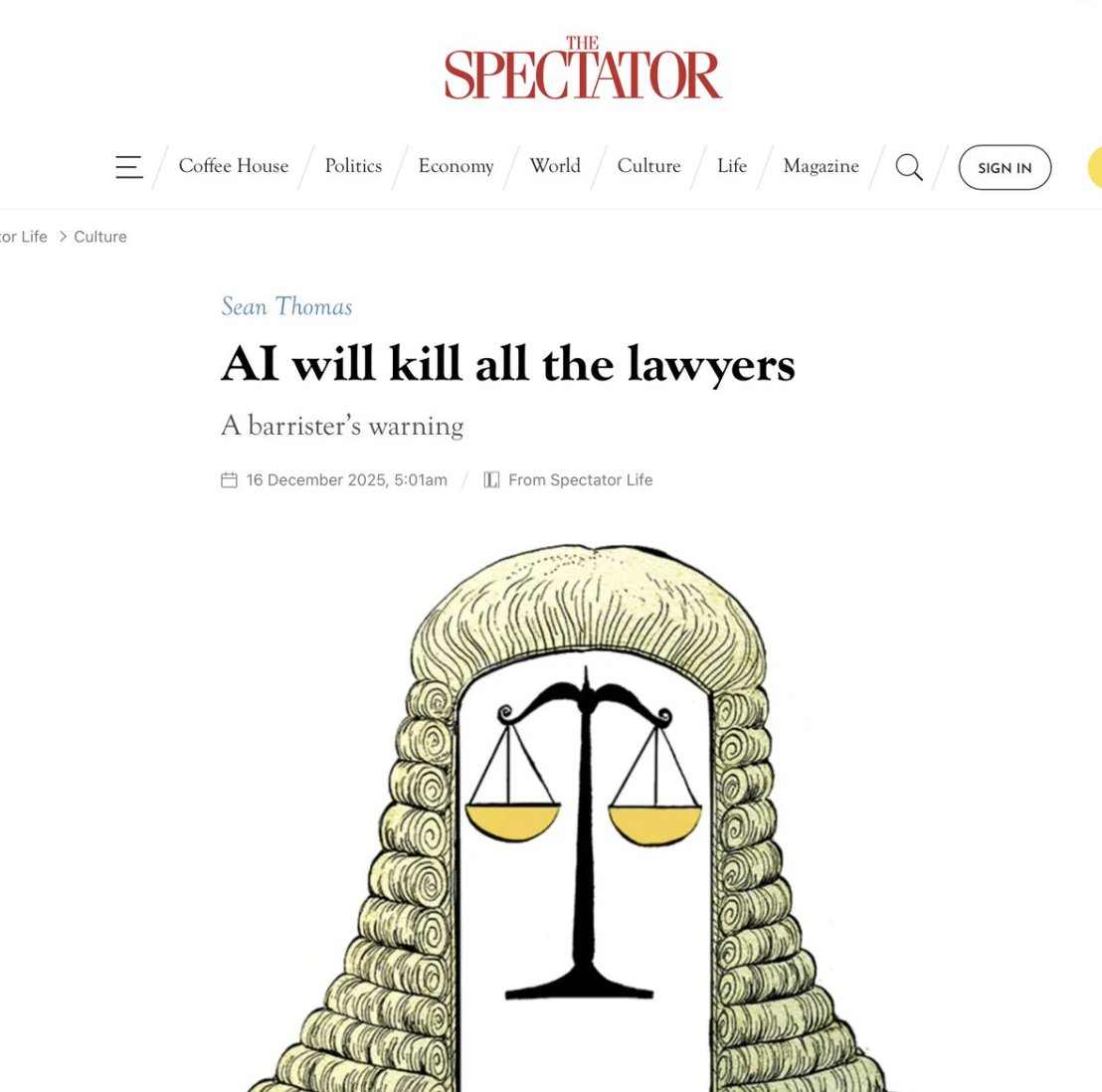
As a lawyer, let me tell you the main reason why AI will likely NOT kill all lawyers, and why law is actually one of the most 'AI-safe' professions today:
The legal profession is very good at protecting itself. It's built around the idea of competence, authority, credibility, and gatekeeping. That's how it has been for centuries.
If AI systems become very good at generating structurally complex and legally accurate outputs, legal procedure rules will be amended to make sure that:
- a human lawyer is always involved in a legal case;
- every legally relevant document is reviewed and signed by a human lawyer.
Also, bar associations worldwide will likely create new rules around legal representation, including procedural and behavioral rules, in a way that a human lawyer will always be necessary.
I don't see it changing in the next 15-20 years.
After that, lawyers will probably find a new way to gatekeep.
I view law as one of the 'AI safest' professions to pursue today (much safer than computer programming, by the way).
Legora, a Swedish artificial intelligence startup that works with law firms, is in discussions to raise more than $100 million in financing that would value the company at around $1.7 billion, according to people familiar with the talks https://t.co/SlGvkmXCvB
Breaking News: Filevine raises $400M to scale Legal Operating Intelligence
Insight Partners, Accel, and Halo Fund are backing the future of LegalTech.
AI built-in. Trusted by 100,000+ legal pros.
The next era of legal work is here.
Read the release: https://t.co/xWHrm50cM3
#Filevine #LegalTech #AI
People who think they no longer depend on trusting experts only survive because they're mistaken. Every time you get on a plane you trust experts implicitly about a million questions you're not even aware of.
This is illustrative:
1) When you get an instant AI answer, it is from a small model, which are weak models, especially at math.
2) Non-reasoning models, like the one powering AI overview, only “think” as they write, they make mistakes & then back justify them as they write more.
Yet another case (this time in Gauteng) of lawyers using AI to do legal research. Unfortunately, the AI generated fake citations.
As it was it was done in the KZN case, the lawyers have been referred to the Legal Practice Council for potential professional misconduct.
Friend who is a doctor told me everyone in his hospital uses ChatGPT now.
Me: “Do you all use o3?”
Him: “No, 4o. Isn’t it best to use the latest model? 4 vs 3?”
@OpenAI we really gotta fix these model names 🤦♂️
Thinking of AI agents purely as a replacement for human labor is a useful customer pitch—but a mental trap for founders and investors.
It locks you into legacy workflows and incremental gains. Lots of the upside will come from leveraging what humans can’t do: persistent memory across systems, instant scalability, 24/7 execution, perfect recall, and seamless API-level control.
Don’t just automate the old way of working—build the new one.
2 years ago today, A16Z announced they put $100M into Pinecone, as everyone and their mother tripped over each other to invest in vector databases.
Given how little standalone vector DBs are valued now, the hype cycle is wild to look back on.
Quick timeline below:
Late 2022:
•ChatGPT launches.
•Early RAG architectures emerge.
•First buzz around Pinecone, Weaviate, Milvus, Chroma.
Q1 2023:
•Massive demand surge for vector search.
•Vector DBs seen as critical infra.
•Heavy VC excitement (“new database category!”).
Q2 2023:
•Peak hype.
•Pinecone raises $100M, Weaviate raises $50M.
•Every AI infra diagram has a vector DB layer.
Q3 2023:
•Saturation hits.
•Postgres, Redis, MongoDB add native vector search.
•Clouds bundle it.
Q4 2023:
•Hype fades.
•Vector search becomes a commodity.
Early 2024:
•Market tightens.
•Attention shifts to agents, fine-tuning, orchestration.
The most transformative legal tech isn't about replacing lawyers with algorithms, but about intelligently automating and analyzing data so attorneys can focus their expertise where it matters: strategy and judgment.
Lots of OpenAI employees have been dropping hints recently that they've developed ASI internally.
But OpenAI's latest product is a buggy mess.
This strongly suggests to me that OpenAI has not, in fact, built ASI.
On top of Mariner, early reports from Google's Project Astra (AI assistant) testers are wild. @LinusEkenstam said taking it away felt like losing a friend.
That sounds like PR speak until you realize these are hardcore tech critics saying it.