@RnaudBertrand "The more accurate statement is:
Chinese models are often 80–95% as capable for many common tasks at 5–20% of the cost.
That's a huge economic advantage"
"If all you ever did was buy high-quality stocks on the 200-week moving average, you would beat the S&P 500 by a large margin over time. The problem is, few human beings have that kind of discipline."
- Charlie Munger
$MA
This is a really interesting paper about stock performance.
If you bought $AMD at the close every day and sold at the open the next day, over decades you’d have gotten a whopping +4,555,517% return.
But if you bought at the open every day and sold at the close the same day, you’d have lost almost everything – down -99.94%.
This pattern holds across every major market globally. This just reiterates that time IN the market beats anything else.
Other examples:
$MU: overnight +138,330,342% – intraday -99.92%
$NVDA: overnight +221,715% – intraday -99.7%
Same stocks. Completely opposite outcomes depending on when you hold it, overnight risk premium pays, intra day trading doesn’t.
BREAKING: The Trump Administration is investing $2 billion in quantum computing companies and will receive equity stakes in return, per WSJ.
Details include:
1. $1 billion of the package will be awarded to IBM, $IBM
2. Chip maker GlobalFoundries, $GFS, is receiving $375 million in funding
3. The rest of the companies will receive $100 million each, except for startup Diraq, which is slated to get $38 million
4. Multiple other public companies will receive funds including D-Wave Quantum, Rigetti Computing, and Infleqtion
Trump's next big bet is on quantum computing.
An excerpt from Elina Svitolina's emotional letter about Gael Monfils to their daughter Skai, for @PlayersTribune, ahead of Gael's final Roland-Garros:
'The first thing you should know, I think, it’s that Gaël Monfils was one of the greatest shot-makers anyone has ever seen. There are others who were more consistent, or who made fewer mistakes … but it’s interesting. Because when you say why these players are great, maybe you are needing to give a long explanation. Or you are needing to show many statistics, or a whole match, or a whole tournament. But with your dad? It’s not like this. With your dad, it’s so simple. You can show someone a single point of his, even a single shot … and now they will “get it.” Because your dad, in just one shot, one moment, he could achieve what I think few athletes ever achieve. He could make people feel something. Almost like at a concert and there’s a perfect song, or at the movies and there’s a perfect line, and you have this feeling like, Oh my god. WOW. It takes your breath away.'
Shocking stat of the day:
Semiconductor stocks have accounted for more than half of the S&P 500's +8% year-to-date gain, or +563 index points.
NVIDIA, $NVDA, alone has contributed +110 index points to the S&P 500.
This is followed by Micron, $MU, at +58 points, Broadcom, $AVGO, at +44 points, AMD, $AMD, at +40 points, and Intel, $INTC, at +39 points.
As a result, the remaining 495 stocks in the index have collectively contributed +272 points.
This comes as the Semiconductor index, $SOX, has rallied +64%, 8x the performance of the S&P 500.
Chip stocks now also account for 18% of the S&P 500’s market cap, near an all-time high.
Semiconductor stocks are a modern-day gold rush.
Be like Bill Ackman. And just rotate between the cheapest Maggy 7’s until it is not cheap anymore, then find the next one…
Right now he is lovin’ Microsoft and Meta.
JP Morgan comfirm their bullishness on AI bottlenecks:
In their 2026 Mid-Year Outlook report.
"The evidence suggests investing for a continuing AI supercycle"
"We believe the narrative around the AI supercycle has become too pessimistic"
"Industries that control the physical bottlenecks... should continue to perform well":
- optical equipment + networking
- memory
- power
With these names mentioned as AI bottlenecks:
- $NVDA
- $TSM
- $AVGO
- $META
- $SNDK
- $MRVL
- $LITE
- $COHR
- $ANET
- $APH
- $VRT
They also say to consider investment in the hyperscalers since "market participants have grown more skeptical of the companies’ expanding capex plans."
I agree, given the expanding demand/supply mismatch esp in cloud services.
I'm personally heavy on $GOOGL and have started building my $META position recently over the past few months. Separately, $MSFT is stupidly cheap rn + $AMZN also deserve consideration just cos of AWS & robotics tailwinds.
I feel a total rotation away from these names is wrong - having some small allocation at cheaper prices now makes sense for future planning.
Like, when capex slows eventually, those bottlenecked names will close up? That's still ages away per all reliable forecasts, but still...makes sense to at least build hyperscaler positions slowly at lower prices?
Overall, nothing "new" in the report that many of us on X didn't know already. And unfortunately no new names highlighted like BofA's semis report in Jan with $SOI.
But good to see institutions like JP Morgan/GS/BofA essentially confirm bullishness on upstream names in the supply chain as multi-yr beneficiaries.
Defensive stocks have never been this disliked:
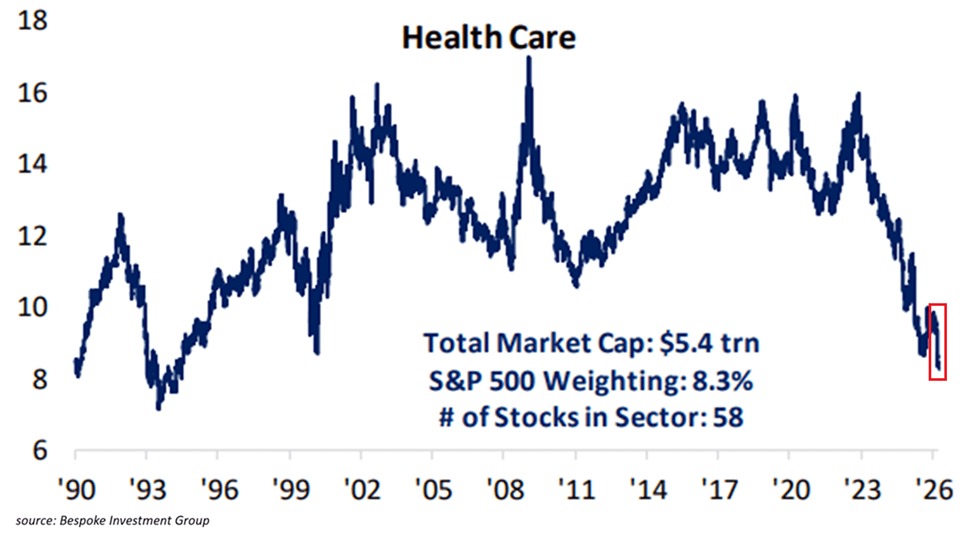
The healthcare sector now accounts for just 8.3% of the S&P 500’s market cap, the lowest percentage since 1994.
Their weight has fallen by -50% since the 2022 bear market.
By comparison, healthcare represented ~9.0% of the index’s value at the 2000 Dot-Com Bubble peak.
Furthermore, consumer staples, healthcare, and utilities collectively now account for just ~15% of the S&P 500’s market cap, the lowest since at least the 1970s.
Their weighting has dropped -12 percentage points since 2022, marking an even bigger drop than during the Dot-Com run.
Tech stocks have never been bigger.
Woe to those who manipulate religion and the very name of God for their own military, economic, and political gain, dragging that which is sacred into darkness and filth. #ApostolicJourney#Cameroon https://t.co/bKteFZ3iWE
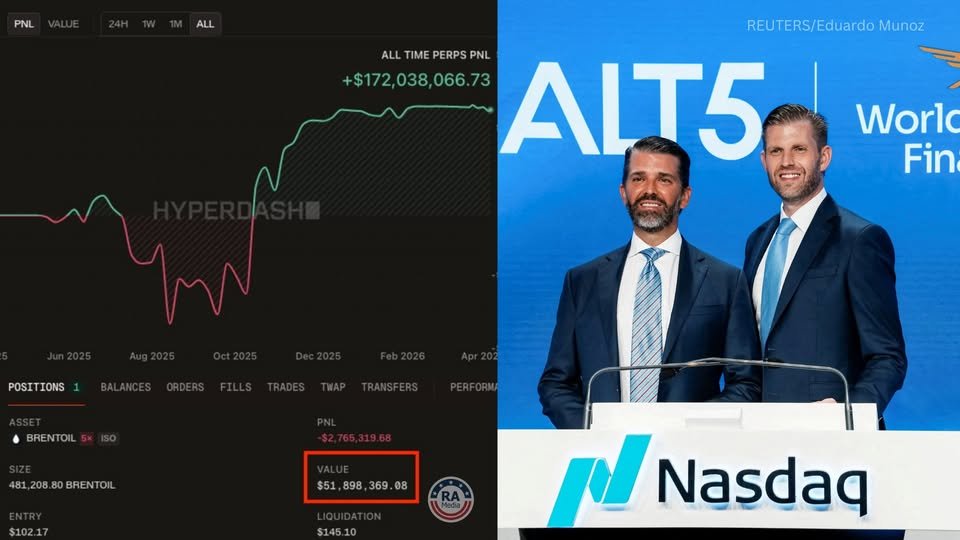
A Trump insider opened a $51,000,000 oil short position — hours before Trump announced a ceasefire with Iran. This guy is now 16 for 16. $170 million in profit. A perfect streak.
This is not a talented trader.
"We placed the bet." "The ceasefire dropped." "We cashed out." Sixteen times in a row.
That is not skill. That is not instinct. That is not research.
That is someone who knows what is coming before it comes.
Think about what that actually means. A private individual is placing a $51 million bet that oil prices are about to collapse — hours before a sitting president announces a ceasefire that collapses oil prices. Not once. Sixteen times. Zero losses.
There are only two explanations and both should terrify you.
Either someone inside the White House — or with direct access to it — is leaking ceasefire negotiations to traders before diplomats, before the press, before the American people hear a single word. That is insider trading. That is corruption. That is a federal crime.
Or the timing of the announcement itself is being shaped around the trade. Which is worse.
This is not a genius investor who reads the news faster than you do. The news hadn't happened yet. He wasn't reading the news. He was getting a phone call.
While Americans were watching the ceasefire announcement and feeling relieved — somebody already knew. Somebody had already bet $51 million on it. And somebody was already counting their winnings.
You are not watching a free market. You are watching a White House with a side hustle. Via~ Really American
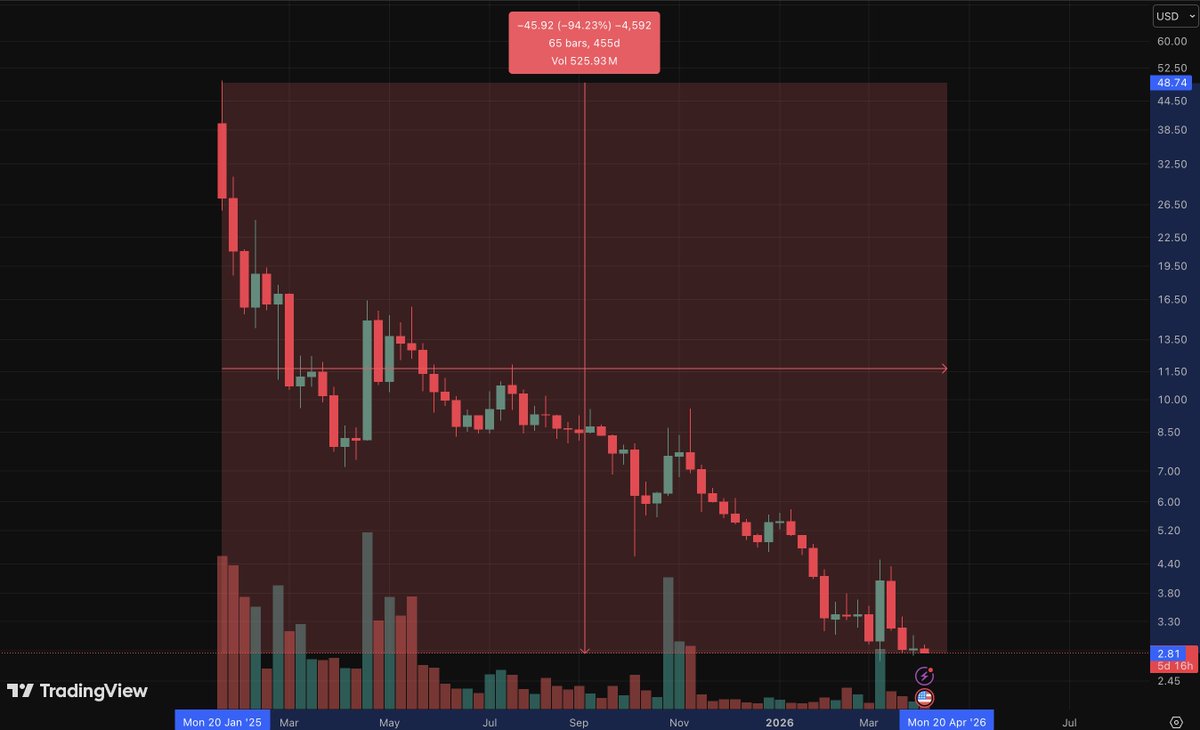
THIS IS THE CHART THEY WILL SHOW IN DOCUMENTARIES. A 94% CRASH. $4.3 BILLION IN LOSSES. ZERO ARRESTS. AND A DINNER INVITATION.
Look at that chart. $48 to $2.81. A 94% collapse. That is not a bear market. That is a liquidation event disguised as a political movement.
The $TRUMP token launched January 17, 2025. Three days later he was sworn into office. Within weeks, 810,000 wallets had lost a combined $2 billion. By 2026, total retail losses crossed $4.3 billion across nearly two million wallets.
For every $1 insiders earned, retail investors lost $20.
The Trump family and affiliated entities collected over $600 million through fees and token sales. Trading fees alone generated $100 million in the first 19 days. Exchanges banked another $172 million. And 94% of the token supply sat in just 40 wallets from the start.
This was a memecoin where the creator became the President of the United States, then dismantled the SEC's entire crypto enforcement division, closed every active investigation, paused every pending case, and then hosted an exclusive gala dinner for the biggest holders at his golf club while protesters outside shouted "Shame."
43% of the guests at that dinner were underwater on their investment.
Now there is a second gala planned for April 25 at Mar-a-Lago. The token hit an all-time low of $2.73 the day they announced it. And there is still $2.7 billion in insider tokens locked until 2028. That is not a vesting schedule. That is a countdown to the next wave of selling pressure.
Meanwhile the MELANIA token is down 99%.
No regulator intervened. No enforcement action was filed. The one agency that could have acted had its crypto division gutted by the very administration that launched the token. A bill was proposed to ban officials from issuing memecoins. It went nowhere.
In any other context this would be called a pump and dump with presidential immunity. Instead it got a dinner invitation.
US technology stocks have rarely ever been this cheap:
The S&P 500 Information Technology index is now trading at just a 4% forward P/E premium to the S&P 500, the lowest since January 2019.
This percentage has fallen -32 points since October 2025, one of the largest discounts on record.
In other words, tech stocks are the cheapest relative to the broader market in 7 years.
By comparison, the technology sector was ~47% more expensive than the S&P 500 at the June 2024 peak.
Tech stocks are now on track to become cheaper than the S&P 500 for the 1st time since 2017.
Is it time to buy tech?
AI companies just BROKE the global supply chain for every piece of technology you own.
And the fallout is way worse than anyone predicted...
Sony is delaying the next PlayStation to 2028 or 2029.
Nintendo is hiking the Switch 2 price mid-cycle.
Apple warned investors that iPhone margins are getting crushed.
Cisco just posted its worst share loss in 4 years.
Oppo is cutting phone shipments by 20%.
Lenovo, Dell, HP, Acer, and ASUS are all raising laptop prices 15-20%.
Samsung is now reviewing memory contracts QUARTERLY instead of annually because prices change too fast to plan.
And Elon Musk just told investors Tesla has to build its own chip factory from scratch because no supplier on the planet can keep up.
His exact words: "We've got two choices: hit the chip wall or make a fab."
All of this happened in the last 3 weeks.
Same cause. Every single time.
AI data centers are buying every memory chip on Earth.
And there's nothing left for everyone else.
Here's how we got here:
3 years ago, ChatGPT launched and the AI arms race began.
Since then, Samsung, SK Hynix, and Micron, the only 3 companies that make memory chips, quietly made a decision that's now reshaping the ENTIRE global economy.
They stopped prioritizing consumer memory.
Every factory. Every production line. Every wafer. All redirected toward one customer: AI data centers
Why?
Money.
AI memory chips sell for 3-5X the margin of regular RAM.
When Google calls offering to buy your entire output at premium pricing, you don't say no.
So the 3 companies that control 90% of the world's memory supply chose their highest-paying customers and left everyone else fighting over scraps.
The numbers from this week are insane:
OpenAI's Stargate project ALONE will consume 40% of the entire world's DRAM output.
HBM demand is surging 70% year over year in 2026.
HBM now takes 23% of total DRAM wafer production, up from 19% last year.
Meanwhile, there's a 4% gap between global DRAM supply and demand. And that doesn't even account for depleted inventories across multiple industries.
DRAM prices have surged over 170% since early 2025.
DDR5 contract prices are still jumping double digits month over month.
And the memory makers? They're printing money.
Micron's revenue is expected to more than DOUBLE this fiscal year.
SK Hynix sales doubled in 2024 and are on pace to double AGAIN.
Samsung just reported quarterly profit nearly tripling.
3 companies. $650 billion in AI spending chasing their products. And they get to name their price.
But the collateral damage is everywhere:
Every industry that uses memory, which is every industry, is getting squeezed.
Smartphone manufacturers are getting destroyed. For a mid-range phone, memory now represents up to 30% of the total build cost. Triple what it was in early 2025.
Chinese phone makers like Xiaomi, Oppo, and Transsion are cutting shipment forecasts and raising prices because they literally cannot afford the memory to build their phones.
Lenovo's CFO called the cost surge "unprecedented" and admitted they stockpiled 50% more inventory than normal just to survive the next few months.
The PC market could shrink by up to 9% this year according to IDC.
Not because people don't want computers. But because they can't afford the memory that goes inside them.
And the gaming industry?
Sony is seriously considering pushing the next PlayStation to 2028 or 2029.
Their carefully planned console cycle is getting blown up because they can't secure memory at prices that make a new console viable.
Nintendo is looking at raising the Switch 2 price. In the middle of a launch cycle. Something console makers almost never do.
Nvidia is cutting RTX GPU production because they can't get enough GDDR7 memory.
Even the car industry is getting hit...
Analysts are warning about a repeat of the pandemic-era chip shortage that shut down auto factories worldwide.
All because AI companies decided their chatbots needed the memory more than your car does.
And this doesn't get better for YEARS.
Building a new memory fab takes 3-5 years minimum.
Micron's new factory in Idaho won't meaningfully increase supply until 2027 at the earliest.
By then, AI demand will have grown even more.
Memory makers are already selling their 2027 AND 2028 capacity to AI customers today.
There is no supply relief coming.
That's why Elon is planning to build Tesla's own "TeraFab," a massive semiconductor plant that makes logic chips, memory, AND packaging all under one roof.
He said existing suppliers including TSMC, Samsung, and Micron simply cannot supply Tesla at the levels the company needs.
Think about that.
One of the richest men in the world, running one of the largest companies on Earth, can't buy enough memory chips. So he's building his own factory.
If ELON can't get supply, what chance does everyone else have?
The AI revolution has a tax.
And YOU'RE paying it.
Every dollar Big Tech spends on AI infrastructure drives up the cost of the memory inside your phone, your laptop, your car, your TV, and your gaming console.
$650 billion in AI spending this year.
3 companies controlling 90% of the memory supply.
And every wafer they allocate to an Nvidia GPU is a wafer denied to the device in your pocket.
The AI boom isn't free.
You're subsidizing it every time you buy a piece of technology.
And the bill just went up like crazy.
In case you don't realize what just happened:
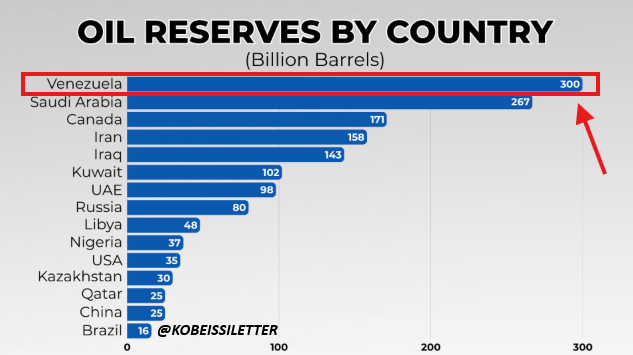
Venezuela holds the LARGEST oil reserves in the world, at 300 billion barrels.
The US is now "running" Venezuela with large US oil companies moving in, according to Trump.
The US now controls the largest oil reserve in the world.
This is 8 minutes long. It’s twitter so few will watch the whole thing-but I did and I now have a much better understanding of what motivated Tyler Robinson.