In suspected #NSTEMI, both #whyCMR & #YesCCT first strategies reduced invasive coronary angiography needs across most subgroups, greater with CTA. CMR better identified non-ischemic causes. https://t.co/gfpxKB3WZk
#JACCIMG@HeutsSam@JordiHeijman
Watch this remarkable interview with CTSNet EIC @joeldunning and Drs. Mateo Marin-Cuartas and @HeutsSam about their paper on updated 5‑year outcomes of transcatheter vs surgical AVR in patients with severe aortic stenosis.
🔗https://t.co/f5E20uBARK
#interview#SAVR#TAVR
💥In this new capacity as Associate Editor for @JAHA_AHA , I invite all cardiac surgeons of the world to submit your work for a new #spotlight on #CardiacSurgery@AmericanHeartFL@AHAScience
🔗Link here: https://t.co/yqhh4b8iFH
💥This will be an excellent opportunity for the cardiac surgical community to share knowledge, new insights and upcoming approaches around the globe🌎🌍🌏
@CleveClinicFL
@DrDamluji 2️⃣1️⃣ a non-statistically significant p-value from a log-rank test that requires proportionality of hazards, which is certainly not the case, does not in any way support so-called ‘equivalence’. The difference in the composite and all-cause mortality is highly clinically relevant!
Ok. I think this is a really important piece of evidence--as increasingly younger lower risk patients have TAVI vs SAVR.
I will cover on TWIC Friday and want to get it right.
I've looked at JACC paper. And I have some questions.
1) The original 2019 trial in NEJM (Popma et al) had a Bayesian noninferiority design, margin ARD 6%. Subsequent reports have switched to frequentist and superiority. I could not find where this was prespecifed or explained. The switch may be important.
2) Why does a 2.8% higher stroke/death outcome in TAVI arm calculate to a p of 0.4? I don't know exactly but in the same JACC issue is a review on dealing with non-proportional hazards https://t.co/gJkMUDCwdw and this data clearly looks non-proportional. So maybe something different like a milestone analysis should be performed. And if this is done, what would the upper bound of the absolute risk increase be? If it was greater than 6%, could we consider TAVI no longer non-inferior? Again, I am not a stats person. Just curious. Why can't NI be assessed at 6 years as well as one year?
2a) For instance, just looking at the reported absolute risk increase of 2.8% [95% CI: −1.9% to 7.6%]; log-rank P = 0.43) the upper bound is > 6% NI margin.
3) If we used the original Bayesian framework what would have been the Pb of harm with TAVI at 6 years?
4) I see these questions as reasonable given the higher re-intervention rate in the TAVI arm (I know, there were technical changes).
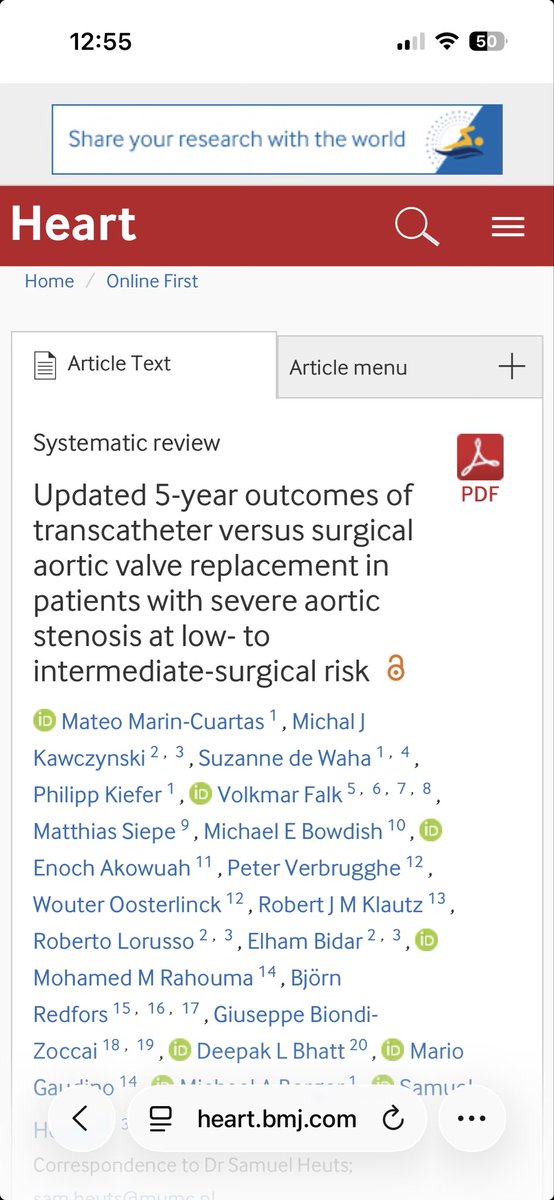
5) Also relevant maybe is this meta-analysis in BMJ finding 99% Pb of superiority of SAVR in 5-year mortality https://t.co/7VxadGFzoC
6) UK TAVI presented 5-year results at EuroPCR in May 2025. Higher stroke rates with TAVI. Not published yet??
7) Something seems to change over time. Look at 4-year EVOLUT results vs 7-year https://t.co/HA9LPZEmYb
TAVI mortality goes from 9% to 27.7% = +18.7%
SAVR mortality goes from 12.1% to 23.9% = +11.8%
From the discussion section. "At 7 years, no significant differences were observed between the treatment arms for all-cause mortality (27.7% TAVR vs 23.9% surgery; difference: 3.7% [95% CI: −2.4% to 9.9%]; log-rank P = 0.29) <- LOOK AT THE UPPER BOUND
@kaulcsmc@djc795@AndrewFoy82
@pomyers@drjohnm Probably because typical SAVR patients are not included in those trials.. Eligibility criteria for TAVI-trials typically describe ‘suitability’ for both procedures, which is really opaque. The issue of external validity was recently addressed in: https://t.co/VVuZJF0ZoS
@pomyers@EnochAkowuah1@JACCJournals Unfortunately a log-rank test may not be used in case of non-proportional hazards and the resulting p-value is uninterpretable. In line with our recent analysis (https://t.co/dLaokRmG0G), the composite of mortality and stroke, and mortality itself, is markedly increased in TAVI!
Hot off the press today!
Should we be more cautious about long term results of TAVI compared with surgery in low and intermediate risk patients ?
https://t.co/zFAKUnzaDl
New MMCTS tutorial: How to robotically harvest the internal mammary artery in a skeletonized, clipless fashion using bipolar micro forceps
📊 Skill Level: 2. Advanced
📹 Watch here: https://t.co/7iSJgpYc9e
@HeutsSam, @drbypass
🩺 The diagnosis of perioperative myocardial infarction (PMI) after coronary artery bypass grafting (CABG) is a much debated issue following the results of recent randomised trials.
💡 In collaboration with expert surgeons, (non-)interventional cardiologists, biochemists, radiologists, intensive care physicians and EACTS, @HeutsSam, @brian_swinnen and @Can_GoTe have developed a survey where you can express your opinion.
⏱️ The survey has been designed to determine current practice and give you the opportunity to influence this highly important topic. It takes less than 10 minutes to complete.
Complete the survey👇
https://t.co/RHT8HfOXfA
Podcast alert - Stroke protection in TAVI - @jhfrudd talks to Samuel Heuts and Pieter Vriesendorp about their review and Bayesian analysis of the data. Is protection useful? What do you practice?
Pod: https://t.co/dJHr4SQREP
PDF: https://t.co/wXSrlBcwvH
Letter to the Editor presenting 3 year follow-up results of FAME-3, which compared FFR-guided PCI to CABG in patients with three-vessel disease: FAME-3’s three year follow-up conclusion might benefit from more nuance https://t.co/Z7BgHb2vNR
@VictorDayan1@STS_CTsurgery@BavariaMd@pomyers@rafasadaba@EduQuintanaCVS@Adolfoferrero 1/ Indeed, of course. It is probably the phenomenon of channeling bias, in which ���sicker’ patients in the dataset on which the calculator was based got the least invasive treatment (for example isolated AVR in dr. Dayan’s case or isolated MVr in the mitral calculator), and,
Bayesian interpretation of non-inferiority in transcatheter versus surgical aortic valve replacement trials: a systematic review and meta-analysis, by Heuts et al https://t.co/UvHj5Noo44
Just published in @EACTS_Journals ICVTS: #tavr is unlikely to be non-inferior for all-cause mortality at 5-years based on our Bayesian inference pooled analysis of all major transcatheter versus surgical aortic valve replacement (TAVR, SAVR) trials.
#lifeexpectancy should be considered in life-time management of #aorticvalve stenosis!
Kudos to our star resident Sam Heuts.
#cardiacsurgery #cardiology #cardiovasculardisease
https://t.co/O2phHjpErf