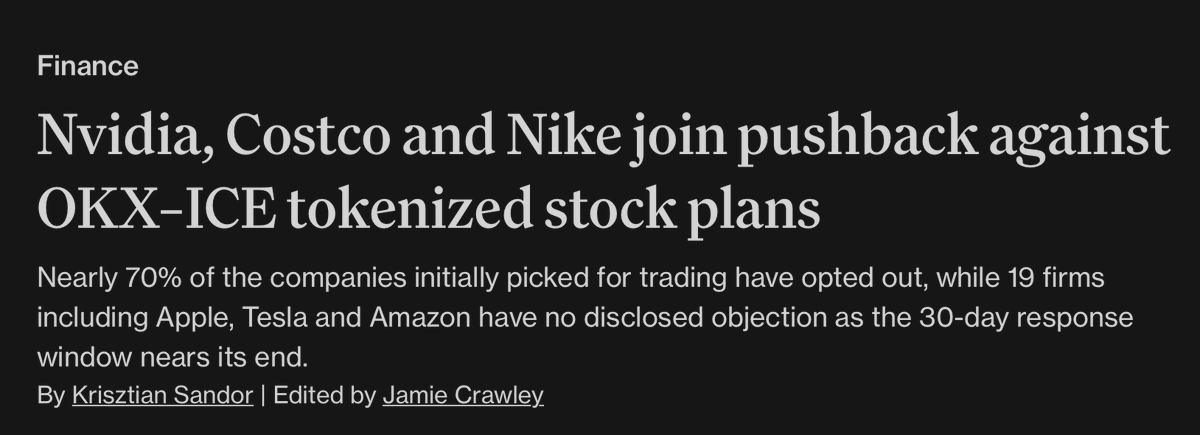
Want to dive a bit into this. Seeing a lot of confusion. TradFi is very nuanced and different from crypto protocols.
At a high level, this is not stock vs stock tokens or TradFi vs crypto, but more about TradFi Company A vs TradFi Company B. LONG and a large part of RH’s stock token vision come out ahead.
@RobinhoodApp history is useful context here. Financial disruption will always have some tension, but long term, innovation can increase total value even if it changes how the pie is being divided.
Making investing more accessible also changed who captured the economics. Some legacy brokers + exchanges like NASDQ resisted these models because they saw them funneling trading volume and revenue away from them.
Eventually, retail participation through models like those Robinhood pioneered helped bring more volume and net new people who might never have participated in these markets or their upside otherwise.
Let’s start with a few explanations:
ICE: A group that owns NYSE. They mostly focus on a trading fee model and futures, options, and energy markets. You can infer from this why TradeXYZ and Polymarket are in deep strategic collaboration with them.
NASDAQ: Facilitates trading but also listings, kind of like the chain where you TGE first. They made $1.5B in net revenue last quarter from listing fees, providing data for indices, and doing IR and marketing for listed companies.
tldr not very similar to the current primitive of stock tokens, what RH or LONG does.
The OKX ICE tokenization plan uses the latest SEC innovation exemption, which enables building a permissioned exchange that runs on a DEX. It has a LOT of limits, from KYC to restrictions on transfers (you can only buy or sell the stock, not send it out to a defi protocol or another wallet), and so on. This is effectively a centralized exchange that runs on DEX infrastructure and enables ICE to set up a business similar to NASDAQ without going through the same licensing and regulatory requirements.
1. Where is most stock trading taking place today?
Neither ICE nor NASDAQ, but off exchange, through retail trades via market makers, dark pools, and so on(*this is where RH stock tokens sit as well*)
For a stock like NVDA, 3x the volume takes place on NASDAQ compared to ICE. Therefore, this is more about NASDAQ trying to counter ICE taking its market share. Not about NASDAQ getting the whole pie for itself, which is impossible with the current market structure. That would mean people would be blocked from trading NVDA on retail brokerage apps like Robinhood.
2. Why do public companies object?
If you’re a company and you paid fees for services + listings that are provided within an agreement on NASDAQ, why would you let another project bypass that when the value prop is unclear and this is just another exchange with different infrastructure? The same way companies take down content based on IP rights, even if it’s just a random tweet. The other element here is that the innovation exemption was a bit rushed out and gave companies only 30 days to object, so the default is to object first and negotiate later.
3. What do public companies listed on OKXICE get?
Some information is not provided, but it appears they don’t get any services. Compared to NASDAQ or NYSE, where you keep your company listed and get all sorts of services. Here, none.
4. How does LONG win here?
Going back to the main assumption we had with LONG: trading tokenized stocks by itself is not interesting enough. The value prop is net new markets that are only possible through composability and programable assets.
Stock pairs on LONG have proven to:
1. Create a sink for the stock by using a deep liquidity design. This is like getting listed within an onchain ETF that takes some supply “forever.” Great for the stock’s health.
2. Provide distribution to a net new audience, plus mindshare, including an international audience that is not trading stocks and people discovering stocks for the first time through a viral form factor and actual stock based communities.
3. Bootstrap insane amounts of onchain liquidity that keep the stock price in sync 24/7. The major concern for these companies is having a depeg every day and backlash from holders.
We don’t have a strong opinion on which side to pick. We don’t have a horse in this race, but we see again how much disruption tokenization is bringing and how each step introduces a new layer of alignment LONG can capitalize on.
LONG.