Where news & history meet. 🇨🇦 Founder, The Canada Project. Think tank Editor | Fmr Editor-in-Chief, Canada's History Mag | 4x bestselling editor/author.
As a public historian and journalist, I thought it would be fun to look at today’s news through a historic lens. Join me on the journey! #TheCanadaProject
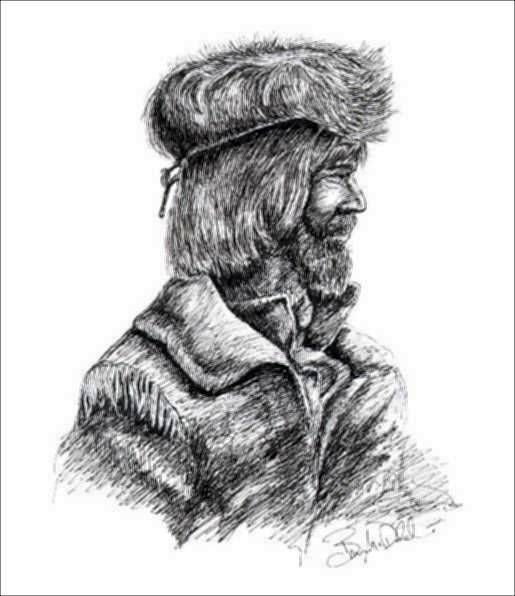
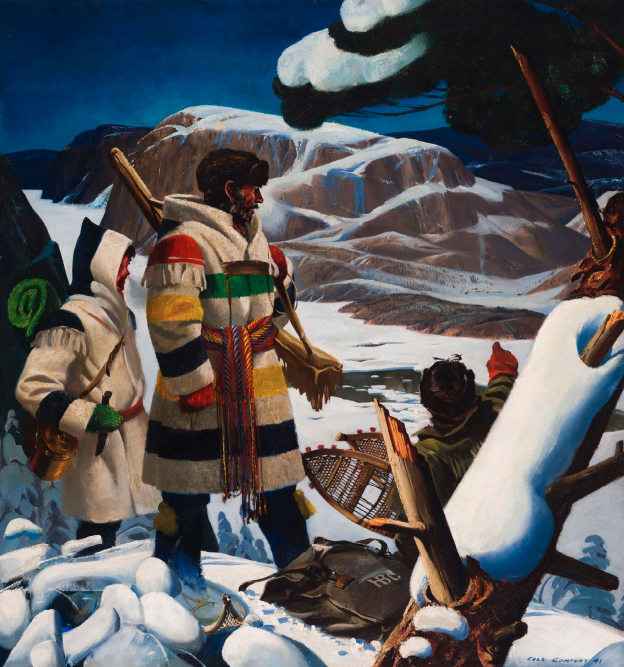
On this day in 1670, the Hudson's Bay Company was founded. In this work, Charles Fraser Comfort depicts two Hudson's Bay Company traders arriving at their post in harsh winter conditions.
A hockey game. A suspension. A riot.
In March 1955, the punishment of Maurice Richard triggered an explosion of anger in Montreal—but the roots ran deeper.
For many French Canadians, Richard symbolized more than sport. His suspension by Clarence Campbell was seen by some as reflecting broader tensions between French- and English-speaking Canadians.
The riot that followed wasn’t just about hockey—it became a moment of political and cultural expression.
Historians continue to debate its meaning, but many see it as a precursor to the Quiet Revolution.
History isn’t just about events—it’s about what they come to represent.
🎥 Learn more at https://t.co/aOiUe6aKk7
Follow CIHE for deeper historical context.
#CanadaHistory #RichardRiot #Quebec #HistoricalContext #CIHE #GoHabsGo
On this day in 1770, David Thompson was born.
Before satellites. Before GPS. There was a man with a sextant, a compass—and an unrelenting drive to understand a continent.
Known to some Indigenous peoples as Koo-Koo-Sint—“the Stargazer”—Thompson used the night sky to chart what others could not see. Over his lifetime, he travelled more than 90,000 kilometres across North America, mapping nearly 4.9 million square kilometres of the northwest.
His work didn’t just fill in blank spaces. It defined them.
Working with the North West Company, Thompson’s maps became the foundation for exploration, trade, and ultimately, the shaping of Canada itself.
He’s been called “the greatest practical land geographer the world has produced.”
Yet today, his name is far less known than the territory he helped reveal.
History isn’t just about who we remember.
It’s about who we’ve forgotten.
#TodayInHistory #CanadianHistory #DavidThompson #ContextMatters
On this day, the Canadian Pacific Railway was incorporated—marking the beginning of one of the most ambitious nation-building projects in Canadian history.
Stretching from coast to coast, the railway didn’t just move goods and people—it connected a young country, helped secure the West, and turned the idea of Canada into a physical reality.
But its legacy is complex. The railway was built through immense human labour, including thousands of Chinese workers who faced dangerous conditions and discrimination—and it played a central role in expanding into Indigenous lands.
The Canadian Pacific Railway helped create Canada as we know it today but it also raises enduring questions about how the nation was built.
Without the railway, does Canada even exist?
Congratulations to the @trurobearcats, who are @MetalfabFire MHL Cup Champions after defeating the @BlizzardEdston 5-3 at home in Game 5. Defenseman Jayden Connors won Playoff MVP. Truro will now head to Summerside, PEI, for the Centennial Cup, which starts on May 7th.
Huge congratulations to my nephew Drew Keiver and his teammates on the @trurobearcats for capturing the MHL Junior A championship title tonight. Great game guys - Enjoy the win!!!
Canada’s Constitution did not always live in Canada.
For more than a century after Confederation, changes to Canada’s Constitution still required approval from the British Parliament. That finally changed on April 17, 1982, when Queen Elizabeth II signed the proclamation patriating the Constitution in Ottawa.
The moment not only brought the Constitution fully under Canadian control — it also introduced the Canadian Charter of Rights and Freedoms, fundamentally reshaping the relationship between citizens, governments, and the courts.
Since then, the Charter has influenced everything from freedom of expression and minority language rights to major Supreme Court decisions that continue to shape Canadian law and public policy.
Few moments in Canadian history have had a deeper or more lasting impact on how the country governs itself.
#OnThisDay #CanadianHistory #CharterOfRights #ConstitutionAct1982 #HistoryMatters
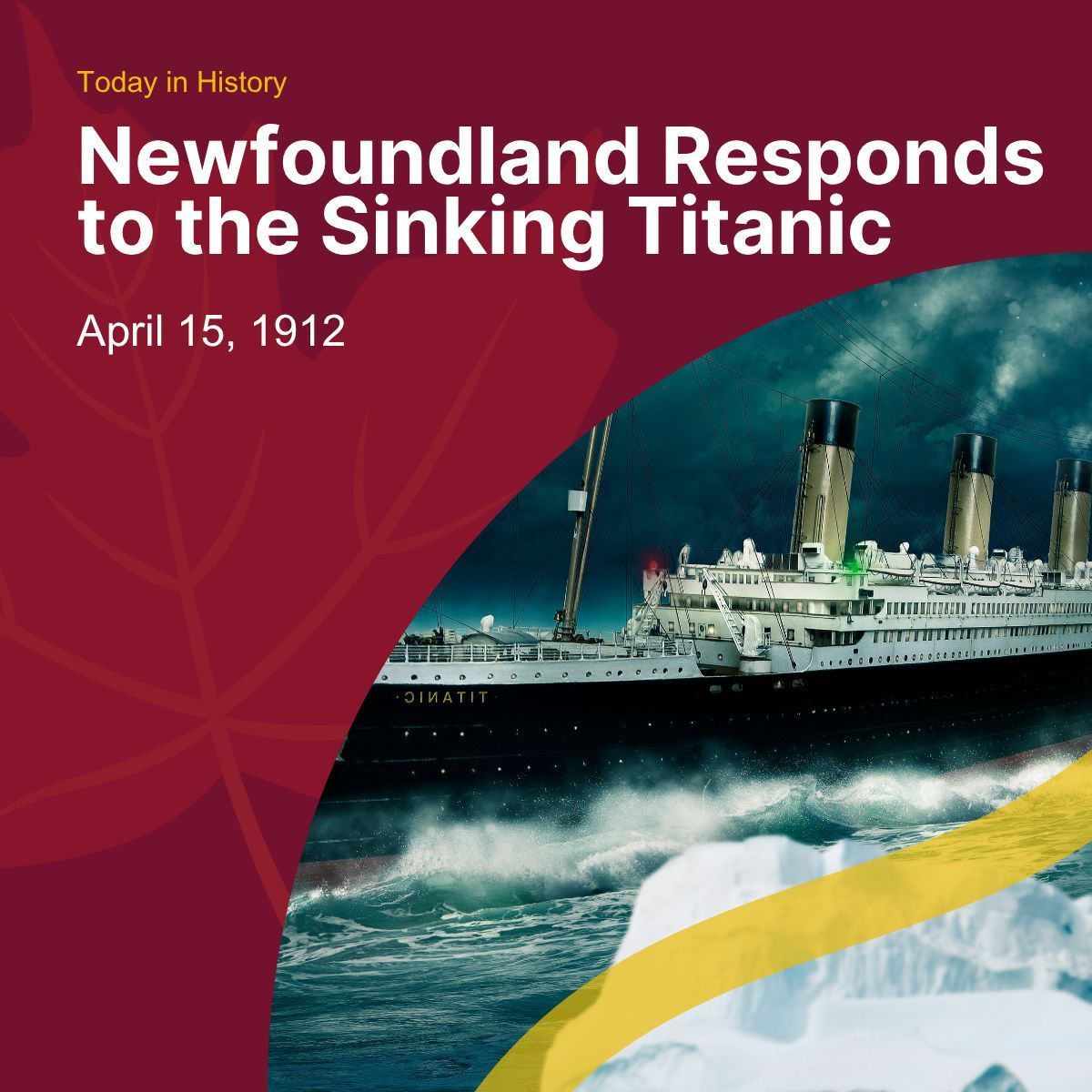
When the Titanic struck an iceberg on the night of April 15, 1912, the disaster unfolded in waters not far from Newfoundland — and the island was among the first places to respond.
The first distress signals were received by a wireless station at Cape Race, Newfoundland. Its operators quickly relayed the news to other ships in the area that the Titanic had hit an iceberg and was sinking. Rescue efforts began almost immediately. The operators also kept an anxious public abreast of the position and condition of the Titanic. Without this rapid response the death toll may have been much higher.
Ships operating out of Newfoundland and Nova Scotia joined the rescue and recovery efforts in the North Atlantic. In the days that followed, these vessels helped search the icy waters and recover victims from one of the worst maritime disasters in history.
At the time, Newfoundland was still its own dominion, yet its people and ships were on the front lines of responding to the tragedy.
It would not be the last time. From maritime disasters to wartime rescue missions and humanitarian efforts at sea, Newfoundland and Labrador has repeatedly stepped forward when ships — and lives — were in danger on the North Atlantic.
Sometimes geography places you close to history.
And sometimes it calls you to act.
#OnThisDay #CanadianHistory #Titanic #Newfoundland #HistoryMatters
TODAY ONLY!
On April 12, all donations and peer-to-peer fundraising will be MATCHED up to $100,000 by PharmaChoice Canada and its network of over 1,100 independently owned pharmacy Members across Canada.
Register for the #TerryFoxRun and fundraise now: https://t.co/bg3aaIAzaF
Ryan Reynolds for #TerryFox. 🇨🇦
Registration is now open for the annual #TerryFoxRun. Join us and kickstart your fundraising today: https://t.co/bg3aaIAzaF
Terry started a marathon against cancer. Together, we can #FinishIt. ❤️
@VancityReynolds
One run. One dream. A country inspired.
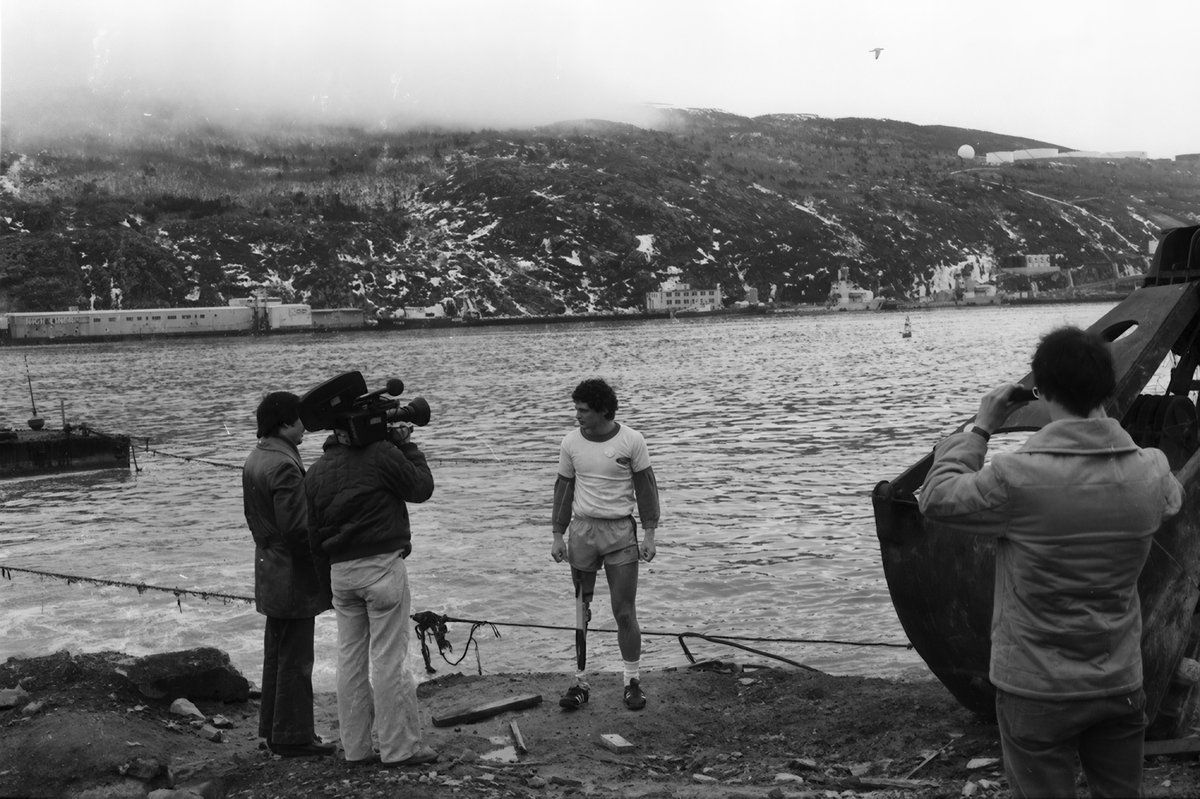
On April 12, 1980, Terry Fox dipped his artificial leg into the Atlantic Ocean near St. John’s, Newfoundland and began the Marathon of Hope — a cross-Canada run to raise money for cancer research.
Fox had lost his leg to cancer just three years earlier. But instead of stepping away from the fight, the 21-year-old from British Columbia set out to run the equivalent of a marathon every day across Canada.
For 143 days, Terry ran more than 5,300 kilometres, capturing the attention and admiration of the entire country. Although cancer forced him to stop near Thunder Bay, his determination sparked a movement that continues to this day.
The Terry Fox Run, held annually around the world, has since raised hundreds of millions of dollars for cancer research.
What began as one person’s journey across Canada became one of the most powerful legacies in Canadian history.
#OnThisDay #CanadianHistory #TerryFox #MarathonOfHope #HistoryMatters
Fought between the 9-12th of April 1917, The Battle of Vimy Ridge marked the first time all four divisions of the Canadian Corps fought as a single formation.
It took nearly three full days of hard fighting, but eventually, the Canadians were able to take the high ground.
Casualties were high. The Canadian Corps suffered over 10,600 casualties – around 10% of their total fighting force – with roughly 3,500 killed. The German Sixth Army losses are not recorded, but at least 7,000 were captured as prisoners of war.
📍Canadian Cemetery No.2, Neuville-St. Vaast
The cemetery was established by the Canadian Corps. The majority of the graves were made for the burial of the dead recovered from surrounding battlefields and from isolated graves which were transferred into the cemetery over a period of years after the Armistice.
There are nearly 3,000, 1914-18 war casualties commemorated in this site. 29 Canadian soldiers buried at the time in the 11th Canadian Infantry Brigade Cemetery, Givenchy-en Gohelle and the Canadian cemetery near Gunner's Crater, Givenchy-en-Gohelle but whose graves are now lost are commemorated by special memorial headstones, inscribed to this effect with the additional quotation, "Their Glory shall not be blotted out"
46 years ago today Terry Fox started his Marathon of Hope in St John’s, Newfoundland on April 12, 1980. Through his legacy, Terry Fox has raised over $1 billion for cancer research.
A war fought largely in Europe helped redraw the map of North America.
On April 11, 1713, the Treaty of Utrecht ended the War of the Spanish Succession. Among its many provisions, France ceded Acadia, Newfoundland, and the Hudson Bay territories to Britain — dramatically shifting the balance of power in what would later become Canada.
But the treaty’s consequences were not just geopolitical. In Acadia, thousands of French-speaking settlers suddenly found themselves living under British rule. Tensions over loyalty and control would simmer for decades, eventually contributing to the expulsion of the Acadians in 1755, one of the most significant population displacements in early Canadian history.
In other words, a diplomatic agreement signed in Europe helped set in motion events that would shape the political, cultural, and demographic future of North America.
Sometimes the most important turning points in Canadian history begin far from Canada itself.
#OnThisDay #CanadianHistory #TreatyOfUtrecht #AcadianHistory #HistoryMatters
I’ll never forget standing at the Vimy Ridge monument in France, looking out over the battlefield. A powerful mix of commemoration, respect, and awe for the Canadian troops who captured it in April 1917. Every Canadian who can should visit and pay tribute to our fallen.
#WeRemember #VimyRidge
A new episode of the History Matters podcast is now live!
In this episode, posted on the April 9th anniversary of the Battle of Vimy Ridge in 1917, Allan talks with military historian Dr. Eric McGeer about the battle and its place in Canadian memory.
The conversation covers the battle itself and its significance in the Arras Offensive and in the course of the First World War, the men who led the planning and preparations in the months leading up to April 9th – primarily Sir Julian Byng and Arthur Currie, under Sir Douglas Haig, the Commander in Chief of the British Expeditionary Force, how Vimy came to be the focus of Canada’s memorialisation of the Great War, and how the meaning of Vimy has shifted over time. In the process Eric and Allan discuss books about Vimy by Pierre Berton, Ted Barris, Jonathan Vance and Tim Cook.
https://t.co/64kwpfaa6J
For years, Canadians have heard warnings that the country’s military may not be ready for a major conflict.
But this concern isn’t new.
In 1866, bands of Irish-American militants known as the Fenian Brotherhood crossed the border and attacked British North America. Their goal was to seize Canadian territory to pressure Britain to free Ireland.
The raids exposed a hard truth:
Canada’s defence relied heavily on part-time militia units, many poorly trained and unevenly equipped.
At the Battle of Ridgeway, volunteer Canadian forces—many of them students and young militia members—faced experienced Fenian fighters. Confusion on the battlefield led to a Canadian retreat.
Yet the crisis also sparked change.
The Fenian Raids pushed colonial leaders to recognize that defence required coordination, training, and national responsibility. The threat from the United States was one of the forces that helped accelerate Confederation in 1867 and eventually led to the creation of a more organized Canadian military.
Throughout Canadian history—from the Fenian Raids to the early years of both World Wars—the country has often entered crises underprepared, then rapidly mobilized.
So the question remains:
Is Canada’s tradition one of readiness—or one of catching up when history forces the issue?
Dolores Claman's 1968 song, "The Hockey Theme", performed by the Jerry Toth Orchestra. Dolores would later say she had never seen a hockey game in person before writing the song, instead imagining Roman Gladiators battling while writing it.
On this day in 1868, Canada was shaken by its first political assassination. 🇨🇦
Thomas D’Arcy McGee, a Father of Confederation and a brilliant orator, was shot outside his Ottawa home. Just moments before, he had delivered a powerful speech in the House of Commons calling for national unity.
McGee was a reformed revolutionary who became a passionate advocate for a "new nationality" where diverse backgrounds could coexist. His legacy remains a cornerstone of the Canadian identity.
#OnThisDay #CdnHist #CanadaHistory #Ottawa
Think the North Pole was an American solo act? Think again! 🇨🇦❄️
#OnThisDay in 1909, Robert Peary claimed the Pole, but he never would’ve made it without Canadian legend Captain Bob Bartlett. The Newfoundlander captained the ship and smashed the trail through the ice, only to be turned back 150 miles from the goal so Peary could claim the glory.
The real MVPs? The Inuit guides like Ootah and Seegloo, whose survival skills and dog-sledding expertise were the actual engines of the expedition. 🐕🦺🏔️