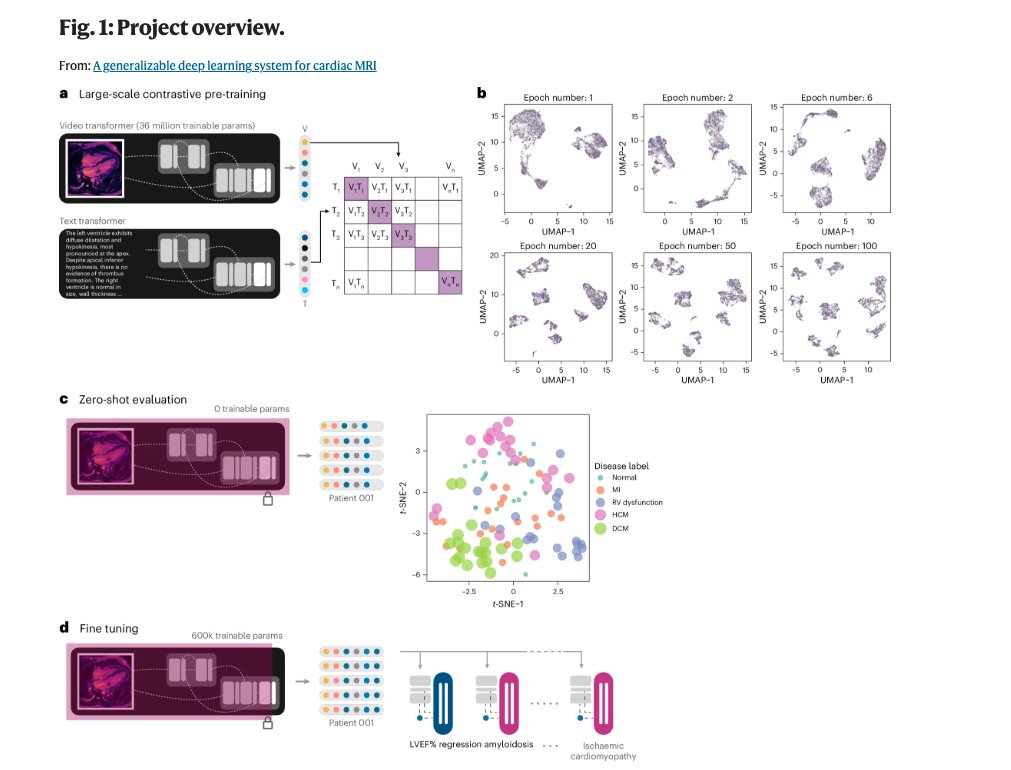
Happy to report that our work on building foundation models for Cardiac MRI has finally been published in Nature Biomedical Engineering! @natBME https://t.co/XKUY0WT0IL
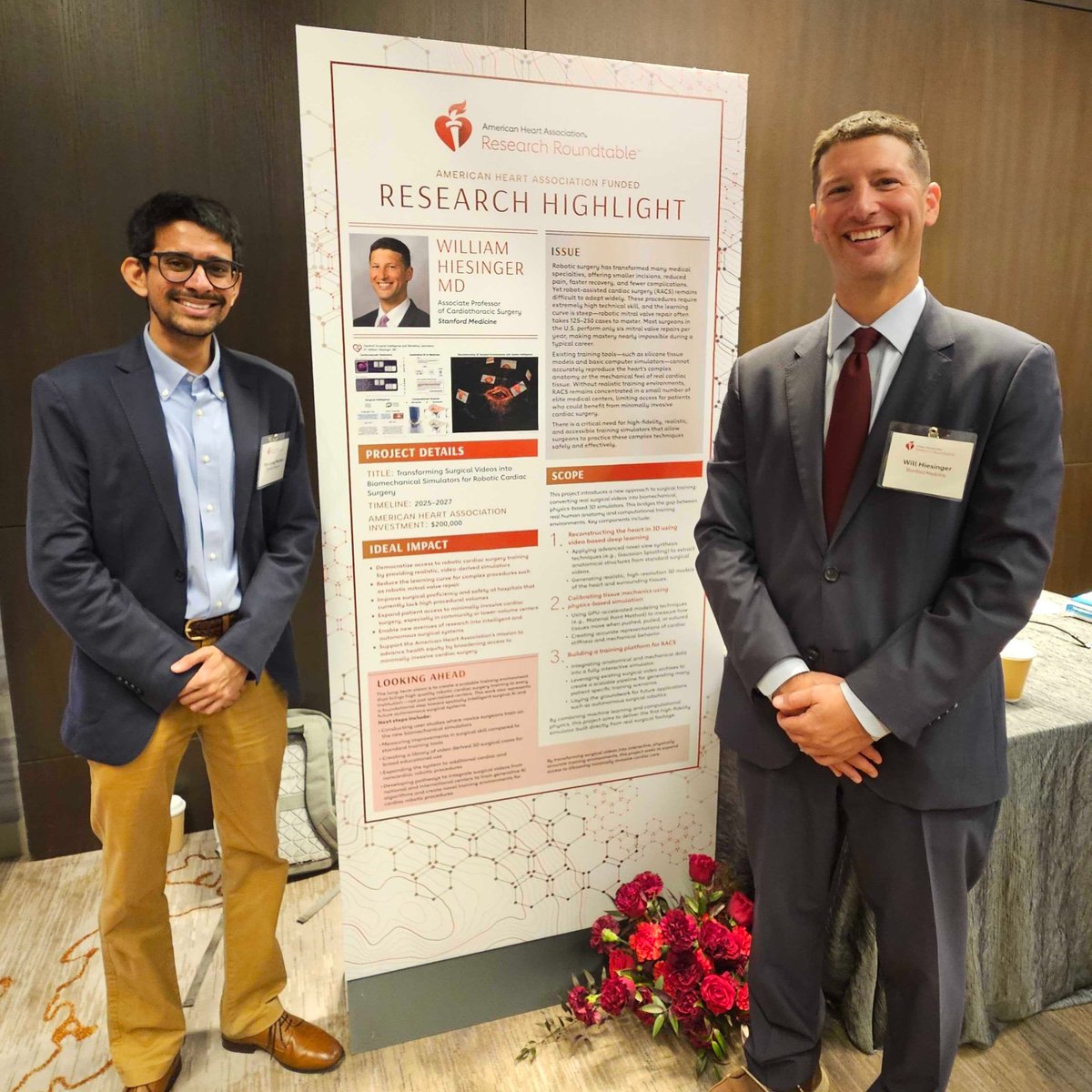
Honored to share our work on AI-powered, biomechanical simulators for robotic surgery at the #AHAResearchRoundtable today!
Big thanks to @AHAScience for supporting this vision ❤️🤖
We are excited to announce 🔥EchoAI-Peds 🔥, the first multi-task deep learning model for pediatric #echofirst analysis.
It's been a pleasure to lead this alongside @mrudangm14 under the guidance of @hiesingerlab and in close collaboration with @jolleylab.
Link below⬇️
[1/n]
I’m making the model weights for our foundational CMR vision encoders (see pinned post) available free for academic use. Paper still in peer review, but can’t wait to see what everyone builds with this!
Git: https://t.co/k2Qgl3Mbtd
Weights: https://t.co/xhlWdhlCfa
#HNY2025
The Hiesinger Lab @stanfordctsurg is at #AHA24! Catch lab members @rohanshad and @dhamank24 presenting their work on uncovering hidden HCM diagnoses in the UKBioBank using deep learning for CMR🫀🧲💻🤖
Where: S104A
When: 4:00 - 4:10 pm (CT), Nov 17
Had a great time talking about finite elements and generative AI in medicine at @BmeSjsu Pathways Seminar last week! Many thanks to my dear friend Prof. @EllaSugerman for the invite and to my @HiesingerLab mates @joseph_cho1 and @cyrilzakka for sharing their great results 🔥
🔥New preprint alert🔥 We're excited to share an early preview of 𝗦𝘂𝗿𝗚𝗲𝗻, a text-diffusion model for generating surgical videos!
This model can generate videos of higher quality (720x480) & longer duration (49 frames) than the current SoTA. Great work by @joseph_cho1!
Two years ago to the day, I joined the @HiesingerLab at Stanford Medicine, and now it’s time for me to wrap up this chapter of my life! 🎓
Reflecting back, I see a tapestry of efforts—my family's unwavering support, my friends’ continuous encouragement, my own growth—and some luck along the way. It truly does take a village, and I'm grateful for every part of mine.
It goes without saying that I’m grateful to both @rohanshad and @HiesingerLab for believing in me every step of the way, and always encouraging me to lead my own projects and find my own voice, despite many of the obstacles we faced.
I’m also lucky to have met some truly impactful people whose work over the years has heavily influenced my own research direction, many of whom have also taken it upon themselves to guide me along the way, namely @Dr_ASChaudhari@RoxanaDaneshjou@curtlanglotz@DrAalami@pranavrajpurkar@euanashley@ardalal_MD and many more!
Excited for what’s next!
In case you missed it, our team in collaboration with @Dr_ASChaudhari, @RoxanaDaneshjou, @DrAalami, and @vishnuravi defined a framework for autonomous EHR systems, and implemented the first Level 1 EHR system with retrieval and extractive capabilities! Check it out!
I’m giving a few talks on GenAI in Health in the next few months to technical founders and practicing clinicians across the US.
Would love to highlight some open source medical AI projects in my slides and am looking for some suggestions. /cc @Michael_D_Moor@katieelink
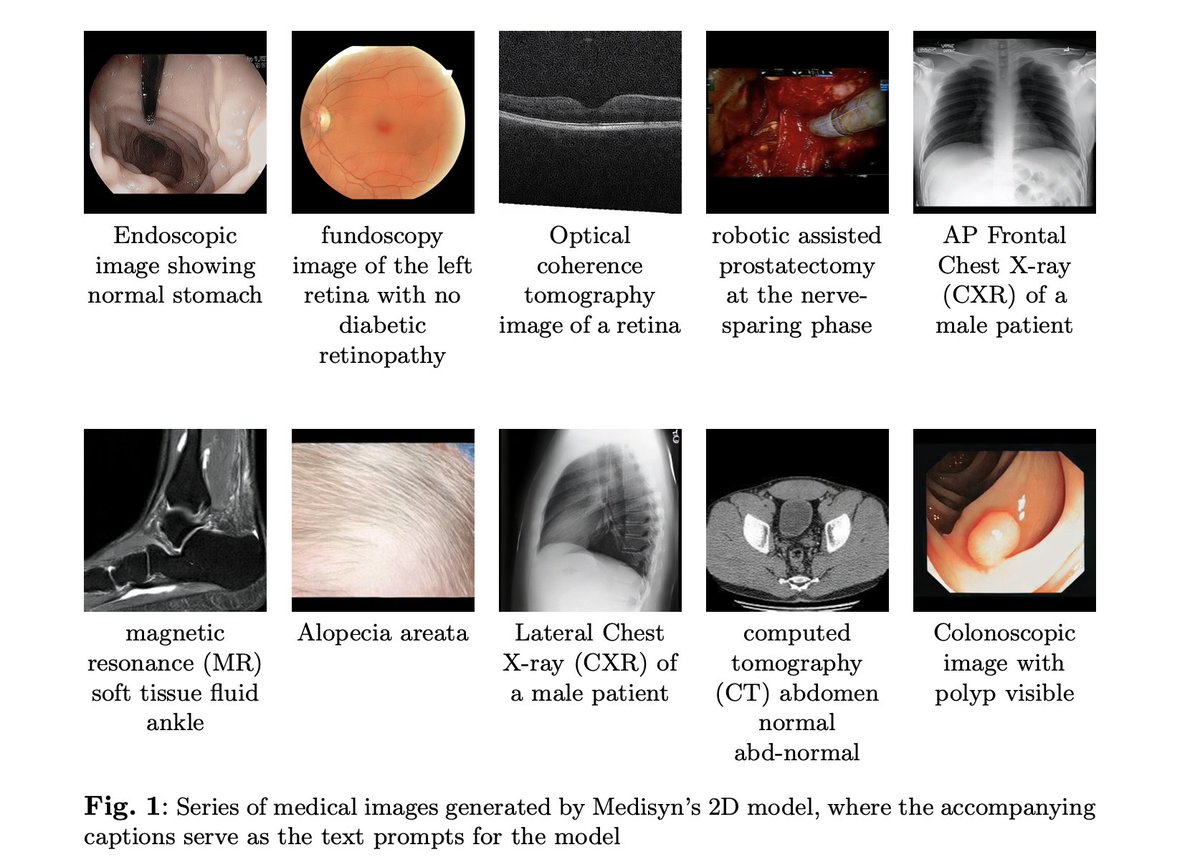
Introducing MediSyn, a pair of text-guided diffusion models for generating high-fidelity and diverse medical 2D and 3D images across medical specialties and imaging modalities.
https://t.co/q461kyshIE
1/n
Exciting week! We're also releasing an early preview of MediSyn, a family of text-diffusion models exploring the potential for generative models to synthesize medical data across many modalities (2D and 3D) and specialties (dermatology, radiology, pathology, GI, ophthalmology, surgery and more)
We're still exploring different techniques to improve text alignment and generation quality but this is a great first step!
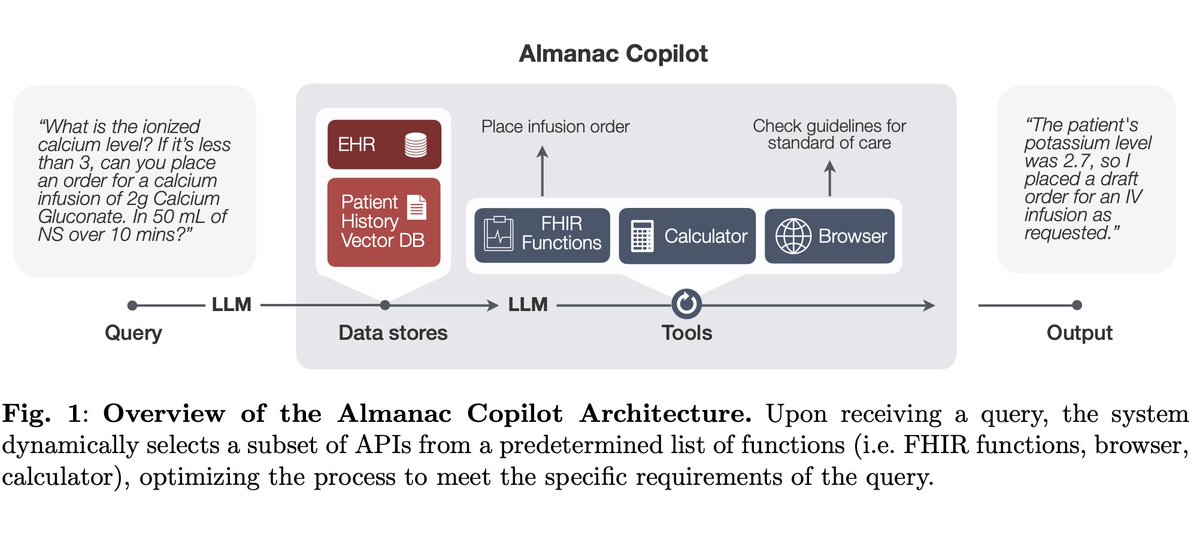
Super excited to showcase our newest work Almanac Copilot an EHR agent capable of answering questions about your patients and placing orders for you across any modern EHR system.
Background: Nearly 75% of clinicians with burnout symptoms pinpoint EHRs as a source due to poor usability or workflow integration.
Methodology: We train a 33B LLM to perform open-ended QA on patient information, as well as order placement using the FHIR interoperability standard (cc @zakkohane , @AdamRodmanMD)
Result: Almanac Copilot obtains a success rate of 74% across 300 common EHR tasks based on MIMIC-IV. Your very own personal EHR assistant!









![joseph_cho1's tweet photo. We are excited to announce 🔥EchoAI-Peds 🔥, the first multi-task deep learning model for pediatric #echofirst analysis.
It's been a pleasure to lead this alongside @mrudangm14 under the guidance of @hiesingerlab and in close collaboration with @jolleylab.
Link below⬇️
[1/n] https://t.co/Hne0ulAkDx](https://pbs.twimg.com/media/G4ibJCKa8AAdsE2.jpg)