⚡ My experience exploring @conso_xyz has been an interesting journey so far!
What caught my attention is the idea behind CONSO Extension: turning everyday AI usage into something measurable and potentially rewarding.
Instead of changing my workflow, I can continue using AI tools for research, learning, and creating while exploring my activity stats, streaks, and ZAPS.
🐻❄️ What I find interesting:
• AI activity tracking in one place
• A gamified experience that encourages consistency
• The vision of connecting AI usage with digital reputation
• More opportunities to explore the CONSO ecosystem
I’m excited to see how this project evolves and what comes next for its community.
AI is already part of our daily routine. Why not make that activity count? 🚀
@conso_xyz #CONSO #AI #Web3 #ZAPS
Wow Brian, I’m honestly shocked at how good your drawing has gotten. Your art is leveling up so fast. That Big Ben piece is beautiful.
Congrats, you’ve officially earned the title Artist @brianvn99 😅💛
[Moai Around the World - Final Stop]
Some journeys are about the places you visit
Some are about the people you meet along the way
And some are about the people who were there from the very beginning💛
Moai has arrived at Big Ben in the UK - for @0xeniac, the 1st person to receive the Moai role in Concrete, and now the final person Moai visits in this journey around the world.
From 1 to 22 Moai, I've had the chance to bring this little character to different corners of the world - celebrating the people who contribute, build, and help make @ConcreteXYZ feel like one community.
And for the final piece, I couldn't think of a more meaningful person to draw. Thank you for being there from the beginning, @0xeniac 💛
P/S: You've never publicly shared your hometown, so I could only go with the UK location detected on your X profile. I'm not sure if it's actually your hometown, but whether it is or not, I hope you'll accept this as a little gift from me 💛
And to everyone asking if I'm stopping now that all 22 Moai are done...
Definitely not!! Hehe... you'll have to wait and see 👇
@lukehajduk04@concrete_intern
🌏 Moai Around the World - Stop 01: Singapore 🇸🇬
Moai has officially left Vietnam and made his first stop in Singapore
Standing tall at Merlion Park, this first piece is a little gift for Mod Bean and friends from Singapore ❤️
And just like that, the journey begins.
Where should Moai go next? 👇
Liquidation has never been the real risk. It's merely the moment risk becomes visible.
Most risk engines across DeFi are built around the same assumption: monitor collateral, calculate health factors, and react when positions approach liquidation thresholds. While this architecture has become the industry standard, it is fundamentally reactive. It measures the state of a position after market conditions have already deteriorated, leaving capital with increasingly limited room to respond.
By the time a health factor begins to flash red, volatility has often accelerated, liquidity has already fragmented, and execution conditions have materially worsened. Liquidation is not the beginning of risk—it is simply the consequence of risks that have been accumulating beneath the surface all along.
This raises a more fundamental question.
Rather than asking whether a position is close to liquidation, shouldn't infrastructure be asking how likely that position is to become liquidated before stress becomes visible?
That is the philosophy behind @ConcreteXYZ 's Probability Engine.
Instead of treating liquidation as a binary event, Concrete models it as a continuously evolving probability. The engine combines forward-looking market signals—including realized and implied volatility, order book depth, liquidity conditions, and historical market behavior—to estimate the likelihood of liquidation long before collateral health begins to deteriorate.
The objective is not to predict markets with perfect accuracy. Financial markets will always remain uncertain. The objective is to continuously quantify that uncertainty, allowing capital to adjust while optionality still exists. Every additional minute before market stress compounds is another opportunity to rebalance exposure, optimize collateral, or reduce downside before those decisions become significantly more expensive.
This changes the role of infrastructure entirely.
Traditional risk systems function as monitoring tools. They observe markets, calculate exposure, and generate alerts once predefined thresholds have been crossed. Predictive infrastructure operates differently. It transforms risk from a metric that is merely observed into a probability that actively informs every capital allocation decision.
That distinction will become increasingly important as institutional capital continues moving on-chain. Institutions are not searching for systems that simply execute liquidations more efficiently; they are looking for infrastructure capable of reducing the probability of liquidation altogether. In institutional finance, success is rarely measured by how well losses are managed after they occur. It is measured by how effectively those losses are prevented from materializing in the first place.
The future of on-chain risk management will not belong to the protocols that react the fastest.
It will belong to the infrastructure that recognizes risk before the market forces everyone else to see it.
Yield is easy to market.
Infrastructure is much harder to build.
Anyone can promise a double-digit APY.
Very few can build the foundation that makes those returns sustainable, resilient, and worthy of long-term capital.
That's why the real question in DeFi has never been:
"How much yield can I earn?"
It's:
"What infrastructure is generating that yield—and can I trust it?"
At @ConcreteXYZ, we believe yield is not the product.
It's the natural outcome of infrastructure designed to make capital work smarter.
That philosophy is built on three foundational principles.
1️⃣ Productivity
Capital should never remain idle.
Every asset should have the opportunity to generate value through structured vault infrastructure, intelligent capital allocation, and automated execution.
True productivity isn't about chasing the highest APY.
It's about creating consistent, repeatable, and sustainable returns over time.
Because capital that isn't working is capital losing value.
2️⃣ Protection
Generating yield is only half the equation.
Keeping that yield—and protecting the capital behind it—is what truly matters.
Risk management isn't a feature layered on top.
It's embedded into the infrastructure itself through programmatic NAV accounting, custody-native architecture, and systematic portfolio controls.
Markets will always be unpredictable.
Infrastructure shouldn't be.
Because long-term wealth isn't built by maximizing upside.
It's built by minimizing unnecessary downside.
3️⃣ Utility
Capital shouldn't become less useful simply because it's earning yield.
The strongest assets are those that remain productive, liquid, and composable at the same time.
They should continue participating across DeFi, unlock additional opportunities, and adapt to changing market conditions—without forcing users to unwind existing positions or sacrifice flexibility.
Yield should enhance capital.
Not restrict it.
Everything we build comes back to three simple ideas.
🟨 Productivity creates value.
🛡️ Protection preserves value.
⚡ Utility expands value.
Individually, each principle is important.
Together, they create an infrastructure where capital doesn't have to choose between performance, security, and flexibility.
Because the future of DeFi won't belong to the protocols offering the highest APY.
It will belong to the infrastructure that allows capital to remain productive, protected, and useful—through every market cycle.
That's the future Concrete is building.
Everyone thinks the future of DeFi is autonomous agents.
I don't.
The biggest breakthrough won't be software that can click buttons faster than humans.
It will be capital that no longer depends on humans to stay productive.
Think about how DeFi works today.
Capital is idle by default.
It only earns when someone decides where to move it, when to rebalance it, which strategy to trust, which protocol to exit, and how much risk to take.
The yield isn't the problem.
The dependency is.
Every percentage point of return comes with an invisible operational cost:
• Researching new opportunities.
• Monitoring positions.
• Managing risk.
• Paying gas.
• Rotating liquidity.
• Repeating the same decisions over and over again.
We've normalized this.
But imagine explaining it to a CFO managing a $100M treasury.
Or to a pension fund.
Or to a Fortune 500 finance team.
"You'll need to monitor dozens of protocols, constantly rebalance your positions, understand smart contract risk, and stay online whenever the market moves."
They wouldn't call that finance.
They'd call it operational chaos.
That's why DeFi's biggest bottleneck isn't liquidity.
It isn't users.
It isn't regulation.
It's the fact that productive capital still relies on continuous human labor.
And systems that depend on human intervention don't scale.
The next generation of DeFi infrastructure won't win because it offers another 2% APY.
It will win because it removes thousands of decisions.
Because the highest form of capital efficiency isn't finding more yield.
It's eliminating the work required to earn it.
That's what makes Autonomous Capital so powerful.
Not capital that thinks.
Not capital controlled by AI.
Capital that continues generating value while infrastructure quietly handles allocation, accounting, execution, and risk management behind the scenes.
That's the future @ConcreteXYZ is building.
Not another yield product.
A financial operating system where capital compounds, adapts, and remains productive—without demanding constant human attention.
The real innovation isn't autonomous agents.
It's making capital itself autonomous.
The biggest risk in DeFi isn't earning less.
It's believing yield is permanent.
Every APY you see is the result of an underlying economic activity.
Someone is borrowing.
Someone is trading.
Someone is providing liquidity.
Someone is generating real-world cash flow.
Or a protocol is temporarily paying incentives to attract capital.
These are the engines that create yield.
The APY is merely the dashboard.
Yet most of the market obsesses over the number on the screen while ignoring the engine underneath.
That's like buying a business based only on its revenue, without asking where the revenue actually comes from—or whether it'll still exist six months from now.
Because yield isn't static.
Borrowing demand disappears.
Trading volumes dry up.
Liquidity migrates.
Reward programs end.
Interest-rate cycles change.
Every source of yield eventually weakens.
The only question is when.
Infrastructure built around a single yield source inevitably breaks when that source stops working.
Infrastructure built to continuously adapt doesn't.
This distinction is becoming increasingly important as institutional capital enters on-chain finance.
Institutions aren't looking for the highest APY this week.
They're looking for infrastructure that can continue producing reliable returns across multiple market cycles.
Because sustainable capital doesn't chase yield.
It allocates to systems that can survive changing market conditions.
That's the philosophy behind @ConcreteXYZ.
Concrete doesn't treat yield as a fixed strategy.
It treats yield as a constantly evolving market.
Capital is continuously reallocated across independent sources of return through automated execution, governance, and integrated risk management.
As one yield engine slows, another becomes more attractive.
As market conditions change, the allocation changes with them.
Not because someone manually reacts.
Because the infrastructure is designed to.
Markets will never stop evolving.
Neither will yield.
The infrastructure that wins won't be the one offering the highest APY today.
It will be the one that keeps capital productive long after today's opportunities have disappeared.
The financial industry has spent decades optimizing how money moves.
Payments settle in seconds.
Stablecoins transfer billions across borders.
Treasuries can move capital globally with a single transaction.
We've made capital incredibly fast.
But we've left it surprisingly unproductive.
Every financial institution carries operational capital.
Treasury balances.
Settlement reserves.
Liquidity buffers.
Custodial funds.
Not because they generate returns.
But because they guarantee something far more important:
certainty.
When a customer redeems funds, a payment clears, or a settlement window opens, that capital has to be there immediately.
For generations, finance accepted an implicit trade-off:
If capital needs to remain available, it cannot remain productive.
Availability came first.
Efficiency came second.
No one questioned it because the underlying infrastructure made any alternative impossible.
But infrastructure has changed.
Stablecoins now settle more than $30 trillion in annualized volume, transforming blockchains into the operational rails for payments, treasury management, and digital finance.
Capital is no longer static.
It is programmable.
Yet one assumption from traditional finance continues to survive into the onchain world:
Operational capital still spends most of its life waiting.
Waiting for the next payment.
Waiting for the next redemption.
Waiting for the next settlement cycle.
Waiting isn't the problem.
Remaining economically idle while waiting is.
This is one of the largest inefficiencies quietly embedded inside modern financial infrastructure.
Not because treasury teams are managing capital poorly.
But because today's systems still separate liquidity from productivity-as if institutions must choose one or the other.
They don't.
Programmability changes the economics of operational capital.
When allocation, execution, accounting, governance, and risk management become automated infrastructure instead of manual coordination, liquidity no longer has to come at the expense of capital efficiency.
Operational balances can remain immediately available...
while continuously working in the background.
That is a fundamentally different model for financial infrastructure.
It doesn't ask institutions to chase yield.
It allows yield to emerge naturally from capital that already exists.
That distinction matters.
Because the next generation of finance won't be built by creating more capital.
It will be built by making existing capital significantly more productive.
This is the problem @ConcreteXYZ is solving.
Not by introducing another yield product.
But by building the operating layer that continuously orchestrates institutional capital through automated allocation, risk-managed execution, governance, accounting, and treasury workflows-allowing eligible operational balances to remain productive without compromising the liquidity they exist to provide.
For decades, finance treated idle operational capital as an unavoidable cost of reliability.
Onchain, it no longer has to be.
The institutions that understand this shift first won't simply earn more yield.
They'll operate with a fundamentally superior financial architecture.
Because the future of finance isn't defined by how quickly money moves.
It's defined by whether money continues creating value-even while it waits.
The biggest challenge for institutions entering DeFi is no longer finding yield opportunities.
The market has already proven that yield exists.
The real challenge is building a system that allows capital to access those opportunities safely, transparently, and at scale.
For companies and financial institutions, earning yield cannot depend on constantly chasing strategies, manually moving liquidity, or accepting unnecessary operational risks.
This is where @ConcreteXYZ takes a different approach.
Instead of building another yield product, Concrete focuses on the infrastructure behind sustainable capital deployment.
→ Structured vaults enable automated and efficient strategy execution.
→ Programmatic NAV accounting creates continuous transparency around performance.
→ Risk-managed allocation keeps capital optimized while reducing the need for constant human intervention.
The result is a DeFi framework designed to replace reactive decision-making with systematic execution.
Traditional DeFi often requires users to continuously monitor markets, rotate positions, and manage risk themselves.
Concrete is built to make yield generation work differently — more predictable, more transparent, and more aligned with how institutions manage capital.
Because when managing serious capital, the goal is not simply to find the highest yield.
The goal is to build a system where capital can grow through infrastructure that is trusted, resilient, and designed to last.
#RiskAdjustedYield #DeFiVaults #ManagedDeFi #ConcreteVaults #OnchainCapitalAllocation #AutomatedCompounding #InstitutionalDeFi
Everyone is talking about autonomous agents.
AI that can trade.
AI that can manage wallets.
AI that can execute transactions without human input.
It's exciting.
But I think we're asking the wrong question.
The future of DeFi isn't about who manages capital.
It's about whether capital still needs to be managed at all.
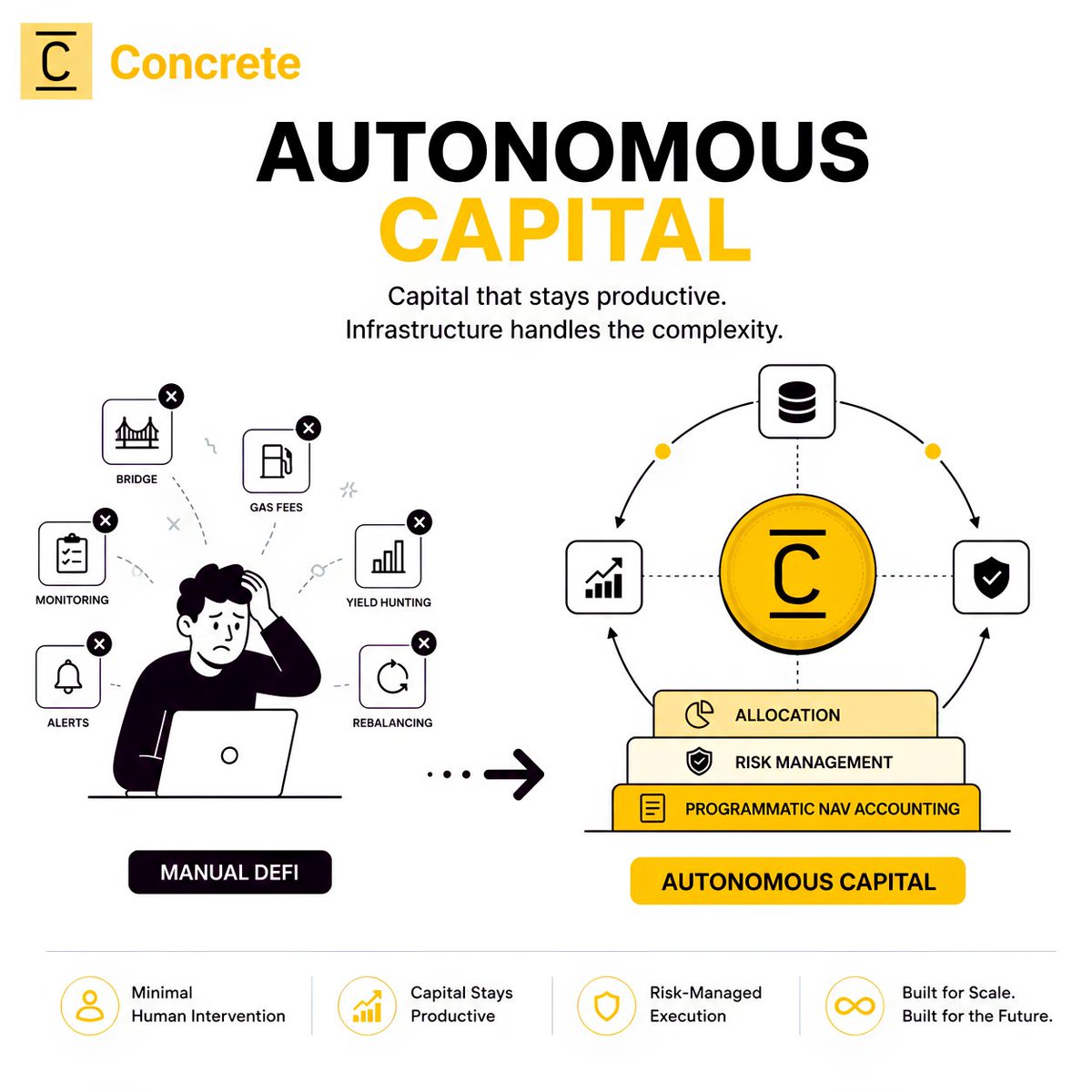
That's where Autonomous Capital comes in.
And no - it doesn't mean capital that can think.
It means capital that remains productive without demanding constant human attention.
For years, DeFi has operated on a hidden assumption:
If you want better returns, you must become your own portfolio manager.
You spend hours researching protocols.
You bridge assets across chains.
You compare APYs that change by the hour.
You rebalance positions.
You monitor liquidation risks.
You pay gas fees every time you adjust your strategy.
Then you wake up the next morning...
...and do it all over again.
The opportunity cost isn't just gas fees.
It's your time.
Your attention.
Your expertise.
In traditional finance, people don't expect to manually move their savings every day just to stay competitive.
Yet somehow, in DeFi, we've accepted that as normal.
That's the real bottleneck.
Not liquidity.
Not capital.
Human bandwidth.
A financial system cannot scale globally if every user is expected to behave like a full-time yield strategist.
Retail users don't have the time.
Businesses don't have the operational capacity.
Institutions won't allocate billions into systems that require constant manual oversight.
The infrastructure itself has to evolve.
This is where @ConcreteXYZ introduces a different paradigm.
Instead of expecting users to continuously optimize their positions, Concrete transforms yield generation into an infrastructure problem.
Structured vaults automate capital allocation.
Risk-managed execution continuously adapts to changing market conditions.
Programmatic NAV accounting provides transparent, on-chain portfolio valuation.
The operational complexity remains behind the scenes - while users simply own productive capital.
That's a subtle difference.
But it's one that changes everything.
The goal isn't to advertise the highest APY on Crypto Twitter.
The goal is to create capital that can continue working through changing markets without requiring its owner to constantly intervene.
Because sustainable wealth isn't built by endlessly chasing yield.
It's built by creating systems where capital compounds consistently while operational complexity disappears.
That's what Autonomous Capital really means.
And I believe it's one of the most important shifts DeFi will experience over the next decade.