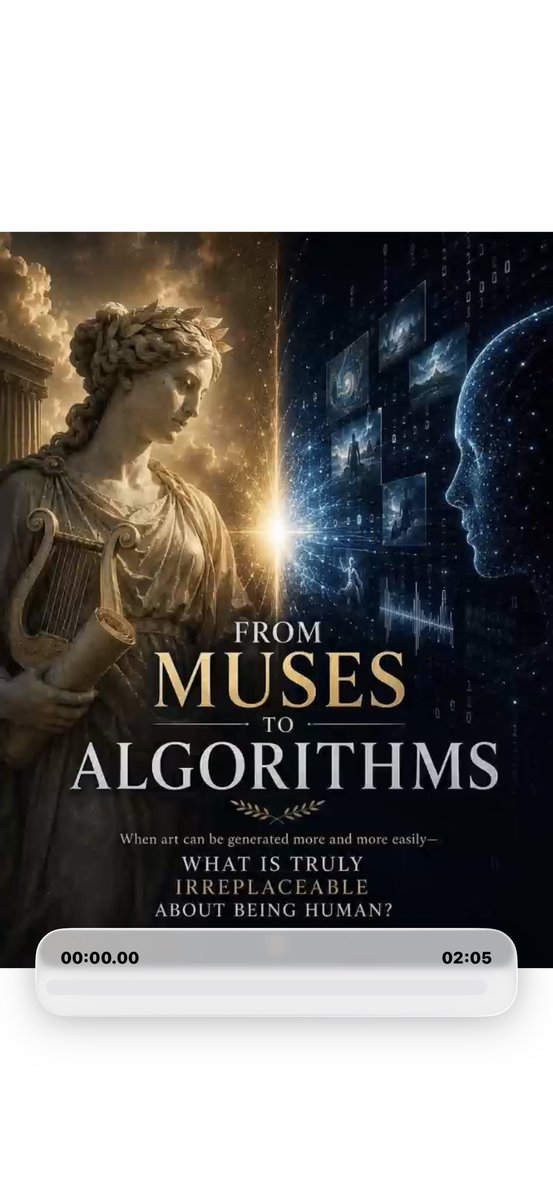
For thousands of years, artists looked beyond themselves for inspiration.
The ancient Greeks imagined nine Muses—guardians of poetry, music, dance, theater, history, and creative imagination. Art was not viewed as a product of efficiency, but as a bridge between human experience and something larger than ourselves.
Today, a new creative partner has entered the conversation: AI.
With a few prompts, algorithms can generate images, music, writing, and even artistic styles that once required years of training.
But as generation becomes easier, a deeper question emerges:
What is true creation?
Can an algorithm learn style?
Certainly.
Can it reproduce patterns?
Increasingly well.
But can it experience wonder, loss, love, struggle, mortality, or the quiet weight of a human life?
This episode explores the journey from the Nine Muses of ancient Greece to the age of artificial intelligence, and asks a question that may become increasingly important in the years ahead:
When art can be generated, what remains uniquely human?
⸻
When Infinite Information Meets Finite Humanity
A series exploring art, cognition, civilization, and the future of human creativity in the age of AI.
#AI #ArtificialIntelligence #Creativity #Art #Muse #GreekMythology #Humanity #CivilizationQuestions #FutureOfArt #DigitalArt #Innovation #Cognition #Philosophy #DaliHiga #WhenInfiniteInformationMeetsFiniteHumanity
At seventy, I still spend two hours a day practicing Latin dance.
Many people see dance as movement.
I see it as a form of learning.
In three-inch dance heels, every step requires balance. Every turn requires core strength. Every movement demands coordination, focus, and body awareness.
The fast rhythm of Cha-Cha challenges not only the body, but also the mind.
Painting trains the eyes.
Dance trains the body.
Learning trains the mind.
As we enter an age of longer lives and expanding possibilities, perhaps growing older does not mean slowing down. Perhaps it means continuing to grow, continuing to learn, and continuing to discover new dimensions of ourselves.
At seventy, I'm still learning.
#AtSeventyImStillLearning #LatinDance #ChaChaCha #Ageless #HealthyAging #DanceLife #LifelongLearning #ActiveAging #CaliforniaMuseumOfFineArts #DaliHiga
Michelangelo is remembered for David.
For the Sistine Chapel.
For some of the greatest masterpieces in human history.
Yet perhaps his greatest work was something else.
For decades, Michelangelo faced the same challenge every day: stone.
Every sculpture demanded patience.
Every masterpiece demanded sacrifice.
Every block of marble resisted.
Many artists search for inspiration.
Michelangelo searched for discipline.
He believed that the figure already existed within the marble. The artist's task was simply to remove what did not belong.
On the surface, he was carving stone.
But perhaps he was also carving himself.
More than five hundred years later, David still stands. The Sistine Chapel still inspires millions.
Yet Michelangelo's greatest masterpiece may not have been a sculpture at all.
It may have been the person he became through a lifetime of dedication, discipline, and relentless refinement.
This video is part of the series:
Those Who Devote Their Lives to Investing in Beauty
Exploring the artists whose lives continue to illuminate the path of human creativity.
Written and narrated by Dali Higa
#Michelangelo #David #SistineChapel #Renaissance #ArtHistory #Beauty #Creativity #Discipline #FineArt #DaliHiga #Civilization #HumanPotential
# Let the Visual Speak
Today, many channels communicate through the person in front of the camera.
This channel often chooses a different path.
Through paintings, sculpture, museum spaces, light, and the creative process itself, we explore art not only as an object to be viewed, but as a language through which human experience can be shared.
In this video, Dali Higa reflects on the idea that some things do not require explanation.
When color, structure, light, and rhythm come together, an artwork begins to speak in its own way.
Featuring Carry the Load, a large-scale painting inspired by observations made during travels along the Ganges, this video explores how visual art can communicate beyond words.
Art.
Civilization.
Structure.
Light.
Time.
Space.
Sometimes the artwork itself is the conversation.
—
Dali Higa
Painter · Collector · Curator
California Museum of Fine Art
San Pedro, California
#DaliHiga #ArtAndCivilization #TheArtOfSeeing #VisualThinking #FineArt #Painting #Museum #ArtCollector #ArtHistory #ContemporaryArt
Leonardo da Vinci is often remembered for the Mona Lisa and The Last Supper.
Yet his true greatness may lie elsewhere.
He spent his life asking questions.
Questions about the human body.
Questions about light.
Questions about nature.
Questions about flight.
Questions about the hidden structures that shape the world.
To Leonardo, art and science were never separate pursuits.
Both were ways of understanding reality.
More than five centuries later, many kingdoms, institutions, and powers have faded into history.
Yet Leonardo remains.
Not because he left answers.
But because he embodied a spirit of curiosity, observation, and lifelong exploration.
In an age when AI can provide information instantly, perhaps the most valuable lesson Leonardo offers is not knowledge itself, but the willingness to keep asking meaningful questions.
This video is part of the series:
“Those Who Devote Their Lives to Investing in Beauty”
Exploring artists, thinkers, and creators whose work continues to shape civilization long after their own time.
Written and narrated by Dali Higa
#LeonardoDaVinci #MonaLisa #TheLastSupper #Renaissance #ArtHistory Civilization Beauty Creativity Curiosity AIandHumanity DaliHiga CivilizationQuestions
Why Might PQ Matter More Than IQ in the Age of AI?
As artificial intelligence continues to expand access to knowledge, a new question begins to emerge:
If answers become increasingly available, what abilities will remain uniquely human?
For more than a century, IQ has been viewed as one of the primary measures of human capability. In a world where knowledge was scarce, knowing more often meant having a significant advantage.
Today, AI can retrieve, organize, and connect information within seconds.
Knowledge is becoming increasingly accessible.
Answers are becoming increasingly inexpensive.
Yet perhaps this shift reveals something even more important:
The future may belong not only to those who know the most, but to those who ask the best questions.
This episode explores the growing importance of PQ — Question Quotient.
Why do civilizations repeatedly develop similar structures?
Why can art survive for thousands of years while power often fades?
Why does more information not necessarily create greater understanding?
Why, as AI becomes increasingly intelligent, do humans need to understand themselves more deeply?
Because AI generates answers.
Questions still shape direction.
And direction ultimately shapes civilization.
Dali Higa explores these questions through the lens of art, civilization, cognition, and the emerging realities of the AI era.
Dali Higa Art
#PQ
#QuestionQuotient
#ArtificialIntelligence
#AI
#Cognition
#Civilization
#CivilizationHundredQuestions
#StructureThinking
#CriticalThinking
#FutureOfEducation
#ArtAndCivilization
#Knowledge
#Questions
#Humanity
#DaliHiga
When Infinite Information Meets Finite Humanity
For thousands of years, humanity has wrestled with a fundamental question:
How much of reality can we truly understand?
From Ancient Greek philosophers and the Buddha to Zhuangzi and Kant, civilizations across history have explored the limits of human perception and understanding.
Yet today, humanity faces a new condition unlike any before.
Knowledge is becoming increasingly accessible.
Artificial intelligence can search, organize, summarize, and connect information at extraordinary speed.
For the first time in history, knowledge is approaching infinity.
Yet human cognitive capacity remains finite.
What happens when infinite information meets finite humanity?
This episode of Civilization Hundred Questions explores one of the defining questions of the AI age:
If knowledge becomes increasingly available, what abilities become most important?
Perhaps the future will not be determined by who possesses the most information, but by who can recognize connections, understand structure, and find direction.
Through art, civilization, history, cognition, and AI, this reflection explores why structure may become one of the most important intellectual tools of our time.
Art makes structure visible.
Structure makes understanding possible.
⸻
Dali Higa
Painter | Collector | Founder of the California Museum of Fine Art
Civilization Hundred Questions
Exploring Art, Civilization, Cognition, and the Future of Human Understanding
#CivilizationHundredQuestions
#DaliHiga
#ArtAndCivilization
#Cognition
#StructureThinking
#ArtificialIntelligence
#FutureOfHumanity
#Philosophy
#CriticalThinking
#Civilization
#Knowledge
#AI
#Art
#History
#HumanNature https://t.co/1I92XSLi3i
The Weight of Humanity: Tolstoy — Morality and Destiny
Russian realism is not merely about reality.
It is about time, morality, dignity, and the human condition.
Through works from the collection of the California Museum of Fine Art, this short video explores why Russian realism continues to speak so powerfully about human existence.
Dali Higa Art
#Tolstoy
#RussianRealism
#FineArt
#Humanity
#ArtHistory
#DaliHigaArt
What history ultimately preserves is often not power, but art.
Most ancient rulers have been forgotten. Empires rise and fall. Kingdoms disappear.
Yet the pyramids remain. The sculptures endure. The murals continue to speak across centuries.
Why have civilizations consistently devoted their finest resources to art?
Because art preserves something deeper than wealth or military strength.
It preserves perception.
It preserves how a civilization understood humanity, beauty, meaning, time, and existence itself.
In this episode, Dali Higa explores one of the central questions behind the ongoing Civilization Hundred Questions series:
Why does art so often outlive power?
From Ancient Egypt and Greece to the Silk Road and the modern digital age, we examine how civilizations leave traces of themselves—and why art may be among the most enduring forms of human memory.
As artificial intelligence reshapes knowledge, algorithms reshape attention, and media networks reshape communication, the question becomes increasingly relevant:
When everything changes rapidly, what will remain?
The California Museum of Fine Art continues its mission of preserving artistic legacies from different civilizations and historical periods while exploring new ways of carrying those memories into the digital age through video, podcasts, and global media networks.
Art is not merely decoration.
It is civilization remembering itself.
—
Topics explored in this episode:
• Art and Civilization • Why Art Outlives Power • Ancient Egypt, Greece, and Dunhuang • Cultural Memory and Human Perception • Museums in the Digital Age • AI, Cognition, and Civilization • The Civilization Hundred Questions Project • Art as a Living Archive of Humanity
—
Dali Higa Art
Painter • Collector • Founder of the California Museum of Fine Art
Exploring art, civilization, cognition, and the rhythm of living.
Knock on the Door of Art. Open the Window of Cognition.
#Art #Civilization #History #Museum #Cognition #CivilizationHundredQuestions #DaliHiga #ArtHistory #CulturalMemory #AIandCivilization #Philosophy #Humanity #Beauty #CivilizationDialogue #Podcast #ArtCollector #Painting #Culture #KnowledgeAndWisdom
WHEN ELEGANCE BECOMES CIVILIZATION’S OUTER GARMENT?
What happens when conflict becomes beautiful?
In this episode, Dali Higa explores two works separated by centuries:
Primavera by Sandro Botticelli and Caesar and Cleopatra, a sculpture in the collection of the California Museum of Fine Art.
At first glance, both appear elegant, refined, and harmonious.
Yet beneath the beauty lies something deeper:
desire,
power,
conflict,
and human nature itself.
In Primavera, force becomes myth.
In Caesar and Cleopatra, power becomes posture.
Neither work removes tension.
Instead, both transform it into a form that civilization can accept, contemplate, and preserve.
Perhaps this is one of civilization’s greatest achievements:
not eliminating chaos,
but giving chaos a structure.
Throughout history, art has often served as more than decoration.
It has functioned as a language through which civilizations organize emotion, power, memory, and meaning.
When elegance becomes the outer garment of civilization,
what remains underneath?
And can art still help us see the forces hidden beneath the surface?
This episode is part of an ongoing exploration of art, civilization, perception, and the structures that shape human experience.
⸻
#Art #Civilization #Botticelli #Primavera #CaesarAndCleopatra #DaliHiga #CaliforniaMuseumOfFineArt #ArtHistory #Aesthetics #Power #Beauty #CivilizationHundredQuestions #PhilosophyOfArt #MuseumCollection #Culture #HumanNature #Podcast