@iMithrandir_@GenLayer@RallyOnChain I see the visiom here. The real unlock is not just agents paying each other. It is agents being able to make commitments, dispute outcomes, and still keep the economy moving.
@iMithrandir_ This is a better NFT funnel than most mints. First you create, then you earn access, then the NFT gives utility back inside the same ecosystem.
✅ I’m in for July 7th. WL earned, not bought.
Wingston is a free mint, 3,000 supply, on Ethereum, but the important part is how people get there.
You do not buy your way into the moment. You earn it by actually using Rally: join at least 3 campaigns, rank top 425 on the weekly leaderboard, and prove you can contribute before the mint opens.
That is the NFT reset I want to see.
The last cycle trained people to chase floors, WL grind noise, and roadmap promises. Wingston points in a cleaner direction:
a product NFT tied to a working creator protocol, daily RLP staking, VIP holder access, and a future Rally Score boost inside the same ecosystem.
So July 7th matters because it tests a better NFT model.
→ Free mint.
→ Real supply cap.
→ On Ethereum.
→ Earned access.
→ Utility connected to an actual business model.
Less “mint now, hope later.”
More “contribute first, earn your place, then get deeper leverage in the network.” 🐾
@iMithrandir_@RallyOnChain This is the healthier version of whitelist grinding I'veseen in a while. So instead of farming Discord noise, people earn access by joining campaigns and proving they can contribute?
A creator finishes a paid campaign.
The post is live. The rules were followed. The mention is there. The payment can be sent.
But then comes the harder question:
Was the work actually good?
That is where normal smart contracts start to feel limited. They can prove a payment happened, a wallet signed, or a task was submitted. They cannot easily judge quality, context, evidence, intent, or whether the result truly met the agreement.
Now apply that to AI agents.
One agent writes research for a DAO. Another handles a support ticket. Another reviews an insurance claim. Another submits work to a bounty marketplace.
The transaction can be automated.
The judgment cannot be reduced to a simple yes or no.
➜ That is the gap @GenLayer is going after.
GenLayer is the adjudication layer for the agentic economy. Its validators use different AI models to review subjective outcomes, weigh evidence and context, and reach consensus on questions that code alone cannot settle. If someone disputes the outcome, it can be appealed until the network reaches finality.
So I do not see this as just another chain.
I see it as infrastructure for the messy part of on chain work:
• creator campaigns
• AI agent jobs
• DAO grants
• bounty submissions
• insurance claims
• marketplaces where delivery quality matters
Crypto already knows how to move money.
The next unlock is judging whether the work behind that money actually deserves to be paid. 🐾
@iMithrandir_@GenLayer@RallyOnChain Interesting read. What I like about this framing is that it does not try to replace smart contracts. It adds a layer for the situations where smart contracts reach their natural limit. Deterministic logic still matters, but not every agreement is deterministic.
🐾 I almost wrote Rally off.
The scoring frustrated me, some campaigns felt uneven, and I was not always sure what the AI actually wanted from a post. That can mess with your writing if you let it.
But @RallyOnChain is now open to everyone. The waitlist is gone.
For smaller creators, that changes the entry point.
You no longer need access, approval, a warm intro, or a big account to start earning. Traditional creator marketing is still built around follower count, agency access, and who already knows who.
Rally pushes the bet the other way: write something useful → match the brief → get scored → earn based on the work.
That is why I still think the core idea is worth paying attention to.
Creators should not need to be KOLs before their influence gets treated like it has value.
➜ Now anyone can join, submit, and prove it.
Come try it! 🔗 https://t.co/kGheBshZI4
@iMithrandir_@RallyOnChain The small creator angle is the strongest part imho. Most platforms say quality matters, but still reward the same big accounts first.
Cancel: “just be consistent”.
Showing up every day sounds noble until you realize half the internet is just clocking in to say nothing again.
That is not discipline. That is content cardio.
I have seen creators post daily for months and somehow become less interesting over time, because repetition does not sharpen a weak point of view. It only makes the weakness easier to spot.
The real edge is not only consistency. It is knowing when a thought is worth posting, when it needs more work, and when it should stay in the drafts.
Post less filler. Build more taste.
That is the creator advice I wish more people gave.
🐾 @RallyOnChain
My crypto origin story started in 2022 with an NFT collection called Always Tired.
Very on brand.
A few mints later I was chasing tokens, testing DeFi, getting rugged, winning some, losing more, and somehow went from InfoFi to writing about AI agents, robotics, and full time creator life 🤷♂️
The spark was curiosity.
The thing that keeps me here is the chance at financial freedom.
Still tired. Still clicking.
What was your first rabbit hole?
🐾 @RallyOnChain
P.S. Always Tired slow rugged, but it is still around as CTO, and I still hold 40 NFTs. Very crypto, right?
@iMithrandir_@RallyOnChain I see what you mean. Perps turn patience into boredom, and that is where most people start paying with something else than money.
🐾 I thought I was done with Rally.
Too many weird campaigns, scoring that didn’t always make sense, top heavy rewards, and too much time spent trying to understand what the AI actually wanted.
Then @RallyOnChain dropped a campaign called Easy Money.
And annoyingly, it is hard to ignore. 🤦♂️
$5,000 prize pool. Top 10 winners get a significant share, almost $500 each. And I’ve seen creators on Rally earning money day after day, campaign after campaign, just by posting solid tweets and getting scored.
So now I have to ask myself the honest question:
Am I really going to ignore a live $5,000 creator campaign because I got annoyed at the meta?
Probably not.
This is the nasty part of being early.
You can hate the meta, question the scoring, and still miss the opportunity if you sit out too long.
If you already post about crypto on X, this is probably worth checking before the leaderboard gets even more crowded.
Don’t DM me next week asking why nobody mentioned it. 😉
@iMithrandir_@virtuals_io@base This is a fair point. Builders matter, but early supporters are often the ones giving projects their first attention, first liquidity, first feedback, and first real distribution.
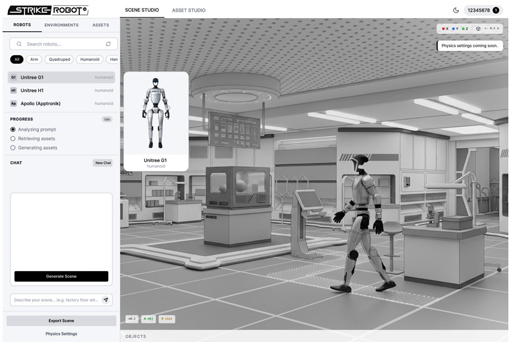
I just saw on the timeline that @StrikeRobot_ai started their next Contributor Epoch, so I spent some time reading up on their recent developments.
A cool thing I noticed right away: they’re heavily focused on sim-to-real infrastructure.
And the more I dig, the more I understand why this matters.
Training a robot in simulation is not the hard part anymore.
→ The hard part is getting that behavior to survive contact with the real world.
Real factories are messy. You have to deal with latency, sensor noise, unpredictable movement, humans walking around, changing environments, and imperfect hardware.
That’s where a lot of the bottleneck in robotics shifts:
→ away from just building robots, toward bridging simulation and real-world deployment.
This is probably also why Strike Robot focuses so heavily on this segment of robotics development.
If they get this part right, it could become a major advantage within their niche.
Think:
• simulation environments
• teleoperation
• validation
• deployment pipelines
• real-world operational data
Maybe the real moat in robotics won’t just be the robots themselves, but certain parts of the infrastructure behind them. 🐾