Missed the Live Session? Catch the Replay Now!
Built for: CIOs, IT Directors, Facilities and Plant Ops leaders, Security teams, and anyone operationally accountable for uptime, response time, and business continuity.
Watch here → https://t.co/dSLlU06ig6
#HipLink#Webinar
We go live tomorrow.
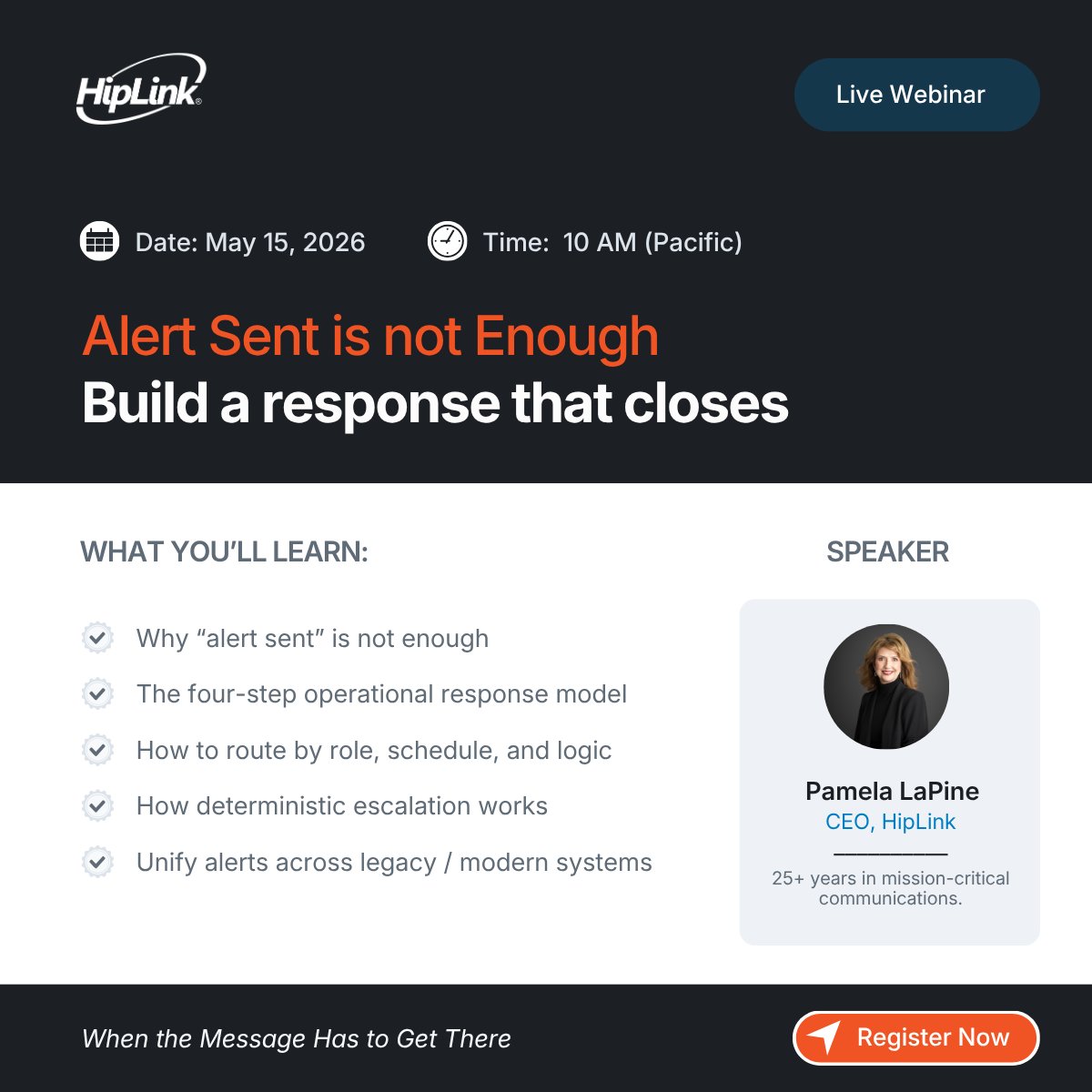
Join us for "From Alerting to Action: Building an Operational Response Layer" to learn how to filter system noise and drive accountable, closed-loop responses.
May 15 | 10 AM PT.
Secure your spot here → https://t.co/PGBOT5Eprs
#Webinar#Hiplink#Tech
Only 2 days left!
The live session," From Alerting to Action: Building an Operational Response Layer" is in two days. May 15, 10 AM Pacific.
Save your FREE spot here → https://t.co/PGBOT5Eprs
#webinar#tech
“Alert sent” ≠ “Incident handled.”
We’re fixing that gap this Friday, May 15.
Only 4 days left! Grab your free seat now!
Register here → https://t.co/cgRz9OlbVs
#webinar#healthcare#publicsafety
Join us for an interactive session on May 15, 10 AM.
Our CEO will outline a practical framework for closing the gap between 'alert received' and 'action taken'.
Register → https://t.co/DtNafmEdMD
#Webinar#healthcare#publicsafety#hiplink#tech
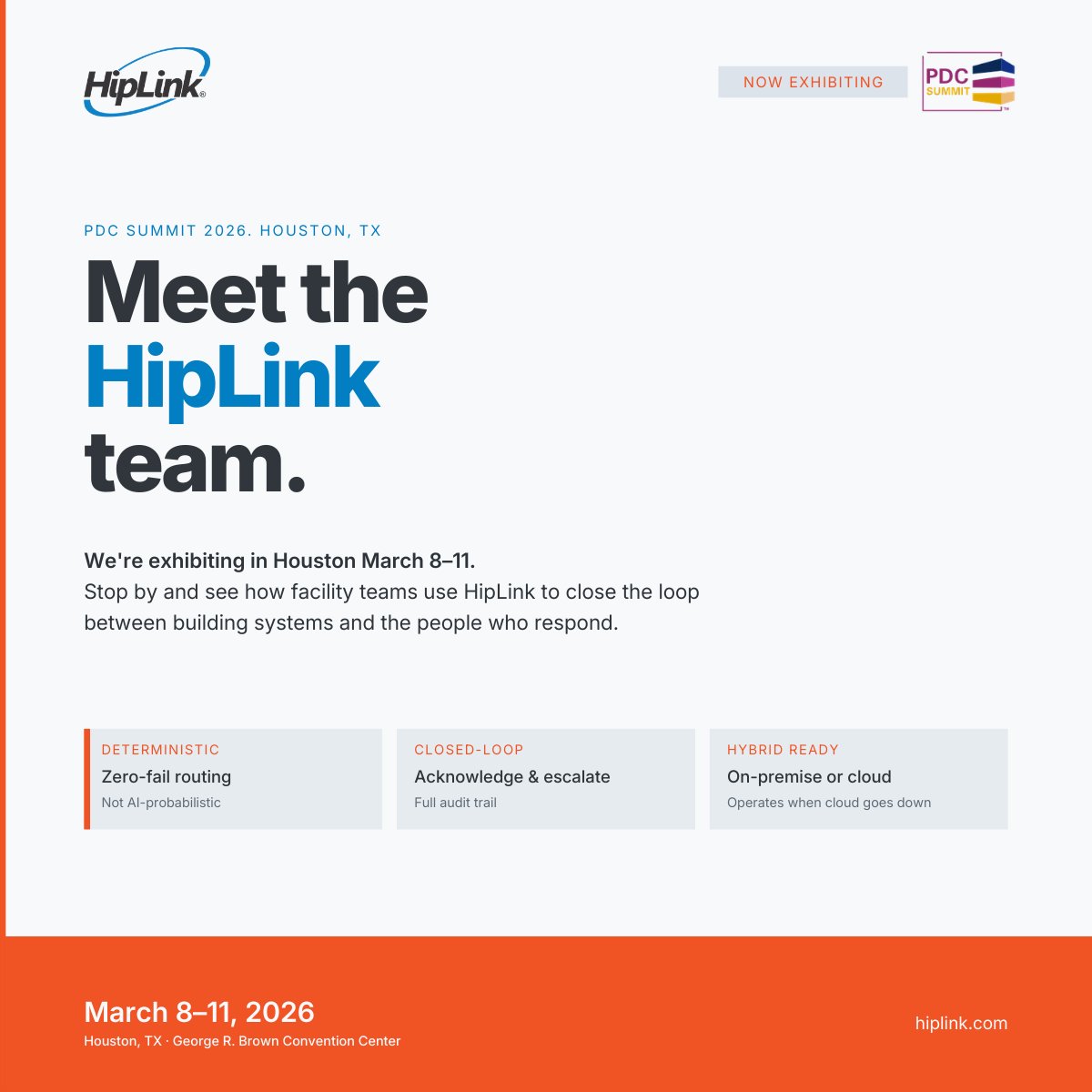
On the floor at #PDCSummit (booth 741).
We're showing how facility teams use HipLink to:
- Route alarms to the right person
- Enforce escalation when no one responds
- Replace tribal knowledge with repeatable workflows
- Create visibility across BMS, security, IT, and voice
Happy New Year 🎉
As we step into the year ahead, we’re focused on helping organizations design for certainty, survivability, and confirmed response when it matters most.
Wishing you a resilient, focused, and successful 2026.
#HappyNewYear
Missed the live webinar? The on-demand replay is now available.
You’ll learn:
→ Practical ways to tackle alarm fatigue
→ Escalation best practices (who/when/how)
→ Real use cases across operations and critical communications
Watch Now → https://t.co/nQmeSmNmi1
#Webinar
Fast is table stakes in critical communication.
If your “urgent alerts” can’t move in seconds, you’re already behind.
But here’s the uncomfortable truth: speed alone doesn’t prevent bad outcomes.
Read > https://t.co/3yRDyIpI1J
#CriticalCommunication#Tech
The full article connects these best practices into a single operational playbook and shows how a platform like @HipLink can sit in the middle as the “connective tissue” between facility systems and the people who keep hospitals running.
9/9
https://t.co/yHSmdI7V9v
Hospital alarms are firing 24/7.
The real risk isn’t “not enough alerts”. It’s too many, with no clear ownership or workflow.
HipLink just published a practical playbook for hospital alarm management.
Key ideas below. 👇
#healthcare#hospitaloperations#tech
Best practice #6–7:
↳ Map your program to NFPA 72, Joint Commission, NPSGs, etc.
↳ Design explicitly against alarm fatigue: filter non-actionable events, deduplicate, and batch low-priority alerts.
Fewer, clearer alarms = faster, safer response.
8/9
On Dec 11, we’re hosting a live webinar to walk through how leading organizations are rethinking this for 2026 and beyond.
From Noise to Clarity: Alarm Management in 2026
Save your spot: https://t.co/g6kruyTA1L
3/3
#MondayMotivation#Webinar#AlarmManagement
If you froze your current alarm setup in place and fast-forwarded to 2026. Would you trust it?
Three simple questions:
→ Do you know exactly who owns each class of critical alert?
→ Can you see, in one place, what happened to every alarm (delivered, escalated, acknowledged)?
→ If you add new systems or sites next year, can your alerting rules adapt without months of rework?
If the honest answer to any of these is “not really,” you’re not alone.
Most organizations are still stitching together tools, lists, and custom scripts.
#Alarms#Tech
2/3