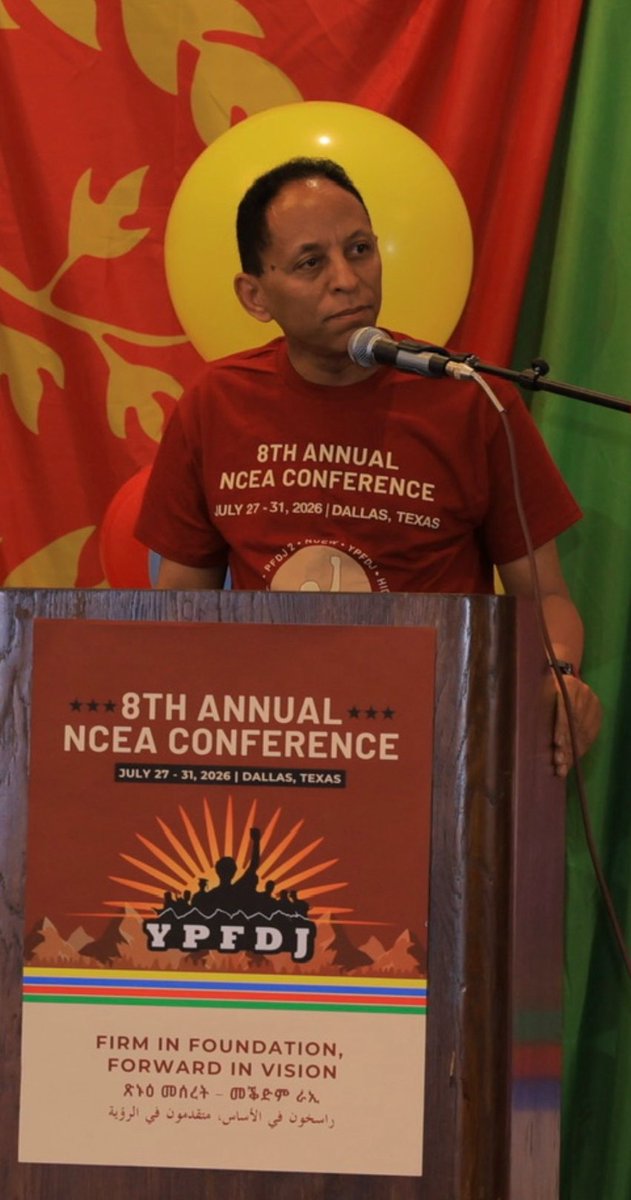
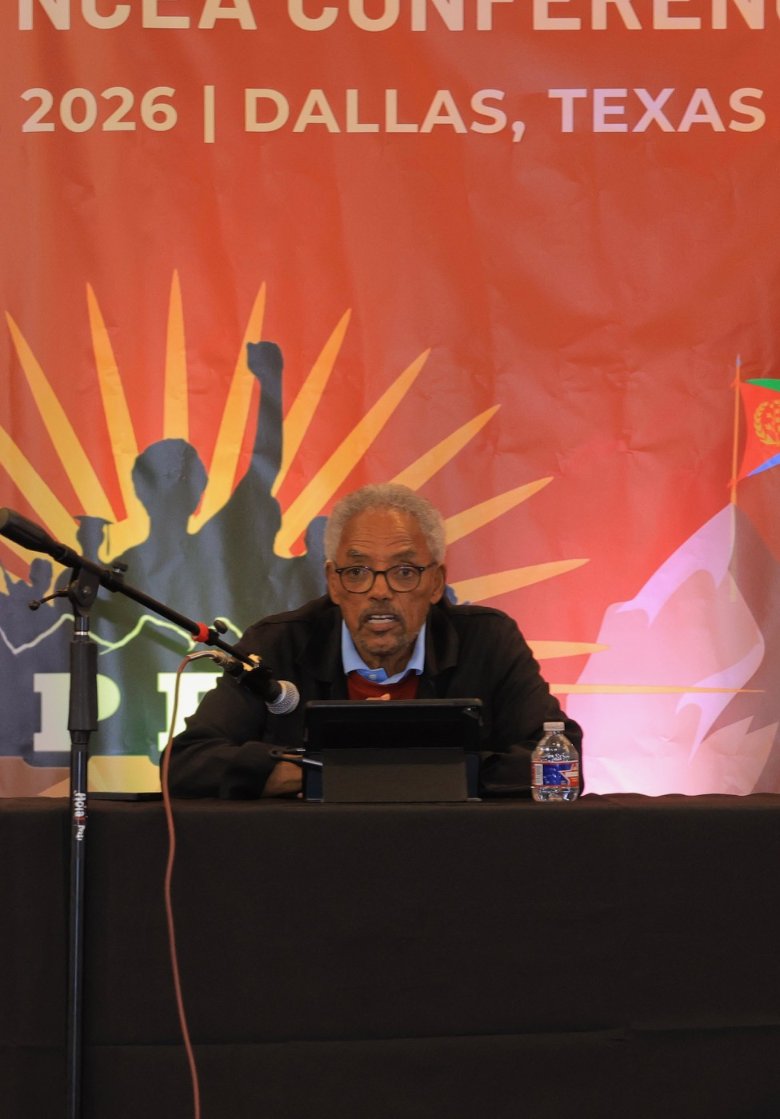
8th Annual NCEA Conference underway in Dallas, Texas, under the theme: " Firm Foundation, Forward in Vision".
Keynote address by Mr. Yosuf Saiq, Head of PFDJ Organizational Affairs, on current situation at home within the context of unfolding regional and global developments and trends; and, remarks on organizational matters by Mr. Berhane Ghebrehiwot, Charge d 'Affairs at the Eritrean Embassy in the US.
Annual Activity Reports by the youth and women segments of NCE; discussion papers on the experience, foresight and vision of the EPLF on education; ownership of national narrative as an element of strategic communication are some of the main events conducted so far in the ongoing four-day Conference.
I am attending the Scandinavian Eritrean Festival in Stockholm, Sweden, for the second time. Once again, I am deeply impressed by the community’s dignity, grace, discipline, joy, and unity. These qualities reflect a determined people committed to succeeding and thriving wherever they are.
The contrast from previous years is striking. During earlier festivals, Eritreans faced violent attempts to disrupt and shut down these community gatherings. Many Eritreans also felt that public discourse and official narratives reduced them to political labels rather than seeing them for who they are.
What was often overlooked was an extraordinary community defined by its values, history, identity, and deep sense of belonging. The love Eritreans have for one another, their pride in their heritage, and their respect for the country they now call home are evident throughout this festival. At a time when much of Europe is grappling with growing anti-immigrant sentiment, the vibrancy, organization, civic engagement, and unity of the Eritrean community stand out in a remarkable way.
This year, I had the opportunity to meet Swedish officials who were attending the festival, engaging with community members, and listening to their perspectives. With elections approaching, many are also reaching out to Eritrean voters. That represents a notable change from previous years and an acknowledgment that the Eritrean community is an active and valued part of Swedish society.
There is still work to be done. Misunderstandings and long-held assumptions do not disappear overnight. But compared to last year, I sensed a greater willingness to engage. That is encouraging, and it reinforces the importance of continuing to build understanding through dialogue, mutual respect, and firsthand experience.
#ScandinavianEritreanFestival #EritreanDiaspora #Eritrea #Stockholm #Unity
Standing on the Shoulders of Giants, Building Tomorrow’s Eritrea
A tree grows taller because of its roots. A nation rises higher because of its history. To see farther, stand on the shoulders of your fathers and grandfathers not to admire the past, but to build the future. Their sacrifice gave us freedom; our responsibility is to make Eritrea rise even higher. 🇪🇷
#Eritrea #AwetNHafash #Legacy #NationBuilding #Future
@martinplaut Our history, traditions, and ways of doing things that you can't truly understand unless you've lived there. We are very proud of our culture and how we gather. our way of being works for us, and it’s best not to judge a place you don't fully know."#Eritrean#Africa
@Yehdavid want our project to reflect true Eritrean culture, not a rigid style like North Korea's. Our traditional Agdo/Hidmo architecture uses beautiful stone and earth that perfectly fits our country’s identity! 🇪🇷
@HermonE_J 90% of our people are farmers, and many cannot read or write yet. Bringing in AI and TikTok right now is dangerous without the right foundation.
Eritrea's National Service seems to be on the spotlight again by certain quarters.
The "new interest" does not stem from some "benevolent concern" for Eritrea. On the contrary, it is floated, purely and simply, in order to weaponize it as a "convenient" whiplash or cudgel for their unwarranted and malicious policies of perennial witch-hunting and harassment.
Indeed, the logic is simple and straight forward.
Countries and international institutions that were complicit in, or that kept mum, at critical junctures of Eritrea's modern history; when its decolonization rights were compromised to mollify the overriding geopolitical interests of major powers; when they left it to its own devices during the three decades of its long and arduous liberation struggle; who relapsed to their traditional position of hostility or apathy even after independence when successive Ethiopian regimes waged illicit wars, and are still contemplating reckless agendas, of territorial irredentism.. etc. have no legal or moral authority to comment on Eritrea's defense architecture.
Truth is international partnership is, and must be, a two-way street. Those who have traditionally abandoned Eritrea during its cyclical ordeals cannot pose as "good-faith" partners to offer unsolicited "advice" on its defense architecture.
The facts are otherwise unambivalent and crystal clear:
1. First off, demobilization is not a new or novel concept to Eritrea. The GOE embarked, on its own volition, on a demobilization programme in 1992, immediately after independence, to reduce the size of the 100,000-strong army of freedom fighters by 65%. The military doctrine at the time was to maintain a small professional army of 35,000 that would be supplemented by a reserve army (National Service) for reasons of contingency in the event of some grave external threat to the nation.
2. In this perspective, National Service was introduced in the context of this military doctrine. It was and remains limited to 18 months by law. And this was the operational modality until the war of aggression that was unleashed by Ethiopia in 1998 under the false pretext of a border dispute.
3. The GOE again embarked on a much more expansive Demobilization Programme in 2001 pursuant to the signing of the Algiers Agreement. The second Demobilization Programme had various training and reinsertion components as it was also funded by Eritrea's international partners including the World Bank, the European Union and bilateral funds. More than 105,000 National Service members were demobilized in this programme that continued until 2007. But it was ultimately shelved as the Ethiopian regime continued to renege on its treaty obligations; occupy, with impunity, sovereign Eritrean territories including Badme; and further pursued a hostile policy of perpetual confrontation.
4. The mindset of the current Ethiopian regime remains, in many respects, a continuation and aggravation of the misguided and deplorable policies of aggression of its predecessors.
4. But even during these trying and difficult times, the GOE has, and continues to take, various measures to mitigate the shared burden of the National Service. The measures adopted range from introduction of new and much higher Civil Service Salary Scale to deployment of the overwhelming majority of NS members to the public sector.
5. In the event, the new smear campaign on the National Service peddled by certain quarters, and its timing, only amplify a malicious ulterior agenda that has nothing to do with the welfare of the Eritrean people and/or the pursuit of regional peace and security.
Understanding Eritrea:
The strained #Eritrea - #USA relationship is rooted in historical distrust from Cold War choices and perceived betrayals. A productive partnership requires understanding and mutual respect to enable cooperation on key issues.
👇👇👉
https://t.co/cZOkglq1ux
It was an honour to host His Excellency President Isaias Afwerki of Eritrea and members of his official delegation at Flex Films' virgin PET Chips facility in Egypt.
Mr. Sanjay Tiku, Business Head – Flex Films, Egypt, welcomed the delegation and engaged in meaningful discussions on the role of advanced manufacturing in fostering industrial growth, driving innovation, and contributing to economic development in the region.
#UFlex #FlexFilms #Egypt #PETChips #ManufacturingExcellence #GlobalGrowth