Weekly interviews with scholars (210 & counting). Adel Aali (host) is a former attorney & healthcare entrepreneur with a long and deep passion for history.
The First Country to Recognize the United States
In November 1776, a small Caribbean island made a move that shocked the British Empire.
As an American ship entered port, its flag was acknowledged—marking what is widely considered the first international recognition of American independence.
But was it intentional… or denied after the fact?
🚩About My 211th Guest Scholar: Dr. Peter Van Cleave
Dr. Peter Van Cleave is a Clinical professor of History and Director of Online Programs of the School of Historical, Philosophical and Religious Studies in Arizona State University.
His publications include the following areas:
►the connections between the Netherlands and the United States during the Age of Revolutions
►Thomas Jefferson and the "Notes on the State of Virginia"
►religious tolerance and religious freedom in the Second Great Awakening
►the relationship between the Dutch Patriot Revolt and the American Revolution
►the legacy of New Netherland and the Dutch in American history
►John Adams and Atlantic politics
📽️This video is made with Filmora.
Iran's Territorial Integrity: Imperial Memory vs. National Identity | S6E7 HbN
►Iran—a nation shaped by imperial memory and modern vulnerability.
Not too long ago, Iran was far larger than it is today. European expansion and colonial intervention cut away at its territories—provinces and realms that had long been part of Iran… or were imagined to be.
—This is the history of how Iran’s shifting borders shaped the modern state—and how, in turn, the idea of the Iranian homeland continues to be shaped by memory, myth, and identity.
Watch interview here: https://t.co/bj7AFJvgLm
►Was King George III Really an All-Powerful Tyrant?
►What hardened the King's attitude toward the Americans?
►Did the British ridicule or revere their king?
►And from “Rule, Britannia!” to “God Save the King” —how this did this transformation happen?
Interview video, transcript and takeaways: https://t.co/ARcH31yFx2
Rethinking King George III: the American Revolution From the British Perspective
—In this interview: “I think he’s having a real crisis of faith at that point, because we know that he will actually draft a letter of abdication, a letter of resignation to basically quit the royal family and go back to the German states where he was from.”
►This is the story of the Missing—and Misunderstood—British Side of the American Revolution
This interview, linked in the comments below, is based on Dr. Bell’s latest book, “The American Revolution and the Fate of the World,” an expansive work that explores the global impact of the Revolution.
Why was OPEC formed? Who were the Seven Sisters that ruled the world? How were oil prices determined in the past? And How are they determined now? Will oil and gas prices decrease more anytime soon?
For answers to these questions, I spoke with Ms. Jacqueline L. Weaver, a Professor of Law at the University of Houston Law Center. Her teaching and research interests cover oil and gas law, energy law and policy, international petroleum, and environmental and natural resources law. She has lectured on topics in international petroleum transactions in Africa, Kazakhstan, Lisbon, China and Bangkok.
https://t.co/IBsDtjMYgc
America's Conspiracy Theories
—World War I was a major turning point for America's conspiracy theories. Before WWI, conspiracy theories targeted minorities and marginalized groups. But after WWI, conspiracy theories became about our government, about the Deep State.
►My guest for this episode is Dr. Kathryn Olmsted, a professor at the History Dept of UC Davis. She is the author of many books on America's conspiracy theories, including two books that we discuss: (1) "Challenging the Secret Government: The Post-Watergate Investigations of the CIA and FBI", and (2) "Real Enemies: Conspiracy Theories and American Democracy, World War I to 9/11".
https://t.co/8SlwmV84xY
For America, 1979 was one of the coldest years of the Cold War. The U.S. lost a friend. Gained a foe. And then its nightmare scenario for the Middle East began to come true. This is the history of how and why the U.S. military now has a permanent presence in the Middle East.
🚩In this interview, we also discuss the following:
The dangers that U.S. military presence in the Middle East poses to U.S. democracy at home,
History of America's military support of Israel,
How America switched from Vietnam to the Middle East,
The Shah of Iran,
The Iran-Iraq War,
History of some events that led up to the 9/11 tragedy, and
What would happen if the U.S. military left the Middle East?
https://t.co/AuCW8Y8zw8
America's History of Increasing Presidential Power
►Congress, and not the presidency, used to be the predominant power of the U.S. government. In this interview, we discuss the history of how politics, populism and polarization changed the balance of power in our government.
►Congress, and not the presidency, used to be the predominant power of the U.S. government. In this interview, we discuss the history of how politics, populism and polarization changed the balance of power in our government.
🚩In this interview:
►Where does the Constitutional principle of the "separation of powers" and "coequal" branches of government come from?
►How did John Locke and baron Montesquieu impact the Federalist papers?
►What are the powers that the Constitution grant to Congress or preserve for the president?
►In the beginning, which had more power: Congress or the Presidency?
►How did Andrew Jackson change the power of the presidency?
►How did the following change the power of the presidency?
Andrew Jackson?
Abraham Lincoln?
Theodore Roosevelt?
Franklin Roosevelt?
The industrial revolution?
The Civil Rights movement?
Polarization of our politics?
►What is presidentialism and what are its perils?
►Why is presidential democracy an oxymoron?
https://t.co/Kw0knfGVst
Iran's Revolutions
History of two and half revolutions in the 20th century, and how they set the stage for 21st centuries.
#IranIsraelWar#IranRevolution2026
An interview with Dr. Abbas Amanat of Yale University: https://t.co/kkobo4Ly3m
@compellingtalks You are welcome.
By the way, we are launching a new podcast dedicated to analyzing the American Revolution, where 33 professors (and counting) provide 33 different global perspectives on the Revolutionary Era.
Learn more about it here: https://t.co/zJG81UQmMG
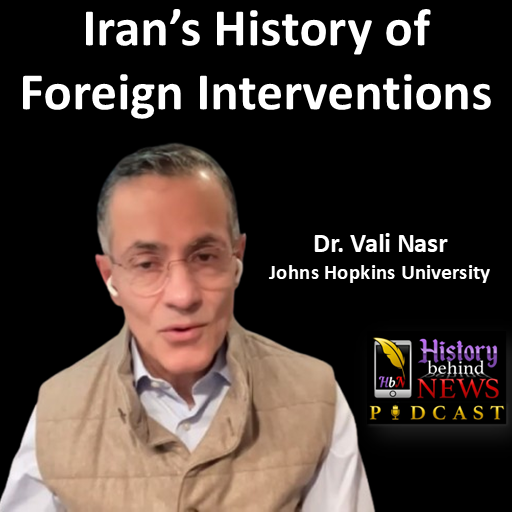
Was 1953 A Coup?
►Reinterpreting U.S. Interventions in Iran
►Podcast interview with Dr. Nasr: 🎧 https://t.co/yGJFo3wawd
-Has Iran experienced more foreign interventions than other countries?
-What really happened to Iran in 1953?
-And why are Iranians reinterpreting its history now?
Sign up for our📰 Newsletter: https://t.co/MsHBybnhMZ
#Iran #IranRevolution
@vali_nasr
Was Iran's 1979 Revolution an Islamic Revolution?
Now that Iranians are staging mass protests against their tyrannical government, I revisit my past interview with Dr. Naghmeh Sohrabi of Brandeis University to ask some fundamental questions:
►Who were the Iranians of the 1979 Revolution?
►How did that revolution succeed?
►What is a revolution anyway?
Watch my interview with Dr. Sohrabi: https://t.co/4CTNkc6HZE
History of America’s relationship with Colombia is far more complicated than most people realize.
It’s a story of secession (how Panama was created out of Colombia), the so-called “School of Assassins,” drugs, immigration, alliance—and interference. Not necessarily in that order!
My guest is Dr. Michael J. LaRosa of Rhodes College.
Watch our full conversation here: 🎞️ https://t.co/1mzfTk6JDn
Greenland, Denmark & America: what’s at stake? Prof. Ebbe Volquardsen of the University of Greenland (Nuuk) explains the people, history, and geopolitics of Greenland—and its ties to the U.S.
🎞️ https://t.co/PkXYdftu9V
Venezuela was once a liberal democracy with close geopolitical relations with the United States. So what happened?
This is the story of Venezuela's devolution from democracy to dictatorship, and from cooperation with America to coups and open conflict.
Watch my interview with Dr. Corrales here:
🎞️ https://t.co/9yTfyIFTNV
How did the 1979 Iranian Revolution happen?
Was it an Islamic Revolution?
What are the legacies of the 1979 Revolution for the Iranian people now?
Listen to my interview with Dr. Naghmeh Sohrabi for answers:
🎧https://t.co/eFaMML4qzU
Iranians have once again taken to streets against the Mullahs regime.
How will the United States and Israel respond?
In this interview, Dr. Vali Nasr answers how Iran's national security has informed Iran's domestic policies for generations.
🎞️ https://t.co/wP0o05joVC
#iran #IranProtests #iranrevolution #Iranians