John ‘Motormouth’ Moschitta Jr. — Guinness World Record holder for the world’s fastest talker at 586 words per minute — delivers Michael Jackson’s ‘Bad’ in 20 seconds for the American Lung Association. The choice of Moschitta was quietly perfect: a man whose entire career is built on extraordinary breath control and lung capacity, raising money for an organisation dedicated to protecting the very thing that makes him unique. At his peak he could articulate 11 words per second — a talent he first developed as a child in Uniondale, Long Island, simply hoping to get into the Guinness Book. It eventually made him one of the most recognisable commercial voices of the 1980s, as the Micro Machines Man and the fast-talking FedEx executive. He also read the Academy Awards rules in 15 seconds at the 55th Oscars, introduced by Liza Minnelli. Twenty seconds. The whole song. Clean.
Bill Gates and Steve Ballmer celebrate the launch of Windows 95 at Microsoft’s campus, Redmond, August 24, 1995. Microsoft paid the Rolling Stones $14 million for ‘Start Me Up’ as the launch anthem — a nod to the new Start button that would define desktop computing for the next decade. Jay Leno hosted. The Empire State Building was lit in Microsoft’s colours. Midnight queues formed outside stores. Over 40,000 copies sold in the UK alone on day one. The operating system’s 32-bit architecture, taskbar, and plug-and-play hardware support transformed personal computing — and the decision to bundle Internet Explorer with it triggered a US Department of Justice antitrust lawsuit three years later that nearly broke the company apart.
Italian explorer Attilio Gatti stands beside a male mountain gorilla he shot in the Parc National Albert, southwest of Lake Kivu, Belgian Congo, 1930 — the kill made possible by a special permit from reluctant Belgian colonial authorities. The park had been created specifically to protect gorillas from exactly this kind of destruction. Accompanying Gatti was South African anatomist Raymond Dart — discoverer of Australopithecus africanus — who dissected the gorilla on site, measuring 18 inches around the biceps and preserving its organs for study in Italy. Almost nothing was known about gorillas at the time; Dart noted that basic facts about their lifespan, diet, and communication were completely unknown. The expedition financially ruined Gatti. He settled in the United States shortly after this photograph was taken and never led an independent African expedition again.
A Royal Canadian Navy officer delivers internment papers to Japanese Canadian fishermen, British Columbia, 1942. Their boats had already been seized months earlier — 1,800 vessels confiscated immediately after Pearl Harbor, leaving entire communities with no income. Now they were being ordered from their homes, most with 24 hours’ notice and two suitcases. Of the 22,000 Japanese Canadians interned, over 14,000 were Canadian-born citizens. The RCMP and Canadian military intelligence both advised the government that there was no security threat — their written assessments explicitly stated no sabotage was expected. The government proceeded regardless. To pay for the internment, it seized and sold the families’ homes, farms, and businesses without permission. The last restrictions on Japanese Canadians weren’t lifted until 1948. Canada’s formal apology came in 1988.
A captured Soviet female soldier is searched by German troops, Eastern Front, July 1941 — the first weeks of Operation Barbarossa. The Soviet Union was unique among all WWII belligerents in deploying nearly one million women in military roles, with over 120,000 in active combat — as snipers, pilots, machine-gunners, and unit commanders. The German military had no framework for this. Nazi ideology held that any woman fighting against Germany was depraved or deranged — not a soldier deserving POW status. Wehrmacht field commanders issued explicit orders for captured Soviet women to be shot immediately. Those who weren’t executed faced torture, sexual assault, and concentration camp imprisonment. The woman in this photograph was photographed in July 1941. What happened to her afterward is not recorded.
Al Pacino tells David Letterman about the Sicily wedding scene from The Godfather — 1972. Coppola laid out the scene: Pacino would pass candies to guests in a traditional Italian ritual, waltz with his new bride, then drive off. Pacino told him he didn’t speak Italian. Coppola said just move around. Then Pacino said he couldn’t drive either. Coppola’s response became one of cinema’s great behind-the-scenes lines: ‘Why did I pick him? Why him?’ Pacino had already nearly been fired before the Sicily scenes were shot — the studio wanted Nicholson, Redford, or Beatty, and early rushes of Pacino’s deliberately subdued Michael convinced them he was wrong for the part. Coppola saved him by rescheduling the restaurant assassination scene earlier in the shoot. What Pacino didn’t tell Coppola until after he was cast: his grandfather had been born in Corleone, Sicily — the town that gave Michael’s family their name.
Cossack soldiers in Wehrmacht uniform, 1943–44 — wearing their traditional papakha fur hats alongside German eagle breast badges. Their presence on the German side was rooted in decades of Soviet persecution. Stalin’s Decossackization policies had stripped Cossack communities of their land, autonomy, and identity. When Germany invaded, there were many willing volunteers. Hitler, for his part, welcomed them: Nazi racial ideology classified Cossacks as descendants of the Ostrogoths — and therefore Aryan. Many brought their wives and children; the Wehrmacht had to build a separate camp for their families. At war’s end, those who surrendered to British forces in Austria were promised safety — then forcibly handed to Soviet SMERSH under the terms of the Yalta Agreement. Most went to the Gulag. Their leaders were executed in Moscow in 1947. Meanwhile, other Cossack formations fought for the Red Army and were among its most decorated units. The same people, on opposite sides of the same war.
Marshal Georgy Zhukov shakes hands with Field Marshal Bernard Montgomery at the Brandenburg Gate, Berlin, July 12, 1945 — minutes after Montgomery invested Zhukov as a Knight Grand Cross of the Order of the Bath and bestowed further decorations on Rokossovsky and Sokolovsky. Both Soviet Marshals can be seen wearing their new British honours — Zhukov with the sash, Rokossovsky with the cross around his neck. Zhukov then awarded Montgomery the Soviet Order of Victory, making him one of only two non-Soviet recipients ever to receive it. The Guard of Honour was formed by the 7th Armoured Division — the Desert Rats — who had chased Rommel across North Africa and were now marching through the ruins of Berlin. Within three years, the Allied Control Council that these men had pledged to run jointly had collapsed, and the Berlin Blockade had begun.
Vladimir Putin speaks at the Juma Mosque of Derbent, Dagestan — Russia’s oldest mosque, founded in 734 AD — June 28, 2023, the first day of Eid al-Adha. He had just been gifted a copy of the Quran, which he said would receive ‘a deserving place in the Kremlin.’ His remarks were a direct response to a Quran burning in Sweden days earlier, which had been permitted by Swedish courts on free-speech grounds. Putin cited Article 282 of Russia’s Criminal Code: ‘In our country it’s a crime to have no respect and stoke inter-faith discord.’ The same Article 282 has been used to imprison Russian political dissidents, LGBT activists, and members of the Jehovah’s Witnesses — whose organization was declared extremist and banned in Russia in 2017 for practicing their faith.
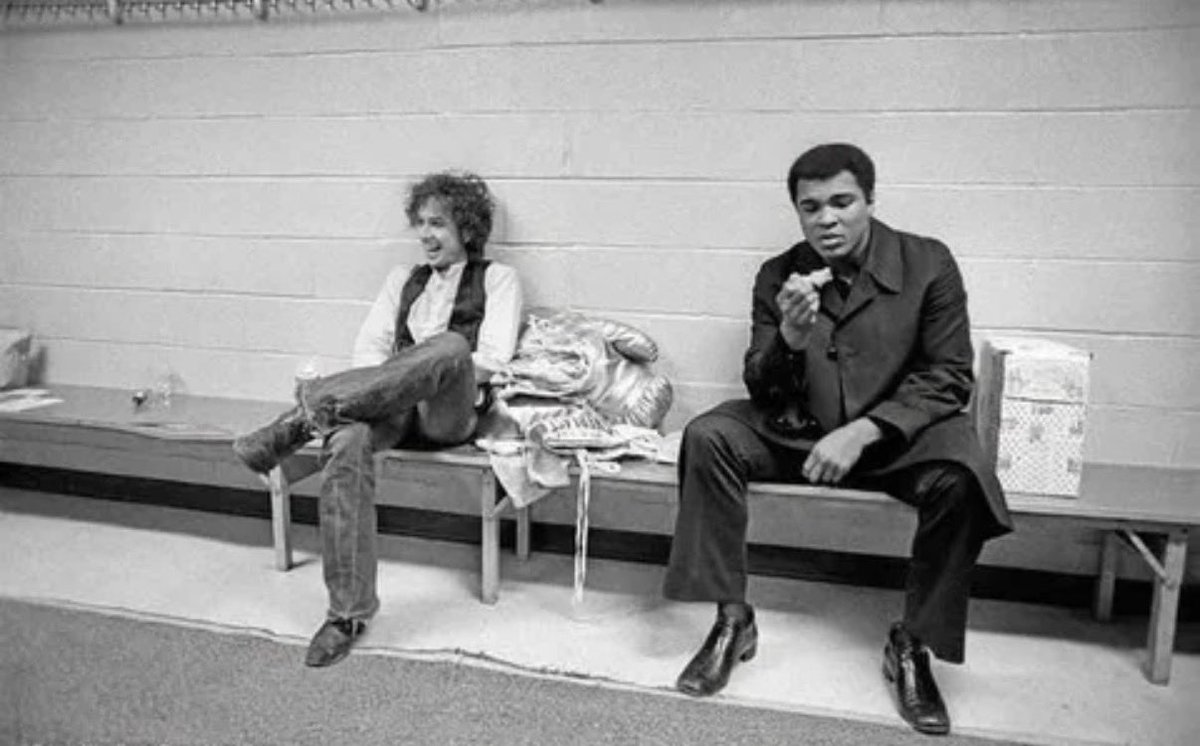
Muhammad Ali and Bob Dylan backstage at Madison Square Garden, December 8, 1975 — photographed by Ken Regan, the sole official photographer of Dylan’s Rolling Thunder Revue tour. The giant boxing glove between them on the bench was Ali’s gift to Dylan that evening. The Night of the Hurricane was the closing concert of the tour, a benefit for Rubin Carter — a middleweight boxer Dylan believed had been wrongfully imprisoned for murder, the subject of his song ‘Hurricane.’ Joan Baez, Joni Mitchell, Allen Ginsberg, and Sam Shepard were all part of the tour. Ali tried to turn the evening into a political rally; Dylan responded by dedicating a song to someone who, he noted pointedly, was ‘not running for President.’ Rubin Carter’s convictions were finally set aside ten years later, in 1985.
Miners pose at the Last Chance Mine, Atlanta, Idaho, ca. 1880s — near the end of the district’s first golden era. Gold had been discovered here in 1863, and the Atlanta lode was struck the following year by prospectors who named the town after a Confederate victory that turned out to be false, but the name stuck. The peak years ran from 1877 to 1884, when high-grade ore drove a local boom. By the time this photograph was taken, the richest ore was already worked out. The district would eventually yield over $16 million in gold and silver — but most of that came after 1932, when modern recovery methods unlocked what these men’s equipment had left behind.
Frank Prentice, assistant storekeeper on the RMS Titanic, speaks to the BBC in 1979 — 67 years after the sinking. He was 23 on the night of April 14, 1912. His explanation for why more people died is specific: the lifeboats launched half-empty. The first boat had capacity for 65 people and carried 28. Passengers were afraid of the 70-foot drop into the water, and most simply didn’t believe the ship was going down. Prentice’s own calculation: ‘We had 16 lifeboats and they each carried 50 — if they’d been filled, we could have saved 800, whereas we only saved 500.’ He didn’t make it into a lifeboat himself. He jumped from the stern, swam through
Matt Groening explains the design principle behind every Simpsons character: make them identifiable in silhouette. He learned it from Mickey Mouse as a child — those two ears, unmistakable from any distance — and applied it deliberately when creating the Simpson family. Bart’s picket-fence spikes, Marge’s beehive, Homer’s two stray hairs — each one readable in pure outline. The crude drawing style wasn’t a stylistic choice: Groening submitted rough sketches assuming animators would clean them up, and they simply traced over his originals instead. The yellow skin followed the same logic — a colour so specific that a single glimpse from across the room was enough to tell you exactly what you were watching. The Simpsons has now aired for over 35 years. The silhouettes haven’t changed.
Former Israeli Prime Minister Benjamin Netanyahu testifies before a House committee on Capitol Hill, September 12, 2002 — one day after the first anniversary of 9/11, and as a private citizen between terms as Prime Minister. He was invited to give ‘an Israeli perspective’ on Iraq. His testimony was unambiguous: ‘If you take out Saddam, I guarantee you that it will have enormous positive reverberations on the region.’ The Iraq War that followed killed hundreds of thousands, displaced millions, and helped generate the conditions that produced ISIS. Netanyahu would return to Congress in 2011, 2015, and 2024 — each time urging stronger American action in the Middle East. He later denied having supported the Iraq invasion.
Bill Gates appears on the Late Show with David Letterman, November 27, 1995, to promote his book ‘The Road Ahead’ and Microsoft’s newly launched Internet Explorer. Gates was 39 and the world’s richest person. The studio audience spent most of the segment laughing at him. When Gates explained you could listen to baseball on your computer, Letterman asked ‘Does radio ring a bell?’ Gates said you could listen whenever you wanted. Letterman replied: ‘Do tape recorders ring a bell?’ Gates also told Letterman that making computers think for themselves had seen ‘almost no progress’ and might never happen — calling the idea of artificial intelligence a ‘scary thought.’ Letterman closed the interview with: ‘It’s too bad there is no money in computers and the internet.’ The clip has since been watched tens of millions of times — on the internet.
Klaus Schwab, founder of the World Economic Forum, was in New York City on September 11, 2001 — having arrived the previous day to receive the Candlelight Award from UN Secretary-General Kofi Annan. That morning he had been scheduled to attend a meeting with newspaper editors directly across from the Twin Towers. By coincidence the meeting was rescheduled, and he was in a taxi heading to the Upper East Side when his driver said something had happened in Lower Manhattan — seconds before the radio announced the second plane had hit. The following year, Schwab moved the WEF’s annual meeting to New York City for the first time in the forum’s history.
In just four years the Khmer Rouge killed between a quarter and a third of Cambodia’s entire population. The survivors were a traumatized nation of orphans, widows, and people who had watched their families murdered. The Extraordinary Chambers in the Courts of Cambodia — the tribunal set up to try Khmer Rouge leaders — only began work in 2006, nearly 30 years after the genocide ended. Only a handful of senior leaders were ever convicted. Pol Pot died in the jungle never having spent a single day in a courtroom.
On April 17, 1975 the Khmer Rouge marched into the Cambodian capital Phnom Penh and within 24 hours had forced the entire population of 2 million people out of the city at gunpoint. What followed over the next four years was one of the most extreme acts of self-destruction in human history. Pol Pot’s regime murdered an estimated 1.7 to 2.5 million people — between a quarter and a third of Cambodia’s entire population. Most of the killers were teenagers.
The Khmer Rouge regime was ended not by international intervention but by Vietnam. In December 1978 the Vietnamese army invaded Cambodia and within weeks had captured Phnom Penh. Pol Pot fled to the jungle where he continued leading a guerrilla movement for nearly two more decades. Incredibly the Khmer Rouge retained Cambodia’s seat at the United Nations until 1993 because Western powers preferred them to the Vietnamese-backed government. Pol Pot died under house arrest in 1998. He was never tried.