Then vs Now :
Abu Simbel - the Great Temple of Ramesses II ...
Abu Simbel Temple is an enormous rock temple complex located on Egypt’s border with Sudan. The two temples of this complex were built in 13th Century BC during the reign of the powerful Ramesses II. While this temple complex is known today as the Abu Simbel Temple, it was referred to in the past as the “Temple of Ramesses, Beloved by Amun.” During the 1960s, the Aswan High Dam reservoir was built, which resulted in the creation of Lake Nasser. This threatened the existence of the Abu Simbel Temple, and it was completely relocated in 1968.
Abu Simbel Temple consists of two huge temples (Great Temple and the Small Temple) that were carved into the mountainside. The temple complex was commissioned by Ramesses II, one of ancient Egypt’s most renowned pharaohs.
According to some scholars, work on the Abu Simbel Temple began around 1264 BC. This is based on the fact that artwork decorating the interior of the Great Temple indicates that the monument was created to celebrate, to a certain extent, the victory of Ramesses II over the Hittites at the Battle of Kadesh in 1274 BC. Alternatively, the year 1244 BC has also been suggested as the year when the construction of Abu Simbel Temple commenced. According to this hypothesis, temple is located on the border with the conquered lands of Nubia, and thus was built following the military campaigns carried out by the pharaoh against the Nubians.
In any event, it has been agreed that the construction of the Abu Simbel Temple took 20 years to complete. At the entrance of the Great Temple, four colossal seated statues of Ramesses II (20m in height) gaze upon all who approach it. As for the Small Temple, which may have been built for Nefertari, the wife of Ramesses II, its entrance is guarded by two statues of the queen, and four of the pharaoh, each measuring 10m in height.
One of the most fascinating aspects of the Abu Simbel Temple is the inner sanctum of the Great Temple. In this sacred space, four statues can be found – Ra, Amun, Ptah and Ramesses himself. The temple was built in such a way that twice a year, the 21st of February and the 22nd of October in present times, the Sun’s rays would find their way directly into the inner sanctum and illuminate three of the statues.
The statue of Ptah was kept in darkness, a possible reason being that he was a deity associated with the Underworld. Two dates are traditionally thought to correspond with the birthday and coronation of the pharaoh, though there is no evidence to support this. In any case, these two dates are accepted to be related to some major events in the Ramesses II’s life.
Abu Simbel Temple was eventually abandoned, and was buried under millennia of desert sand. This monument was forgotten, and was only rediscovered during the early part of the 19th century. The re-discovery was allegedly made by the Swiss traveler and geographer Johann Ludwig Burckhardt (most famous for his discovery of Petra, Jordan).
According to one version of the story, in 1813 Burckhardt was traveling down the Nile when he saw the top of the Great Temple, which had not been covered by the sand. In another version of the tale, the Swiss scholar was led to the site by an Egyptian boy named Abu Simbel, and later named the site after him. Burckhardt himself was unable to uncover the temple. He mentioned the site to his friend, Giovanni Battista, and the two tried to excavate the monument, to no avail. In 1817, Battista returned, succeeded in uncovering the temple, and took everything that was valuable and portable out of the temple.
#archaeohistories
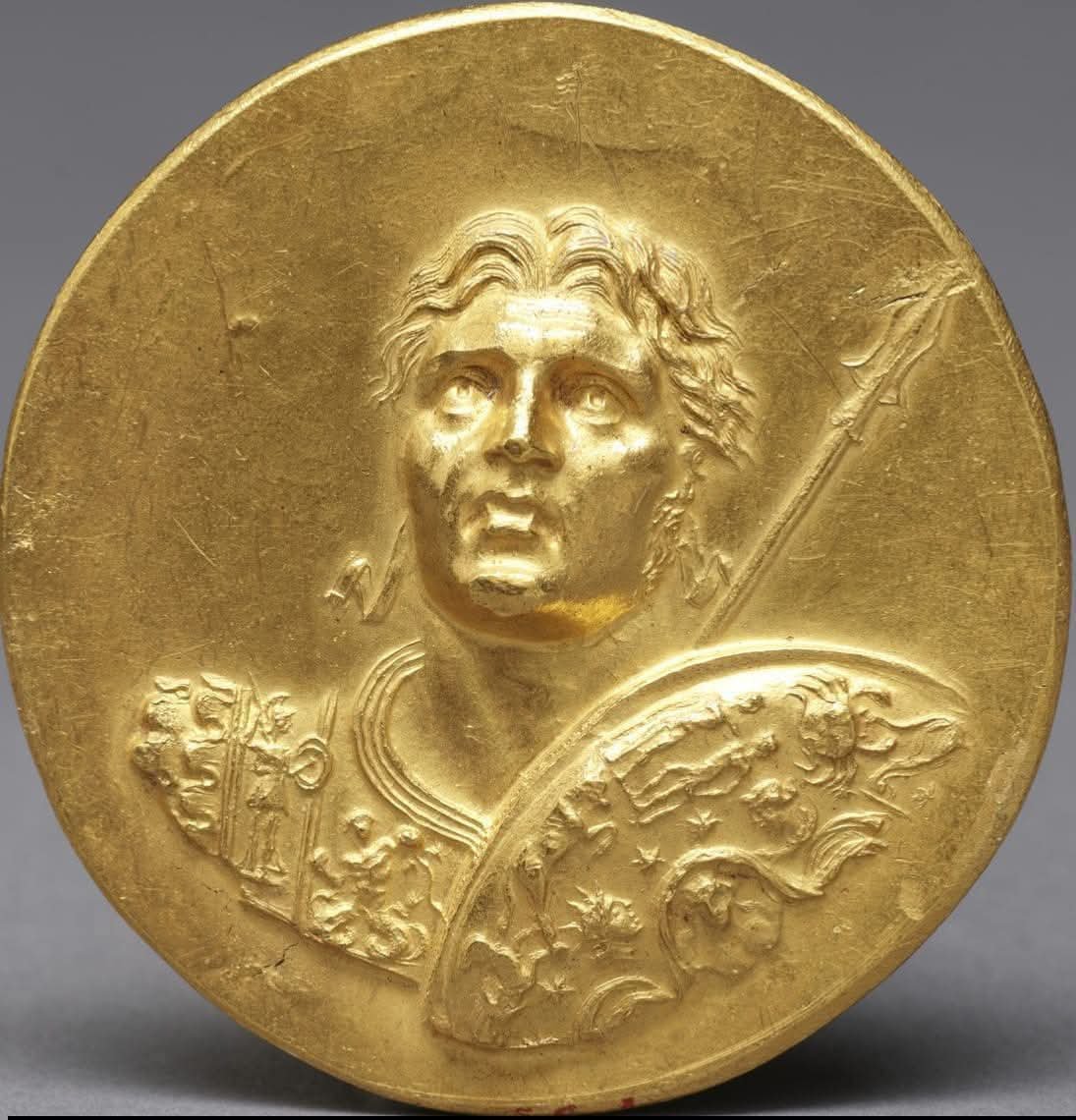
Stunning Gold Medallion with the Portrait Alexander the Great...
This Medallion was discovered in Egypt as part of a hoard that comprised about twenty similar medallions (now dispersed among various museums), eighteen gold ingots, and six hundred gold coins issued by Roman emperors from Severus Alexander (r. 222-235 CE) to Constantius I (r. 293-306 CE). One of the medallions, now in the Calouste Gulbenkian Museum in Lisbon, bears an inscription that possibly reads "Olympic games of the year 274", a date corresponding to 242-243 CE. It is possible that the medallions were intended as prizes to be given out at that event. Alternatively, they may have been issued by Emperor Caracalla (r. 198-217 CE), who is potrayed on some of them. Caracalla liked to be compared to the great king and conquerror Alexander of Macedon (r. 336-323 BC). Like Alexander, this Roman emperor waged war in the East, and actually died in the course of his campaign against the Parthians.
This particular medallion shows Alexander the Great gazing heavenward and bearing a shield decorated with signs of the zodiac. This portrait shows him with his hair pulled back. He wears a decorated cuirass with a figure of Athena on the shoulder strap and, on the chest, a scene from the Gigantomachy (War of the Giants). The back depicts Alexander and Nike, goddess of victory, riding in a chariot, flanked by the deities Roma and Mars.
The Walter Art Museum, Baltimore Maryland.
#drthehistories
The Atacama Giant in Chile is the world's largest prehistoric human geoglyph, built around 1000–1400 AD. The 119m desert figure likely served as an astronomical calendar to track seasons, crops, and rainfall, and is culturally linked to the Andean creator deity Tunupa-Tarapaca.
Carved into the slopes of Cerro Unitas in Chile's Atacama Desert, the Atacama Giant stands approximately 119m tall, making it the largest known prehistoric anthropomorphic geoglyph in the world. Archaeologists believe it was created by indigenous Andean peoples between 1000-1400 AD, during a period when extensive trade networks connected communities across the Andes and Pacific coast.
Unlike Peru's Nazca Lines, which are famous for their geometric and animal designs, the Atacama Giant is thought to have had a practical as well as spiritual function. Some researchers propose that the figure's distinctive head ornaments and alignments may have been used to track the position of the moon and seasonal cycles, helping communities predict rainfall and determine the best times for planting and travel across one of the driest regions on Earth.
The geoglyph remains one of more than 5,000 known prehistoric earthworks discovered throughout the Atacama Desert, making the region one of the world's richest concentrations of ancient landscape art.
The Atacama Desert's extreme aridity, some areas receive less than 1 millimeter of rain annually, has preserved many geoglyphs for over a thousand years with remarkably little erosion.
#archaeohistories
Coiled snake pendant with chain by René Jules Lalique, crafted from gold, pearls, and champlevé enamel, Paris, 1898-1899. Collection: State Hermitage Museum, St. Petersburg, Russia.
This object is an incense burner. Where does the smoke come out? Through the wings. The body comes apart, incense is placed inside, and the smoke rises from the praying mantis's back.
Artwork Details: Japan, Meiji period (1868-1912). Iron, gold, silver lining. H. 8.9 cm; L. 15.2 cm. The Metropolitan Museum of Art, New York. Accession no. 36.120.669a, b.
This piece is the product of a tradition called Jizai Okimono. In Japanese, 'jizai' means 'moving at will.' The legs, head, and front limbs can actually be posed.
According to Tokyo National Museum records, the earliest known example of these articulated iron figures is a dragon signed by Myochin Muneaki, dated 1713 (take a look at the second image I've shared).
The Myochins were a centuries-old dynasty of samurai armorers. Their shift from crafting military gear to moving animal figures actually began when the demand for armor dropped during the long years of peace in the Edo period. When carrying swords was completely banned at the start of the Meiji period, these master craftsmen dedicated their skills entirely to making export pieces for the Western market just to survive. The praying mantis is a product of this historical transition.
In Japanese culture, the praying mantis is considered the samurai's equivalent in the insect world; it both protects and destroys. This motif, crafted into samurai sword guards (or tsuba) for centuries, found its way onto incense burners during the Meiji period.
This incense burner reached The Metropolitan Museum of Art through a 1936 donation by collector and attorney Howard Mansfield.
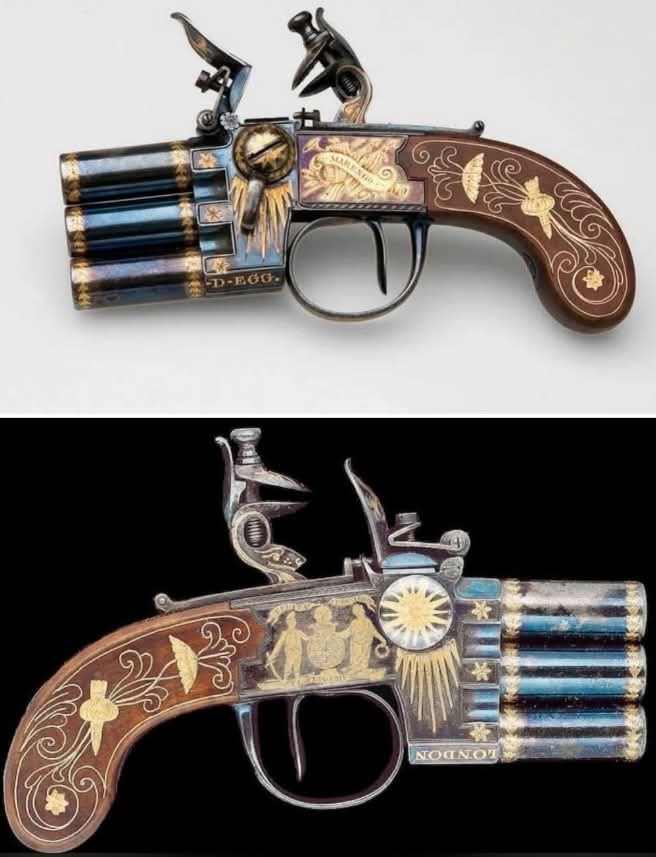
Napoleon’s Three-Barrel Pistol (1802), a gold-inlaid flintlock by London gunmaker Durs Egg, gifted by a British officer. Its tap-action system fires three shots, with a “Marengo” engraving honoring his 1800 victory.
Built around 1802, it features a multi-barrel “tap-action” system, allowing several shots to be fired in sequence without reloading, an advanced concept for the time. The pistol is richly decorated with gold inlay and classical motifs, reflecting both craftsmanship and status.
Inscriptions referencing Marengo (1800), one of Napoleon’s key victories, suggest it was created as a commemorative or diplomatic piece rather than a practical battlefield weapon. High-end firearms like this were often exchanged as gifts among officers and dignitaries.
Durs Egg was known for experimental firearm designs, including early repeating mechanisms, making his workshop one of the more innovative in London at the turn of 19th Century.
#archaeohistories
Three Headed Lernaean Hydra; wall painting from an Etruscan Tomb (4th Century BC), at necropolis of Pianacce, Italy 🇮🇹
Tomb (Tomb of Infernal Chariot) is considered one of beautifully painted Etruscan Tomb and a structure for holding funeral rites that is unrivalled in all of Etruria. Tomb was discovered in 2003, at a site in Pianacce and is one of most important discoveries of Etruscan civilisation ever found.
Tomb is characterised by a perfectly preserved coloured painting that depicts an exceptional iconographic theme: a quadriga (chariot) pulled by two lions and two gryphons and driven by a demon with a terrifying and possessive look, most likely an innovative representation of the demon Charun, the equivalent of the Greek Charon who accompanied deceased souls to Hades.
Figure of Charioteer had never been seen in Etruscan art before this discovery.
#drthehistories
The three gold signet rings in the image come from the famous Tomb of the Griffin Warrior in Pylos. The tomb was discovered in 2015 near the Palace of Nestor and belonged to a Mycenaean warrior of high standing who lived around 1500–1450 BC.