#OnThisDay, June 3, 2012, Dana Air Flight 0992, a scheduled Nigerian domestic passenger flight from Abuja to Lagos, suffered a dual-engine failure and crashed into buildings, killing all 153 people on board and six on the ground.
With 159 deaths, it remains the deadliest commercial airliner crash in Nigerian history since the 1973 Kano air disaster. #HistoryVille
ỌGUN ÒKÚTA (STONE WAR), 1931.
In 1917 Sir Frederick Lugard introduced a direct tax system, but by 1931 the tax was increased from three shillings to six shillings. This development infuriated the natives who decried the obnoxious tax system.
Little protests gradually sprung up across Yorùbáland as natives marched to the palace of their respective Kings. Outbursts were recorded at Abeokuta, Iseyin and at Ikirun with casualties and properties destroyed. But none of these was enough to make the colonial administration re-examine their position.
In Akure, the movement was led by one Mr Akomolede, Odopetu Ajolehinogun (said to be traditional chief and second in command to the Deji), Dukudu Ologuneyon, and Osue Eruoba (an High-Chief) among others. They accused the Deji of Akure, Oba Afunbiowo Adesida I of colluding with the British government to make life difficult for his people, they criticised him for sending all his children to study overseas.
On July 27, 1931, the Native Authority Police and tax collectors assembled at the Akure Native Court Hall with Oba Afunbiowo in attendance. They sent for the Akure people to pay their tax, but only few natives complied. Mr. Akomolede was brought to the D. O to pay the reduced tax of five and half shillings. He refused and asserted that he could only pay three shillings. Because of this, he was arrested and taken to Lagos. The news of his arrest spread like wild fire. On hearing this, the natives began to throw stones at the King and the District Officer, G. G. Harris inside the court (this was how the war derived its name), In a fit of anger, they rushed inside the court, turned the tables upside down and disorganised the Court Hall.
In response the native police besieged Akure up to August 11, 1931. They spent several month ransacking the city before some of the leaders of the revolt could be arrested, many were jailed and forced others to go on exile. Several farm products, livestocks and other valuable goods were destroyed. Oba Afunbiowo was able to secure the release of all the leaders of the revolt that were kept in the British solitary confinements and this restored normalcy to the Kingdom.
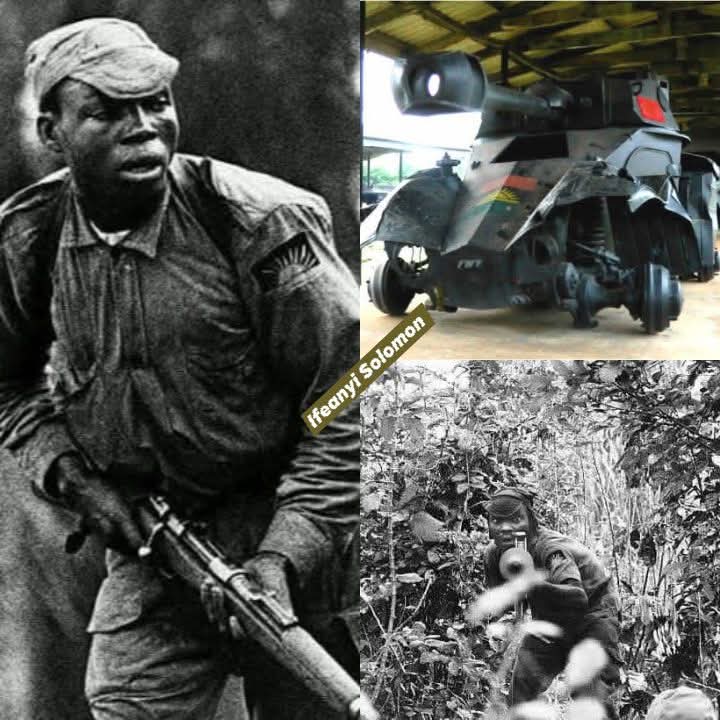
BBC is currently attempting to rewrite the history of 1967 by labeling the Igbo people as the aggressørs. This is a blatant distortion of the truth.
History confirms that the first shøts were f!red by Nigerian federal forces at Gakem on July 6, 1967. Biafra did not start this w∆r; it was a desperate act of self preservation following systemic pogrøms and existential thr£ats.
What followed was not a rebellion, but a f!ght for su√vival against a brutal bløckade.
We refuse to let our history be erased or maπipulated. Our ancestors fought to protect their families, they did not choose this w@r.
We stand firmly on this historical reality.💪💪💪
#HistoricalTruth #BiafraHistory #Alaigbo #NeverAgain #TruthMatters
There’s this story about underage soldiers with arms that the British government used to propagate narratives against Biafra during the war, which influenced many countries to support Nigeria against Biafra. This is one of those pictures.
According to many Biafran accounts, this picture was staged. It is believed that some British journalists allegedly handed guns to those boys just to take photographs and later published them to portray Biafra negatively through claims of child soldier abuse.
My dad told me that during that period, he was among the young boys who participated in the war efforts, but they were never allowed to carry rifles. Their duties were mainly to sneak around and spy on Nigerian soldiers’ camps, gather information, and sometimes climb trees to monitor movements and report back.
To many people from the Biafran side, pictures like this were part of wartime propaganda allegedly arranged by foreign journalists to influence international opinion against Biafra.
There courage was exceptional. They were the bravest of the brave, arguably the finest army ever assembled in modern era. For 3 years, they withstood a global alliance of the twisted genocidal mindset of British neo-colonialists, USSR, Arab World, AU and others.
We will never forget.
Wole Soyinka gently touches Elizabeth Osisioma during the stage play, "The Good Woman of Setzuan," at the University College Dramatic Arts Society, Ibadan, June 1960. #HistoryVille
Photo Credit: Kirby Histories