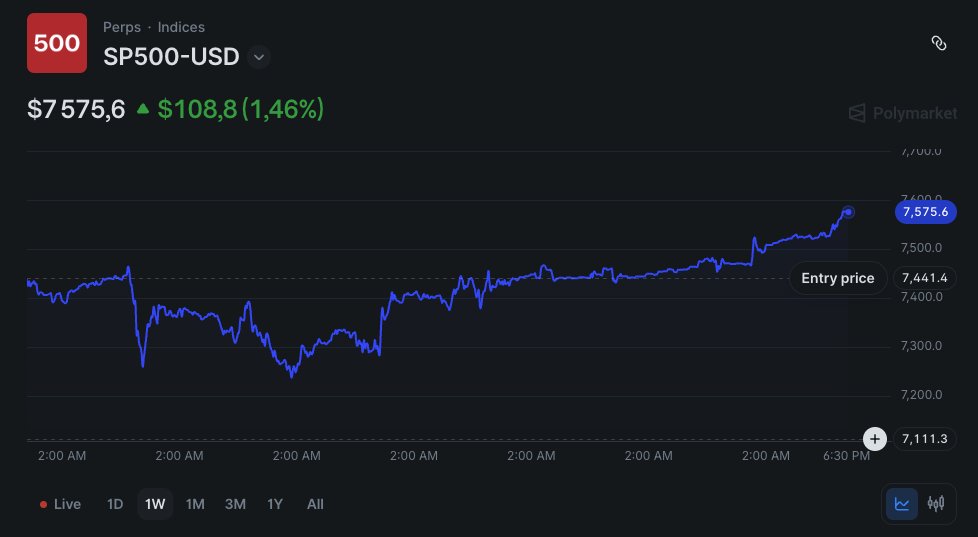
📈 Journal 29: Polymarket launched perps. Here’s why I care.
Polymarket still has no token. $10B valuation. Over $1B in weekly volume. 192 million transactions in March alone.
When $POLY drops, it could be one of the biggest airdrops in crypto history 🪂
And in every cycle, the same pattern repeats: projects disproportionately reward early adopters of new features.
Being in the first wave of users testing perps before it goes fully public is exactly the kind of activity that gets flagged and rewarded.
I’m putting volume through it this week. The UX is clean, the experience is smooth, and there’s no reason not to be testing this.
Try it!
I’ve been in crypto since 2021.
While most people disappeared in 2022, I stayed.
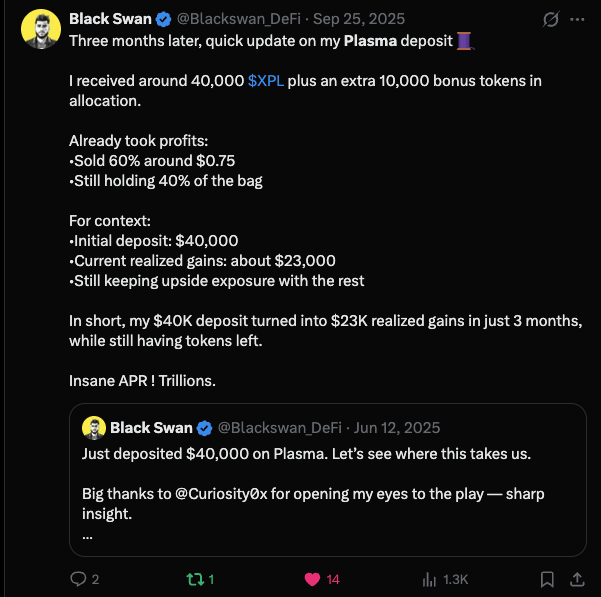
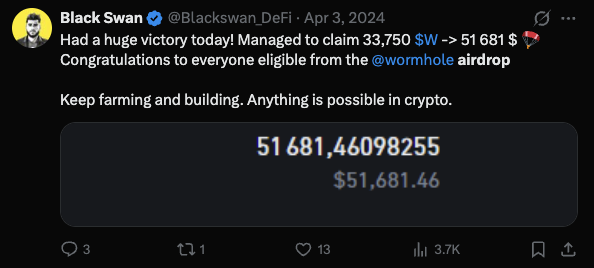
Between 2022 and 2025, I generated a mid-6-figure income purely from airdrops.
No luck.
No insider access.
Just strategy, consistency, and showing up every single day when others quit.
This cycle, I’m running it back. But this time, I’m doing it publicly.
Starting tomorrow, I’m launching a daily journal.
Every single day. No exceptions.
Full transparency.
• My daily airdrop farming moves
• My Polymarket positions and progression
• My complete portfolio allocation
• My macro view on the market
• The narratives I believe will dominate the next 3 to 6 months
• The overlooked opportunities most people are ignoring
The goal is simple. Build a high signal circle of disciplined operators
focused on one thing, winning the next two years.
If you’re serious about making this cycle count, this is where you want to be.
Two years, zero excuses 🫡
Day 1 drops tomorrow.
Ethereum itself must pass the walkaway test.
Ethereum is meant to be a home for trustless and trust-minimized applications, whether in finance, governance or elsewhere. It must support applications that are more like tools - the hammer that once you buy it's yours - than like services that lose all functionality once the vendor loses interest in maintaining them (or worse, gets hacked or becomes value-extractive). Even when applications do have functionality that depends on a vendor, Ethereum can help reduce those dependencies as much as possible, and protect the user as much as possible in those cases where the dependencies fail.
But building such applications is not possible on a base layer which itself depends on ongoing updates from a vendor in order to continue being usable - even if that "vendor" is the all core devs process. Ethereum the blockchain must have the traits that we strive for in Ethereum's applications. Hence, Ethereum itself must pass the walkaway test.
This means that Ethereum must get to a place where we _can ossify if we want to_. We do not have to stop making changes to the protocol, but we must get to a place where Ethereum's value proposition does not strictly depend on any features that are not in the protocol already.
This includes the following:
* Full quantum-resistance. We should resist the trap of saying "let's delay quantum-resistance until the last possible moment in the name of ekeing out more efficiencies for a while longer". Individual users have that right, but the protocol should not. Being able to say "Ethereum's protocol, as it stands today, is cryptographically safe for a hundred years" is something we should strive to get to as soon as possible, and insist on as a point of pride.
* An architecture that can expand to sufficient scalability. The protocol needs to have the properties that allow it to expand to many thousands of TPS over time, most notably ZK-EVM validation and data sampling through PeerDAS. Ideally, we get to a point where further scaling is done through "parameter only" changes - and ideally _those_ changes are not BPO-style forks, but rather are made with the same validator voting mechanism we use for the gas limit.
* A state architecture that can last decades. This means deciding, and implementing, whatever form of partial statelessness and state expiry will let us feel comfortable letting Ethereum run with thousands of TPS for decades, without breaking sync or hard disk or I/O requirements. It also means future-proofing the tree and storage types to work well with this long-term environment.
* An account model that is general-purpose (this is "full account abstraction": move away from enshrined ECDSA for signature validation)
* A gas schedule that we are confident is free of DoS vulnerabilities, both for execution and for ZK-proving
* A PoS economic model that, with all we have learned over the past half decade of proof of stake in Ethereum and full decade beyond, we are confident can last and remain decentralized for decades, and supports the usefulness of ETH as trustless collateral (eg. in governance-minimized ETH-backed stablecoins)
* A block building model that we are confident will resist centralization pressure and guarantee censorship resistance even in unknown future environments
Ideally, we do the hard work over the next few years, to get to a point where in the future almost all future innovation can happen through client optimization, and get reflected in the protocol through parameter changes. Every year, we should tick off at least one of these boxes, and ideally multiple. Do the right thing once, based on knowledge of what is truly the right thing (and not compromise halfway fixes), and maximize Ethereum's technological and social robustness for the long term.
Ethereum goes hard.
This is the gwei.
Privacy has always been one of my favorite theses in crypto. Back in 2021, I first entered this space through Cosmos, and a project that immediately captured my attention: Secret Network. At the time, I was a big supporter of the entire Cosmos ecosystem.
Fast-forward to January 2026, and the picture is stark: the world is racing in the opposite direction from privacy. We see increasing surveillance, stricter compliance requirements, expanding blacklists, and more accounts being frozen "just in case." Meanwhile, a growing portion of our net worth is now held on fully transparent blockchains, where every transaction is traceable, analyzable, and endlessly profilable.
In this environment, privacy is no longer just a nice technical feature. It has become a real premium, a critical advantage. Not because everyone wants to hide illicit activity, but because more and more people want options: the option to separate their identity from their wealth, to avoid being systematically mapped, targeted, or boxed in by algorithms and institutions.
Among all projects, Monero remains, in my view, the purest and most complete expression of this thesis. With Monero, you can transfer value without broadcasting your entire financial picture to the world. The sender, the receiver, and the amount stay private by default. There is no permanent trail that can be followed years later to map you, monitor you, or weaponize against you.
This is exactly why I believe this narrative is stronger than ever right now.
My current conviction bag in this space? Three names only: $XMR, $RAIL, $ZEC.
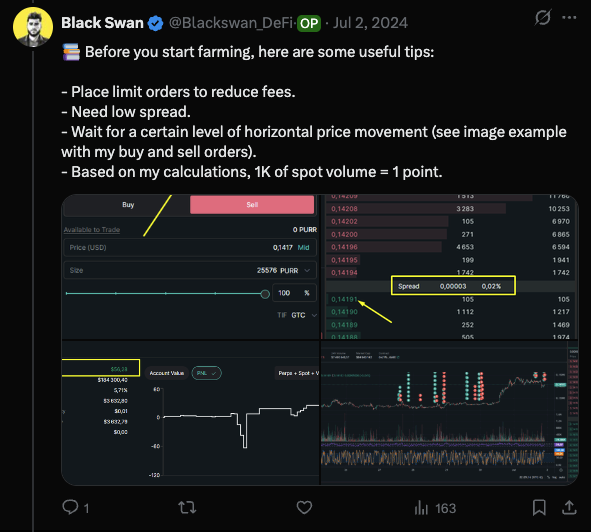
After testing many setups, this is how I currently farm DEX pairs without burning capital 👇
🟢 The first thing that matters is pair selection.
The idea is to trade assets with very low volatility and relatively low open interest.
Less stress, less drawdown, and you can run a lot more volume at the same risk level.
Personally, I keep coming back to the same two names, $BNB and $XRP.
Large market caps, structurally low volatility, usually one or two real news events per year, not more.
That keeps price action clean and limits sudden moves, both up and down.
Open interest on these pairs is generally much lower compared to BTC, ETH, SOL, or even HYPE.
🟢 Second tip, trade duration matters more than people think.
I usually hold my positions for 2 to 4 hours. In my experience, this is the best reward-to-time ratio, and, more importantly, it allows me to push volume throughout the day actively.
Keeping positions open for 24 or 48 hours does the opposite. You lock capital for too long, which makes it much harder to generate enough volume unless you’re trading huge size and sitting on multi-million-dollar positions.
🟢 Third tip, volume, there’s no shortcut here.
I personally target 3-4M$ in weekly volume per perp DEX. That’s the benchmark I try to hit consistently.
Right now, I’m spreading that across four venues,
- Backpack: https://t.co/yr2x30fXME
- Extended: https://t.co/ysOmEwS3Pp
- Variational: https://t.co/K0ZVuRcfDF
- Hyperliquid
If you trade daily and stick to the routine, it’s totally doable. Consistency is key here. Keep grinding those points each week, and in a few months, you’ll have a solid stack ready for a big airdrop 🪂
🧵 Journal #12 | The Daily Road to $1M
Variational farming :
- $251.88 PnL
- $2.72M volume, 100 percent on the $XRP pair
- Solid OI/volatility ratio
- 52.19 points earned this week
In my opinion, 1 point could be worth between $20 and $60. That puts this week’s 52.19 points at roughly $1,000 to $3,100 in potential value.
You do not need an enormous size, just regular activity and discipline.
If you are not on Variational yet, this is a good moment to get started.
Referral link if you want to join 👇
https://t.co/K0ZVuRcfDF
I’ll keep sharing weekly updates as this evolves.
Final update :
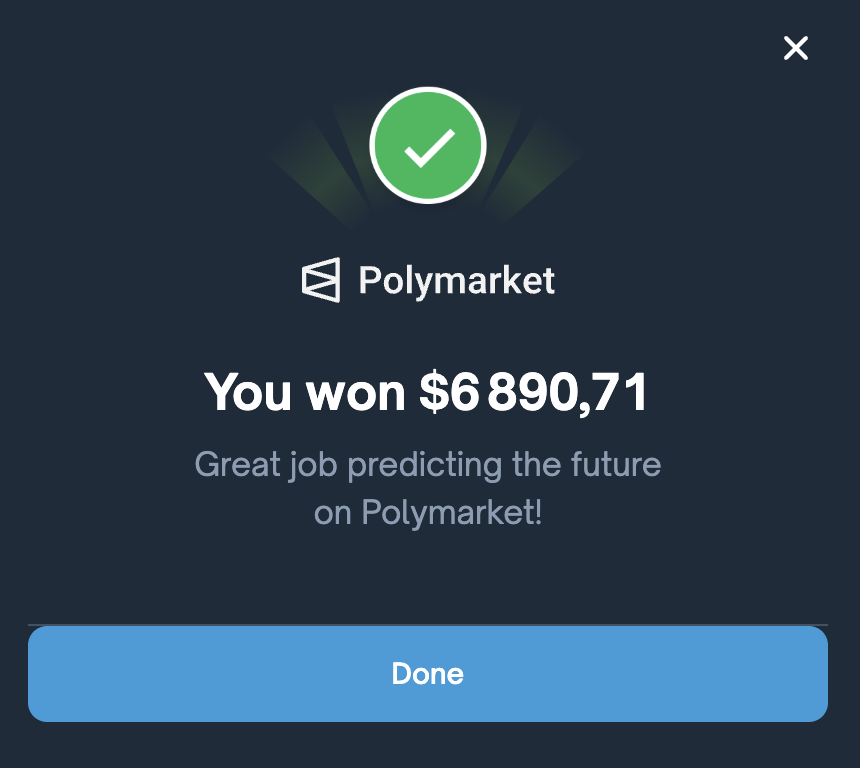
The 1,951 $ position finished at 4,543 $
The smaller one at 294 $ ended at 2,348 $
I’ll keep updating the journal each time something resolves so you can follow the evolution and maybe catch your own entries.
If you aren’t on Polymarket yet, I don’t know what to tell you at this point.
I’ve just registered my wallets and completed KYC for the upcoming @megaeth pre-sale through Echo.
I missed the first phase, but I don’t plan on missing the second one.
I’m already quite exposed to the ecosystem since I hold some of the main collections, including Megalio and Bad Bunnz.
Feels like we’re still early with MegaETH 👇
🧵 Journal #7 | The Daily Road to $1M
Started late on Lighter, so I’ll need to push hard on volume to catch up. Targeting 10,000 points before the airdrop.
What you need to know:
• DEX with zero fees → easy to farm volume without burning yourself
• 30%+ of supply reserved for the airdrop
• Points are trading around $10
My personal goal: $250M FDV for a 30% airdrop allocation -> $6.25 per point.
⚠️ Nowhere near a Hyperliquid-level opportunity, but still worth the grind.
I’ll post an update in a month with:
• Total points gained
• PnL (should stay near zero)
• Volume pushed
Shoutout to @DidiTrading for shedding light on this.