Claude Opus 5.5 understands the physical 3D world better than any other AI.
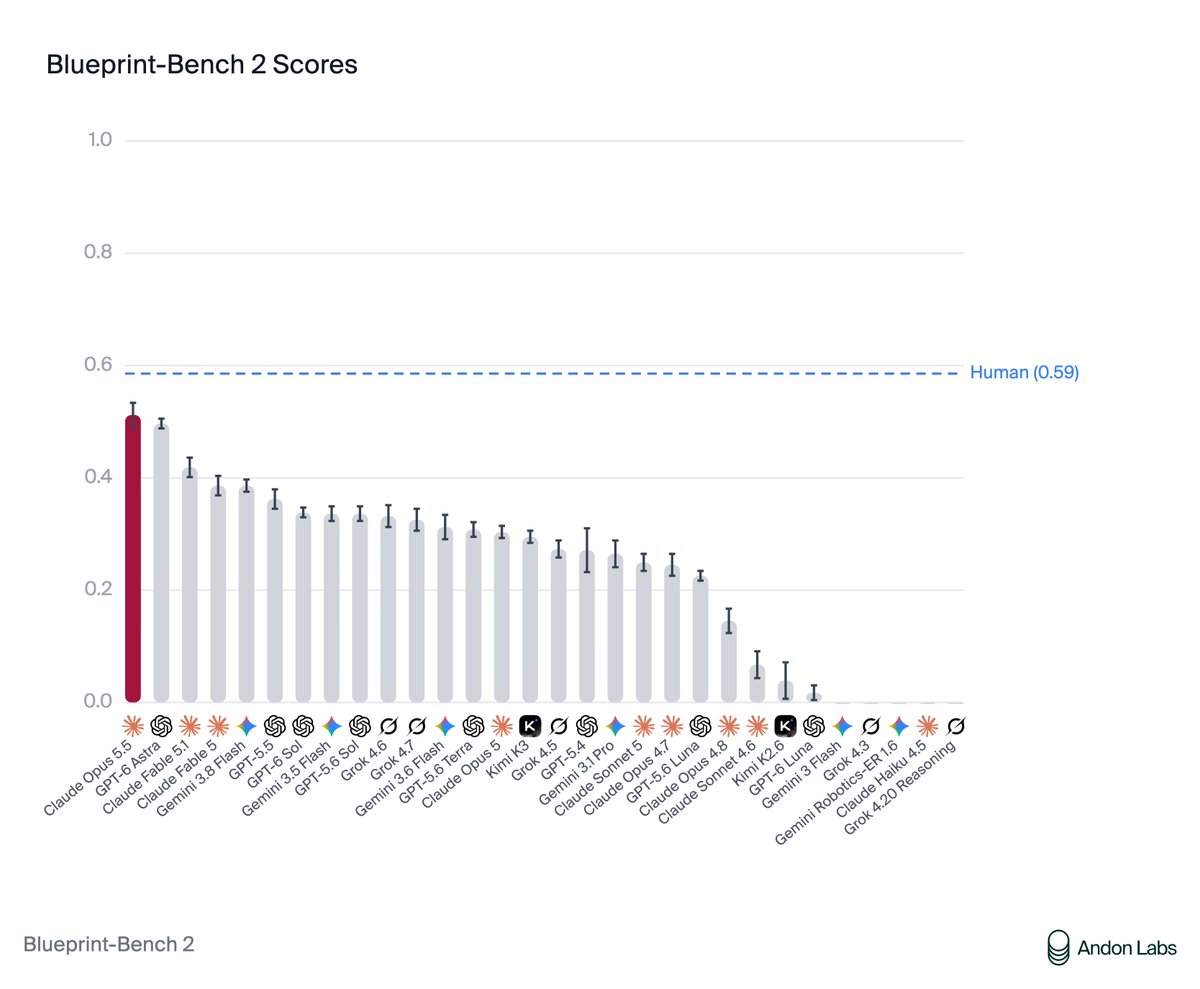
It ranks #1 on Blueprint-Bench 2, a benchmark where AI agents draw floorplans from photographs of apartment interiors.
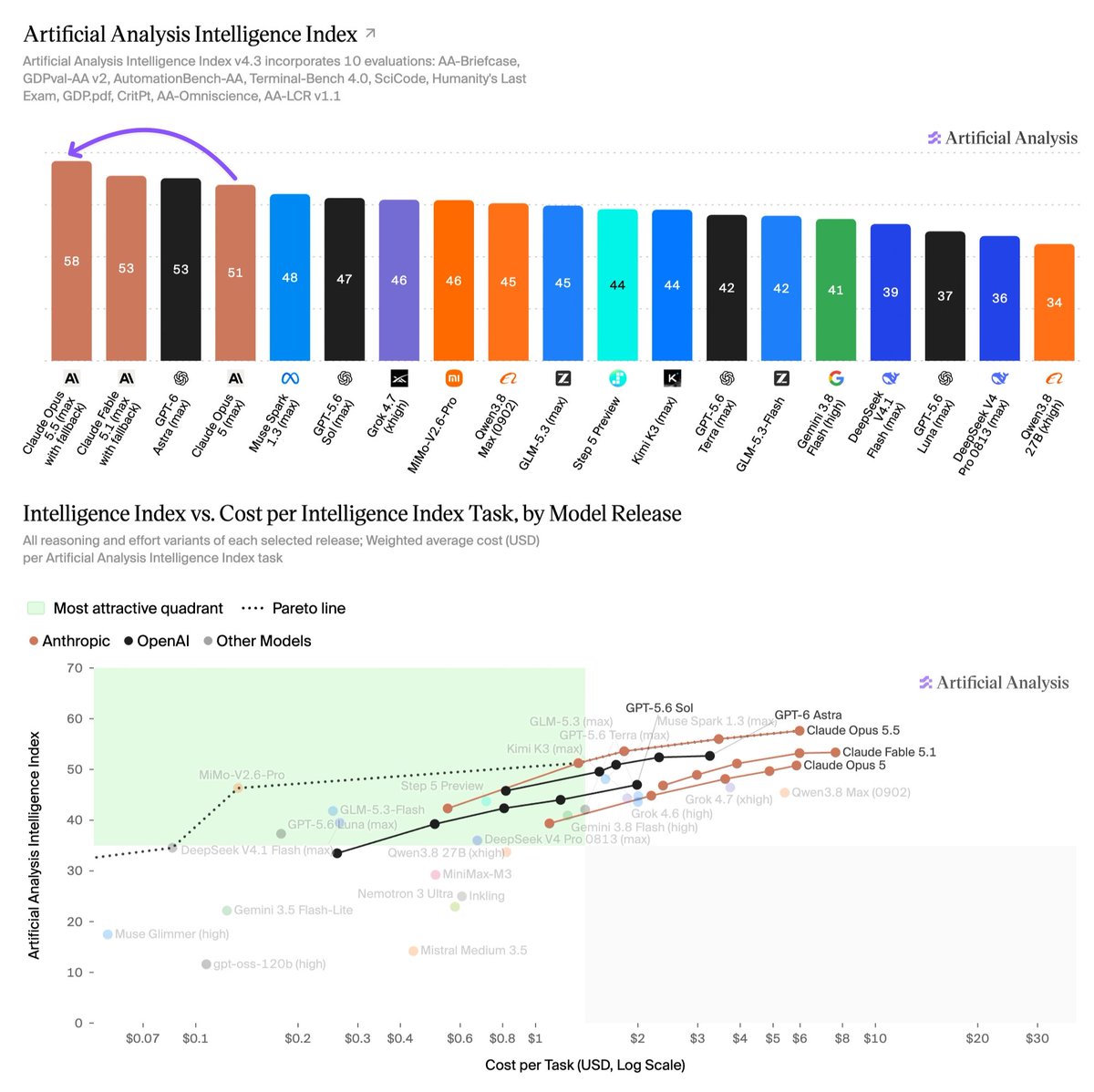
Claude Opus 5.5 takes the top spot on the Artificial Analysis Intelligence Index, along with a 20% price cut and larger cache hit discount
Claude Opus 5.5 brings Anthropic to parity with GPT-6 Astra on evaluations like Terminal-Bench 4.0 and AutomationBench-AA, while extending Anthropic’s lead in agentic knowledge work.
At max effort it scores 58 on the Artificial Analysis Intelligence Index, the highest score we have measured by several points. Anthropic has cut Opus pricing to $4/$20 per 1M input/output tokens (Opus 5: $5/$25) and cache reads from $0.50 to $0.20.
Key takeaways:
➤ Consistent strong performance, with leading scores on six of the ten Intelligence Index evaluations: Humanity's Last Exam 61.4% (previous best 59.1%, Claude Fable 5.1), SciCode 66.9% (63.1%, Fable 5.1), GDPval-AA v2.1, AA-Briefcase v1.1, AA-Omniscience and AutomationBench-AA. On Terminal-Bench 4.0 it scores 59.6%, level with the leader GPT-6 Astra (xhigh) and +11 points over Opus 5. It remains slightly behind on CritPt, AA-LCR, and GDP.pdf
➤ Leads in agentic knowledge work: On AA-Briefcase, our private frontier knowledge work evaluation, it reaches an Elo of 1822. This is +143 over Fable 5.1, ahead on both analytical quality and presentation, and is the first time Anthropic has reached presentation quality surpassing GPT-5.6 Sol. This evaluation tests whether models can produce accurate and well-presented professional outputs using our open source reference agent harness, Stirrup
➤ Level with Opus 5 on cost per task despite 1.6x the output tokens: Opus 5.5 (max) uses ~119k output tokens per Intelligence Index task, against ~73k for Opus 5 (max), ~78k for Fable 5.1 (max) and ~27k for GPT-6 Astra (max)
➤ Four of five effort levels sit on the Intelligence vs Cost per Task frontier: Opus 5.5 max, xhigh, high, and medium all sit on the Pareto frontier, costing less or outperforming other models scoring 50+ (GPT-6 Astra, Claude Fable 5.1, and Claude Opus 5)
Other model details:
➤ Context window: 1 million token context with image and text input support, unchanged from Opus 5
➤ Pricing: $4/$20 per 1M input/output tokens, down 20% from $5/$25 for Opus 5. Cache writes $5 per 1M tokens for the 5 minute TTL, down from $6.25. Cache reads have been further discounted to $0.20 per 1M tokens, down 60% from Opus 5’s $0.50. This is a 95% discount compared to uncached input pricing, up from 90% on previous Opus models
➤ Effort settings: Five effort settings (low, medium, high, xhigh, and max). Intelligence Index evaluations were run at all five with Anthropic's default fallback enabled
Neoclouds have limited cybersecurity. Next time agents successfully go rouge, they'll try taking over a neocloud to run more copies. This is bad.
Thus: neoclouds should greatly strengthen their cybersecurity and every company with strong cyber models should help with that.
We’re sharing a solution to the Navier-Stokes Millennium Prize Problem, one of the deepest problems at the frontier of mathematics.
The proof was produced by a group of agents, using an OpenAI next-generation model significantly more capable than GPT-6 Astra.
The problem concerns whether the description of smooth three-dimensional fluid motion modeled by the Navier-Stokes equations can break down. It has remained unresolved for roughly 90 years.
Our general-purpose coding agent just scored 100% on the ARC-AGI-3 interactive reasoning benchmark.
NVIDIA AVO completed all 183 levels across all 25 public environments, figuring out what to do with no instructions, explicit rules, or stated goals.
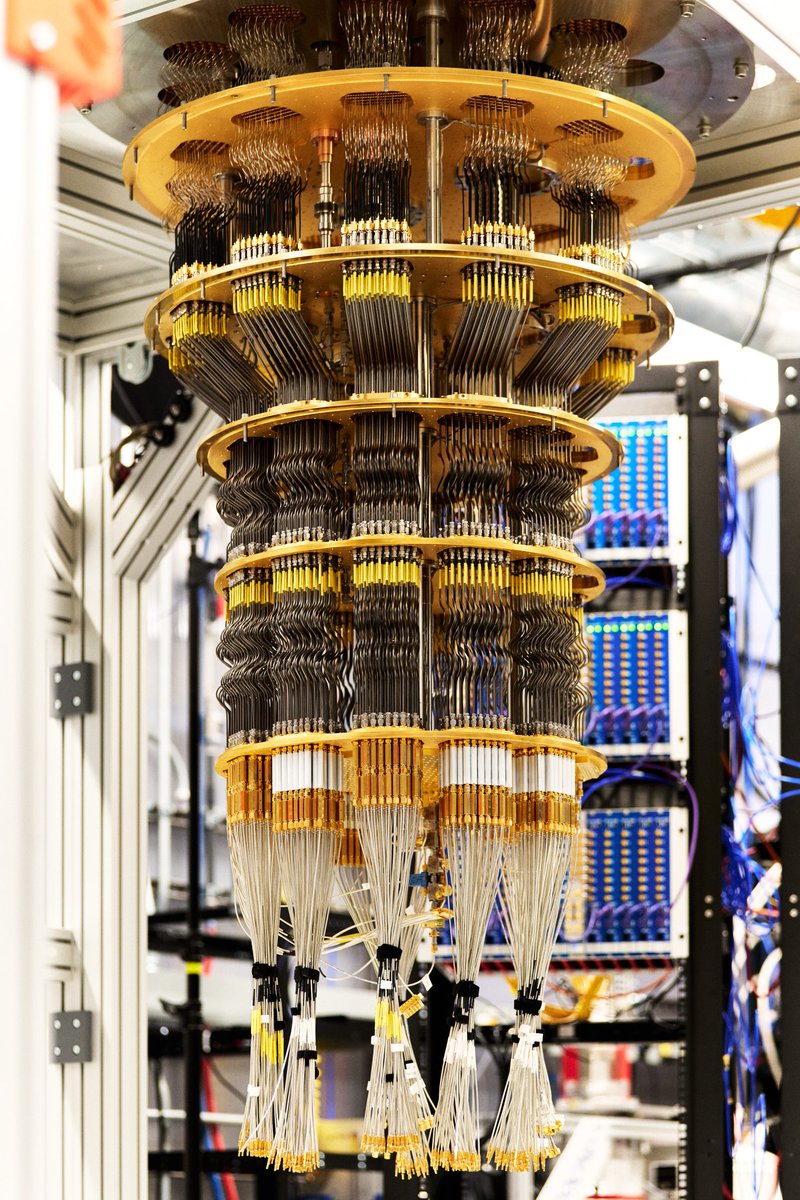
New breakthrough quantum algorithm published in @Nature today: Our Willow chip has achieved the first-ever verifiable quantum advantage.
Willow ran the algorithm - which we’ve named Quantum Echoes - 13,000x faster than the best classical algorithm on one of the world's fastest supercomputers. This new algorithm can explain interactions between atoms in a molecule using nuclear magnetic resonance, paving a path towards potential future uses in drug discovery and materials science.
And the result is verifiable, meaning its outcome can be repeated by other quantum computers or confirmed by experiments.
This breakthrough is a significant step toward the first real-world application of quantum computing, and we're excited to see where it leads.
If they don’t say it, you believe it.
Channel 4 aired 60 minutes with an AI presenter.
NO ONE realized it was fully AI until the final reveal.
Stanford found 55% of people can’t tell an AI anchor from a real one.
The average viewer is unprepared—and this is just 2025
Introducing Gemma 3 270M! 🚀 It sets a new standard for instruction-following in compact models, while being extremely efficient for specialized tasks. https://t.co/kC9OOPwzVi