Today, our group company Hivemind Digital Group is announcing the completion of $17M in strategic funding, led by M&G Investments, with participation from CPIC Investment Management (H.K.) Company Ltd., ZA Bank, @FalconXGlobal, and Sonic Boom Ventures, alongside board members and senior executives at leading financial institutions.
We are pleased to welcome Alex Seddon, Head of Impact and Private Equity at M&G Investments, to our Board of Directors.
Our thesis has been consistent since day one, and becomes even more clear today. Blockchain and the broader frontier technology are increasingly becoming a new form of financial asset, and having a profound impact on reshaping financial service infrastructure. Investors should be able to access these new financial primitives with institutional-grade transparency and governance.
This milestone accelerates the infrastructure build-out that makes it possible, and we are excited to be at the forefront of the grand financialization of frontier technology.
Read the full announcement ➡️ https://t.co/lZBb0JGuub
Tokenization is moving from pilots to production.
Our founder @zhang_matt joined @avax_one ’s Pete Wylie on @TheBlockCo's Layer One to discuss what it takes to make tokenized assets productive, and where the next wave of growth comes from.
https://t.co/8WJJxpHRZ5
Agentic Commerce, 18 Months In.
Check out my latest research on the current state of agentic commerce: https://t.co/NkrsqBK3ln
An honest take on where the market stands today, who is positioned to win, where value is accruing, and the whitespace opportunities that still exist.
What’s been most revealing from conversations with agentic commerce leaders the past few months is the disparity between the buzzy headlines vs the actual strategies that companies are taking to build defensible moats in this space. There’s a real gap between noise vs action.
Agentic commerce feels like less of a greenfield opportunity and more of an extension of the existing commerce/payments market today, with most value still expected to accrue to the existing leaders who already own the end-user relationship, the merchant network, or the settlement rails.
I'd encourage builders to look at the bottlenecks that are still hindering growth in this space:
- KYA, agent identity, authorization - Agent governance, policies, and controls are still quite limited and simple vs trad corporate card controls that offer far greater customization and granular policy. Agentic payments products need to first reach feature parity with what exists in trad commerce for users to consider adopting.
- Merchant readiness and acceptance - Many digital storefronts are not machine-readable, and a meaningful share of merchants block agents outright. Merchants rightfully have concerns about agent fraud protection, security, and liability (i.e. do they incur the chargeback liability when an agent buys something it shouldn’t have?). Fragmented protocols, standards, and identity solutions also give merchants reasons to wait until some of the dust settles and there’s a clearer path forward for them to engage with agents. Startups can build merchant solutions that alleviate some of these risks and headaches for merchants.
- B2B - A lot of the data that B2B agents need to build powerful enterprise solutions sits trapped in ERP custom fields, procurement email threads, and PDF contracts. Tackling the B2B opportunity requires first building the pipes to collect this data at scale before existing workflows can be automated. Whoever does this effectively will benefit from the B2B flywheel: more transactions, better accuracy, more spend authority, higher switching costs. Opportunity exists for corp spend mgmt fintechs, vertical-specific startups, and enterprise agentic policy/security/knowledge graph startups to all compete for market share.
Agents will only transact at scale once consumers, merchants, and finance teams trust them with real spending authority. The rules, controls, and data behind that trust are still being developed, and the companies focused on this will shape how agentic commerce works once the volume arrives.
If you’re building or investing in agentic commerce, please reach out. I’d love to hear from you!
Current state of agentic commerce:
In our latest research, Senior Investment Principal @kay_phillips_ goes beyond the headlines, exploring the progress made in Agentic Commerce over the past 18 months since the first wave of products were announced in this space.
The piece looks past the launch headlines at how the market is actually developing: where value is accruing across a six-layer stack, how AI and payments leaders are expanding toward each other and the strategies they are using to compete, and which use cases (B2C, M2M, and B2B) are furthest along and hold the most whitespace opportunity for new entrants.
Check out the full piece here:
https://t.co/7d4uFolBwu
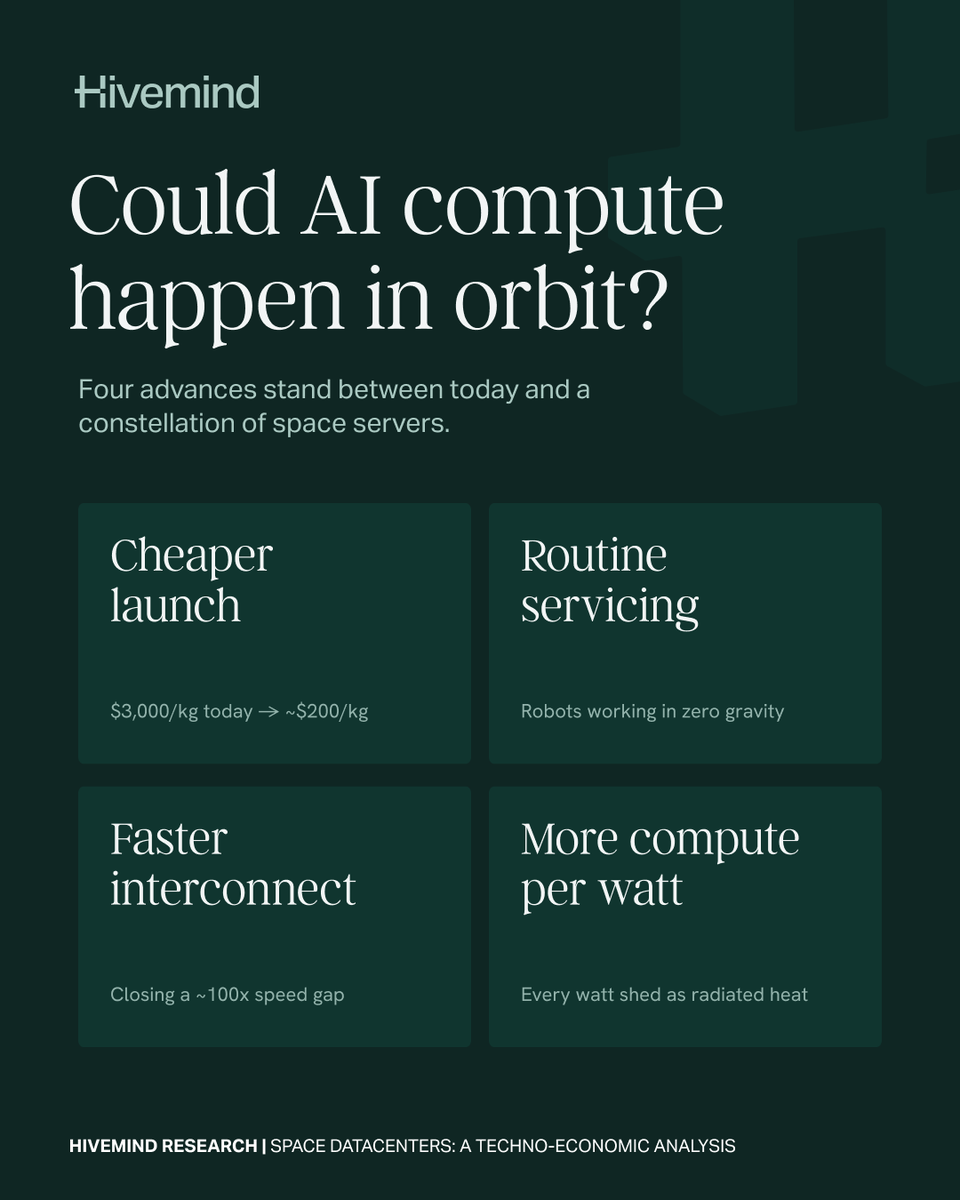
Could the next major expansion of AI compute happen in orbit?
Hivemind Capital's latest research finds a significant opportunity, if the economics work.
A constellation of space servers could expand global GPU capacity by 6–24x, running on uninterrupted solar power and sidestepping the land and grid constraints facing data centers on Earth.
Getting there takes four major advances. Only one involves rockets.
→ Cheaper launch
Launch costs sit around $3,000/kg today. Orbital compute becomes competitive at roughly $200/kg, close to where Starship's stated target lands once launch providers add their margins.
→ Routine servicing
Satellites will need maintenance in orbit, which means robots with fine motor control in zero gravity and the software to coordinate them. Neither exists yet.
→ Faster interconnect
Laser links between satellites run about 100x slower than connections inside a single cabinet on Earth. That gap has to close, or model architectures have to need less of it.
→ More compute per watt
Every watt in orbit must be shed as radiated heat, so efficiency matters even more than on the ground. Proton-gated transistors and heterogeneous computing are two promising paths, and both will likely reach terrestrial data centers first.
Each of these advances could become a company in its own right. Whether the race ends in space or on the ground is still open.
Explore the full analysis 👇
https://t.co/M4BmLXxjpe
In Q3 2026, @avax_one has materially strengthened its balance sheet. The company reduced ~$15M debt, released sizeable restricted cash, and bought back 335k+ stocks. More importantly, AVAX One has done all of these without selling a single AVAX token.
We believe in running a sustainable and profitable franchise for the long run. We might not be the noisiest out there, but we will surely continue to grind in and do the right thing to create shareholder value.
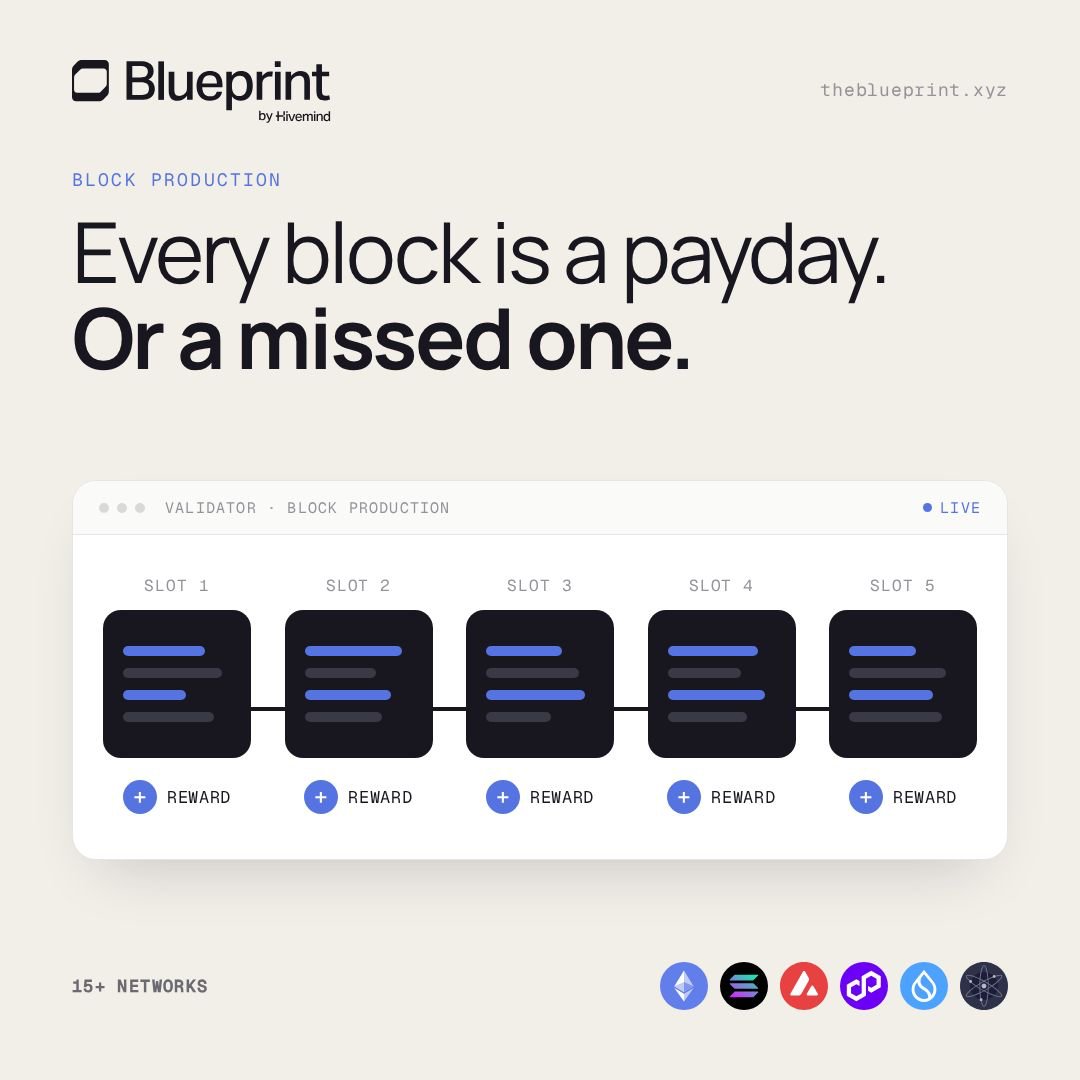
Blockchains run 24/7/365.
Block production is how a validator bundles transactions into a new block and adds it to the chain. Validators are rewarded for every block they produce.
Miss your turn and those rewards are gone, and the network takes a performance hit.
At Blueprint, we run validators across major blockchain networks with industry-leading uptime, and zero missed blocks, so your stake keeps earning.
To learn more about Blueprint’s private and public validators visit https://t.co/BbEEggibZc.
Joining the speaker lineup at The Bridge:
@sjaitly (Morgan Creek Digital) @zhang_matt (@HivemindCap) @thomasuhm (Qube Research & Technologies)
October 27. New York City.
Secure your ticket: https://t.co/ezoYqgxgKl
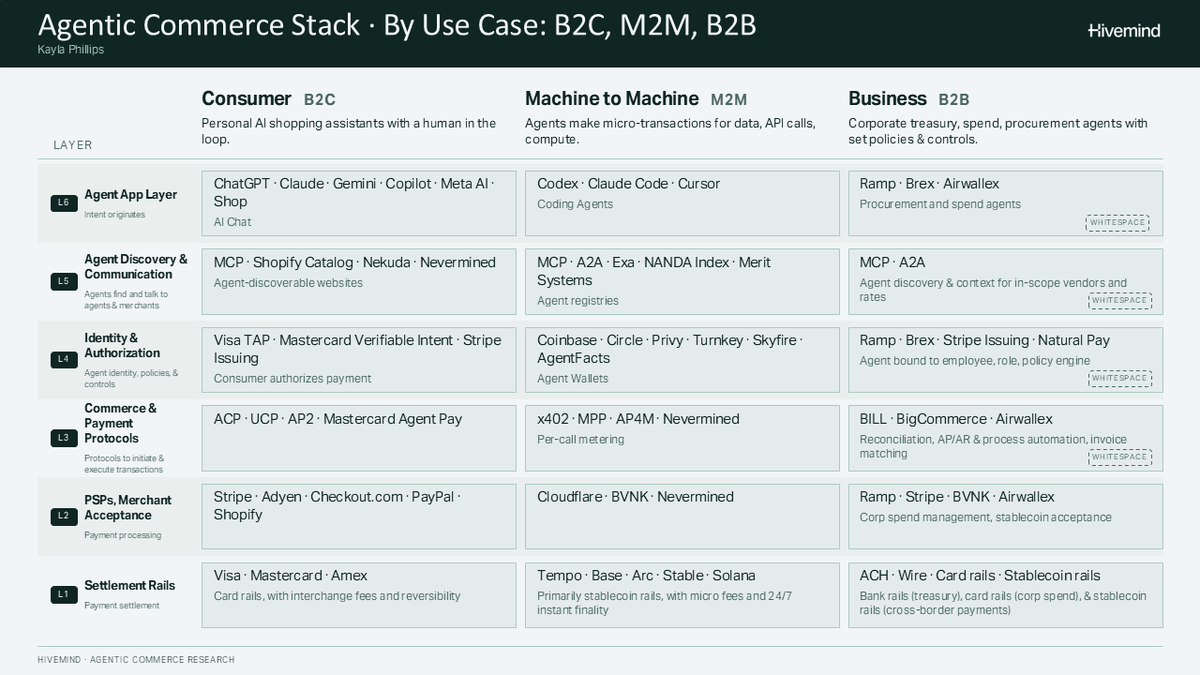
Building off my last couple posts, here is a breakout of the agentic commerce stack by use case - B2C, M2M, B2B.
B2C is furthest along, M2M is the 0-1 opportunity, and B2B has the most concrete path to adoption and the most whitespace.
B2C - Currently driving 63% of total AC revenue ($3.74B). But this is mostly AI-driven discovery, not actual agent-executed checkout yet. Interestingly, AI-referred traffic has a 42% higher purchase conversion than trad search. Incumbents dominate at the consumer app layer; the current bottleneck for agent checkout is getting merchants agent-ready. Startups @nekuda_ai and @Nevermined_ai are tackling this.
M2M - New, early, and mostly experimental today. x402 and MPP processed ~$1M TPV last month with $0.06 avg tx size. The M2M business model is still being determined. x402 (Coinbase/Cloudflare) currently leads, routing transactions to Cloudflare for metering (L2) and Base for settlement (L1), among other providers. But x402 settles every payment individually, which strains micro-transaction economics. MPP addresses this with streaming "sessions" and Nevermined batches payments through prepaid credits. It’s still too early to say Coinbase and Cloudflare have won the high-value layers of the M2M stack.
B2B - Clearest path to near-term revenue with massive TAM. 40% of B2B buyers are already using agents in purchasing flows with $15T in agent-led B2B purchases projected by 2028. Whitespace exists across the app layer, agent discovery, identity/auth, and commerce protocols. B2B moats will form through a data flywheel, and the market will verticalize. An agent tied to an employee, role, and policy engine generates company-specific reconciliation and invoice-matching data with every purchase. That data improves accuracy, earning the agent more spend authority over time and raising switching costs. Because B2B workflows are bespoke, we’ll likely see 1-2 leaders emerge per vertical, like we’ve seen in vertical AI and SaaS.
Currently:
- @Visa@Mastercard are prioritizing B2C, but also building for M2M and B2B.
- @coinbase@Cloudflare are focused on M2M.
- @tryramp@brexHQ@airwallex are targeting B2B.
- @stripe is building across all 3.
Looking ahead:
- Card networks will prioritize all 3 use cases, becoming universal card & stablecoin settlement networks.
- Stripe will further define and bundle its stack by use case.
- B2B whitespace will verticalize and thin out as competition heightens between 1) fintechs that already hold corporate spend relationships, 2) startups building vertical niches, and 3) startups with stronger agent policy and identity products.
Matt Brassey, Engineering Manager at Blueprint, built our staking infrastructure to institutional standards, powering the staking behind public DATs like @avax_one on @avax, @UpexiTreasury on @solana, and funds like @HivemindCap.
Blueprint validators deliver industry leading security, uptime and rewards.
If you're interested in putting your treasury to work, or partnering with Blueprint, learn more at https://t.co/BbEEggibZc
AI leaderboards can make model performance look definitive. In practice, the signal is getting harder to trust.
In a new article for @Enterprise_Time, Hivemind Capital Partner and Head of Venture & Research Emmanuel Vallod examines why benchmarks are becoming less useful as tests are saturated or contaminated and leading models increasingly cluster near the top.
For organizations evaluating AI, the more meaningful question is how the full system performs under real operating conditions. Emmanuel explores why infrastructure and sustained reliability are becoming increasingly important measures of where AI can deliver lasting value.
Read the full article:
https://t.co/OESxKGBqIP
AI Startups: Tech-First vs. Distribution-First?
Listen to episode #288 of the Ignite Podcast with Emmanuel Vallod of Hivermind Capital on your favorite podcast player here: https://t.co/mfqvu6wCFa
@hivemindcap#Startups#VentureCapital#Investing
What Challenges Test Startup Growth?
Listen to episode #288 of the Ignite Podcast with Emmanuel Vallod of Hivermind Capital on your favorite podcast player here: https://t.co/mfqvu6wCFa
@hivemindcap#Startups#VentureCapital#Investing
Blueprint's global offsite in NYC brought our team together from around the world last week. We celebrated our wins, tackled tough challenges and mapped out our path ahead.
CEO @_JakeGreenstein laid out the vision, applying the lessons learned building operations from scratch at @HivemindCap and Algorand Inc. Jake knows where the hours disappear, where the security issues lurk and where the risk hides.
Fix the operations layer and you clear the path for the whole industry. One ledger and one platform for portfolio management, staking, accounting and tax.
Learn more about us at https://t.co/BbEEggiJOK.
Our event is underway!
@XinfinUSA is moderating a panel on AI Agents on Blockchain: Hype, Hurdles, and What Actually Works.
He’s joined by @robotventures, @HivemindCap, and @IBM
Blueprint now integrates with @CopperHQ — including full support for ClearLoop.
The Problem:
ClearLoop is elegant infrastructure, but it can create an accounting problem. Your assets never leave Copper’s secure custody, but they're delegated as collateral on the exchange. The same BTC shows up in two places at once, a custody balance at Copper and an exchange balance. If your books don't understand delegation, you’re either double-counting it or losing it.
The Solution:
Blueprint tracks the full ClearLoop lifecycle: delegations, undelegations, and settlement events, in order with timestamps. Delegated collateral is represented accurately, visible at the exchange, counted once.
The Result:
A clean close: What's in custody, what's working on the exchange, what settled overnight. A clean tie between them.
Off-exchange settlement shouldn't cost you your reconciliation. Now it doesn't.
My last post mapped the agentic commerce stack into 6 layers. Across these layers, value accrues in a barbell: the app layer at the top, merchant acceptance & settlement at the bottom.
This post covers how the major players are scaling across those layers to compete for market share, with each one already dominating a high-value layer and racing to control more of the end-to-end transaction flow to gain an early-mover advantage. Some takeaways:
Our own @zhang_matt joins the investor hot seat at the @avax Summit later this month.
Matt will sit down with Christopher Cheung (TenSquared Capital), Anjan Vinod (ParaFi Capital), and Joe Bruzzesi (Raptor Digital) for Investor Hot Seat: Ask Anything, moderated by Michael Bucella (Neoclassic Capital).
The panel covers what gets funded, what gets passed on, and what founders need to know about raising capital right now.
📅 Wednesday, September 16
🕐 12:35 - 1:05 PM ET
📍 Chelsea Industrial, Hudson Stage
Learn more at https://t.co/3t3PBF78TA
What happens to breakthrough technology before there’s a company to invest in?
Too often, it gets stuck in the gap between research and commercialization.
Hivemind's Head of Venture & Research Emmanuel Vallod joined Ian Bergman on the Innovators Inside podcast to discuss why traditional venture capital often arrives too late for frontier research, and how darkmatter lab is working to change that by supporting promising AI and blockchain projects before company formation.
They also look ahead at what a more research-first approach to venture could mean for the next generation of deep tech companies.
🎧 Listen here: https://t.co/sf4eJLrxe5
▶️ Watch here: https://t.co/5pocHeImdt
We'll see you at the @rwasummit in Brooklyn next week when @zhang_matt takes the stage.
Matt joins the panel "Getting the Soup Just Right: Creating the Conditions for Liquidity and Secondary Market Activity," alongside Alex Taaffe (@GSR_io) and Simon Barnby (@ArchaxEx), moderated by Krisztián Sándor of @CoinDesk.
Our recent $17M strategic funding round, led by M&G Investments, will help us accelerate our tokenization initiatives, and this panel is the perfect place to explore those opportunities and how we can enable the technology.
📅 Tuesday, September 1, 2026
🕒 2:55-3:20 PM
🔗 https://t.co/MpGTfizf3Q
We hope to see you there!