Happy Dota Day Everyone!! <3 -- 13 years since full launch, 15 years from open beta, 26 years if you guys are the good ole Dota 1 crowd. OVER A QUARTER OF A CENTURY WITH THIS BEAUTIFUL GAME WE LOVE AND LOVE TO HATE!! #Dota2
Para quem está me xingando, achei uma análise que explica detalhadamente o motivo de eu achar que foi pênalti em cima do egípcio por um puxão na entrada da área! ⬇️
https://t.co/3sO32skYoe
🇫🇷 Mbappe já ameaçou não jogar pela seleção francesa se fosse obrigado a fazer publicidade para Bets!
"Nós somos a seleção francesa, inspiramos muitas pessoas por aí. Muitos de nós vem da periferia, onde isso destrói um número incalculável de pessoas."
🚨 As a service to global researchers working on the 24 June 2026 #Venezuela#earthquakes, SSA has created a short list of our journal papers related to the region. These papers will be freely available until 16 July 2026. #OpenAccess
https://t.co/nFThjMlG5R
Reportagem do NY Times de 1975 sobre o atleta Pelé:
- corria 100 metros em 11 segundos.
- impulsão de 1,82 m.
- visão periférica 30% maior que de outros atletas.
"Se treinado, Pelé poderia estar entre os Top 10 no decatlo no mundo", diz um especialista.
https://t.co/aKAsiwM9vB
HOLANDA E MPB 🎶
Torcida da Holanda faz festa com hit 'Magalenha', de Carlinhos Brown, nos Estados Unidos
⚽ Acompanhe a Copa do Mundo pelo @EstadaoEsporte
Um dos melhores momentos na HISTÓRIA das Copas do Mundo
Noruega garantindo a classificação pro mata-mata e depois o time todo se juntando e fazendo a famosa "Remada Viking" com a torcida
Deve ser inesquecível viver isso aqui
Um grande incômodo me motivou a criar um mini doc em 3 episódios.
Tudo começou quando a #FIFA deixou de reconhecer os 1.283 gols de Pelé.
A entidade descartou os tentos marcados em jogos amistosos, considerados não oficiais, e passou a contabilizar apenas 776 gols para o Rei. Acredito que aqueles marcados no Exército ou em partidas menores poderiam ser subtraídos da contagem oficial.
São poucos. Mas amistosos contra grandes equipes europeias não poderiam ser ignorados.
Essas partidas tinham um grande peso na época, e assim deveriam ser consideradas.
Talvez a intenção desse revisionismo tenha acontecido com o propósito de valorizar os craques ainda em atividade. Mas Pelé é insuperável.
Numa saga divertida e com relatos inéditos, a série tem participação de grandes atletas de diversas gerações, como o tricampeão, Jair Furacão e o pentacampeão, Vampeta.
Está havendo um apagamento do legado do Rei Pelé? Essa é a minha pergunta central.
O primeiro episódio já está disponível nos canais #UOL.
Roteiro: @lapena e @palomadoss
Direção e produção: @eduardobelo
#worldcup #copadomundo #pele #neymar #SeleçãoBrasileira #eua #mexico #Canada2026
MMMMMA FOI UM SUCESSO EM NÚMEROS!!!! ABSURDO MESMO! PORÉM OS COMUNISTAS VENCERAM! OUTUBRO PRECISAMOS DE MAIS LUTAS ENTRE ESQUERDA E DIREITA! ALGUÉM SE CANDIDATA !?
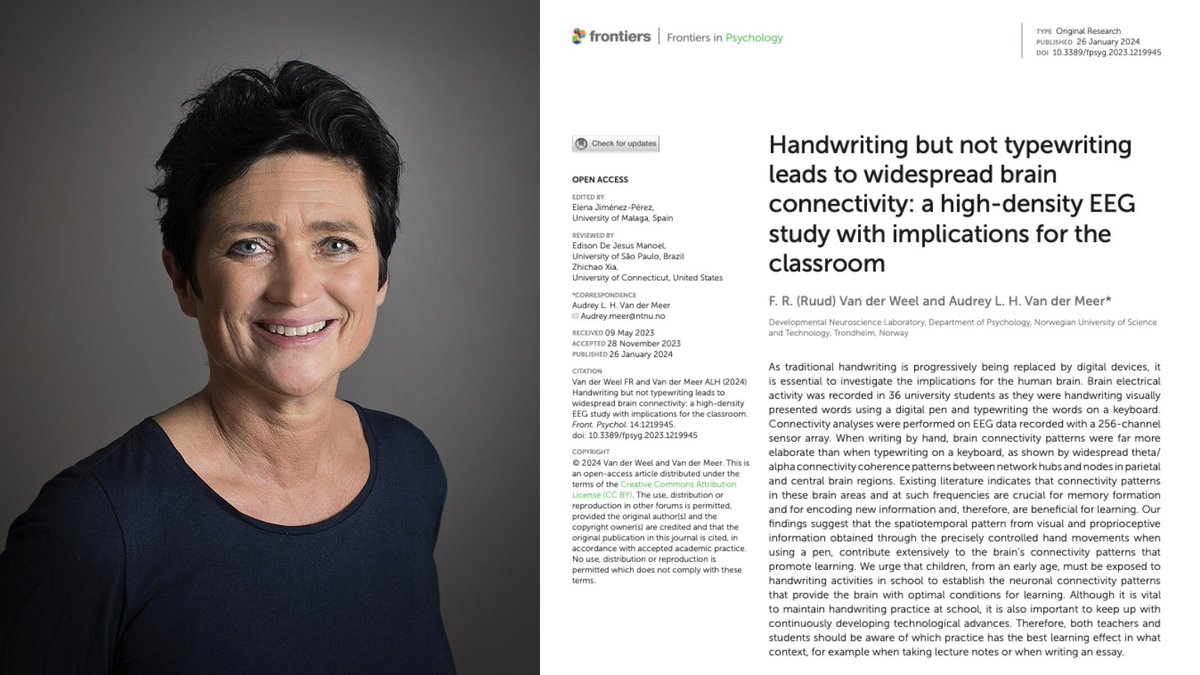
A Norwegian neuroscientist spent 20 years proving that the act of writing by hand changes the human brain in ways typing physically cannot, and almost nobody outside her field has read the paper.
Her name is Audrey van der Meer.
She runs a brain research lab in Trondheim, and the paper that closed the argument was published in 2024 in a journal called Frontiers in Psychology. The finding is brutal enough that it should have changed every classroom on Earth.
The experiment was simple. She recruited 36 university students and put each one in a cap with 256 sensors pressed against their scalp to record brain activity. Words flashed on a screen one at a time.
Sometimes the students wrote the word by hand on a touchscreen using a digital pen, and sometimes they typed the same word on a keyboard. Every neural response was recorded for the full five seconds the word stayed on screen.
Then her team looked at the part of the data most researchers had ignored for years, which is how different parts of the brain were communicating with each other during the task.
When the students wrote by hand, the brain lit up everywhere at once.
The regions responsible for memory, sensory integration, and the encoding of new information were all firing together in a coordinated pattern that spread across the entire cortex. The whole network was awake and connected.
When the same students typed the same word, that pattern collapsed almost completely.
Most of the brain went quiet, and the connections between regions that had been alive seconds earlier were nowhere to be found on the EEG.
Same word, same brain, same person, and two completely different neurological events.
The reason turned out to be something nobody had really paid attention to before her work. Writing by hand is not one motion but a sequence of thousands of tiny micro-movements coordinated with your eyes in real time, where each letter is a different shape that requires the brain to solve a slightly different spatial problem.
Your fingers, wrist, vision, and the parts of your brain that track position in space are all working together to produce one letter, then the next, then the next.
Typing throws all of that away. Every key on a keyboard requires the exact same finger motion regardless of which letter you are pressing, which means the brain has almost nothing to integrate and almost no problem to solve.
Van der Meer said it plainly in her interviews.
Pressing the same key with the same finger over and over does not stimulate the brain in any meaningful way, and she pointed out something that should scare every parent who handed their kid an iPad.
Children who learn to read and write on tablets often cannot tell letters like b and d apart, because they have never physically felt with their bodies what it takes to actually produce those letters on a page.
A decade before her, two researchers at Princeton ran the same fight using a completely different method and ended up at the same answer. Pam Mueller and Daniel Oppenheimer tested 327 students across three experiments, where half took notes on laptops with the internet disabled and half took notes by hand, before testing everyone on what they actually understood from the lectures they had watched.
The handwriting group won by a wide margin on every question that required real understanding rather than surface recall.
The reason was hiding in the transcripts of what the two groups had actually written down.
The laptop students typed almost word for word, capturing more total content but processing almost none of it as they went, while the handwriting students physically could not write fast enough to transcribe a lecture in real time, which forced them to listen carefully, decide what actually mattered, and put it in their own words on the page.
That single act of choosing what to keep was the learning itself, and the keyboard had quietly skipped the choosing and skipped the learning along with it.
Two studies. Two countries. Same answer.
Handwriting makes the brain work. Typing lets it coast.
Every note you have ever typed instead of written went into your brain through a thinner pipe. Every meeting, every book highlight, every idea you captured on your phone instead of on paper was processed at half depth.
You did not forget those things because your memory is bad. You forgot them because typing never woke the part of the brain that would have made them stick.
The fix is the thing your grandmother already knew.
Pick up a pen. Write the thing down. The slower road is the faster one.