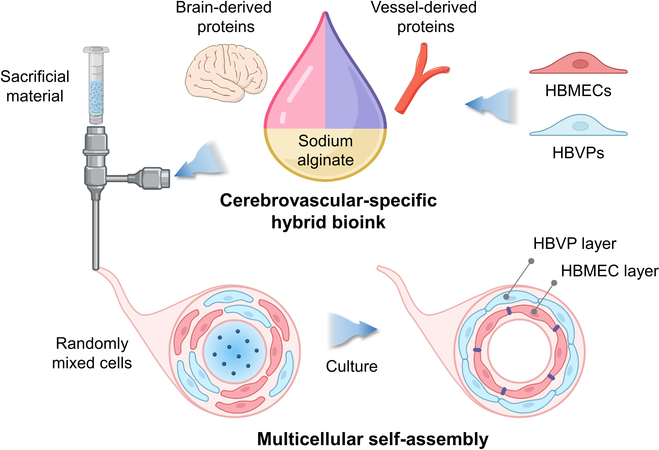
A 3D model accurately mimicking the #BloodBrainBarrier in a laboratory environment has been successfully developed by research teams led by Professor @JinahJang4 from POSTECH & Professor Sun Ha Paek from @snuh_official. @HohyeonHan Learn More @SPJournals https://t.co/9NbUh71CnA
@JMaterChem B and @BioMaterSci are delighted to showcase this joint themed collection on Injectable Hydrogels, guest edited by @PaezLab and @Khoonono 💉Unless already #OpenAccess read all articles in the collection for FREE until 14 July 📰
🔗https://t.co/jmgCnQylfS
@Johana_BolivarM@ISBioFab However, the exact mechanisms behind this directional exocytosis are still not fully understood.🤔 It could be influenced by factors like the oxygen gradient or the curvature of the intestinal environment. It's definitely a fascinating question to ponder!
Thrilled to share our work on developing a functional in vitro enteroendocrine model at the #Biofab2024 Twitter poster conference powered by @ISBioFab!😎
Please check out our poster below 👇 and feel free to leave any comments or questions. 😉
@Johana_BolivarM@ISBioFab Hi Johana! Thanks for the question! Mucin in the gut is predominantly expressed towards the lumen to protect and lubricate the intestinal lining. Goblet cells secrete mucins via exocytosis towards the lumen, where the mucins hydrate and expand to form the mucus layer.
@lucia_g_brunel@ISBioFab Thank you so much for your encouraging words! Wishing you all the best with your fascinating work! Looking forward to staying in touch and sharing more of our progress. 😊
@lucia_g_brunel@ISBioFab I once published a review article about how different 3D geometries can affect in vitro tissue function and found an interesting study about mimicking the wrinkle pattern of the gut. Take a look if you're interested!
@lucia_g_brunel@ISBioFab Thank you for your detailed explanation! It seems like the key is in optimizing the rheological properties of the granular bath to perfectly match the requirements of the printing process. Your work is truly marvelous!
@lucia_g_brunel@ISBioFab Thanks for your question, Lucia! The EEC cells are encapsulated within the dECM hydrogel at a concentration of 5M/ml. They are then printed into either tubes or domes. I hope this makes things clearer for you!
@lucia_g_brunel@ISBioFab Thanks for your response, Lucia! I’m curious, is it possible to create small granules with Gelatin and large ones with Carbopol, or are there size limitations inherent to these materials?
@lucia_g_brunel@ISBioFab I noticed that you used different materials for the support batch. Was there a specific reason you chose this approach over controlling the granule size from a single material?
@fisch_philipp@ISBioFab The BBB work has just been submitted to a journal for publication. Please stay tuned for updates on this exciting development. Thank you again for your attention to my research!
@fisch_philipp@ISBioFab However, I am planning to incorporate this aspect in my upcoming project, which involves an innervated gut model! In addition, I would like to share that I am also working on a Blood-Brain Barrier (BBB) model, which is fabricated using the same coaxial printing technique.